有机化学 ›› 2026, Vol. 46 ›› Issue (10): 3783-3803.DOI: 10.6023/cjoc202606009 上一篇 下一篇
综述与进展
刘春萌a,b, 魏雨晴b, 袁乾家b, 毛国梁a,*( ), 张万斌b,*()
收稿日期:2026-06-09
修回日期:2026-06-23
发布日期:2026-06-26
基金资助:
Chunmeng Liua,b, Yuqing Weib, Qianjia Yuanb, Guoliang Maoa,*(), Wanbin Zhangb,*()
Received:2026-06-09
Revised:2026-06-23
Published:2026-06-26
Contact:
Supported by:文章分享
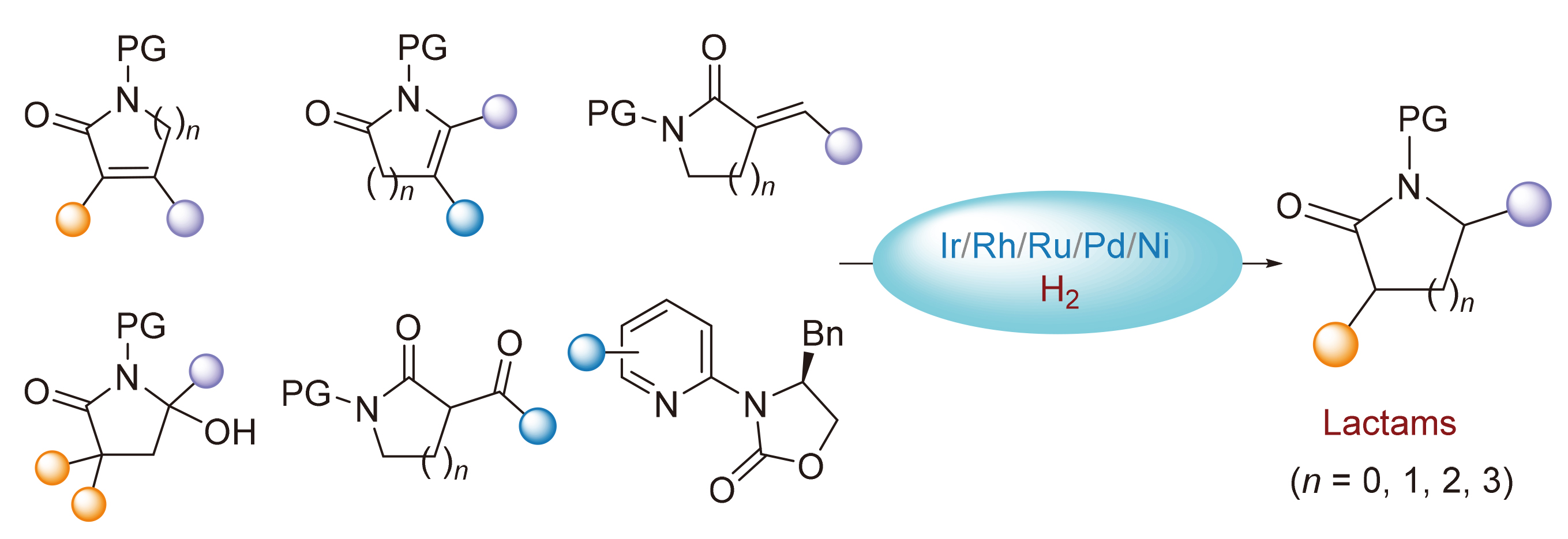
手性内酰胺广泛存在于天然产物与药物分子中, 也是一类重要的合成中间体, 其高效不对称合成具有重要的研究价值. 过渡金属催化的不对称氢化反应具有原子经济性好、催化效率高及操作简便等优势, 是最具工业化潜力的手性合成技术之一. 近年来, 基于铱、铑、钌、钯及镍等金属的催化氢化体系相继建立, 并成功实现了手性内酰胺的高效不对称合成. 根据金属催化剂的类型进行分类, 综述了不同催化体系的特点、反应底物适用范围及产物立体选择性来源, 并总结了其在药物或天然产物合成中的应用. 最后, 对该领域的发展前景进行了展望, 以期为手性内酰胺的高效合成提供参考.
刘春萌, 魏雨晴, 袁乾家, 毛国梁, 张万斌. 过渡金属催化不对称氢化合成手性内酰胺的研究进展[J]. 有机化学, 2026, 46(10): 3783-3803.
Chunmeng Liu, Yuqing Wei, Qianjia Yuan, Guoliang Mao, Wanbin Zhang. Research Progress on the Synthesis of Chiral Lactams via Transition Metal-Catalyzed Asymmetric Hydrogenation[J]. Chinese Journal of Organic Chemistry, 2026, 46(10): 3783-3803.

| [1] |
(a)
doi: 10.1039/B903905H pmid: 33373523 |
|
(b)
pmid: 33373523 |
|
|
(c)
doi: 10.1021/jm4000038 pmid: 33373523 |
|
|
(d)
doi: 10.1021/acs.chemrev.0c01010 pmid: 33373523 |
|
|
(e)
doi: 10.1039/D4QO00227J pmid: 33373523 |
|
|
(f)
doi: 10.6023/cjoc202502011 pmid: 33373523 |
|
|
(沈健, 王彦博, 吴正兴, 徐德锋, 张万斌, 有机化学, 2025, 45, 2637.)
doi: 10.6023/cjoc202502011 pmid: 33373523 |
|
| [2] |
(a)
doi: 10.1021/ar030055g pmid: 37039110 |
|
(b)
doi: 10.1021/cr4005549 pmid: 37039110 |
|
|
(c)
doi: 10.2174/1385272819666140407212959 pmid: 37039110 |
|
|
(d)
doi: 10.1039/C3OB42181C pmid: 37039110 |
|
|
(e)
doi: 10.1039/d3ob00309d pmid: 37039110 |
|
| [3] |
(a)
doi: 10.1021/cr100218m |
|
(b)
doi: 10.1039/c2cs15312b |
|
|
(c)
doi: 10.1021/acs.chemrev.6b00564 |
|
|
(d)
doi: 10.6023/cjoc201509016 |
|
|
(袁乾家, 张万斌, 有机化学, 2016, 36, 274.)
doi: 10.6023/cjoc201509016 |
|
|
(e)
doi: 10.6023/cjoc202303001 |
|
|
(褚杨杨, 韩召斌, 丁奎岭, 有机化学, 2023, 43, 1934.)
doi: 10.6023/cjoc202303001 |
|
|
(f)
doi: 10.1002/chir.v35.8 |
|
|
(g)
|
|
|
(h)
|
|
|
(i)
doi: 10.6023/cjoc202505032 |
|
|
(陈奇姝, 杨泊, 稂琪伟, 丁小兵, 李秀秀, 张绪穆, 有机化学, 2025, 45, 3326.)
doi: 10.6023/cjoc202505032 |
|
| [4] | |
| [5] |
(a)
doi: 10.1021/ar700114k |
|
(b)
|
|
|
(c)
doi: 10.6023/cjoc202400049 |
|
|
(张满刚, 殷勤, 有机化学, 2024, 44, 3258.)
doi: 10.6023/cjoc202400049 |
|
| [6] |
|
| [7] |
(a)
doi: 10.1039/d3cs00329a pmid: 37427715 |
|
(b)
doi: 10.1002/cjoc.v42.23 pmid: 37427715 |
|
|
(c)
doi: 10.31635/ccschem.023.202303412 pmid: 37427715 |
|
| [8] |
doi: 10.1002/adsc.v352:11/12 |
| [9] |
doi: 10.1002/ajoc.v3.7 |
| [10] |
doi: 10.1002/anie.201309521 pmid: 24446418 |
| [11] |
doi: 10.1021/acs.orglett.6b03397 |
| [12] |
doi: 10.1021/acs.orglett.7b00171 |
| [13] |
doi: 10.1021/acs.orglett.7b00651 |
| [14] |
doi: 10.1002/cjoc.v36.7 |
| [15] |
doi: 10.1021/acs.joc.9b00829 pmid: 31117569 |
| [16] |
doi: 10.1021/acs.organomet.1c00450 |
| [17] |
doi: 10.1021/acscatal.2c05579 pmid: 36910869 |
| [18] |
|
| [19] |
doi: 10.1039/D3QO02034G |
| [20] |
doi: 10.1021/acscatal.5c06880 |
| [21] |
doi: 10.1021/acs.orglett.6b02074 pmid: 27508307 |
| [22] |
doi: 10.1021/acscatal.8b00827 |
| [23] |
doi: 10.1039/c8ob02231c pmid: 30406248 |
| [24] |
doi: 10.1039/C9OB02536G |
| [25] |
doi: 10.1021/acs.orglett.1c04132 |
| [26] |
doi: 10.1039/D3QO00319A |
| [27] |
doi: 10.1021/acs.orglett.6c01366 |
| [28] |
doi: 10.1021/jo400589j |
| [29] |
doi: 10.1021/acs.orglett.6b02416 |
| [30] |
doi: 10.1002/anie.v57.43 |
| [31] |
doi: 10.1021/acs.orglett.0c00669 |
| [32] |
|
| [33] |
doi: 10.1021/jacs.4c09794 |
| [34] |
doi: 10.1002/anie.202016771 pmid: 33460521 |
| [35] |
doi: 10.1021/acs.orglett.3c00532 |
| [36] |
doi: 10.1039/D0CC05599A |
| [1] | 黄锦龙, 肖帆, 吴慧敏, 董秀琴, 王春江. 铱催化不对称串联烯丙基化/iso-Pictet-Spengler环化反应合成手性四氢-γ-咔啉[J]. 有机化学, 2026, 46(9): 3769-3776. |
| [2] | 杨爽, 房新强. 小环化合物的不对称氢化研究进展[J]. 有机化学, 2026, 46(9): 3495-3505. |
| [3] | 张瑞楠, 郑琪智, 赖圣怡, 罗文俊, 许冰, 张展鸣, 张俊良. Sadphos在丰产金属催化反应中的应用[J]. 有机化学, 2026, 46(9): 3390-3398. |
| [4] | 李家圆, 陈品红, 刘国生. 铜催化烯丙位C—H键不对称氧化反应[J]. 有机化学, 2026, 46(9): 3630-3639. |
| [5] | 敖选丽, 马超洁, 王淑冰, 何蕾, 赏宇, 朱锦阳, 李建秀, 张琴, 张荣平, 侯博. 2,4-二酮内酰胺衍生物的设计、合成及其抑制Mpro活性筛选[J]. 有机化学, 2026, 46(8): 3104-3113. |
| [6] | 郑浩宇, 李传莹, 周友运. 过渡金属不对称催化通过C—O键形成合成手性叔烷基醚的研究进展[J]. 有机化学, 2026, 46(8): 2892-2925. |
| [7] | 陈颂耀, 冯雪, 屠蔓苏, 郝文娟, 姜波. 镍(II)/双咪唑啉催化不对称高阶(5+3)环化反应构建兼具中心与轴手性的马鞍形八元桥联联芳基衍生物[J]. 有机化学, 2026, 46(7): 2796-2807. |
| [8] | 余品科, 刘海阳, 肖帆, 董秀琴. 铁系金属催化烯烃不对称氢化反应的研究进展[J]. 有机化学, 2026, 46(7): 2622-2643. |
| [9] | 熊康宇, 陆展. 过渡金属催化1,1-二取代烯烃的不对称硼氢化反应研究进展[J]. 有机化学, 2026, 46(7): 2493-2510. |
| [10] | 赵凯凯, 范润奇, 林国强, 冯陈国. 叔丁基亚砜-噁唑啉配体的合成及其在钯催化不对称烯丙基烷基化反应中的应用[J]. 有机化学, 2026, 46(6): 2458-2463. |
| [11] | 刘则琳, 何泗泉, 阿迪拉•阿布都热西提, 金钟. (–)-加兰他敏的简洁全合成: 一种高效的碱促进内酰胺化策略[J]. 有机化学, 2026, 46(6): 2423-2430. |
| [12] | 张超, 罗洲, 赵申, 沈安, 杨国强, 刘媛媛. 配体接力促进的钯催化卡宾插入/Tsuji-Trost串联反应实现不对称[4+1]环化构筑手性茚满[J]. 有机化学, 2026, 46(6): 2431-2441. |
| [13] | 秦观宝, 赵梦龙, 韩召斌, 丁奎岭. 共轭烯酮的不对称双(转移)氢化研究进展[J]. 有机化学, 2026, 46(6): 2163-2176. |
| [14] | 沈国礼, 何玥, 景士文, 安子博, 徐丹丹. 过渡金属催化1,3-二烯的不对称环化反应研究进展[J]. 有机化学, 2026, 46(5): 1916-1938. |
| [15] | 许颖, 杨美琳, 崔大鹏, 于淼, 刘颖杰. 脱氟反应的研究进展[J]. 有机化学, 2026, 46(5): 1962-1983. |
| 阅读次数 | ||||||
|
全文 |
|
|||||
|
摘要 |
|
|||||


