有机化学 ›› 2026, Vol. 46 ›› Issue (6): 2163-2176.DOI: 10.6023/cjoc202603008 上一篇 下一篇
综述与进展
秦观宝a,b, 赵梦龙b, 韩召斌b,*( ), 丁奎岭b,c,d,*()
收稿日期:2026-03-06
修回日期:2026-04-02
发布日期:2026-04-27
基金资助:
Guanbao Qina,b, Menglong Zhaob, Zhaobin Hanb,*(), Kuiling Dingb,c,d,*()
Received:2026-03-06
Revised:2026-04-02
Published:2026-04-27
Contact:
* E-mail: zbhan@sioc.ac.cn;kding@sioc.ac.cn
Supported by:文章分享

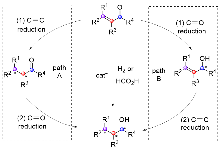
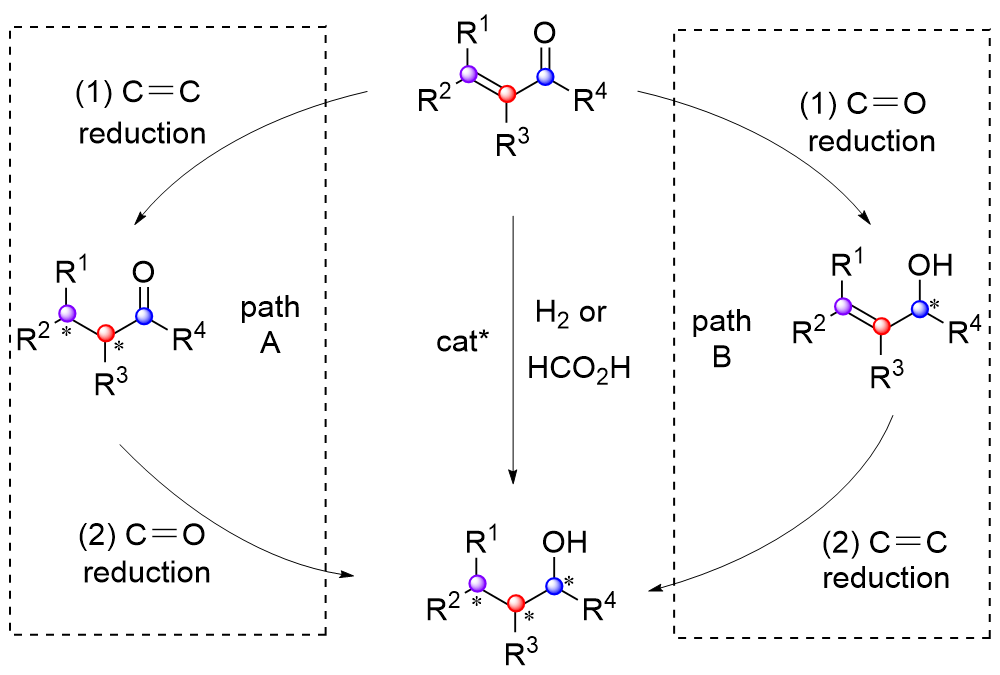
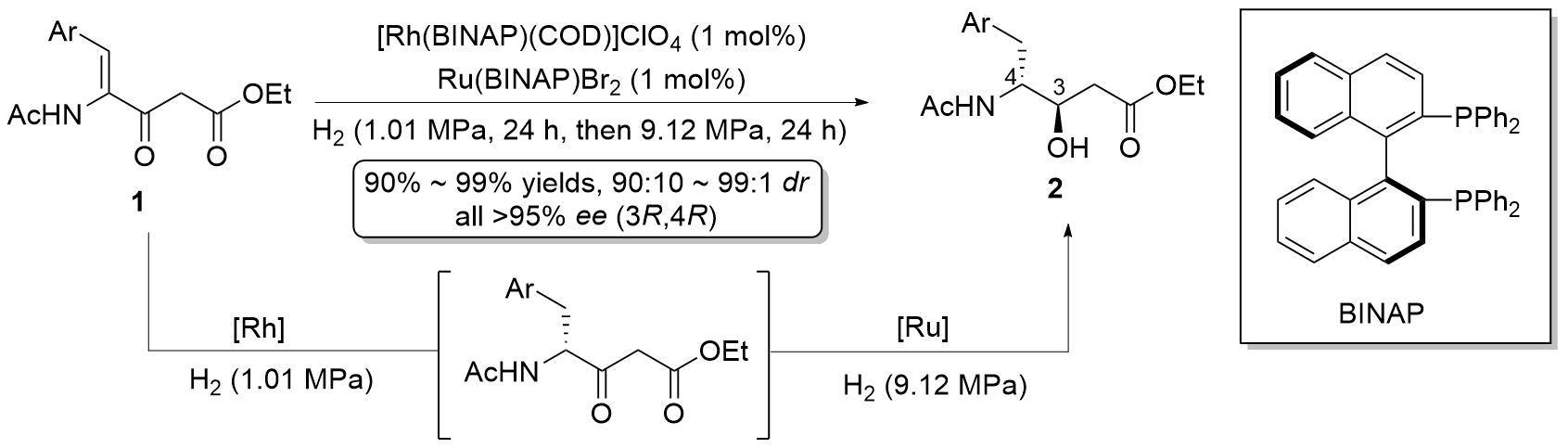
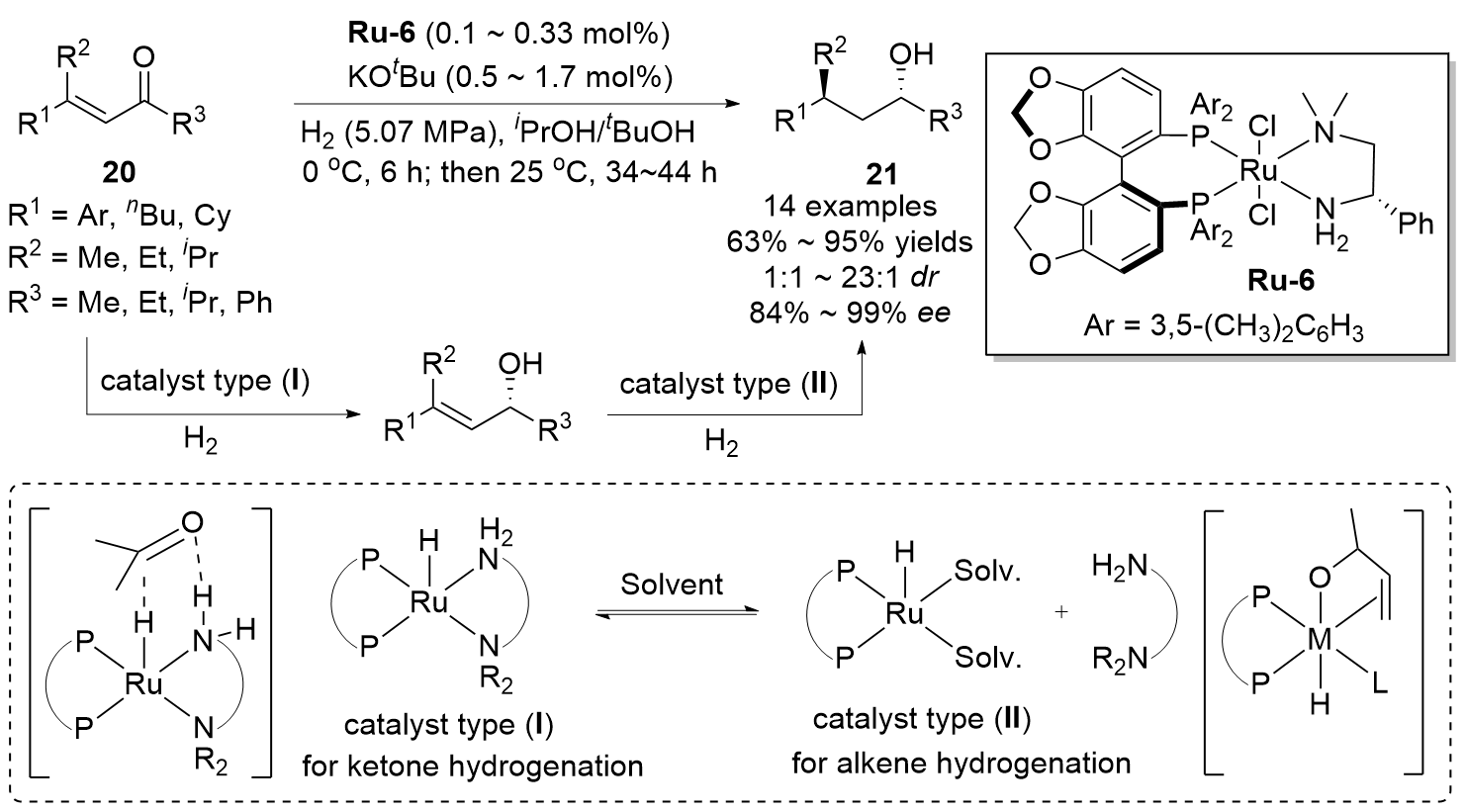
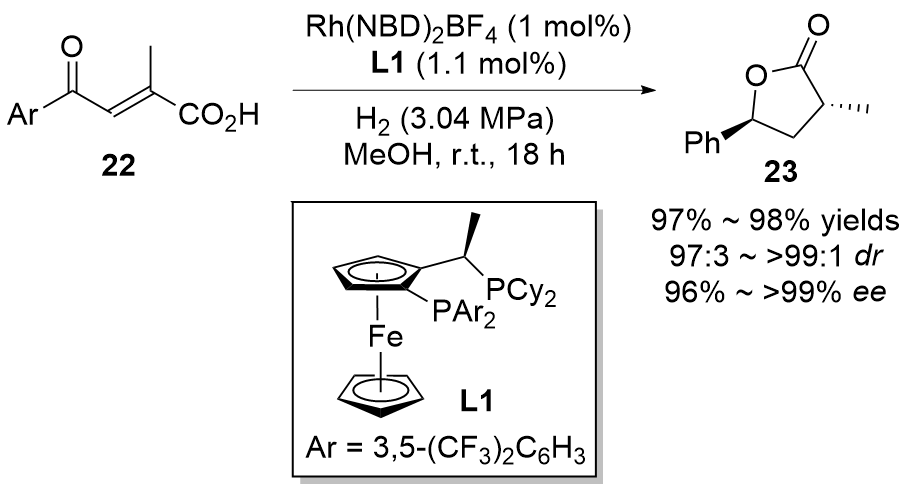
共轭烯酮结构多样, 来源广泛, 其不对称双(转移)氢化是构建多手性中心仲醇的高效策略. 然而, 该转化需要催化体系还原两类性质不同的不饱和键, 并实现多重立体选择性的控制, 极具挑战. 近年来, 通过新配体和催化剂的发展、双金属接力催化体系的构建及添加剂调控催化过程等手段, 这一领域取得了显著进展. 从共轭烯酮的结构特点出发, 系统综述了过渡金属催化共轭烯酮不对称双氢化和不对称双转移氢化的研究进展, 并对当前领域存在的关键问题及未来发展方向进行了总结与展望.
秦观宝, 赵梦龙, 韩召斌, 丁奎岭. 共轭烯酮的不对称双(转移)氢化研究进展[J]. 有机化学, 2026, 46(6): 2163-2176.
Guanbao Qin, Menglong Zhao, Zhaobin Han, Kuiling Ding. Advances in Asymmetric Double (Transfer) Hydrogenation of Conjugated Enones[J]. Chinese Journal of Organic Chemistry, 2026, 46(6): 2163-2176.


| [1] |
|
| [2] |
doi: 10.1021/cr020049i |
| [3] |
doi: 10.1021/cr100218m |
| [4] |
doi: 10.1021/acs.chemrev.6b00564 |
| [5] |
|
| [6] |
|
| [7] |
doi: 10.1021/jo9720400 |
| [8] |
doi: 10.1002/anie.v48:33 |
| [9] |
doi: 10.1021/jo102091f |
| [10] |
doi: 10.1021/cs300037z |
| [11] |
doi: 10.1002/adsc.v353.16 |
| [12] |
doi: 10.1021/jo0478205 |
| [13] |
|
| [14] |
doi: 10.1021/acs.joc.2c01733 pmid: 36251770 |
| [15] |
doi: 10.1021/jacs.4c11070 |
| [16] |
doi: 10.1021/acscatal.4c05378 |
| [17] |
doi: 10.1002/chem.v23.37 |
| [18] |
|
| [19] |
doi: 10.1021/jacs.2c02422 |
| [20] |
doi: 10.1002/anie.v64.3 |
| [21] |
doi: 10.1016/j.tetlet.2012.04.050 |
| [22] |
doi: 10.1021/acs.orglett.9b01002 |
| [23] |
doi: 10.1002/anie.v52.32 |
| [24] |
doi: 10.1039/C8CC07787H |
| [25] |
|
| [26] |
doi: 10.1021/acs.joc.3c01723 |
| [27] |
doi: 10.1021/jacs.2c09266 |
| [28] |
doi: 10.1021/acs.orglett.6b00212 |
| [29] |
doi: 10.1021/acs.orglett.7b01343 |
| [30] |
doi: 10.1002/anie.v56.41 |
| [31] |
doi: 10.1021/acs.orglett.2c00451 |
| [32] |
doi: 10.1021/acs.orglett.2c01076 |
| [33] |
doi: 10.1021/jacs.3c14239 |
| [34] |
|
| [35] |
doi: 10.1021/acs.joc.0c02981 |
| [36] |
doi: 10.1021/acs.orglett.1c00047 pmid: 33600184 |
| [37] |
doi: 10.1039/D1SC05963G |
| [38] |
doi: 10.1039/D4CC00356J |
| [39] |
doi: 10.1021/acs.joc.1c02916 |
| [40] |
doi: 10.1021/acs.orglett.5c00839 |
| [41] |
|
| [42] |
doi: 10.1021/acs.orglett.5c04476 |
| [1] | 沈国礼, 何玥, 景士文, 安子博, 徐丹丹. 过渡金属催化1,3-二烯的不对称环化反应研究进展[J]. 有机化学, 2026, 46(5): 1916-1938. |
| [2] | 许颖, 杨美琳, 崔大鹏, 于淼, 刘颖杰. 脱氟反应的研究进展[J]. 有机化学, 2026, 46(5): 1962-1983. |
| [3] | 张文杰, 段正超, 胡向平. 手性P-N-O配体促进的铱催化芳香酮不对称氢化反应[J]. 有机化学, 2026, 46(5): 2129-2137. |
| [4] | 戴乐薇, 王建玲, 邹东. 芳胺对位C(sp2)—H键官能团化研究进展[J]. 有机化学, 2026, 46(5): 1813-1844. |
| [5] | 叶富, 袁伟明. 光氧化还原催化炔烃的双碳官能团化反应进展[J]. 有机化学, 2026, 46(4): 1146-1165. |
| [6] | 刘水林, 陈镤, 贺晶, 刘宁, 黄华文. 过渡金属催化自由基介导1,3-二烯的选择性双官能团化研究进展[J]. 有机化学, 2026, 46(4): 1330-1359. |
| [7] | 刘猛, 刘涛波, 韩梅兰, 王舒扬, 桂智排措, 徐光利, 韩鸿萍. 过渡金属催化烯烃碳硅化反应研究进展[J]. 有机化学, 2026, 46(3): 840-858. |
| [8] | 张晋瑜, 卢志刚, 刘喆, 王聪. 过渡金属催化亚甲基环丙烷的硅氢化和硼化反应[J]. 有机化学, 2026, 46(3): 806-816. |
| [9] | 梁新宇, 米春春, 郭福军, 谢文斌, 史钦钦, 黄辉. 芳基亚磺酸钠与芳基硫鎓盐的脱硫交叉偶联反应[J]. 有机化学, 2026, 46(3): 1000-1007. |
| [10] | 周可, 王泽涌, 黎亚琳, 张倩, 李馨月, 邹汉芳, 张明忠, 郭圣荣, 陈铁桥. 一种由四卤化碳生成三氯甲基自由基的氧化策略: 无过渡金属合成三氯甲基化吲哚酮[J]. 有机化学, 2026, 46(3): 974-985. |
| [11] | 杨利婷, 潘慧茹, 许晓旭, 张益恺, 来姝妤, 曹信誉, 刘国群, 乔辉杰, 焦明立. 一种无过渡金属、绿色温和的一锅法合成3-碘代/溴代咪唑并[1,2-a]吡啶类化合物[J]. 有机化学, 2026, 46(3): 915-924. |
| [12] | 刘颖杰, 闵来生, 杨锐蓉, 宋冬雪, 彭瑞, 梁德强. CuI催化C—C键偶联反应构建2-羰基-1,4-二酮[J]. 有机化学, 2026, 46(2): 603-611. |
| [13] | 赵宇含, 马惠敏, 戈书林, 孔令斌. 碘催化烯烃与活性亚甲基化合物的分子间环丙烷化反应[J]. 有机化学, 2025, 45(9): 3469-3477. |
| [14] | 陈奇姝, 杨泊, 稂琪伟, 丁小兵, 李秀秀, 张绪穆. 铱/f-Amphox催化吡啶酮的不对称氢化反应制备手性吡啶醇★[J]. 有机化学, 2025, 45(9): 3326-3334. |
| [15] | 任揽星, 徐阿娜, 肖锡林, 游恒志, 宋利娟. 溶剂效应对Ir催化的不对称氢化反应对映选择性影响的理论研究[J]. 有机化学, 2025, 45(8): 2904-2912. |
| 阅读次数 | ||||||
|
全文 |
|
|||||
|
摘要 |
|
|||||


