有机化学 ›› 2026, Vol. 46 ›› Issue (9): 3630-3639.DOI: 10.6023/cjoc202605030 上一篇 下一篇
研究论文
李家圆, 陈品红, 刘国生*( )
)
收稿日期:2026-05-30
修回日期:2026-07-13
发布日期:2026-07-23
基金资助:
Jiayuan Li, Pinhong Chen, Guosheng Liu*()
Received:2026-05-30
Revised:2026-07-13
Published:2026-07-23
Contact:
About author:Dedicated to the 100th anniversary of the birth of Professor Xikui Jiang.
Supported by:文章分享
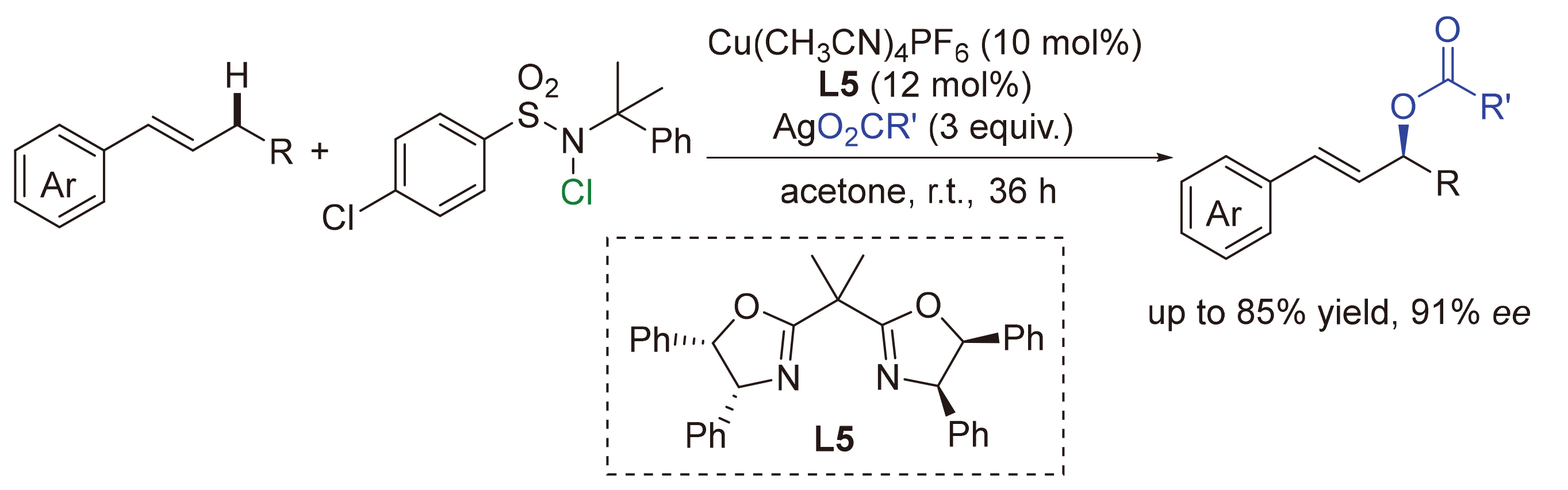
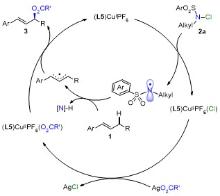
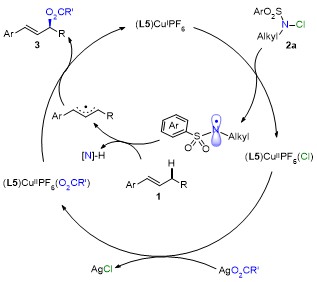
烯丙位C—H键的不对称氧化是构建手性烯丙醇及其衍生物的重要策略, 但由于C—H键惰性高及立体选择性控制困难, 该转化极具挑战性. 发展了一种铜催化芳基烯烃烯丙位C—H键的不对称氧化反应, 实现了以简单烯烃为限制试剂直接构建手性烯丙酯的方法. 该反应条件温和, 具有良好的官能团兼容性与底物普适性, 能够以中等至良好的收率及良好到优秀的对映选择性获得手性烯丙酯产物.
李家圆, 陈品红, 刘国生. 铜催化烯丙位C—H键不对称氧化反应[J]. 有机化学, 2026, 46(9): 3630-3639.
Jiayuan Li, Pinhong Chen, Guosheng Liu. Copper-Catalyzed Enantioselective Oxidation of Allylic C—H Bonds[J]. Chinese Journal of Organic Chemistry, 2026, 46(9): 3630-3639.
| Entry | Ligand | Salt | Yieldb/% | eec/% | r.r.d |
|---|---|---|---|---|---|
| 1 | L1 | AgOPiv | 10 | 0 | n.d. |
| 2 | L1 | NaOPiv | 0 | — | — |
| 3 | L1 | KOPiv | 0 | — | — |
| 4 | L2 | AgOPiv | 0 | — | — |
| 5 | L3 | AgOPiv | 0 | — | — |
| 6 | L4 | AgOPiv | 4 | n.d. | n.d. |
| 7 | L5 | AgOPiv | 55 | 89 | 11∶1 |
| 8 | L6 | AgOPiv | 25 | 60 | 10∶1 |
| 9e | L5 | AgOPiv | 40 | 71 | 10∶1 |
| 10f | L5 | AgOPiv | 16 | 80 | 11∶1 |
| 11g | L5 | AgOPiv | 73 | 90 | 11∶1 |
| Entry | Ligand | Salt | Yieldb/% | eec/% | r.r.d |
|---|---|---|---|---|---|
| 1 | L1 | AgOPiv | 10 | 0 | n.d. |
| 2 | L1 | NaOPiv | 0 | — | — |
| 3 | L1 | KOPiv | 0 | — | — |
| 4 | L2 | AgOPiv | 0 | — | — |
| 5 | L3 | AgOPiv | 0 | — | — |
| 6 | L4 | AgOPiv | 4 | n.d. | n.d. |
| 7 | L5 | AgOPiv | 55 | 89 | 11∶1 |
| 8 | L6 | AgOPiv | 25 | 60 | 10∶1 |
| 9e | L5 | AgOPiv | 40 | 71 | 10∶1 |
| 10f | L5 | AgOPiv | 16 | 80 | 11∶1 |
| 11g | L5 | AgOPiv | 73 | 90 | 11∶1 |
| [1] |
doi: 10.1039/c5cs00628g pmid: 26507237 |
| [2] |
doi: 10.1038/s41570-021-00300-6 pmid: 37117588 |
| [3] |
doi: 10.1021/cr00013a016 |
| [4] |
doi: 10.1039/b816707a |
| [5] |
doi: 10.1021/cr100198w |
| [6] |
doi: 10.1021/acscentsci.6b00032 |
| [7] |
doi: 10.1021/jacs.8b05195 |
| [8] |
doi: 10.1002/cjoc.v40.23 |
| [9] |
doi: 10.1039/D5SC08653A |
| [10] |
doi: 10.1039/D0CS00440E |
| [11] |
doi: 10.1038/s41570-022-00388-4 pmid: 35965690 |
| [12] |
doi: 10.1039/c0cs00142b |
| [13] |
doi: 10.1021/acs.accounts.8b00231 |
| [14] |
doi: 10.1126/science.1183602 |
| [15] |
doi: 10.1021/acs.chemrev.6b00657 |
| [16] |
doi: 10.1007/s11426-025-2757-1 |
| [17] |
doi: 10.1126/science.1193478 |
| [18] |
doi: 10.6023/A20030086 |
|
(王曦翎, 陈杰, 马娜娜, 丛志奇, 化学学报, 2020, 78, 490.)
doi: 10.6023/A20030086 |
|
| [19] |
doi: 10.1021/acs.accounts.0c00591 |
| [20] |
doi: 10.1021/acs.accounts.5b00062 |
| [21] |
doi: 10.1021/jacs.8b00350 pmid: 29542921 |
| [22] |
doi: 10.1002/anie.v58.39 |
| [23] |
doi: 10.1021/acs.chemrev.7b00373 |
| [24] |
doi: 10.1016/S0040-4020(97)00322-0 |
| [25] |
doi: 10.1021/acs.accounts.8b00265 |
| [26] |
doi: 10.1039/D1CS00727K |
| [27] |
doi: 10.1038/s44160-021-00016-x |
| [28] |
doi: 10.6023/cjoc202406042 |
|
(令天鹏, 秦海涛, 刘峰, 有机化学, 2025, 45, 498.)
doi: 10.6023/cjoc202406042 |
|
| [29] |
|
| [30] |
|
| [31] |
doi: 10.1021/ja01530a067 |
| [32] |
doi: 10.1016/S0040-4020(01)01172-3 |
| [33] |
doi: 10.1016/j.tetlet.2013.03.046 |
| [34] |
|
| [35] |
doi: 10.1021/jacs.4c11145 |
| [36] |
doi: 10.1021/jacs.4c12544 |
| [37] |
doi: 10.1038/s41929-024-01276-4 |
| [38] |
doi: 10.1021/jacs.5c05382 |
| [39] |
doi: 10.1021/jacs.5c06136 |
| [40] |
doi: 10.1038/s41586-019-1655-8 |
| [41] |
doi: 10.1021/jacs.0c05373 |
| [42] |
doi: 10.1021/jacs.3c11368 |
| [43] |
doi: 10.1016/j.ica.2004.05.022 |
| [44] |
doi: 10.1021/jacs.6c05474 |
| [1] | 黄锦龙, 肖帆, 吴慧敏, 董秀琴, 王春江. 铱催化不对称串联烯丙基化/iso-Pictet-Spengler环化反应合成手性四氢-γ-咔啉[J]. 有机化学, 2026, 46(9): 3769-3776. |
| [2] | 曾添晴, 倪宇阳, 袁瑶, 朱钢国. 可见光诱导叔胺促进的烯烃酰基氟烷基化反应[J]. 有机化学, 2026, 46(9): 3737-3747. |
| [3] | 陈小龙, 高琳, 丁奎岭, 王晓明. 铜催化不对称炔丙基取代/环化串联反应研究进展[J]. 有机化学, 2026, 46(9): 3506-3522. |
| [4] | 张瑞楠, 郑琪智, 赖圣怡, 罗文俊, 许冰, 张展鸣, 张俊良. Sadphos在丰产金属催化反应中的应用[J]. 有机化学, 2026, 46(9): 3390-3398. |
| [5] | 吴志杰, 周超, 李金山, 徐佳欣, 张义成, 刘杰, 王磊. 可见光促进通过氢原子转移合成1,4-二羰基衍生物[J]. 有机化学, 2026, 46(8): 3158-3168. |
| [6] | 韩银松, 王东炜, 肖佳怡, 冯若昆. 酰胺噁唑啉导向的铜催化[2.2]对环芳烷直接C—H酰氧基化反应[J]. 有机化学, 2026, 46(8): 3147-3157. |
| [7] | 郑浩宇, 李传莹, 周友运. 过渡金属不对称催化通过C—O键形成合成手性叔烷基醚的研究进展[J]. 有机化学, 2026, 46(8): 2892-2925. |
| [8] | 于丰恺, 朱先进, 徐紫涵, 石凌宇, 石永佳, 李旭锋, 杨道山. 铜催化三组分反应合成含硫醚片段的三氮唑类化合物[J]. 有机化学, 2026, 46(7): 2825-2834. |
| [9] | 高鹰鹏, 张林军, 宋基懿, 钟品勇, 刘晋彪. 铜催化2-氨基苯甲酸与异硫氰酸酯脱硫环化合成2-氨基苯并-1,3-噁嗪-4-酮[J]. 有机化学, 2026, 46(7): 2808-2815. |
| [10] | 陈颂耀, 冯雪, 屠蔓苏, 郝文娟, 姜波. 镍(II)/双咪唑啉催化不对称高阶(5+3)环化反应构建兼具中心与轴手性的马鞍形八元桥联联芳基衍生物[J]. 有机化学, 2026, 46(7): 2796-2807. |
| [11] | 李凌岳, 张嘉沛, 张硕, 崔露元, 刘希功, 刘磊. 无配体铜催化四氢-β-咔啉的氧化重排反应[J]. 有机化学, 2026, 46(7): 2789-2795. |
| [12] | 张文钰, 刘星雨, 薛琦, 李杨, 汪苇杭, 李金恒. 基于氢原子转移策略的铜催化N-氟代磺酰胺C(sp3)—H键官能团化研究进展[J]. 有机化学, 2026, 46(7): 2529-2543. |
| [13] | 熊康宇, 陆展. 过渡金属催化1,1-二取代烯烃的不对称硼氢化反应研究进展[J]. 有机化学, 2026, 46(7): 2493-2510. |
| [14] | 王弘毅, 周韦屹, 彭凌子, 郭昌. 铜催化的α-亚胺酯不对称烷基化反应对映选择性合成(S)-BIRT-377[J]. 有机化学, 2026, 46(7): 2779-2788. |
| [15] | 王雷雷, 吴娟娟, 侯易, 王景和, 孙岩, 刘静, 郭佳蕾, 齐笑, 朱超, 刘强, 吕雷阳. 铜催化6-氮杂尿嘧啶与环烷烃的交叉脱氢偶联反应[J]. 有机化学, 2026, 46(7): 2770-2778. |
| 阅读次数 | ||||||
|
全文 |
|
|||||
|
摘要 |
|
|||||