

Chinese Journal of Organic Chemistry ›› 2026, Vol. 46 ›› Issue (5): 1871-1882.DOI: 10.6023/cjoc202510014 Previous Articles Next Articles
REVIEWS
张梦媛*( ), 袁之敏
收稿日期:2025-10-20
修回日期:2025-11-24
发布日期:2026-01-23
基金资助:
Mengyuan Zhang*(), Zhimin Yuan
Received:2025-10-20
Revised:2025-11-24
Published:2026-01-23
Contact:
* E-mail: zmywf2021@163.com
Supported by:Share
Mengyuan Zhang, Zhimin Yuan. Multifunctional Circularly Polarized Luminescence of Small Organic Molecules[J]. Chinese Journal of Organic Chemistry, 2026, 46(5): 1871-1882.
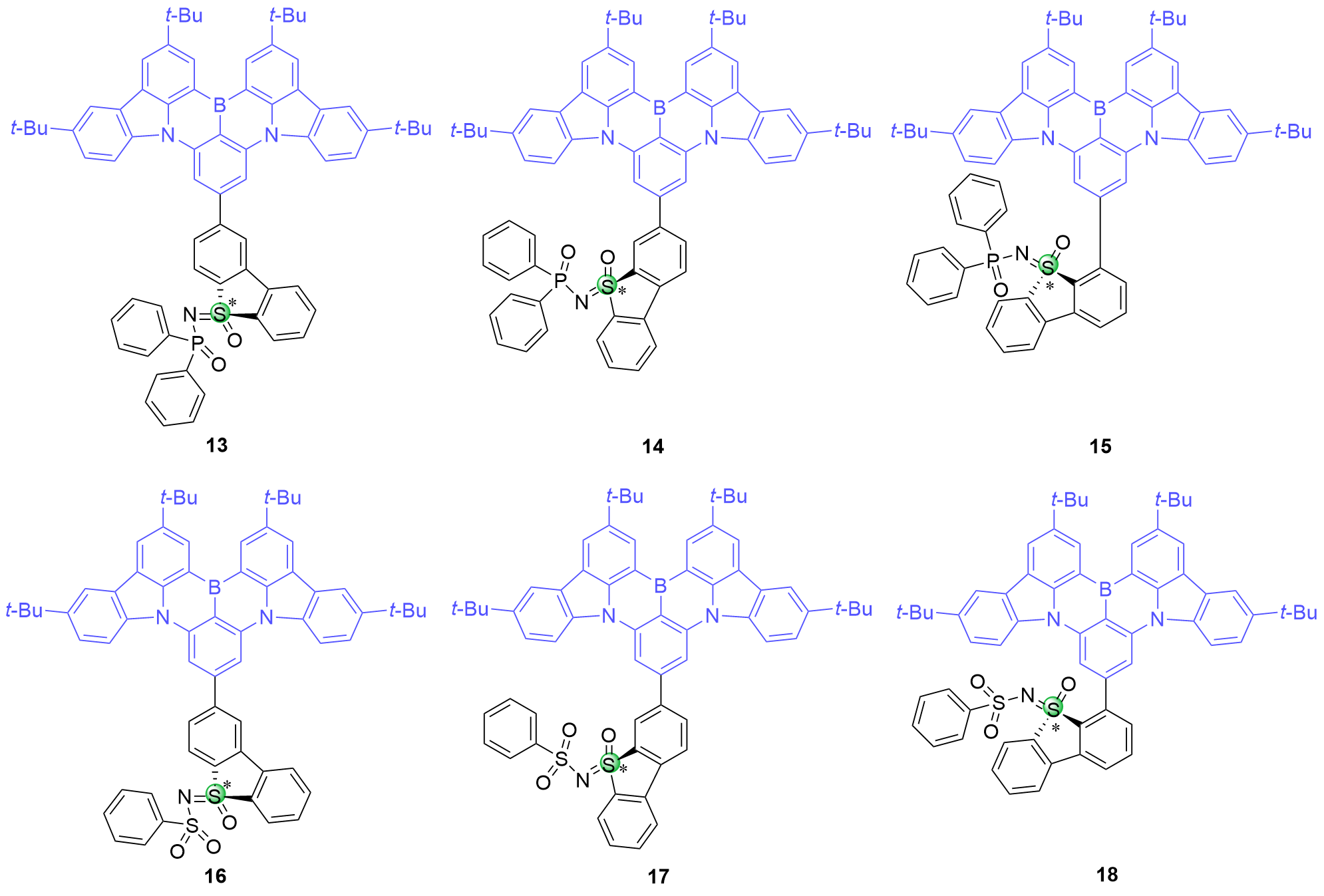
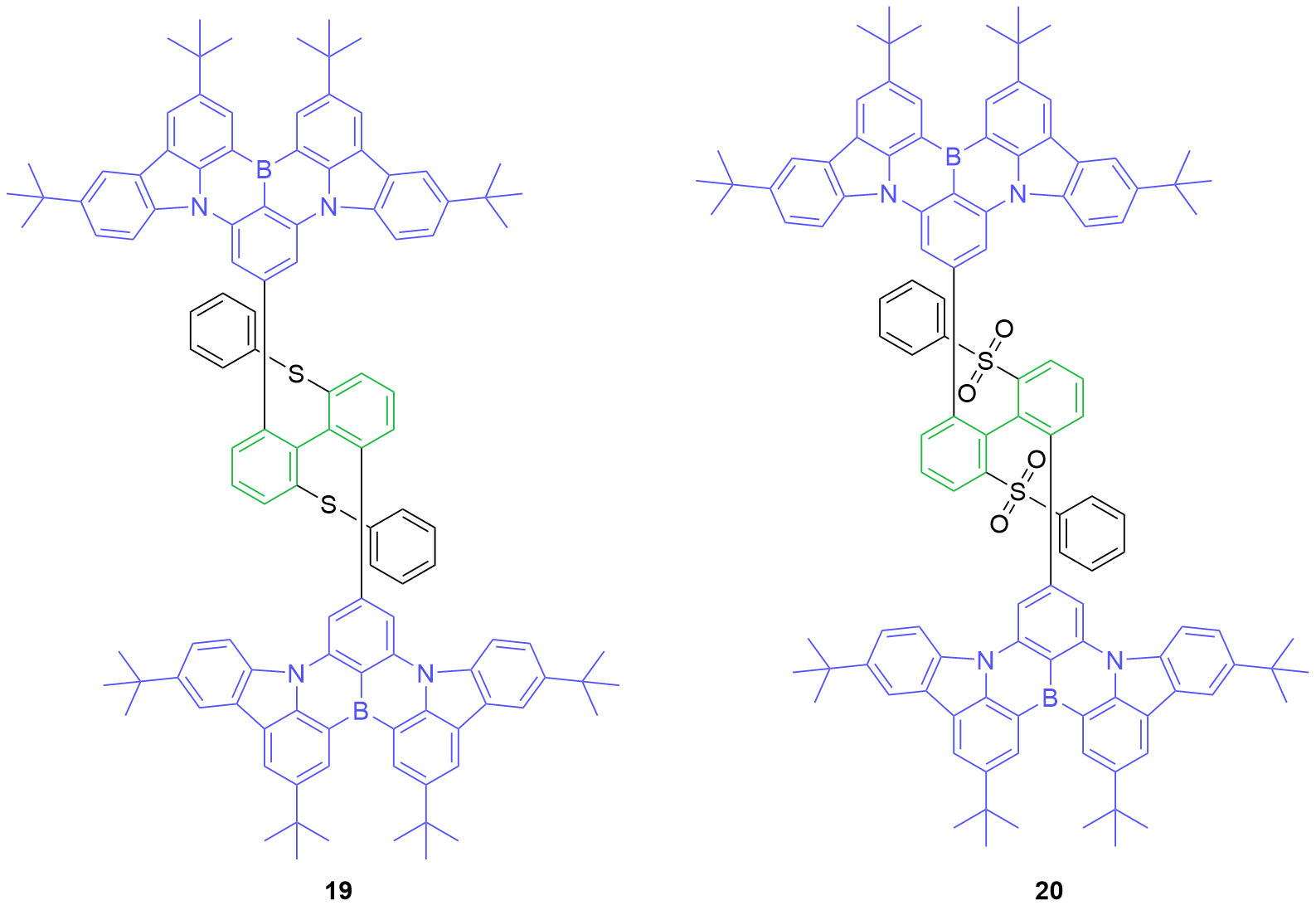
| Compd. | λPLa/nm | FWHMa/nm | ΔESTa/eV | ΦF b/% | |glum| c/10-3 |
|---|---|---|---|---|---|
| 13 | 497 | 26 | 0.03 | 90.9 | 2.9 |
| 14 | 505 | 28 | 0.05 | 86.5 | 4.7 |
| 15 | 495 | 25 | 0.03 | 92.0 | 1.9 |
| 16 | 503 | 29 | 0.10 | 92.7 | 1.7 |
| 17 | 509 | 29 | 0.09 | 91.2 | 5.4 |
| 18 | 496 | 25 | 0.11 | 92.8 | 0.6 |
| Compd. | λPLa/nm | FWHMa/nm | ΔESTa/eV | ΦF b/% | |glum| c/10-3 |
|---|---|---|---|---|---|
| 13 | 497 | 26 | 0.03 | 90.9 | 2.9 |
| 14 | 505 | 28 | 0.05 | 86.5 | 4.7 |
| 15 | 495 | 25 | 0.03 | 92.0 | 1.9 |
| 16 | 503 | 29 | 0.10 | 92.7 | 1.7 |
| 17 | 509 | 29 | 0.09 | 91.2 | 5.4 |
| 18 | 496 | 25 | 0.11 | 92.8 | 0.6 |


| [1] |
doi: 10.1021/cr60310a001 |
| [2] |
doi: 10.1002/tcr.v22.1 |
| [3] |
doi: 10.1002/anie.v62.20 |
| [4] |
doi: 10.1007/s11426-021-1146-6 |
| [5] |
doi: 10.1038/s41467-023-38801-1 |
| [6] |
doi: 10.1002/anie.v64.4 |
| [7] |
doi: 10.1016/j.cej.2022.138390 |
| [8] |
doi: 10.1002/adma.v32.41 |
| [9] |
doi: 10.1002/cptc.v6.3 |
| [10] |
doi: 10.1002/chir.v27.1 |
| [11] |
doi: 10.1002/asia.v19.9 |
| [12] |
doi: 10.1002/chem.v27.9 |
| [13] |
doi: 10.1021/acs.jpclett.0c03174 |
| [14] |
doi: 10.1002/anie.v60.2 |
| [15] |
doi: 10.1039/D5TC00097A |
| [16] |
doi: 10.1002/adom.v11.6 |
| [17] |
|
| [18] |
doi: 10.3390/nano12030424 |
| [19] |
doi: 10.1007/s11426-024-2084-1 |
| [20] |
doi: 10.1039/C9CC05109K |
| [21] |
doi: 10.1039/D4CC01698J |
| [22] |
doi: 10.6023/A17090440 |
|
(李猛, 林伟彬, 房蕾, 陈传峰, 化学学报, 2017, 75, 1150.)
doi: 10.6023/A17090440 |
|
| [23] |
|
|
(曹恒昱, 高之胜, 闫馨, 李欢欢, 陶冶, 化学进展, 2025, 37, 949.)
doi: 10.7536/PC240907 |
|
| [24] |
doi: 10.6023/cjoc202208023 |
|
(杨晓东, 郑小康, 董海亮, 孙静, 王华, 有机化学, 2023, 43, 1292.)
doi: 10.6023/cjoc202208023 |
|
| [25] |
doi: 10.1002/anie.v64.3 |
| [26] |
|
|
(于兰, 薛沛然, 李欢欢, 陶冶, 陈润锋, 黄维, 化学进展, 2022, 34, 1996.)
doi: 10.7536/PC210818 |
|
| [27] |
doi: 10.1016/j.ccr.2020.213329 |
| [28] |
doi: 10.1039/D3QM01125A |
| [29] |
doi: 10.1038/25954 |
| [30] |
doi: 10.1002/anie.v57.28 |
| [31] |
doi: 10.1039/D3TC04514E |
| [32] |
doi: 10.1021/acsami.0c17295 |
| [33] |
doi: 10.1039/D1TC03030B |
| [34] |
doi: 10.1002/adfm.v35.14 |
| [35] |
doi: 10.1002/chir.v35.7 |
| [36] |
|
| [37] |
doi: 10.1002/adfm.v23.27 |
| [38] |
doi: 10.1021/acs.jpclett.6b00554 pmid: 27058743 |
| [39] |
doi: 10.1002/anie.v61.30 |
| [40] |
doi: 10.1002/anie.v59.12 |
| [41] |
doi: 10.1002/smll.v19.46 |
| [42] |
doi: 10.1002/anie.v58.48 |
| [43] |
doi: 10.1038/s41566-024-01538-4 |
| [44] |
doi: 10.1002/adfm.v31.20 |
| [45] |
doi: 10.1002/tcr.v19.8 |
| [46] |
doi: 10.1002/adom.v13.1 |
| [47] |
doi: 10.1039/D2QO01383E |
| [48] |
doi: 10.1039/C5CC04105H |
| [49] |
doi: 10.1039/d4mh00605d pmid: 38990337 |
| [50] |
doi: 10.1007/s11426-024-2560-9 |
| [51] |
doi: 10.1002/adfm.v35.1 |
| [52] |
doi: 10.1002/anie.v64.40 |
| [53] |
doi: 10.1002/adom.v12.13 |
| [54] |
doi: 10.1021/acs.orglett.8b02995 |
| [55] |
|
| [56] |
doi: 10.1002/adma.v34.36 |
| [57] |
|
| [58] |
doi: 10.1002/anie.v63.18 |
| [59] |
|
| [60] |
doi: 10.1039/D3CS00698K |
| [61] |
doi: 10.1021/acs.chemrev.5b00263 pmid: 26492387 |
| [62] |
doi: 10.1007/s11237-018-9558-6 |
| [63] |
doi: 10.1360/972009-2307 |
|
(闫继明, 秦安军, 孙景志, 唐本忠, 科学通报, 2010, 55, 1206.)
|
|
| [64] |
doi: 10.1186/s43074-020-00012-y |
| [65] |
|
| [66] |
doi: 10.1002/chem.v20.47 |
| [67] |
doi: 10.1002/anie.v57.18 |
| [68] |
doi: 10.1039/C8CS00444G |
| [69] |
doi: 10.1021/acsami.7b12320 |
| [70] |
doi: 10.1039/b921610c |
| [71] |
doi: 10.1021/jacs.6b07087 |
| [72] |
doi: 10.1002/adom.v12.11 |
| [73] |
doi: 10.1016/j.dyepig.2023.111422 |
| [74] |
doi: 10.1002/anie.v59.9 |
| [75] |
doi: 10.1002/anie.v61.28 |
| [76] |
doi: 10.1002/adom.v12.16 |
| [77] |
doi: 10.1002/agt2.70069 |
| [1] | Chunlin Chen, Jie Tan, Bangcui Zhang, Guanchen Dong, Yanhua Yang, Xiangguang Li, Shulin Gao. A Bifunctional Triphenylamine-Based Fluorescent Dye for Anti-counterfeiting and Latent Fingerprint Detection [J]. Chinese Journal of Organic Chemistry, 2026, 46(3): 1095-1104. |
| [2] | Jidong Zhang, Hao Wang, Xiaoxin Quan, Shenghai Zhang, Wei She. Synthesis of Aggregation-Induced Emission (AIE) Organic Polymorphs Based on Tetraphenylethene Structure: Research on Molecular Conformation and Detection Performance of Cys [J]. Chinese Journal of Organic Chemistry, 2026, 46(3): 934-940. |
| [3] | Junyu Zhu, Jinlong Liao, Lei Dai, Wencheng Chen, Yanping Huo. Design, Synthesis, and Electroluminescent Performance Study of meta-Terphenyl-Modified Thermally Activated Delayed Fluorescence Host [J]. Chinese Journal of Organic Chemistry, 2025, 45(9): 3390-3400. |
| [4] | Pengze Yan, Shuli Gao, Tianrui Li, Jinling Miao, Xuchuan Jiang, Yong Nie. Progress in the Synthesis of Carborane Compounds with Aggregation-Induced Emission [J]. Chinese Journal of Organic Chemistry, 2025, 45(8): 2677-2697. |
| [5] | Yanqiu Li, Yawei Jia, Pangkuan Chen. Recent Progress of Chiral Conjugated Organic Triarylboron (Ar3B) Luminescent Materials [J]. Chinese Journal of Organic Chemistry, 2025, 45(4): 1119-1136. |
| [6] | Ting Luo, Yufeng Xiao, Xun Li, Wen Xia, Kaka Zhang. Fabrication of Highly-Efficient Thermally Activated Delayed Fluorescence-Type Organic Afterglow Materials Based on Intramolecular Charge Transfer Technology [J]. Chinese Journal of Organic Chemistry, 2025, 45(11): 4202-4209. |
| [7] | Hongyu Dai, Honghong Sun, Peifa Wei, Weijiang Guan. Strategies for the Synthesis of High-Efficiency Aggregation-Induced Emission Photosensitizers [J]. Chinese Journal of Organic Chemistry, 2025, 45(11): 4128-4142. |
| [8] | Qing-Yue Song, Guiyi Yang, Yue Zhang, Zijie Qiu. Research Progress on the Synthesis and Optoelectronic Properties of Helicene Derivatives [J]. Chinese Journal of Organic Chemistry, 2025, 45(11): 3953-3973. |
| [9] | Cuiping Sun, Yuting Xue, Pangkuan Chen. Recent Advances in Heterohelicene-Based Circularly Polarized Luminescence Materials [J]. Chinese Journal of Organic Chemistry, 2025, 45(11): 4048-4069. |
| [10] | Ziwei Chen, Sikang Duan, Yihui Wang, Huadan Fan, Mengjie Yang, Sisi Wang, Hua Lu. Peripheral-Group Induced Chirality of β-Isoindigo Based Aza Dipyrrometheneboron Difluoride (BODIPY) Analogs [J]. Chinese Journal of Organic Chemistry, 2025, 45(11): 4163-4170. |
| [11] | Chenyang Zhao, Jingxiao Ren, Guanghui Ouyang, Minghua Liu. Supramolecular Assembly and Circularly Polarized Luminescence Regulation of a Chiral Dipyrene-Glutamic Acid Amphiphile [J]. Chinese Journal of Organic Chemistry, 2025, 45(11): 4171-4177. |
| [12] | Bingyan Chen, Jie Sun, Linghong Xiong, Xuewen He. Fluorescence Light-Up Detection and Imaging of Atypical Nucleic Acid Structures [J]. Chinese Journal of Organic Chemistry, 2025, 45(11): 4082-4107. |
| [13] | Yixuan Chen, Zheng Zhao. Aggregation-Induced Emission Photosensitizers for Photodynamic Antimicrobial Therapy [J]. Chinese Journal of Organic Chemistry, 2025, 45(11): 3998-4012. |
| [14] | Fafen Chen, Chunlin Chen, Zhi Peng, Bangcui Zhang, Haiyan Luo, Shan Li, Shulin Gao, Jianfei Wang, Xiangguang Li, Yanhua Yang. Triphenylamine-Based Schiff Base Compounds for the Latent Fingerprints Visualization [J]. Chinese Journal of Organic Chemistry, 2025, 45(11): 4185-4194. |
| [15] | Zixuan Dong, Junjun Su, Hongfei Pan, Xiangkui Ren, Zhijian Chen. Near-Infrared Aggregation-Induced Emission (AIE) Molecules Based on Coupling of Triarylamine-Modified Benzothiadiazole Units [J]. Chinese Journal of Organic Chemistry, 2025, 45(1): 205-211. |
| Viewed | ||||||
|
Full text |
|
|||||
|
Abstract |
|
|||||
