

Chinese Journal of Organic Chemistry ›› 2026, Vol. 46 ›› Issue (8): 3169-3179.DOI: 10.6023/cjoc202601005 Previous Articles Next Articles
ARTICLES
马志鹏a, 刘文涛a, 孙承华b, 孙继斌b,*( ), 陈华杰a,*()
收稿日期:2026-02-27
修回日期:2026-03-21
发布日期:2026-05-13
基金资助:
Zhipeng Maa, Wentao Liua, Chenghua Sunb, Jibin Sunb,*(), Huajie Chena,*()
Received:2026-02-27
Revised:2026-03-21
Published:2026-05-13
Contact:
*E-mail: chenhjoe@xtu.edu.cn; sunjibin@mail.ipc.ac.cn
Supported by:Share
Zhipeng Ma, Wentao Liu, Chenghua Sun, Jibin Sun, Huajie Chen. Tetra-aryl Functionalization of Tetracyanodiacenaphthoanthracene Diimides and Their Tunable Optoelectronic Properties[J]. Chinese Journal of Organic Chemistry, 2026, 46(8): 3169-3179.
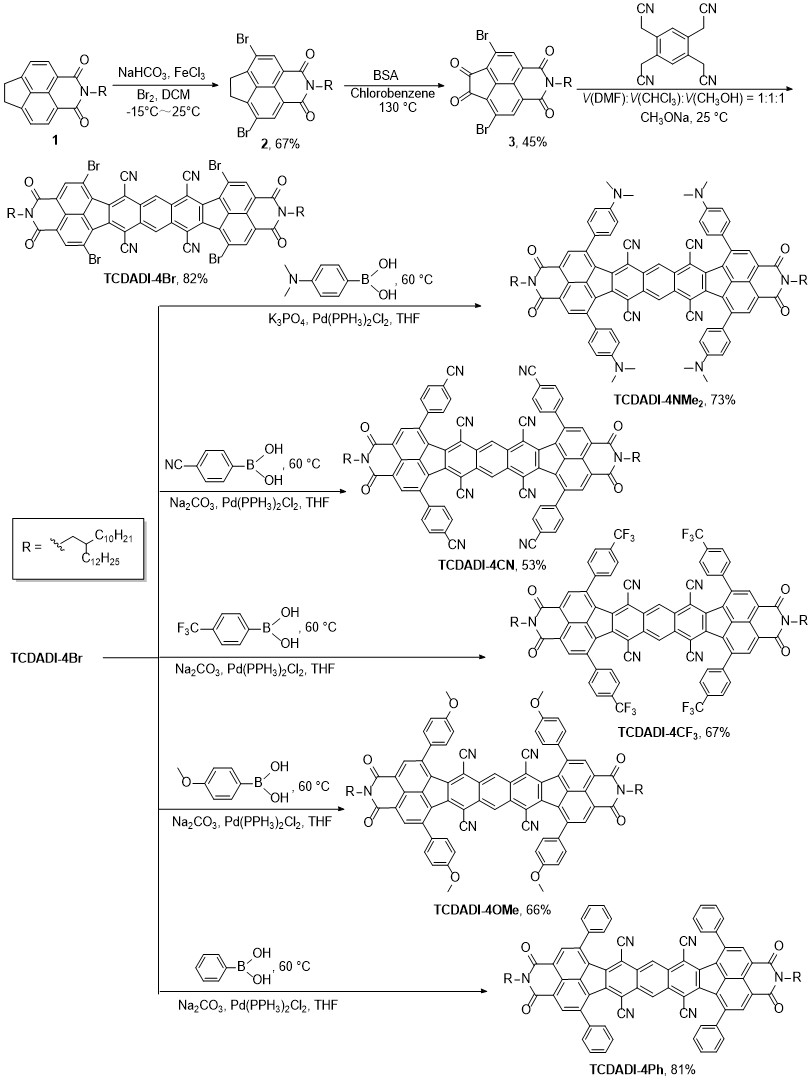
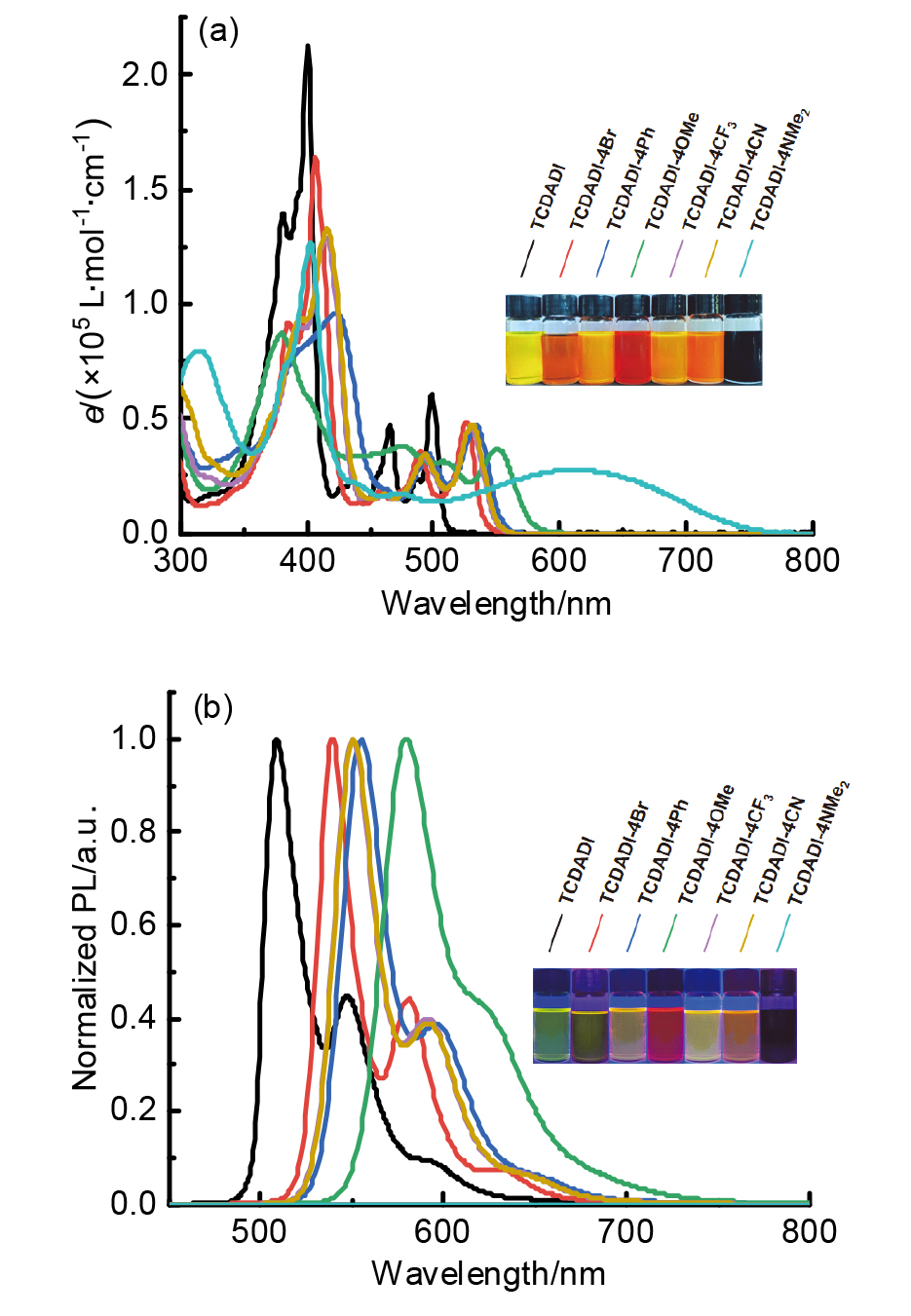
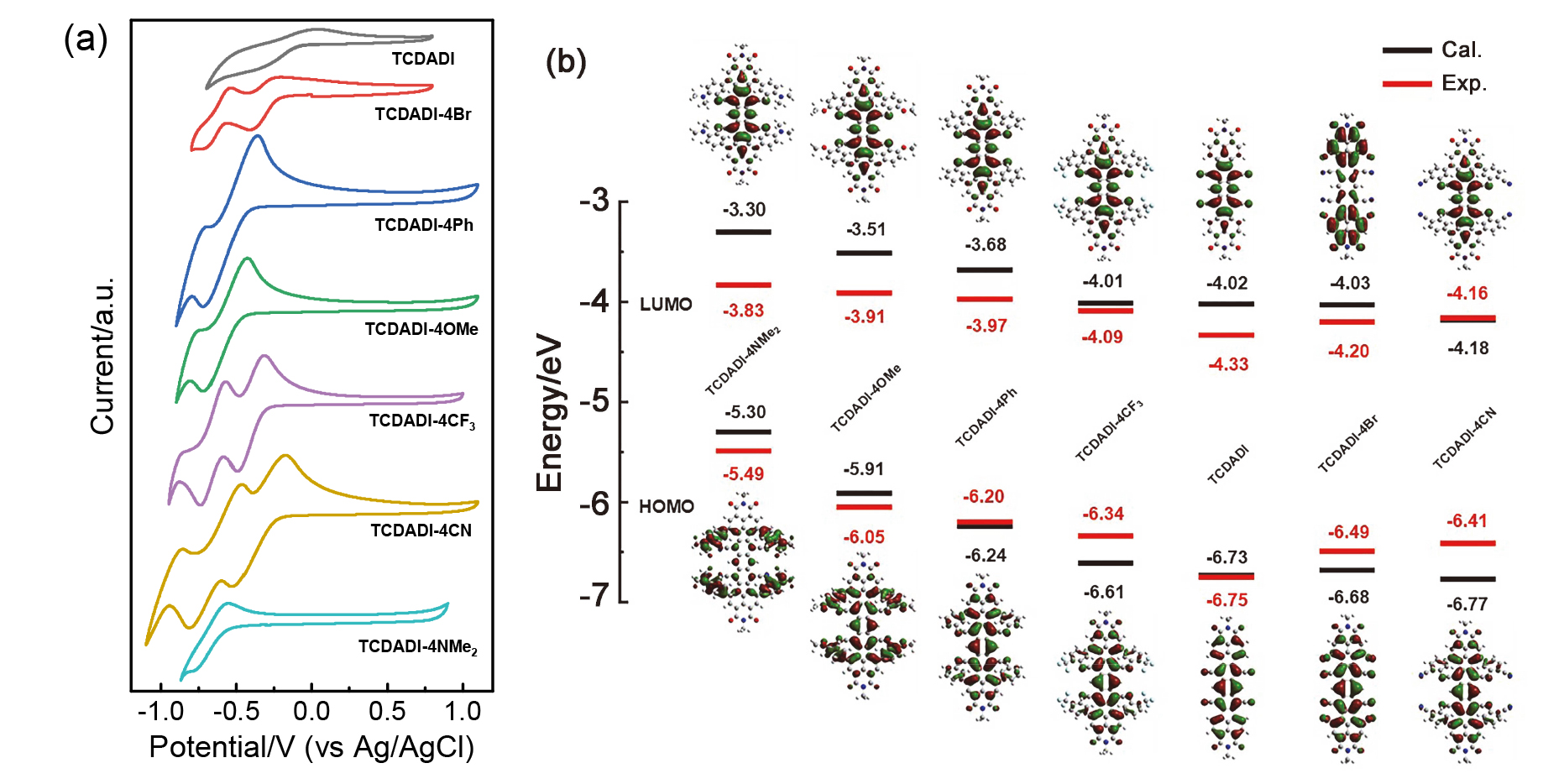
| Sample | ${\lambda }_{\text{sol}}^{max}$a/nm | ${\lambda }_{\text{PL}}^{max}$b/nm | ${\lambda }_{\text{onset}}^{\text{sol}}$c/nm | ${E}_{\text{g}}^{\text{opt}}$d/eV | PLQYe/% | ${E}_{\text{red}}^{\text{onset}}$/V | ELUMOf/eV | EHOMOg/eV |
|---|---|---|---|---|---|---|---|---|
| TCDADI | 401 | 509 | 513 | 2.42 | 41.21 | -0.09 | -4.33 | -6.75 |
| TCDADI-4Br | 407 | 540 | 541 | 2.29 | 4.76 | -0.22 | -4.20 | -6.49 |
| TCDADI-4Ph | 423 | 555 | 557 | 2.23 | 82.6 | -0.45 | -3.97 | -6.20 |
| TCDADI-4OMe | 379 | 580 | 580 | 2.14 | 48.22 | -0.51 | -3.91 | -6.05 |
| TCDADI-4CF3 | 414 | 550 | 552 | 2.25 | 98.12 | -0.33 | -4.09 | -6.34 |
| TCDADI-4CN | 416 | 551 | 554 | 2.24 | 98.73 | -0.26 | -4.16 | -6.41 |
| TCDADI-4NMe2 | 403 | — | 750 | 1.65 | 0 | -0.59 | -3.83 | -5.49 |
| Sample | ${\lambda }_{\text{sol}}^{max}$a/nm | ${\lambda }_{\text{PL}}^{max}$b/nm | ${\lambda }_{\text{onset}}^{\text{sol}}$c/nm | ${E}_{\text{g}}^{\text{opt}}$d/eV | PLQYe/% | ${E}_{\text{red}}^{\text{onset}}$/V | ELUMOf/eV | EHOMOg/eV |
|---|---|---|---|---|---|---|---|---|
| TCDADI | 401 | 509 | 513 | 2.42 | 41.21 | -0.09 | -4.33 | -6.75 |
| TCDADI-4Br | 407 | 540 | 541 | 2.29 | 4.76 | -0.22 | -4.20 | -6.49 |
| TCDADI-4Ph | 423 | 555 | 557 | 2.23 | 82.6 | -0.45 | -3.97 | -6.20 |
| TCDADI-4OMe | 379 | 580 | 580 | 2.14 | 48.22 | -0.51 | -3.91 | -6.05 |
| TCDADI-4CF3 | 414 | 550 | 552 | 2.25 | 98.12 | -0.33 | -4.09 | -6.34 |
| TCDADI-4CN | 416 | 551 | 554 | 2.24 | 98.73 | -0.26 | -4.16 | -6.41 |
| TCDADI-4NMe2 | 403 | — | 750 | 1.65 | 0 | -0.59 | -3.83 | -5.49 |
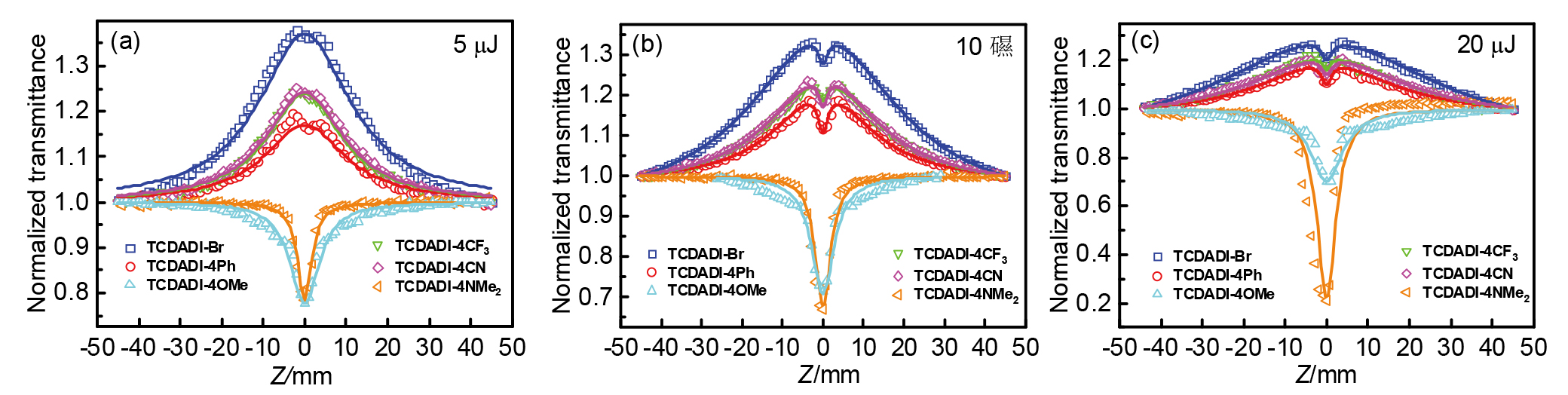
| Sample | E0a/μJ | Tmb | σex/σ0c | Fond/ (J•cm-2) | βeffe/(cm• GW-1) |
|---|---|---|---|---|---|
| TCDADI-4NMe2 | 5 | 0.78 | 1.28 | 0.15 | 109 |
| TCDADI-4OMe | 5 | 0.77 | 1.31 | 0.02 | 232 |
| TCDADI-4NMe2 | 10 | 0.67 | 1.47 | 0.19 | 90 |
| TCDADI-4OMe | 10 | 0.71 | 1.35 | 0.03 | 119 |
| TCDADI-4NMe2 | 20 | 0.23 | 1.75 | 0.09 | 127 |
| TCDADI-4OMe | 20 | 0.70 | 1.39 | 0.03 | 85 |
| Sample | E0a/μJ | Tmb | σex/σ0c | Fond/ (J•cm-2) | βeffe/(cm• GW-1) |
|---|---|---|---|---|---|
| TCDADI-4NMe2 | 5 | 0.78 | 1.28 | 0.15 | 109 |
| TCDADI-4OMe | 5 | 0.77 | 1.31 | 0.02 | 232 |
| TCDADI-4NMe2 | 10 | 0.67 | 1.47 | 0.19 | 90 |
| TCDADI-4OMe | 10 | 0.71 | 1.35 | 0.03 | 119 |
| TCDADI-4NMe2 | 20 | 0.23 | 1.75 | 0.09 | 127 |
| TCDADI-4OMe | 20 | 0.70 | 1.39 | 0.03 | 85 |
| [1] |
|
| [2] |
|
| [3] |
|
| [4] |
|
| [5] |
|
| [6] |
|
| [7] |
|
| [8] |
|
| [9] |
|
| [10] |
|
| [11] |
|
| [12] |
|
| [13] |
|
| [14] |
|
| [15] |
|
| [16] |
|
| [17] |
|
| [18] |
|
| [19] |
|
| [20] |
|
| [21] |
|
| [22] |
|
| [23] |
|
| [24] |
|
| [25] |
|
| [26] |
|
| [27] |
|
| [28] |
|
| [29] |
|
| [30] |
|
| [31] |
|
| [32] |
|
| [33] |
|
| [1] | JIan Xiao, Zhiying Wu, Ziyi Chen, Pengfei Zhao. Tetraethylenepentamine Functionalized Phenolic Resin as Highly Active Acid-Base Bifunctional Catalyst for Knoevenagel Condensation Reaction [J]. Chinese Journal of Organic Chemistry, 2022, 42(4): 1179-1187. |
| [2] | Sai Wu, Wuxi Tao, Guo Wang, Bin Zhao, Huajie Chen. Synthesis and Optoelectronic Properties of A-D-A Type Small Molecule Acceptors Containing Isatin-Fused Acenaphthenequinone Imide Terminal Groups [J]. Chinese Journal of Organic Chemistry, 2021, 41(5): 2019-2028. |
| [3] | Tan Dan, Wu Sai, Wei Huan, Hu Yuanyuan, Chen Huajie. Design, Synthesis, and Properties of Conjuated Molecules with Isatin-Fused Acenaphthenequinone Imide Moieties [J]. Chinese Journal of Organic Chemistry, 2020, 40(9): 2919-2928. |
| [4] | Wang Lingfeng, Qian Ying. Near-Infrared Quinoline-Fluoroborodipyrrole Dye: Synthesis and Lysosomal Fluorescence Imaging [J]. Chinese Journal of Organic Chemistry, 2020, 40(5): 1246-1250. |
| [5] | Yan Shiqiang, Guo Wei, Wang Wensheng, Zhang Wei. Zinc-Proline Complex Catalyzed Knoevenagel Condensation in Water [J]. Chin. J. Org. Chem., 2019, 39(5): 1469-1474. |
| [6] | Wang Xiang, Chen Ping, Zhi Sanjun, Hu Huayou, Kan Yuhe. CBr4-Promoted Efficient Synthesis of 2-(1H-Benzo[d] imidazol-2-yl)-3-arylacrylonitriles [J]. Chin. J. Org. Chem., 2018, 38(11): 3123-3126. |
| [7] | Liu Yuting, Li Rong, Xing Yanjun. Synthesis of Novel Hydroxyl-Functionalized Ionic Liquids andApplication in Knoevenagel Condensation [J]. Chin. J. Org. Chem., 2015, 35(7): 1520-1525. |
| [8] | Hou Hailiang, Li Zhifeng, Ying Anguo, Xu Songlin. Application of Task-Specific Ionic liquids to Knoevenagel Condensation [J]. Chin. J. Org. Chem., 2014, 34(7): 1277-1287. |
| [9] | Zhao Dongwang, Wu Yuetong, Chen Tingting, Dai Liyi, Wang Yuanyuan. Efficient and Convenient Synthesis of Ionic Liquid Supported SBA-15 Mesoporous Srganosilica and Its Beneficial Applications in Henry Reaction [J]. Chin. J. Org. Chem., 2013, 33(08): 1791-1797. |
| [10] | Ding Yan, Huang He, Hu Yi. New Progress on Lipases Catalyzed C—C Bond Formation Reactions [J]. Chin. J. Org. Chem., 2013, 33(05): 905-914. |
| [11] | LI Chuan-Jiang, YOU Hong-Jun, ZHANG Zhi-Yong, DAI Zhi-Qun, GUAN Jin-Tao, WEI Ben-Mei. Synthesis and Optoelectronic Properties of an Arylamine-Endcapped Spirofluorene for Blue Light Emission [J]. Chin. J. Org. Chem., 2011, 31(12): 2095-2101. |
| [12] | CHEN Shou-Cong, ZHANG Chun-Yan, LIU Ji-Ping, WANG Dao-Quan, WANG Ming-An. Synthesis and Fungicidal Activity of Cyclododecanone Derivatives with Hydantoin [J]. Chin. J. Org. Chem., 2010, 30(11): 1768-1773. |
| [13] |
YING, An-Guo a,b ; YE, Wei-Dong b; LIU, Luo a,b ; WU, Guo-Feng a,b; CHEN, Xin-Zhi*,a ; QIAN, Sheng b; ZHANG, Qiu-Pingb . Progress in the Application of Ionic Liquids to Organic Synthesis [J]. Chin. J. Org. Chem., 2008, 28(12): 2081-2094. |
| [14] | CHEN Xian-Kai, CHEN Jun-Rong, LI Quan*, ZHAO Ke-Qing. Theoretical Study on Spectra and Second-Order Nonlinear Optical Properties of Liquid Crystal Compound Diphenyl Terephthalates [J]. Chin. J. Org. Chem., 2008, 28(06): 1050-1054. |
| [15] |
LI Jia-Yun, PENG Jia-Jian, QIU Hua-Yu, JIANG Jian-Xiong, WU Ji-Rong NI Yong, LAI Guo-Qiao*. Knoevenagel Condensation Reaction Catalyzed with Ionic Liquid Functionalized SiO2 [J]. Chin. J. Org. Chem., 2007, 27(04): 483-487. |
| Viewed | ||||||
|
Full text |
|
|||||
|
Abstract |
|
|||||
