

Chinese Journal of Organic Chemistry ›› 2026, Vol. 46 ›› Issue (8): 2859-2891.DOI: 10.6023/cjoc202605015 Previous Articles Next Articles
REVIEWS
王朝阳a, 皮超b,*( ), 密霞a,*()
收稿日期:2026-05-14
修回日期:2026-05-27
发布日期:2026-06-03
基金资助:
Chaoyang Wanga, Chao Pib,*(), Xia Mia,*()
Received:2026-05-14
Revised:2026-05-27
Published:2026-06-03
Contact:
*E-mail: pichao@zzu.edu.cn;mixia@hactcm.edu.cn
Supported by:Share
Chaoyang Wang, Chao Pi, Xia Mi. Recent Advances in Visible-Light-Induced Reactions Involving N-Alkoxypyridinium Salts[J]. Chinese Journal of Organic Chemistry, 2026, 46(8): 2859-2891.
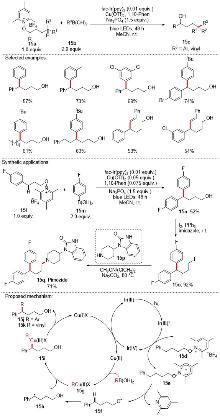
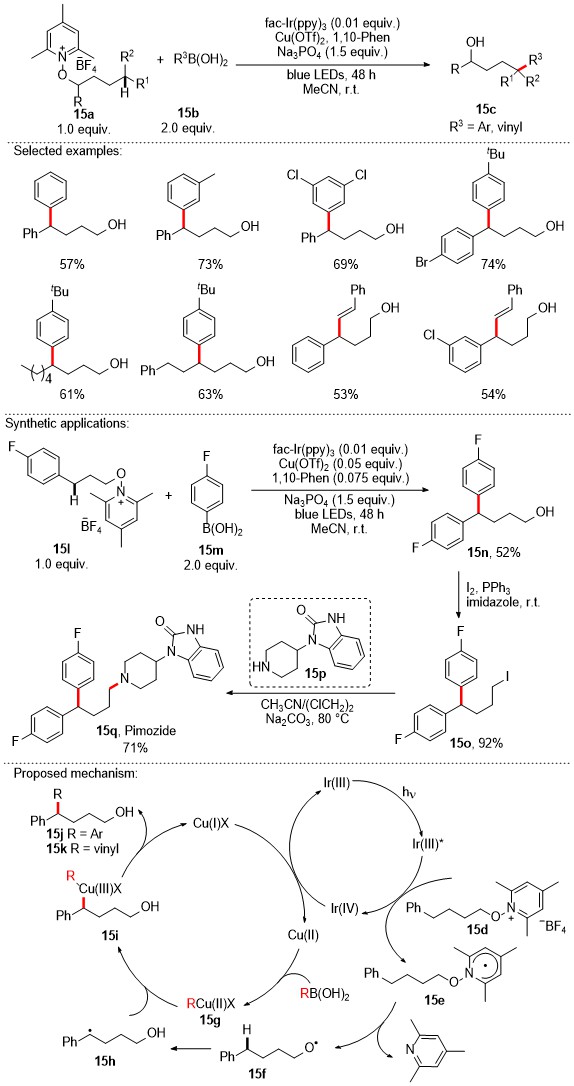
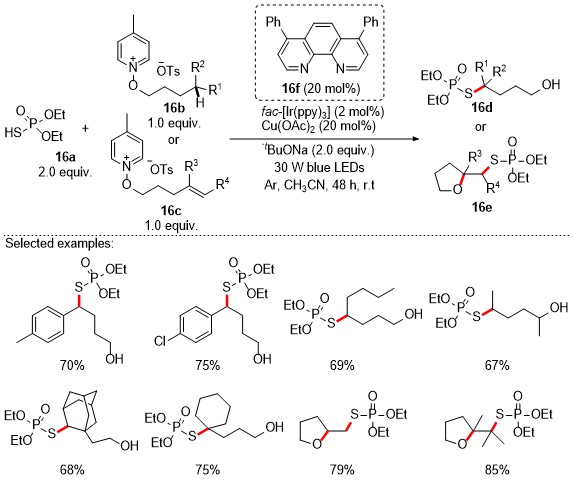
| [1] |
|
| [2] |
|
| [3] |
|
| [4] |
|
| [5] |
|
| [6] |
|
| [7] |
|
| [8] |
|
| [9] |
|
| [10] |
|
| [11] |
|
| [12] |
|
| [13] |
|
| [14] |
|
| [15] |
|
| [16] |
|
| [17] |
|
| [18] |
|
| [19] |
|
| [20] |
|
| [21] |
|
| [22] |
|
| [23] |
|
| [24] |
|
| [25] |
|
| [26] |
|
| [27] |
|
| [28] |
|
| [29] |
|
| [30] |
|
| [31] |
|
| [32] |
|
| [33] |
|
| [34] |
|
| [35] |
|
| [36] |
|
| [37] |
|
| [38] |
|
| [39] |
|
| [40] |
|
| [41] |
|
| [42] |
|
| [43] |
|
| [44] |
|
| [45] |
|
| [46] |
|
| [47] |
|
| [1] | Dongping Wang, Yuxin Zhang, Shanshan Wei, Fengjiao Wang, Congjun Zhu. Recent Advances in Photoredox Nickel-Catalyzed Deoxygenative Coupling of Carboxylic Acids [J]. Chinese Journal of Organic Chemistry, 2026, 46(7): 2669-2682. |
| [2] | Yonglong Zheng, Xinlong Luo, Yumin Xu, Haohua Huo. Metal/Photoredox-Catalyzed C(sp3)—C(sp3) Cross-Electrophile Coupling [J]. Chinese Journal of Organic Chemistry, 2026, 46(7): 2589-2603. |
| [3] | Peiwen Liu, Fu Ye, Weiming Yuan. Recent Advances in Visible-Light-Mediated Copper-Catalyzed Difunctionalization of 1,3-Enynes [J]. Chinese Journal of Organic Chemistry, 2026, 46(7): 2563-2580. |
| [4] | Dong Yan, Weibao He, Yucai Tang, Cui Xin, Zi Yang, Xiang Chen. Research Progress in the Synthesis of 1,3-Benzoxazine via Radical Cascade Reaction [J]. Chinese Journal of Organic Chemistry, 2026, 46(6): 2327-2336. |
| [5] | Lewei Dai, Jianling Wang, Dong Zou. Recent Advances in the Functionalization of para-C(sp2)—H Bonds of Anilines [J]. Chinese Journal of Organic Chemistry, 2026, 46(5): 1813-1844. |
| [6] | Guanghui Wang, Binghui Wang, Xu Ban, Xiaowei Zhao, Zhiyong Jiang. Visible Light-Driven Tandem Cyclization Reactions of 1,3-Eneynes with 4-Acyl-dihydropyridines to Access Azaarene-Functionalized Polysubstituted Furans [J]. Chinese Journal of Organic Chemistry, 2026, 46(4): 1763-1775. |
| [7] | Fu Ye, Weiming Yuan. Recent Advances in Dicarbofunctionalization of Alkynes via Photoredox Catalysis [J]. Chinese Journal of Organic Chemistry, 2026, 46(4): 1146-1165. |
| [8] | Yu-Chen Miao, Hang Qi, Huan-Ming Huang. Recent Advances in Enantioselective Transformations Enabled by Synergistic Photoredox/Chromium Catalysis [J]. Chinese Journal of Organic Chemistry, 2026, 46(4): 1481-1495. |
| [9] | Lingxu Meng, Lin Shen, Xiangling Luo, Yumei Lin, Lei Gong. Design of Photoactive Cr- and Co-Based Complexes and Their Applications in Organic Synthesis [J]. Chinese Journal of Organic Chemistry, 2026, 46(4): 1513-1528. |
| [10] | Yixi Zhang, Lijuan Pang, Huawen Huang. Visible-Light-Induced Aerobic Dehydrogenative Couplings of Quinoxalin-2(1H)-ones with Aldehydes [J]. Chinese Journal of Organic Chemistry, 2026, 46(4): 1730-1738. |
| [11] | Dan Yang, Tianzhen Li, Jingyi Bai, Honghao Zhang, Feng Shi. Visible-Light Photoredox-Catalyzed Reductive Dearomatization of Indoles [J]. Chinese Journal of Organic Chemistry, 2026, 46(4): 1699-1712. |
| [12] | Bin Zhang, Wenjing Xiao, Jiarong Chen. Controlled Generation and Transformations of Alkene Radical Anions [J]. Chinese Journal of Organic Chemistry, 2026, 46(4): 1181-1204. |
| [13] | Shan Gao, Xin Xie, Yuanhong Liu. Nickel/Visible Light Dual-Catalyzed C—O Bond Coupling Reactions of Aryl Bromides with Alcohols [J]. Chinese Journal of Organic Chemistry, 2026, 46(1): 266-278. |
| [14] | Jiarui Liang, Jinlan Li, Yun Jiang, Qiuli Yao, Yingshu Xu, Anjun Wang. Visible-Light-Driven Halogen-Bond-Induced Direct Coupling of Diethyl α-Iodomethylphosphonates with Coumarins/Quinolinones [J]. Chinese Journal of Organic Chemistry, 2026, 46(1): 135-145. |
| [15] | Yinsheng Miao, Lei Zhang, Jianqi Chen, Lili Wang, Zheng Duan. Synthesis of Pyrazolo(iso)quinoline Derivatives from Aryl Alkynes and N-Imine(iso)quinoline Ylides Catalyzed by Bisphosphonium Salt [J]. Chinese Journal of Organic Chemistry, 2025, 45(8): 2876-2884. |
| Viewed | ||||||
|
Full text |
|
|||||
|
Abstract |
|
|||||
