

Chinese Journal of Organic Chemistry ›› 2026, Vol. 46 ›› Issue (2): 624-632.DOI: 10.6023/cjoc202506014 Previous Articles Next Articles
ARTICLES
李佳豪, 袁冰, 于凤丽*( )
)
收稿日期:2025-06-06
修回日期:2025-09-09
发布日期:2025-10-09
通讯作者:
于凤丽
基金资助:
Jiahao Li, Bing Yuan, Fengli Yu*()
Received:2025-06-06
Revised:2025-09-09
Published:2025-10-09
Contact:
Fengli Yu
Supported by:Share
Jiahao Li, Bing Yuan, Fengli Yu. Study on Epoxidation of Cyclopentene Catalyzed by Diniobium Pentoxide Loaded on Carbon@Silica Composite Material[J]. Chinese Journal of Organic Chemistry, 2026, 46(2): 624-632.
| Solvent | Conv./% | Selectivity/% | |||
|---|---|---|---|---|---|
| | | | | ||
| DMF | 56.7 | 42.7 | 54.8 | 1.4 | 1.1 |
| MeCN | 90.5 | 74.4 | 7.5 | 7.9 | 10.2 |
| EtOH | 89.5 | 81.5 | 1.8 | 6.6 | 10.1 |
| t-BuOH | 72.3 | 83.2 | 2.5 | 5.7 | 8.6 |
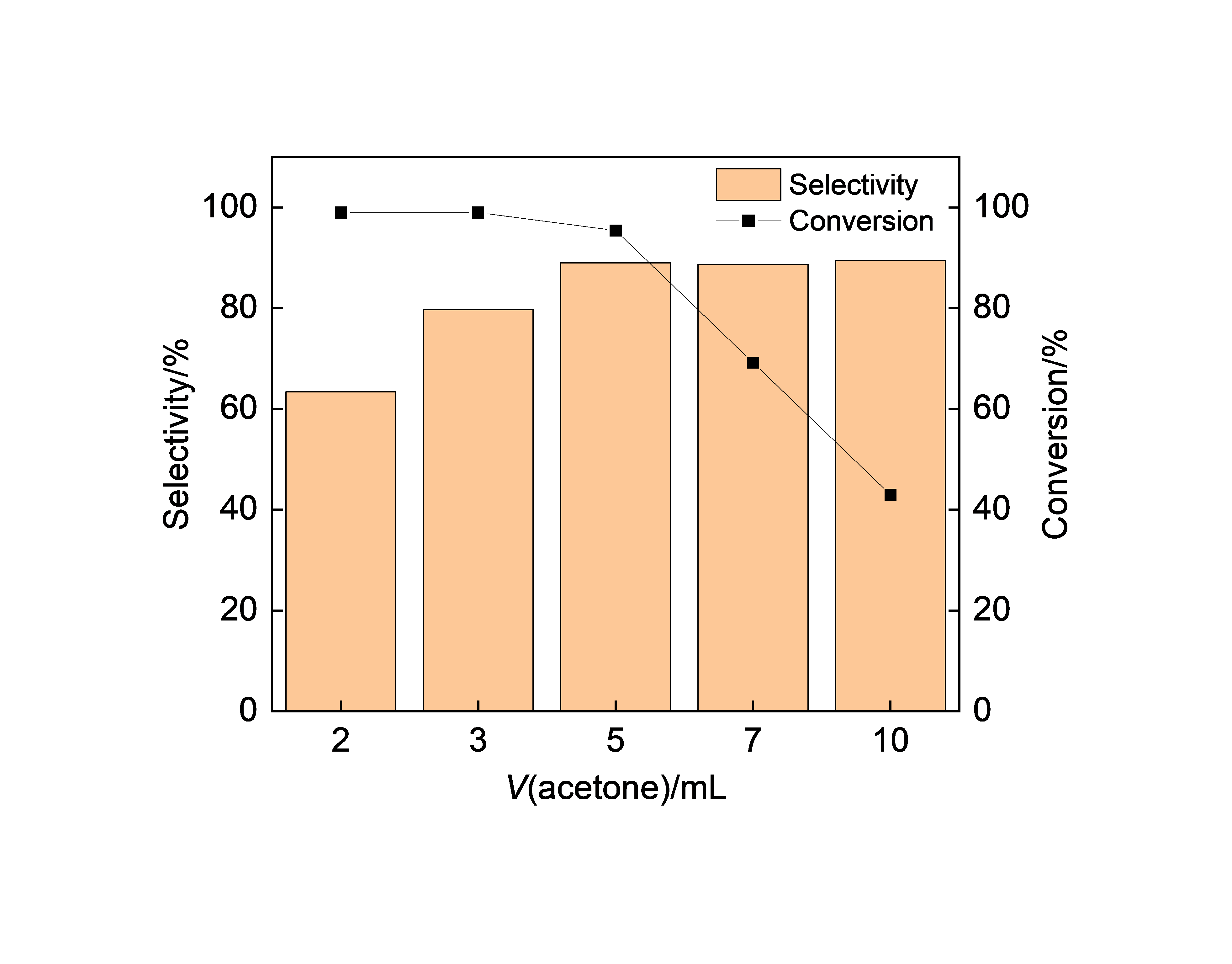
| Acetone | 95.4 | 89.0 | 3.5 | 3.5 | 4.0 |
| Solvent | Conv./% | Selectivity/% | |||
|---|---|---|---|---|---|
| | | | | ||
| DMF | 56.7 | 42.7 | 54.8 | 1.4 | 1.1 |
| MeCN | 90.5 | 74.4 | 7.5 | 7.9 | 10.2 |
| EtOH | 89.5 | 81.5 | 1.8 | 6.6 | 10.1 |
| t-BuOH | 72.3 | 83.2 | 2.5 | 5.7 | 8.6 |
| Acetone | 95.4 | 89.0 | 3.5 | 3.5 | 4.0 |
| Entry | Catalyst | Conv./% | Sel./% |
|---|---|---|---|
| 1 | Nb2O5 | 17.1 | 58.6 |
| 2 | Nb2O5/CNx | 56.6 | 84.4 |
| 3 | Nb2O5/mSiO2 | 84.1 | 89.2 |
| 4 | Nb2O5/CNx@mSiO2b | 94.0 | 92.1 |
| 5 | Nb2O5/CNx@mSiO2c | 76.2 | 94.9 |
| 6 | Nb2O5/CNx@mSiO2d | 66.7 | 94.7 |
| Entry | Catalyst | Conv./% | Sel./% |
|---|---|---|---|
| 1 | Nb2O5 | 17.1 | 58.6 |
| 2 | Nb2O5/CNx | 56.6 | 84.4 |
| 3 | Nb2O5/mSiO2 | 84.1 | 89.2 |
| 4 | Nb2O5/CNx@mSiO2b | 94.0 | 92.1 |
| 5 | Nb2O5/CNx@mSiO2c | 76.2 | 94.9 |
| 6 | Nb2O5/CNx@mSiO2d | 66.7 | 94.7 |
| Entry | Catalyst | Experiment condition | Conv./% | Sel./% | Recycle number | Ref. |
|---|---|---|---|---|---|---|
| 1 | Co@MCM(F) | MeCN, 60 ℃, 3 h | 45.2 | 80.7 | 1 | [ |
| 2 | R-Ti-MWW-PI | MeCN, 60 ℃, 2 h | 97.8 | 99.9 | 6 | [ |
| 3 | TS-1_P-0.05K | MeOH, 40 ℃, 2 h | 52.0 | 98.2 | 5 | [ |
| 4 | Mg0.5Co0.5Fe2O4 | 1,4-Dioxane, 60 ℃, 8 h | 95.2 | 96.3 | 5 | [ |
| 5 | SBA-15-ImCl-PF6-W | No solvent, 35 ℃, 3 h | 53.0 | 99.0 | 7 | [ |
| 6 | Nb2O5/CNx@mSiO2 | Acetone, 35 ℃, 4 h | 94.0 | 92.1 | 3 | This work |
| Entry | Catalyst | Experiment condition | Conv./% | Sel./% | Recycle number | Ref. |
|---|---|---|---|---|---|---|
| 1 | Co@MCM(F) | MeCN, 60 ℃, 3 h | 45.2 | 80.7 | 1 | [ |
| 2 | R-Ti-MWW-PI | MeCN, 60 ℃, 2 h | 97.8 | 99.9 | 6 | [ |
| 3 | TS-1_P-0.05K | MeOH, 40 ℃, 2 h | 52.0 | 98.2 | 5 | [ |
| 4 | Mg0.5Co0.5Fe2O4 | 1,4-Dioxane, 60 ℃, 8 h | 95.2 | 96.3 | 5 | [ |
| 5 | SBA-15-ImCl-PF6-W | No solvent, 35 ℃, 3 h | 53.0 | 99.0 | 7 | [ |
| 6 | Nb2O5/CNx@mSiO2 | Acetone, 35 ℃, 4 h | 94.0 | 92.1 | 3 | This work |
| [1] |
doi: 10.1134/S0965544112050088 |
| [2] |
doi: 10.1016/j.apcata.2004.12.029 |
| [3] |
doi: 10.1016/j.jorganchem.2019.121073 |
| [4] |
doi: 10.3389/fchem.2020.585347 |
| [5] |
doi: 10.3390/catal12101241 |
| [6] |
doi: 10.1016/j.apcatb.2022.121461 |
| [7] |
doi: 10.1016/j.cattod.2018.04.002 |
| [8] |
doi: 10.1002/chem.v25.16 |
| [9] |
doi: 10.1021/acs.langmuir.1c00893 |
| [10] |
|
| [11] |
|
| [12] |
doi: 10.1016/j.catcom.2023.106754 |
| [13] |
doi: 10.1016/j.jcis.2024.03.076 |
| [14] |
doi: 10.1039/C7GC00298J |
| [15] |
doi: 10.1002/cctc.v9.23 |
| [16] |
doi: 10.1039/C9CY01398A |
| [17] |
doi: 10.1016/j.cattod.2022.08.021 |
| [18] |
doi: 10.1016/j.jcis.2023.12.069 |
| [19] |
doi: 10.1039/C8CC03267J |
| [20] |
doi: 10.1039/D1NR05695F |
| [21] |
doi: 10.1016/j.apsusc.2021.151829 |
| [22] |
doi: 10.1016/j.indcrop.2022.115140 |
| [23] |
doi: 10.1016/j.cej.2023.143110 |
| [24] |
doi: 10.1039/D3TA07853A |
| [25] |
doi: 10.1021/acs.chemrev.6b00374 |
| [26] |
doi: 10.1021/acscatal.7b02335 |
| [27] |
|
| [28] |
doi: 10.15376/biores |
| [29] |
doi: 10.1016/j.fuel.2022.124400 |
| [30] |
doi: 10.1039/D1NJ02427B |
| [31] |
doi: 10.1016/j.cjche.2022.07.004 |
| [32] |
|
| [33] |
doi: 10.1016/j.materresbull.2024.112927 |
| [34] |
doi: 10.1002/slct.v1.20 |
| [35] |
doi: 10.1002/slct.v6.9 |
| [1] | Congying Guo, Rui Gao, Qian Li, Hui Wang, Danwei Zhang, Wei Zhou, Zhan-Ting Li. Self-Assembly of Highly Stable Nanoparticles by Amphiphilic Glycolurils for Efficient Intracellular Short DNA Delivery [J]. Chinese Journal of Organic Chemistry, 2025, 45(8): 2945-2952. |
| [2] | Huimin Ma, Yuhan Zhao, Yewei Huang, Lingbin Kong. Chemoselective Green Synthesis of Cyanoepoxides in Aqueous Solvents [J]. Chinese Journal of Organic Chemistry, 2025, 45(8): 2867-2875. |
| [3] | Bo Cao, Xiang Wen, Jie Chen, Bin Wang. “Click” Tetradentate Nitrogen Donor Ligands for Nonheme Iron-Catalyzed Asymmetric Epoxidation Reactions [J]. Chinese Journal of Organic Chemistry, 2025, 45(12): 4490-4496. |
| [4] | Biao Han, Yaoyao Zhang, Shuhan Chen, Mengge Zhao, Nan Li, Weishuang Li, Lei Zhu. Preparation of Axially Grafted Temperature-Responsive Chiral Salen MnIII and Application in Asymmetric Epoxidation of Olefins in Water [J]. Chinese Journal of Organic Chemistry, 2023, 43(1): 244-253. |
| [5] | Weiwei Wang, Yu Zhao, Xinlei Liu, Jiazhen Jiang, Ming'an Wang. Synthesis and Antifungal Activity of 3-Aryl-7-methyl- 7-hydroxy-2-octen-6-olide [J]. Chinese Journal of Organic Chemistry, 2021, 41(6): 2343-2353. |
| [6] | Hongbo Dong, Weiwei Wang, Yu Zhao, Xinlei Liu, Ming'an Wang. Synthesis and Antifungal Activity of 3,7-Dimethyl-7-hydroxy-2-octen-6-olide Analogues [J]. Chinese Journal of Organic Chemistry, 2021, 41(4): 1646-1657. |
| [7] | Gucheng Yuan, Jiawei Liu, Shihang Yu, Chaonan Yuan, Qinghua Bian, Min Wang, Jiangchun Zhong. Asymmetric Synthesis of (3Z,6Z,9S,10R)-9,10-Epoxy-3,6-heneicosadiene, Sex Pheromone Component of Hyphantria cunea [J]. Chinese Journal of Organic Chemistry, 2021, 41(11): 4437-4443. |
| [8] | Qi Lianshan, Wang Tao, Wei Yongmei, Tian Hengshui. Study on the Effect of Co-reductant Aldehydes on Epoxidation of Propylene Catalyzed by Metalloporphyrins [J]. Chinese Journal of Organic Chemistry, 2020, 40(5): 1305-1309. |
| [9] | Sun Moran, Dai Lei, Yang Hua, Liu Hongmin, Yu Dequan. Enantioselective Synthesis of Core Structures of Hydramicromelins A, B and C [J]. Chin. J. Org. Chem., 2018, 38(9): 2443-2449. |
| [10] | Zhu Qingying, Shen Haimin, Ji Hongbing. Asymmetric Epoxidation of trans-Chalcone by H2O2 Induced by β-Cyclodextrin Derivatives in Water [J]. Chin. J. Org. Chem., 2016, 36(8): 1907-1914. |
| [11] | Zou Xiaochuan, Shi Kaiyun, Li Jun, Wang Yue, Wang Cun, Deng Chaofang, Ren Yanrong, Tan Jun, Fu Xiangkai. Research Progress on Epoxidation of Olefins Catalyzed by Mn(II, III, V) in Different Valence States [J]. Chin. J. Org. Chem., 2016, 36(8): 1765-1778. |
| [12] | Zhang Jian, Wang Heng, Ren Shaobo, Zhang Wenxia, Liu Yunkui. Cu(0)/Selectfluor System-Catalyzed Epoxidation of Chalcone Compounds [J]. Chin. J. Org. Chem., 2015, 35(12): 2650-2654. |
| [13] | Ji Li, Liu Jinqiang, Qian Chao, Chen Xinzhi. Advances in the Application of Urea-Hydrogen Peroxide to Oxidation Reactions [J]. Chin. J. Org. Chem., 2012, 32(02): 254-265 . |
| [14] | ZHAO Bang-Tun, WU Sheng-Jiang, YE Bao-Xian. Synthesis and Properties of Amphiphilic Tetrathiafulvalene Derivatives [J]. Chin. J. Org. Chem., 2011, 31(07): 1027-1031. |
| [15] | WANG Qiao-Feng, CHEN Hui, LIU Feng, WANG Quan-Jun, WANG Xu-Guo, ZHANG Sheng-Yong. Asymmetric Epoxidation of α,β-Enones Catalyzed by Chiral Amine Salts [J]. Chin. J. Org. Chem., 2009, 29(10): 1617-1620. |
| Viewed | ||||||
|
Full text |
|
|||||
|
Abstract |
|
|||||
