

Chinese Journal of Organic Chemistry ›› 2026, Vol. 46 ›› Issue (4): 1146-1165.DOI: 10.6023/cjoc202512019 Previous Articles Next Articles
REVIEWS
叶富a, 袁伟明b,*( )
)
收稿日期:2025-12-16
修回日期:2026-01-24
发布日期:2026-02-06
通讯作者:
袁伟明
基金资助:
Fu Yea, Weiming Yuanb,*()
Received:2025-12-16
Revised:2026-01-24
Published:2026-02-06
Contact:
Weiming Yuan
Supported by:Share
Fu Ye, Weiming Yuan. Recent Advances in Dicarbofunctionalization of Alkynes via Photoredox Catalysis[J]. Chinese Journal of Organic Chemistry, 2026, 46(4): 1146-1165.
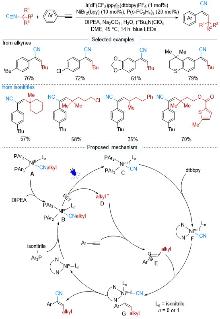
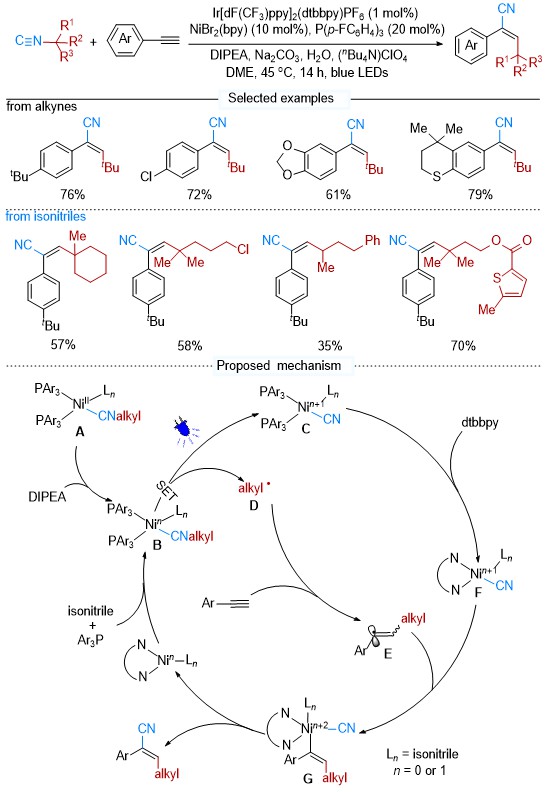
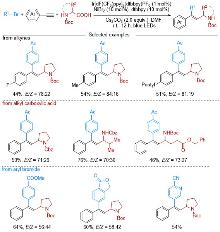
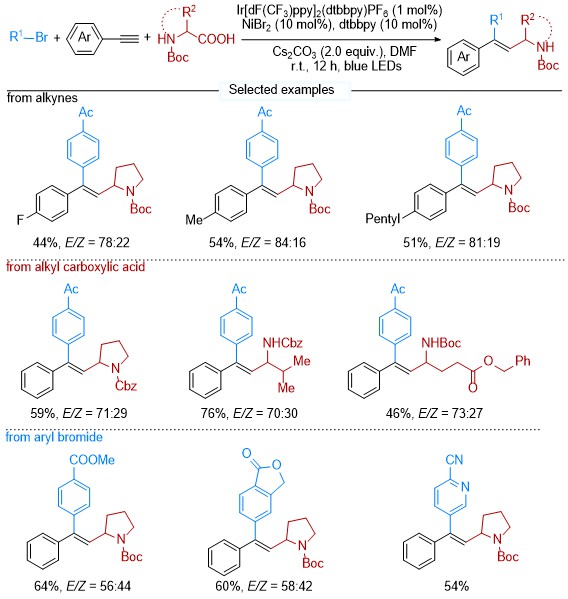
| [1] |
(a)
|
|
(b)
|
|
|
(c)
|
|
|
(d)
|
|
|
(e)
|
|
| [2] |
(a)
|
|
(b)
|
|
|
(c)
|
|
| [3] |
(a)
|
|
(b)
|
|
|
(c)
|
|
| [4] |
(a)
|
|
(李康葵, 龙先扬, 黄岳, 祝诗发, 化学学报, 2024, 82, 658.)
|
|
|
(b)
|
|
| [5] |
(a)
|
|
(b)
|
|
|
(c)
|
|
|
(d)
|
|
| [6] |
(a)
|
|
(b)
|
|
|
(c)
|
|
|
(徐磊, 王方, 陈凡, 朱圣卿, 储玲玲, 有机化学, 2022, 42, 1.)
|
|
| [7] |
(a)
|
|
(b)
|
|
|
(c)
|
|
|
(平媛媛, 宋海霞, 孔望清, 有机化学, 2022, 42, 3302.)
|
|
|
(d)
|
|
|
(e)
|
|
|
(f)
|
|
|
(g)
|
|
| [8] |
|
| [9] |
(a)
|
|
(b)
|
|
|
(c)
|
|
|
(d)
|
|
| [10] |
(a)
|
|
(b)
|
|
|
(c)
|
|
|
(d)
|
|
| [11] |
|
| [12] |
|
| [13] |
(a)
|
|
(b)
|
|
| [14] |
|
| [15] |
|
| [16] |
|
| [17] |
(a)
|
|
(b)
|
|
| [18] |
|
| [19] |
(a)
|
|
(b)
|
|
|
(c)
|
|
|
(d)
|
|
|
(e)
|
|
|
(乐柏佟, 吴新鑫, 朱晨, 有机化学, 2022, 42, 458.)
|
|
|
(f)
|
|
|
(g)
|
|
|
(h)
|
|
| [20] |
|
| [21] |
|
| [22] |
|
| [23] |
|
| [24] |
|
| [25] |
(a)
|
|
(b)
|
|
|
(c)
|
|
| [26] |
|
| [27] |
|
| [28] |
(a)
|
|
(b)
|
|
|
(c)
|
|
| [29] |
|
| [30] |
|
| [31] |
|
| [32] |
(a)
|
|
(b)
|
|
| [33] |
|
| [34] |
|
| [35] |
(a)
|
|
(b)
|
|
| [36] |
|
| [37] |
|
| [38] |
|
| [39] |
|
| [40] |
|
| [1] | Lingxu Meng, Lin Shen, Xiangling Luo, Yumei Lin, Lei Gong. Design of Photoactive Cr- and Co-Based Complexes and Their Applications in Organic Synthesis [J]. Chinese Journal of Organic Chemistry, 2026, 46(4): 1513-1528. |
| [2] | Yixi Zhang, Lijuan Pang, Huawen Huang. Visible-Light-Induced Aerobic Dehydrogenative Couplings of Quinoxalin-2(1H)-ones with Aldehydes [J]. Chinese Journal of Organic Chemistry, 2026, 46(4): 1730-1738. |
| [3] | Shuilin Liu, Pu Chen, Jing He, Ning Liu, Huawen Huang. Recent Advances in Transition Metal-Catalyzed Radical-Mediated Selective Difunctionalization of 1,3-Dienes [J]. Chinese Journal of Organic Chemistry, 2026, 46(4): 1330-1359. |
| [4] | Liwei Zhao, Liang Zhang, Peng Hu. Hydrogen Atom Transfer-Induced Functional Group Migration [J]. Chinese Journal of Organic Chemistry, 2026, 46(4): 1284-1302. |
| [5] | Xinyu Liang, Chunchun Mi, Fujun Guo, Wenbin Xie, Qinqin Shi, Hui Huang. Desulfinative Cross-Coupling of Aryl Sodium Sulfinate with Aryl Sulfonium Salts [J]. Chinese Journal of Organic Chemistry, 2026, 46(3): 1000-1007. |
| [6] | Yingjie Liu, Laisheng Min, Ruirong Yang, Dongxue Song, Rui Peng, Deqiang Liang. CuI-Catalyzed C—C Bond Coupling Reaction for the Construction of 2-Carbonyl-1,4-diketones [J]. Chinese Journal of Organic Chemistry, 2026, 46(2): 603-611. |
| [7] | Tianjiao Han, Qianqian Shi, Yundong Fu, Guangjian Mei. Regio-reversed [3+2] Cycloaddition of Triketone Enones with Nitrones [J]. Chinese Journal of Organic Chemistry, 2026, 46(1): 146-155. |
| [8] | Huanle Li, Qi Pan, Shaojie Lou, Yangjie Mao, Danqian Xu. Recent Advances in Selective C—H Bond Functionalization of Amines Through Hydrogen Atom Transfer (HAT) Process [J]. Chinese Journal of Organic Chemistry, 2025, 45(9): 3213-3243. |
| [9] | Yinsheng Miao, Lei Zhang, Jianqi Chen, Lili Wang, Zheng Duan. Synthesis of Pyrazolo(iso)quinoline Derivatives from Aryl Alkynes and N-Imine(iso)quinoline Ylides Catalyzed by Bisphosphonium Salt [J]. Chinese Journal of Organic Chemistry, 2025, 45(8): 2876-2884. |
| [10] | Lanxing Ren, A'na Xu, Xilin Xiao, Hengzhi You, Lijuan Song. Theoretical Study on the Solvent Effect on the Enantioselectivity of Iridium-Catalyzed Asymmetric Hydrogenation Reactions [J]. Chinese Journal of Organic Chemistry, 2025, 45(8): 2904-2912. |
| [11] | Ming Chen, Jing Zhang. Recent Progress in Traceless Directed Functionalization Reactions of Arylcarboxylic Acids [J]. Chinese Journal of Organic Chemistry, 2025, 45(8): 2660-2676. |
| [12] | Shuang Wang, Yangjie Mao, Shaojie Lou, Danqian Xu. Recent Advances in Asymmetric C—H Bond Functionalization Using Oxidizing Directing Groups [J]. Chinese Journal of Organic Chemistry, 2025, 45(6): 1961-1994. |
| [13] | Genwei Gao, Zhen Li, Yan Li, Xi Lu. Recent Progress on the Construction of C(sp2)—C(sp3) Bonds via Photoredox/Nickel Dual Catalysis [J]. Chinese Journal of Organic Chemistry, 2025, 45(6): 1905-1919. |
| [14] | Hui Li, Ablimit Abdukader, Lei Zhou. Radical Denitrogenative Ring Opening of N-Benzyl-benzotriazoles for the Synthesis of 6-Substituted Phenanthridines under Visible Light Conditions [J]. Chinese Journal of Organic Chemistry, 2025, 45(5): 1770-1777. |
| [15] | Feng Lin, Yan Zhang, Ming Wu, Huiyan Liu, Wen-Juan Hao, Bo Jiang. Visible-Light-Induced Annulative Acylative Difunctionalization of 1,6-Enynes for Accessing 1-Indanones [J]. Chinese Journal of Organic Chemistry, 2025, 45(5): 1729-1738. |
| Viewed | ||||||
|
Full text |
|
|||||
|
Abstract |
|
|||||
