

化学学报 ›› 2025, Vol. 83 ›› Issue (5): 535-550.DOI: 10.6023/A24120390 上一篇
综述
胡博a, 肖霞a,*( ), 王鹏a,b, 束小龙a, 卞梦琪a, 王健捷a, 赵震a,b,*()
投稿日期:2024-12-31
发布日期:2025-04-16
作者简介: |
胡博, 本科生, 就读于沈阳师范大学化学化工学院, 主要从事分子筛多孔材料合成、二氧化碳烷烃耦合转化方面的研究工作. |
 |
肖霞, 博士, 沈阳师范大学化学化工学院副教授, 硕士研究生导师, 主要从事分子筛多孔材料的合成及其能源催化方面的研究工作. 主持国家自然科学基金、辽宁省自然科学基金等各类科研项目7项, 参与科技部重点研发计划、国家自然科学基金重大重点项目、中石油重大科技专项等5项. 已在ACS Catal., Chem. Commun., Micropor. Mesopor. Mat.和中国科学: 化学等国内外学术期刊上发表论文30余篇, 参编《炼油稀土催化》、《化学: 中心科学》和《Heterogeneous Catalysis for Sustainable Energy》著作3部. 荣获辽宁省研究生教学成果奖特等奖、辽宁省高等学校本科教学成果二等奖和沈阳市自然科学学术成果奖等. 入选辽宁省“百千万人才工程”万人层次, 沈阳市中青年科技创新人才支持计划, 沈阳市拔尖人才. |
 |
赵震, 教育部国家级高层次人才; 中国石油大学(北京)教授, 博士生导师; 沈阳师范大学特聘教授、沈阳师范大学化学化工学院院长, 能源与环境催化研究所所长. 中国科协“一带一路”国际联合能源与环境催化研究中心主任; 辽宁省高校重大科技平台“能源与环境催化工程技术研究中心”主任. 现兼任中国化学会催化专业委员会委员; 中国稀土学会常务理事和催化专业委员会副主任; 中国能源学会副会长和能源与环境专业委员会主任等多个学术兼职. 入选国际先进材料协会(IAAM)Fellow、国际VEBLEO学会组织Fellow、教育部“长江学者奖励计划”特聘教授、“新世纪百千万人才”国家级人选、“国务院政府特殊津贴”专家、辽宁杰出科技工作者、辽宁省高校攀登学者、辽宁省普通高等学校本科教学名师、辽宁省教书育人模范、辽宁省学术头雁、辽宁省优秀科技工作者、辽宁省课程思政教学名师、沈阳市十大科技英才、沈阳市优秀专家、沈阳市杰出人才等荣誉称号. 主要从事能源与环境催化、稀土催化、催化新材料等方面的研发工作. 主持科技部重点研发计划项目、863主题(专题)项目课题、国家自然科学基金重大研究计划集成、重点项目、国家自然科学基金重点项目等国家级项目(课题)19项; 省市级各类项目30余项; 已在Nature Commun., PNAS, Angew. Chem. Int. Ed., Energy & Environment. Science, AICHE J., Appl. Catal. B: Environment, ACS Catal., J. Catal.和中国科学: 化学等国内外知名学术期刊上发表SCI论文600余篇, 引用23300多次, H因子81 (Scopus); 2014~2024年连续11年入选爱思唯尔公司公布的中国高被引学者榜单(化学工程与技术). 荣获国际纯粹与应用化学联合会(IUPAC)新材料及其合成杰出贡献奖、湖北省科学技术自然科学奖二等奖、中国稀土科学技术奖一等奖、中国化工学会基础研究成果一等奖、侯德榜化工科技奖创新奖、辽宁省高等学校本科教学成果一等奖、二等奖及辽宁省研究生教学成果奖特等奖等多项教学科研奖励. |
基金资助:
Bo Hua, Xia Xiaoa,*(), Peng Wanga,b, Xiaolong Shua, Mengqi Biana, Jianjie Wanga, Zhen Zhaoa,b,*()
Received:2024-12-31
Published:2025-04-16
Contact:
* E-mail: Supported by:文章分享

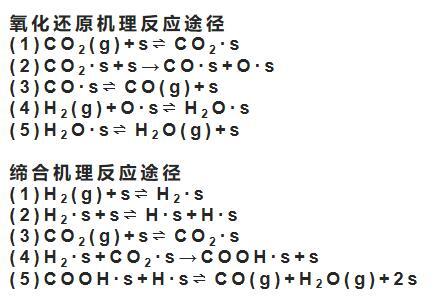
二氧化碳(CO2)作为温室效应的主要贡献者, 同时也是廉价且丰富的碳资源. 通过CO2加氢合成低碳烯烃, 不仅能够实现CO2的资源化利用, 还能减少低碳烯烃生产对石油资源的依赖, 具有重要的环境和经济意义. 本文综述了铁基(Fe基)催化剂催化CO2加氢制低碳烯烃的研究进展与反应机理(CO2-FTS路径和CO2-甲醇路径), 详细归纳了双金属活性组分(Fe-Co、Fe-Ni、Fe-Ru等)、载体(金属氧化物、金属有机骨架化合物、碳材料、分子筛等)、助剂(碱金属、碱土金属、过渡金属及其氧化物、稀土金属、生物助剂等)以及制备方法和条件对CO2-FTS路径中铁基催化剂活性和选择性的影响规律, 探讨了铁基催化剂在反应过程中活性位点的结构演变规律(如Fe3O4、Fe5C2等), 分析了影响催化剂性能的组成与结构因素. 重点阐述了CO2-FTS路径中逆水煤气变换(RWGS)反应的氧化还原路径和缔合路径, 以及费托合成(FTS)反应中表面碳化物机理、表面烯醇机理和CO插入机理三种可能的作用机制. 最后对CO2加氢制低碳烯烃铁基催化剂的研究方向进行了展望, 提出了未来可能的研究趋势与挑战, 以期为设计和合成用于CO2加氢制取高价值化学品的高效催化剂提供科学指导.
胡博, 肖霞, 王鹏, 束小龙, 卞梦琪, 王健捷, 赵震. 二氧化碳加氢制低碳烯烃Fe基催化剂研究进展[J]. 化学学报, 2025, 83(5): 535-550.
Bo Hu, Xia Xiao, Peng Wang, Xiaolong Shu, Mengqi Bian, Jianjie Wang, Zhen Zhao. Advances in Fe-based Catalysts for the Hydrogenation of CO2 to Light Olefins[J]. Acta Chimica Sinica, 2025, 83(5): 535-550.
| Entry | Catalysts | CO2 Conversion/% | CO Selectivity/% | Hydrocarbon distributiona/% | GHSV/ (mL•g-1•h-1) | Temperature./℃ | Pressure/ MPa | Ref. | |||
|---|---|---|---|---|---|---|---|---|---|---|---|
| CH4 | C20~C40 | C2=~C4= | C5+ | ||||||||
| 1 | Co-Fe | 31.4 | — | 20.4 | 57.3 | 22.3 | 9600 | 320 | 1 | [ | |
| 2 | Na/Fe@CoCo-3 | 50.3 | 4.6 | 13.9 | 41.3 | 44.8 | — | 330 | 3 | [ | |
| 3 | Fe-Co(0.17)/K(1.0) | 31.0 | 18.0 | 15.9 | 84.1 | 3600 | 300 | 1.1 | [ | ||
| 4 | Ni/Fe=1:99 | 32.6 | 89.1 | 57.0 | 7.4 | 35.6 | 0 | 5000 | 350 | — | [ |
| 5 | CM-Al2O3 | 41.0 | 12.4 | 33.7 | 6.4 | 41.1 | 18.7 | — | 320 | 2 | [ |
| 6 | Fe/CeO2 rods | 20.6 | 61.2 | 80.6 | 6.2 | 12.3 | 0.6 | 1600 | 390 | — | [ |
| 7 | Fe(12.9) | 12.8 | 49.5 | 67.7 | 28.5 | 1.4 | 2.4 | 18000 | 320 | 3 | [ |
| 8 | Fe/ZrO2 | 42 | 15 | 20.0 | 8.2 | 46.0 | 26.8 | 1200 | 340 | 2 | [ |
| 9 | N-600-0 | 46 | 17.5 | 32.2 | 17.6 | 23.3 | 26.9 | 3600 | 400 | 3 | [ |
| 10 | Fe/C-K@NC-350/500 | 35.1 | 28.1 | 23.8 | 7.9 | 37.7 | 30.6 | 5000 | 340 | 3 | [ |
| 11 | 40FeK/SMC | 44.7 | 85.5 | 4.8 | 6.5 | 13.6 | 75.1 | — | 260 | 2 | [ |
| 12 | Fe-K/HPCMs1 | 33.4 | 38.9 | 22.1 | 18.8 | 29.5 | 29.6 | 3600 | 400 | 3 | [ |
| 13 | IO@gC-1.0 | 21.9 | 78.3 | 50.5 | 46.3 | 3.2 | — | 370 | — | [ | |
| 14 | FeNa/EG-A | 42.4 | 8.3 | 12.6 | 7.8 | 38.0 | 41.6 | 2000 | 320 | 3 | [ |
| 15 | Fe-Cu-K/ZSM-5(Si/Al=25) | 37.7 | 80.7 | 18.3 | 24.9 | 56.8 | 2000 | 300 | 1 | [ | |
| 16 | Mn15Na32im | 31.9 | 97.2 | 12.4 | 6.2 | 33.0 | 48.4 | 11000 | 320 | 1.5 | [ |
| 17 | IWI200 | 22.4 | 17.8 | 46.3 | 33.0 | 7.8 | 12.9 | 36000 | 300 | — | [ |
| 18 | 3% (w) Rb/Fe3O4 | 39.7 | 8.1 | 19.5 | 4.4 | 47.4 | 28.7 | 2500 | 300 | 0.5 | [ |
| 19 | FeMnZr4K | 39.0 | 81.5 | 15.4 | 4.7 | 28.4 | 51.5 | 12000 | 320 | 1 | [ |
| 20 | 1Fe-1Zn-K | 51.0 | 6.0 | 34.9 | 7.8 | 53.6 | 3.7 | 1000 | 300 | 0.5 | [ |
| 21 | 5Mn-Na/Fe | 38.6 | 11.7 | 13.5 | 4.6 | 34.6 | 47.2 | 2040 | 320 | 3 | [ |
| 22 | 0.14Mn/Fe3O4-NaAc | 27.0 | 26.8 | 14.4 | 6.4 | 40.3 | 38.9 | — | 320 | 0.5 | [ |
| 23 | FeMnNd | 49.3 | 74.9 | 20.2 | 9.1 | 36.0 | 34.3 | 4000 | 300 | 1 | [ |
| 24 | 20Fe0.5Cu0.5Nd/MOR | 23.3 | 28.3 | 34.9 | 27.1 | 25.4 | 12.6 | — | 350 | 1 | [ |
| 25 | 35Fe-7Zr-1Ce-K | 57.34 | 3.05 | 20.64 | 7.86 | 55.62 | 15.87 | 1000 | 320 | 2 | [ |
| 26 | Fe@C-1.0 | 52.3 | 92.6 | 8.5 | 4.2 | 26.0 | 61.3 | 3000 | 300 | 2 | [ |
| Entry | Catalysts | CO2 Conversion/% | CO Selectivity/% | Hydrocarbon distributiona/% | GHSV/ (mL•g-1•h-1) | Temperature./℃ | Pressure/ MPa | Ref. | |||
|---|---|---|---|---|---|---|---|---|---|---|---|
| CH4 | C20~C40 | C2=~C4= | C5+ | ||||||||
| 1 | Co-Fe | 31.4 | — | 20.4 | 57.3 | 22.3 | 9600 | 320 | 1 | [ | |
| 2 | Na/Fe@CoCo-3 | 50.3 | 4.6 | 13.9 | 41.3 | 44.8 | — | 330 | 3 | [ | |
| 3 | Fe-Co(0.17)/K(1.0) | 31.0 | 18.0 | 15.9 | 84.1 | 3600 | 300 | 1.1 | [ | ||
| 4 | Ni/Fe=1:99 | 32.6 | 89.1 | 57.0 | 7.4 | 35.6 | 0 | 5000 | 350 | — | [ |
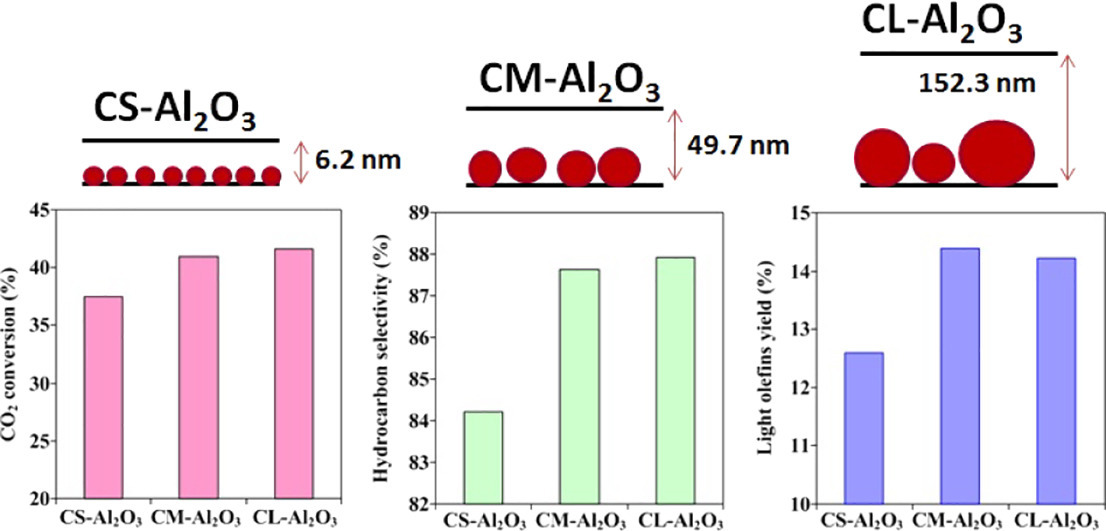
| 5 | CM-Al2O3 | 41.0 | 12.4 | 33.7 | 6.4 | 41.1 | 18.7 | — | 320 | 2 | [ |
| 6 | Fe/CeO2 rods | 20.6 | 61.2 | 80.6 | 6.2 | 12.3 | 0.6 | 1600 | 390 | — | [ |
| 7 | Fe(12.9) | 12.8 | 49.5 | 67.7 | 28.5 | 1.4 | 2.4 | 18000 | 320 | 3 | [ |
| 8 | Fe/ZrO2 | 42 | 15 | 20.0 | 8.2 | 46.0 | 26.8 | 1200 | 340 | 2 | [ |
| 9 | N-600-0 | 46 | 17.5 | 32.2 | 17.6 | 23.3 | 26.9 | 3600 | 400 | 3 | [ |
| 10 | Fe/C-K@NC-350/500 | 35.1 | 28.1 | 23.8 | 7.9 | 37.7 | 30.6 | 5000 | 340 | 3 | [ |
| 11 | 40FeK/SMC | 44.7 | 85.5 | 4.8 | 6.5 | 13.6 | 75.1 | — | 260 | 2 | [ |
| 12 | Fe-K/HPCMs1 | 33.4 | 38.9 | 22.1 | 18.8 | 29.5 | 29.6 | 3600 | 400 | 3 | [ |
| 13 | IO@gC-1.0 | 21.9 | 78.3 | 50.5 | 46.3 | 3.2 | — | 370 | — | [ | |
| 14 | FeNa/EG-A | 42.4 | 8.3 | 12.6 | 7.8 | 38.0 | 41.6 | 2000 | 320 | 3 | [ |
| 15 | Fe-Cu-K/ZSM-5(Si/Al=25) | 37.7 | 80.7 | 18.3 | 24.9 | 56.8 | 2000 | 300 | 1 | [ | |
| 16 | Mn15Na32im | 31.9 | 97.2 | 12.4 | 6.2 | 33.0 | 48.4 | 11000 | 320 | 1.5 | [ |
| 17 | IWI200 | 22.4 | 17.8 | 46.3 | 33.0 | 7.8 | 12.9 | 36000 | 300 | — | [ |
| 18 | 3% (w) Rb/Fe3O4 | 39.7 | 8.1 | 19.5 | 4.4 | 47.4 | 28.7 | 2500 | 300 | 0.5 | [ |
| 19 | FeMnZr4K | 39.0 | 81.5 | 15.4 | 4.7 | 28.4 | 51.5 | 12000 | 320 | 1 | [ |
| 20 | 1Fe-1Zn-K | 51.0 | 6.0 | 34.9 | 7.8 | 53.6 | 3.7 | 1000 | 300 | 0.5 | [ |
| 21 | 5Mn-Na/Fe | 38.6 | 11.7 | 13.5 | 4.6 | 34.6 | 47.2 | 2040 | 320 | 3 | [ |
| 22 | 0.14Mn/Fe3O4-NaAc | 27.0 | 26.8 | 14.4 | 6.4 | 40.3 | 38.9 | — | 320 | 0.5 | [ |
| 23 | FeMnNd | 49.3 | 74.9 | 20.2 | 9.1 | 36.0 | 34.3 | 4000 | 300 | 1 | [ |
| 24 | 20Fe0.5Cu0.5Nd/MOR | 23.3 | 28.3 | 34.9 | 27.1 | 25.4 | 12.6 | — | 350 | 1 | [ |
| 25 | 35Fe-7Zr-1Ce-K | 57.34 | 3.05 | 20.64 | 7.86 | 55.62 | 15.87 | 1000 | 320 | 2 | [ |
| 26 | Fe@C-1.0 | 52.3 | 92.6 | 8.5 | 4.2 | 26.0 | 61.3 | 3000 | 300 | 2 | [ |








| [1] |
|
| [2] |
|
| [3] |
|
| [4] |
|
| [5] |
|
| [6] |
|
|
(倪泽南, 郭玉鑫, 张启俭, 应用化工, 2023, 52, 2443.)
|
|
| [7] |
|
| [8] |
|
| [9] |
|
| [10] |
|
|
(刘伊伟, 黄健, 陈云霞, 精细石油化工, 2024, 41, 65.)
|
|
| [11] |
|
|
(史建公, 刘志坚, 刘春生, 中外能源, 2019, 24, 59.)
|
|
| [12] |
|
| [13] |
|
| [14] |
|
| [15] |
|
|
(刘歆颖, 邓国才, 郭先芝, 陈荣悌, 燃料化学学报, 1999, 5, 447.)
|
|
| [16] |
|
| [17] |
|
| [18] |
|
| [19] |
|
| [20] |
|
| [21] |
doi: 10.1039/c5cp07788e pmid: 26867109 |
| [22] |
|
| [23] |
|
| [24] |
|
| [25] |
|
| [26] |
|
| [27] |
|
| [28] |
|
| [29] |
|
| [30] |
|
| [31] |
|
|
(黄杰, 艾培培, 郭立升, 孙松, 洁净煤技术, 2025, 31, 145.)
|
|
| [32] |
|
| [33] |
|
| [34] |
|
| [35] |
|
| [36] |
|
| [37] |
|
| [38] |
|
| [39] |
|
| [40] |
doi: 10.1038/s41467-021-26090-5 pmid: 34625554 |
| [41] |
|
| [42] |
|
| [43] |
|
| [44] |
|
| [45] |
doi: 10.1021/acscatal.9b01466 |
| [46] |
|
| [47] |
|
| [48] |
|
| [49] |
|
| [50] |
|
| [51] |
|
| [52] |
|
| [53] |
|
| [54] |
|
| [55] |
|
| [56] |
|
| [57] |
|
| [58] |
|
| [59] |
|
| [60] |
|
| [61] |
|
| [62] |
|
| [63] |
|
| [64] |
|
| [65] |
doi: 10.1016/j.cattod.2020.03.007 |
| [66] |
|
| [67] |
|
| [68] |
|
| [69] |
|
| [70] |
|
| [71] |
|
| [72] |
|
| [73] |
|
| [74] |
|
| [75] |
|
| [76] |
|
| [77] |
|
|
(成康, 张庆红, 康金灿, 王野, 中国科学:化学, 2020, 50, 743.)
|
|
| [78] |
|
|
(梁兵连, 段洪敏, 侯宝林, 苏雄, 黄延强, 王爱琴, 王晓东, 张涛, 化工进展, 2015, 34, 3746.)
doi: 10.16085/j.issn.1000-6613.2015.10.035 |
|
| [79] |
|
| [80] |
|
| [81] |
|
| [82] |
|
|
(贾亦静, 陶金泉, 黄文斌, 刘昊然, 李蓉蓉, 姚荣鹏, 白天瑜, 魏强, 周亚松, 化工进展, 2025, 44, 820.)
doi: 10.16085/j.issn.1000-6613.2024-0201 |
|
| [83] |
|
| [84] |
|
| [85] |
|
| [86] |
|
| [87] |
|
| [88] |
|
| [89] |
|
| [90] |
|
| [91] |
|
| [92] |
|
|
(何孝祥, 顾雄毅, 范琛, 朱贻安, 华东理工大学学报(自然科学版), 2011, 37, 424.)
|
|
| [93] |
|
| [94] |
|
| [95] |
|
| [96] |
|
| [97] |
|
| [1] | 刘珊珊, 董微微, 李珍珍, 张瑶瑶, 李超, 焦林郁. 离子液体调控的串联脱氢环化反应多样性合成生物质基氮杂环[J]. 化学学报, 2025, 83(5): 479-487. |
| [2] | 王瑛琦, 常嘉怡, 李敏, 梁红, 李知恒, 谢文富, 王强. 金属原子表面修饰TiO2光电催化CO2与$NO_{2}^{-}$共还原合成尿素[J]. 化学学报, 2025, 83(3): 247-255. |
| [3] | 王帅, 宋华. 氮修饰Ni2P-Nx/SiO2催化剂设计合成及间甲酚加氢脱氧性能研究[J]. 化学学报, 2024, 82(9): 979-986. |
| [4] | 王力鹏, 曹道帆, 刘雪, 李超, 刘科. 工况条件下富氢气体中CO选择性氧化反应的耐受性调控及作用机制研究[J]. 化学学报, 2024, 82(7): 819-832. |
| [5] | 王海成, 马海燕. 爪形氨基酚氧基锌氯化物催化环氧化物和酸酐共聚研究[J]. 化学学报, 2024, 82(6): 577-588. |
| [6] | 周何鑫, 崔青云, 胡雪敏, 杨文秀, 田肖, 王硕. 金属有机框架衍生氮掺杂碳限域钴原子簇催化硝基化合物转移加氢[J]. 化学学报, 2024, 82(5): 503-510. |
| [7] | 张强, 王欢, 王帅, 王园园, 张梅, 宋华. NiCe(x)/FLRC-TiO2催化剂的制备及其加氢脱氧性能研究[J]. 化学学报, 2024, 82(3): 287-294. |
| [8] | 王成强, 冯超. 亲核性氟源在碳碳不饱和键选择性氟化官能化反应中的应用[J]. 化学学报, 2024, 82(2): 160-170. |
| [9] | 李雅宁, 王晓艳, 唐勇. 自由基聚合的立体选择性调控★[J]. 化学学报, 2024, 82(2): 213-225. |
| [10] | 王镜焱, 马海燕. 2,6-二亚甲基吡啶桥联双(氨基酚氧基)钠、钾配合物的合成及催化外消旋丙交酯开环聚合研究[J]. 化学学报, 2024, 82(10): 1058-1068. |
| [11] | 黄涎廷, 韩洪亮, 肖婧, 王帆, 柳忠全. I2O5/KSCN介导的炔烃碘硫氰化反应[J]. 化学学报, 2024, 82(1): 5-8. |
| [12] | 吴宇晗, 张栋栋, 尹宏宇, 陈正男, 赵文, 匙玉华. “双碳”目标下Janus In2S2X光催化还原CO2的密度泛函理论研究[J]. 化学学报, 2023, 81(9): 1148-1156. |
| [13] | 杨蓉婕, 周璘, 苏彬. 基于共价有机框架修饰电极的维生素A和C的选择性检测★[J]. 化学学报, 2023, 81(8): 920-927. |
| [14] | 陈其文, 张先正. 纳米酶介导的炎性肠道疾病治疗研究进展★[J]. 化学学报, 2023, 81(8): 1043-1051. |
| [15] | 崔国庆, 胡溢玚, 娄颖洁, 周明霞, 李宇明, 王雅君, 姜桂元, 徐春明. CO2加氢制醇类催化剂的设计制备及性能研究进展[J]. 化学学报, 2023, 81(8): 1081-1100. |
| 阅读次数 | ||||||
|
全文 |
|
|||||
|
摘要 |
|
|||||
