

化学学报 ›› 2026, Vol. 84 ›› Issue (3): 333-340.DOI: 10.6023/A25110384 上一篇 下一篇
研究论文
孙庆磊a,†, 张琦a,†, 金延超b, 慈海娜a,c,*( ), 魏振文b,*(), 何燕a,*()
投稿日期:2025-11-26
发布日期:2026-01-20
作者简介:基金资助:
Sun Qingleia, Zhang Qia, Jin Yanchaob, Ci Hainaa,c,*(), Wei Zhenwenb,*(), He Yana,*()
Received:2025-11-26
Published:2026-01-20
Contact:
*E-mail: cihn@qust.edu.cn;
weizhenwen@doright.biz;
heyan@qust.edu.cn
About author:Supported by:文章分享
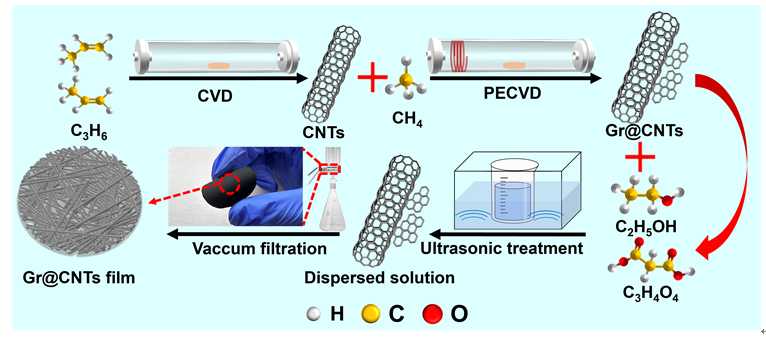
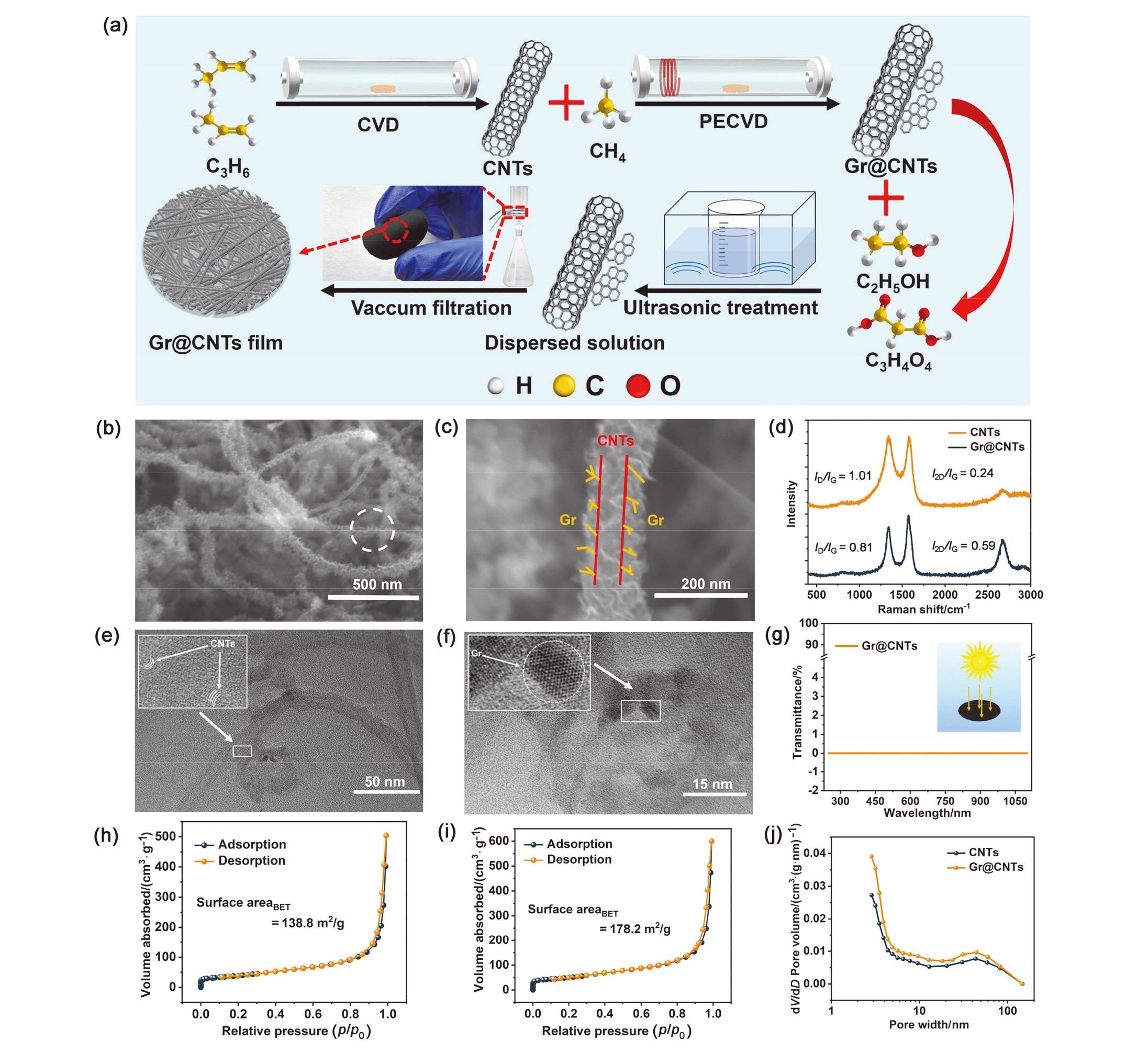
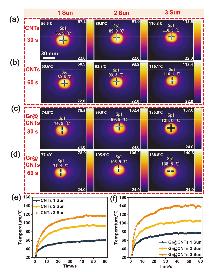
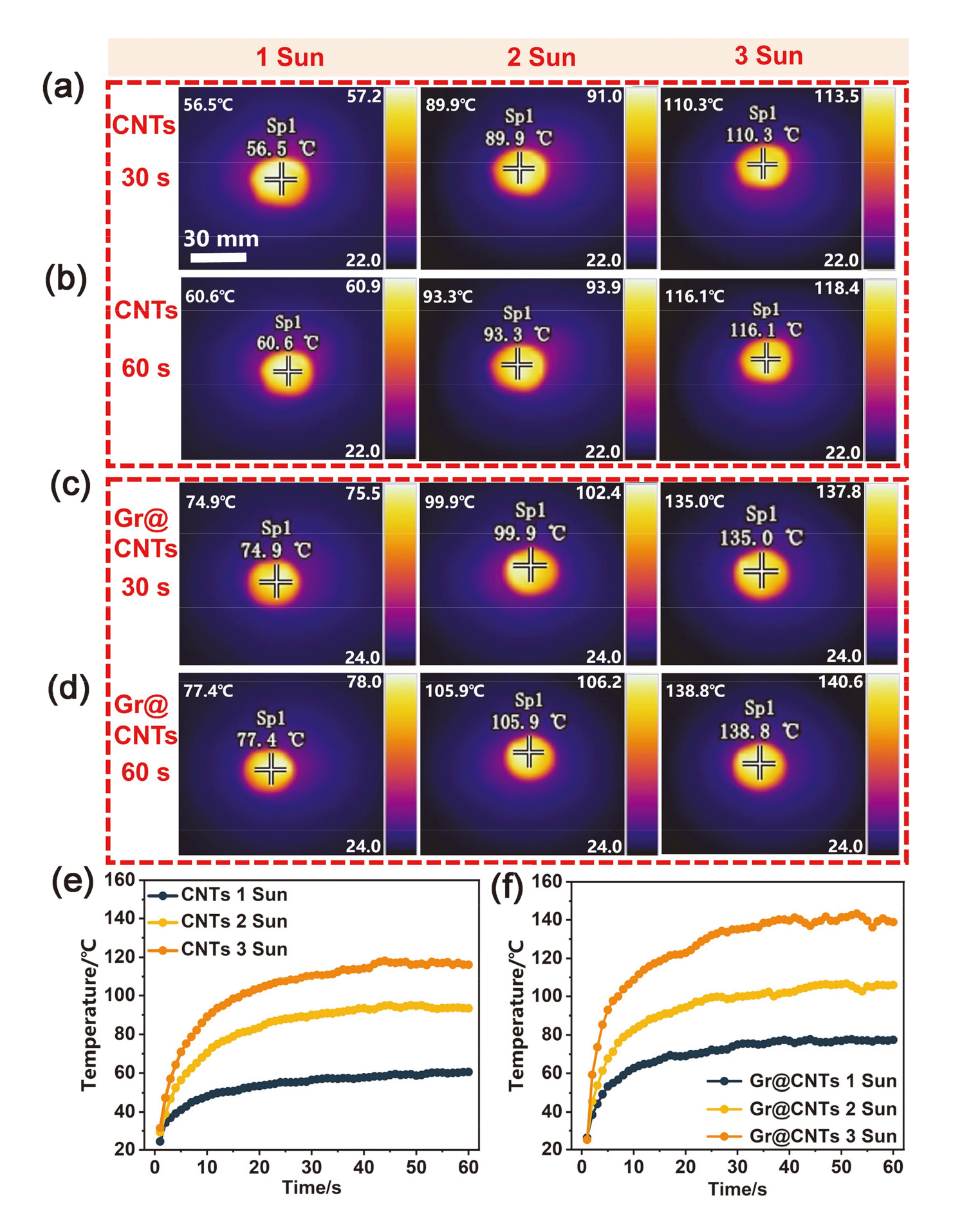
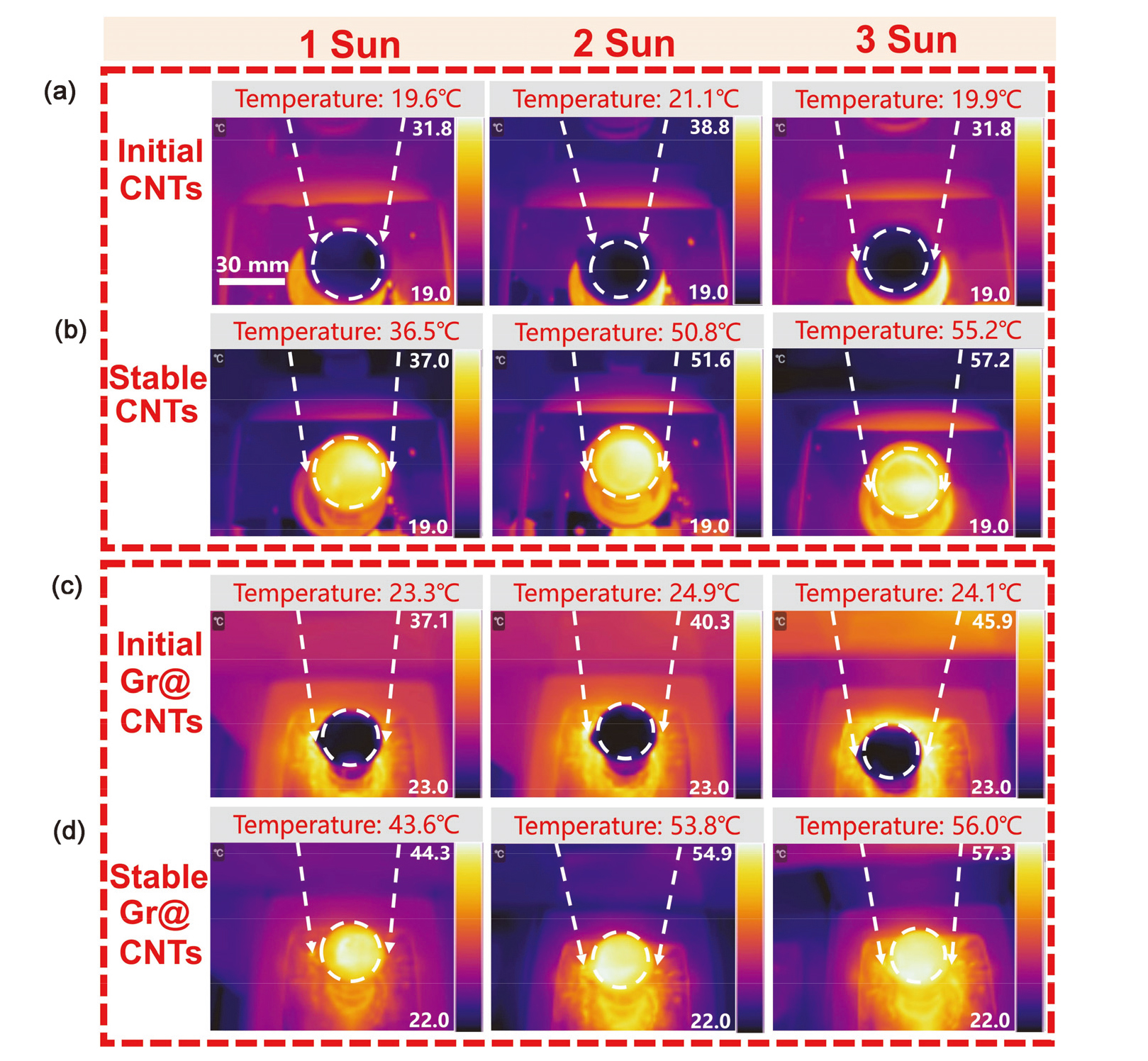
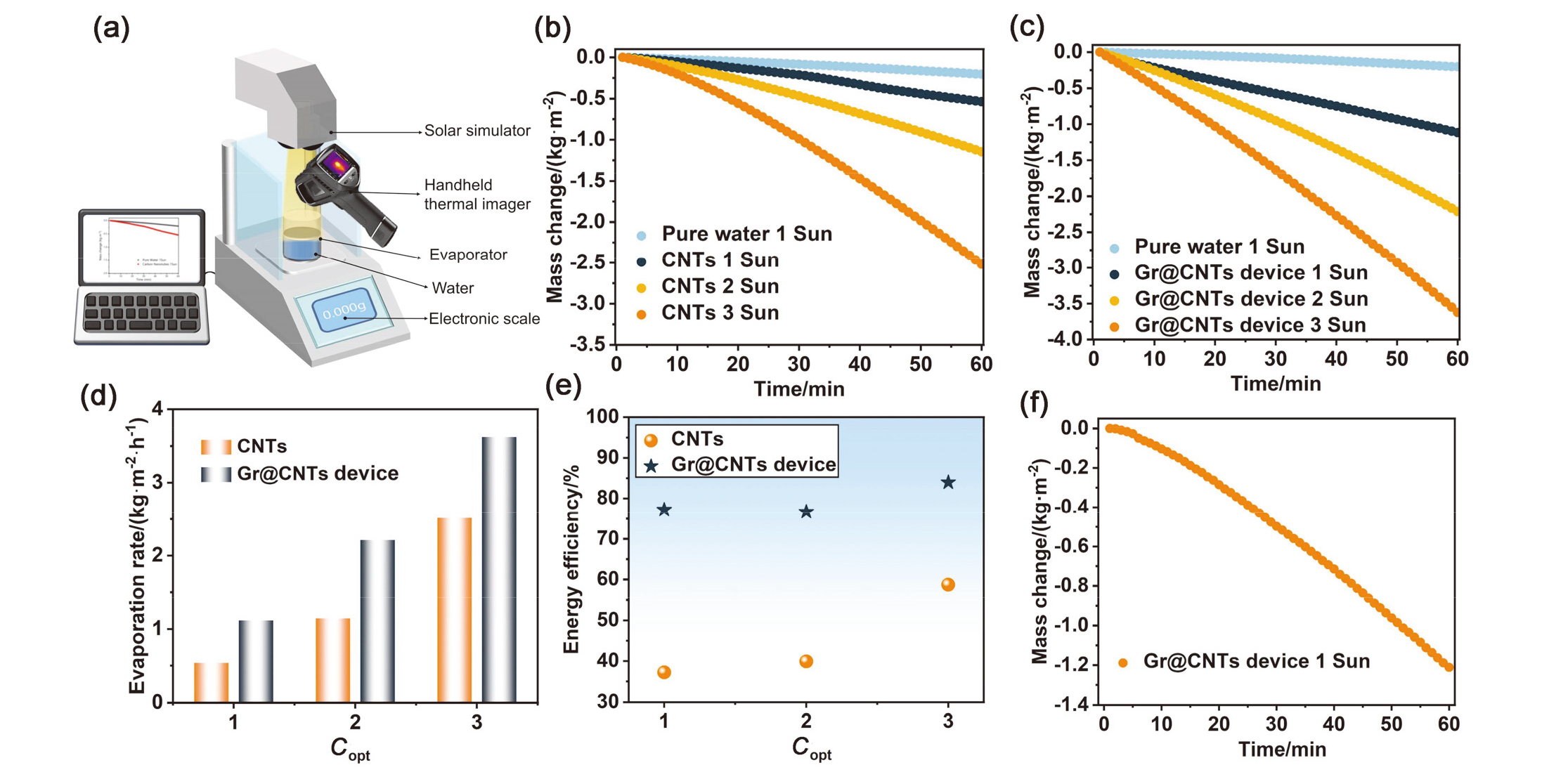
随着全球经济的快速发展和人口规模的持续增长, 水资源短缺问题日益严峻. 开发新型高效水净化材料以实现水资源可持续利用, 已成为当前研究的热点. 太阳能界面蒸发技术因高效利用可再生能源进行水处理而备受关注, 其中光热材料的设计与构筑是其关键所在. 碳基纳米材料因具有宽光谱吸收、高光热转化效率、优良的稳定性及可调控的结构特性, 被认为是极具潜力的新一代光热材料. 基于此, 采用等离子体增强化学气相沉积(PECVD)技术, 在碳纳米管(CNTs)基体上原位生长石墨烯(Gr)纳米片, 构筑了三维Gr@CNTs异质结材料. 该材料具有高比表面积和大孔隙结构, 在3 Sun光照强度(3 kW/m2)下, 材料的表面温度在30 s内可迅速升至138.8 ℃. 经过碱化处理后获得强亲水性自支撑薄膜, 并与聚氨酯海绵复合形成蒸发器, 可应用于太阳能蒸发系统, 其水蒸发速率可达3.62 kg/(m2•h), 光热转化效率高达84.0%. 相比于纯CNTs材料, Gr@CNTs材料展现出更加优异的光热性能和快速光响应特性, 为碳基光热材料在高效太阳能蒸发与水处理领域的进一步优化与应用提供了借鉴方向.
孙庆磊, 张琦, 金延超, 慈海娜, 魏振文, 何燕. 石墨烯@碳纳米管异质结光热材料的构筑及太阳能蒸发性能研究[J]. 化学学报, 2026, 84(3): 333-340.
Sun Qinglei, Zhang Qi, Jin Yanchao, Ci Haina, Wei Zhenwen, He Yan. Construction of Graphene@Carbon Nanotubes Heterojunction Photothermal Materials and Their Solar Evaporation Performance[J]. Acta Chimica Sinica, 2026, 84(3): 333-340.
| [1] |
doi: 10.1016/j.enconman.2014.11.056 |
| [2] |
doi: 10.1016/j.rser.2016.08.058 |
| [3] |
doi: 10.1002/adma.v27.39 |
| [4] |
doi: 10.1016/j.rser.2015.10.135 |
| [5] |
doi: 10.1016/j.nanoen.2023.109176 |
| [6] |
doi: 10.1073/pnas.1222475110 |
| [7] |
|
| [8] |
doi: 10.1039/C7MH01064H |
| [9] |
doi: 10.1038/nenergy.2016.133 |
| [10] |
doi: 10.1021/nn304948h pmid: 23157159 |
| [11] |
doi: 10.1002/cjoc.v40.9 |
|
(景欣欣, 王伟铎, 莫何苏, 谈朋, 陈志刚, 吴正颖, 孙林兵, 无机化学学报, 2024, 40, 1033.)
|
|
| [12] |
doi: 10.6023/A23040148 |
|
(杨地, 史潇凡, 张冀杰, 卜显和, 化学学报, 2023, 81, 1052.)
doi: 10.6023/A23040148 |
|
| [13] |
doi: 10.1002/smtd.v9.3 |
| [14] |
doi: 10.1002/aenm.v9.1 |
| [15] |
doi: 10.1039/C7TA08972D |
| [16] |
doi: 10.1002/adfm.v35.29 |
| [17] |
doi: 10.1038/s41467-024-53902-1 |
| [18] |
doi: 10.1016/j.compscitech.2022.109683 |
| [19] |
doi: 10.1002/adma.v29.38 |
| [20] |
doi: 10.1021/acsnano.7b01965 |
| [21] |
doi: 10.1021/acsami.0c01707 |
| [22] |
doi: 10.1016/j.cej.2025.159733 |
| [23] |
doi: 10.1016/j.jechem.2024.03.011 |
| [24] |
doi: 10.1016/j.cej.2024.155665 |
| [25] |
doi: 10.1016/j.solmat.2021.111068 |
| [26] |
doi: 10.6023/A23040150 |
|
(王文涛, 耿伟纬, 郭小龙, 王康辉, 姚玉元, 丁黎明, 化学学报, 2023, 81, 595.)
doi: 10.6023/A23040150 |
|
| [27] |
doi: 10.6023/A24040134 |
|
(陈宇波, 郑德旭, 王楠, 刘吉双, 于凤阳, 吴飒建, 刘生忠, 李志鹏, 化学学报, 2024, 82, 987.)
doi: 10.6023/A24040134 |
|
| [28] |
doi: 10.1002/cjoc.v43.1 |
| [29] |
doi: 10.1002/cjoc.v43.19 |
| [30] |
doi: 10.1016/j.jechem.2025.01.024 |
| [31] |
|
| [32] |
|
| [1] | 霍紫荆, 林声键, 陈青松, 黄钧衡. 硫掺杂碳纳米管催化剂用于宽pH范围高效电合成H2O2[J]. 化学学报, 2025, 83(5): 439-444. |
| [2] | 孙伟, 辛国祥, 刘飞, 鞠藤, 程宇通, 宋金玲, 包金小, 布林朝克. 三维石墨烯/富含氧空位Fe2O3复合材料的构建实现超级电容器超高能量密度[J]. 化学学报, 2025, 83(3): 256-265. |
| [3] | 汪子航, 钱静雯, 许佳慧, 邱浩渝, 晏梦珑, 刘芸, 罗杰, 盛毓泰, 陈易, 王贤保. 石墨烯/二氧化钛/磷化铁复合低铂催化剂用于高效甲醇氧化[J]. 化学学报, 2025, 83(3): 221-228. |
| [4] | 雷雅茹, 熊廷楷, 于湘涛, 黄秀兵, 唐晓龙, 易红宏, 周远松, 赵顺征, 孙龙, 高凤雨. 新型多孔三聚氰胺负载MnCe用于高选择性电催化CO2产甲酸[J]. 化学学报, 2024, 82(4): 396-408. |
| [5] | 赵天成, 蒋鸿宇, 张琨, 徐一帆, 康欣悦, 胥鉴宸, 周旭峰, 陈培宁, 彭慧胜. 基于环烷烃/乙醇混合碳源高性能碳纳米管纤维的连续化制备[J]. 化学学报, 2023, 81(6): 565-571. |
| [6] | 宁聪聪, 杨倩, 毛阿敏, 唐梓嘉, 金燕, 胡宝山. 石墨烯纳米带的可控制备研究进展[J]. 化学学报, 2023, 81(4): 406-419. |
| [7] | 刘稳, 王昱捷, 杨慧琴, 李成杰, 吴娜, 颜洋. 离子液体非共价诱导制备碳纳米管/石墨烯集流体用于钠金属负极[J]. 化学学报, 2023, 81(10): 1379-1386. |
| [8] | 成受明, 周波. 基于超高分辨质谱的溶解性有机质分子转化机理分析[J]. 化学学报, 2022, 80(8): 1106-1114. |
| [9] | 闫绍兵, 焦龙, 何传新, 江海龙. ZIF-67/石墨烯复合物衍生的氮掺杂碳限域Co纳米颗粒用于高效电催化氧还原[J]. 化学学报, 2022, 80(8): 1084-1090. |
| [10] | 王超峰, 郑国栋, 王悦, 宋慧佳, 陈小艺, 高瑞霞. 金属卟啉-Sn网络可控非共价功能化碳纳米管的制备及蛋白吸附应用[J]. 化学学报, 2022, 80(2): 126-132. |
| [11] | 王旭生, 杨胥, 陈春辉, 李红芳, 黄远标, 曹荣. 石墨烯量子点/铁基金属-有机骨架复合材料高效光催化二氧化碳还原※[J]. 化学学报, 2022, 80(1): 22-28. |
| [12] | 翟耀, 辛国祥, 王佳琦, 张邦文, 宋金玲, 刘晓旭. 微波辅助合成具有优异电化学性能的rGO/CeO2超级电容器电极材料[J]. 化学学报, 2021, 79(9): 1129-1137. |
| [13] | 张欣欣, 刘荣, 王蕾, 付宏刚. 细菌纤维素基柔性锌离子电池正极的构筑及性能研究[J]. 化学学报, 2021, 79(5): 670-677. |
| [14] | 刘长安, 洪士博, 李蓓. 石墨烯在甘油/尿素剥离液中的稳定行为的分子动力学模拟研究[J]. 化学学报, 2021, 79(4): 530-538. |
| [15] | 黄杰, 奚江波, 陈伟, 柏正武. 石墨烯衍生物作为无金属碳基催化剂在有机催化中的应用[J]. 化学学报, 2021, 79(11): 1360-1371. |
| 阅读次数 | ||||||
|
全文 |
|
|||||
|
摘要 |
|
|||||
