

化学学报 ›› 2026, Vol. 84 ›› Issue (7): 1175-1196.DOI: 10.6023/A26030068 上一篇 下一篇
综述
董祎a, 王伟光b, 刘雯骞a, 朱雪雨a, 陈靖宇a, 周炯a,*( )
)
投稿日期:2026-03-04
发布日期:2026-05-15
作者简介: |
董祎, 东北大学理学院化学专业2023级本科生, 目前在周炯教授课题组进行科研创新训练, 主要研究方向为超分子大环吸附分离. |
 |
周炯, 东北大学教授、博士生导师. 从事功能导向的超分子化学及智能化学研究. 在Chem、PNAS、Nat. Commun.、J. Am. Chem. Soc.、Angew. Chem. Int. Ed.、Adv. Mater.等国际知名期刊发表SCI论文80余篇, 引用5000余次, 13篇ESI高被引论文, 4篇ESI热点论文, 封面论文11篇. 担任国家“英才计划”导师、国际先进材料学会终身会士、Vebleo协会会士等. 连续入选全球前2%顶尖科学家(2023~2025), 获得国际先进材料学会科学家奖、辽宁省化学会青年化学奖等荣誉. |
基金资助:
Yi Donga, Weiguang Wangb, Wenqian Liua, Xueyu Zhua, Jingyu Chena, Jiong Zhoua,*()
Received:2026-03-04
Published:2026-05-15
Contact:
* E-mail: zhoujiong@mail.neu.edu.cn
Supported by:文章分享
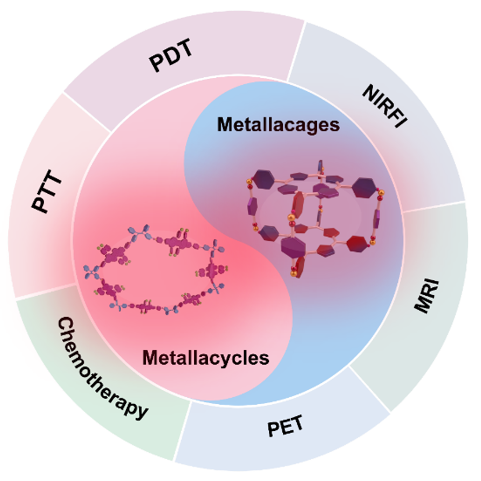
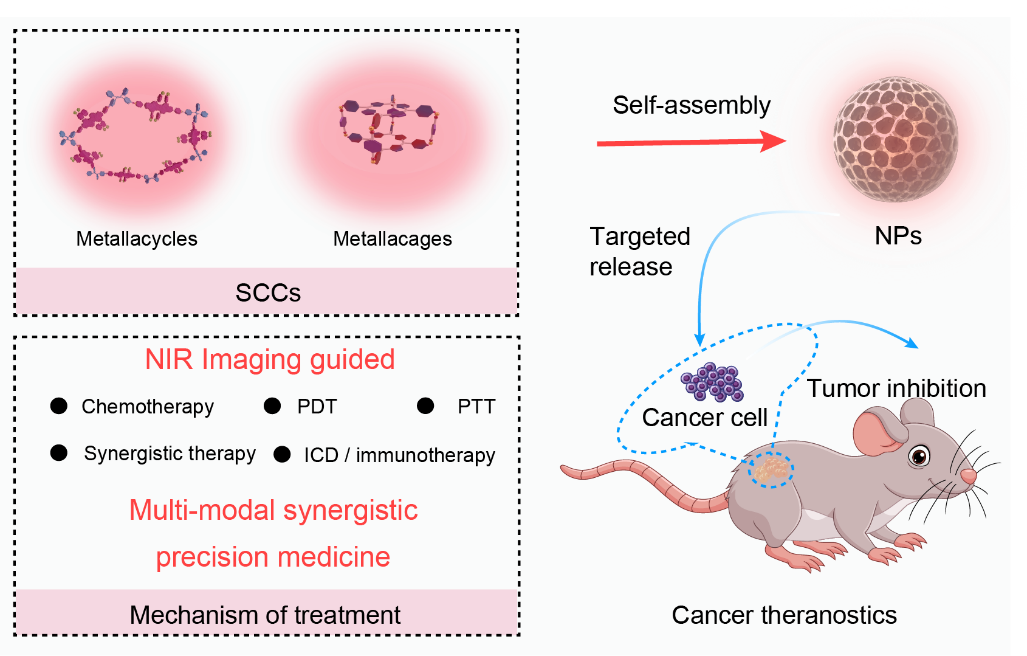
金属大环与金属笼作为一类超分子结构, 凭借其高度可设计性、精准可控的空间构型与多功能集成能力, 近年来在肿瘤精准治疗领域中展现出广阔的应用前景. 近红外(NIR)光具有优异的组织穿透深度、低光散射与背景荧光干扰小等特点, 已成为生物成像与深部治疗的重要手段. 基于NIR发光构建的金属大环与金属笼, 不仅结合了超分子结构的可编程性与金属配位的功能多样性, 还在成像引导下展现出对光热治疗(PTT)、光动力治疗(PDT)、化疗、免疫治疗等多种治疗模式的协同集成功能. 通过精确的配体工程与金属中心调控, 这类体系能够在深层肿瘤部位实现高效的药物富集、靶向释放与治疗过程的实时可视化, 为个性化、靶向性强、副作用低的肿瘤综合治疗提供了创新策略. 本文系统梳理了近年该领域的重要研究进展, 从结构设计、成像机制、治疗模式及其协同机制等方面进行分类总结, 并探讨了当前研究面临的关键挑战与未来的发展方向.
董祎, 王伟光, 刘雯骞, 朱雪雨, 陈靖宇, 周炯. 自组装近红外金属大环和金属笼用于癌症诊疗[J]. 化学学报, 2026, 84(7): 1175-1196.
Yi Dong, Weiguang Wang, Wenqian Liu, Xueyu Zhu, Jingyu Chen, Jiong Zhou. Self-assembled Near-Infrared Metallacycles and Metallacages for Cancer Theranostics[J]. Acta Chimica Sinica, 2026, 84(7): 1175-1196.
| [1] |
doi: 10.1038/s41572-025-00640-3 pmid: 40775245 |
| [2] |
doi: 10.1016/j.ccell.2025.06.011 pmid: 40645185 |
| [3] |
doi: 10.1016/j.cell.2025.05.046 |
| [4] |
doi: 10.1002/cac2.12658 |
| [5] |
doi: 10.1016/j.cell.2021.05.021 pmid: 34081922 |
| [6] |
|
| [7] |
doi: 10.1016/S0140-6736(25)00261-2 |
| [8] |
doi: 10.1016/j.ccell.2025.07.005 |
| [9] |
doi: 10.1038/s41571-025-01049-3 |
| [10] |
doi: 10.1016/j.ccell.2023.12.012 |
| [11] |
doi: 10.1038/s41591-024-03415-7 |
| [12] |
doi: 10.1038/s41392-025-02516-0 |
| [13] |
doi: 10.1016/j.ccell.2025.12.002 |
| [14] |
doi: 10.1038/s41467-025-68086-5 |
| [15] |
doi: 10.1038/s41467-025-67488-9 |
| [16] |
doi: 10.1038/s41556-025-01819-2 |
| [17] |
doi: 10.1016/j.ccell.2025.12.001 |
| [18] |
doi: 10.1002/adma.v38.10 |
| [19] |
doi: 10.1002/adfm.v36.31 |
| [20] |
doi: 10.1038/s41467-025-67190-w |
| [21] |
doi: 10.1002/adfm.v35.52 |
| [22] |
doi: 10.1038/s41467-025-67967-z |
| [23] |
|
| [24] |
doi: 10.1038/s41467-025-63020-1 |
| [25] |
|
| [26] |
doi: 10.1016/j.biomaterials.2024.123021 |
| [27] |
doi: 10.1002/adhm.v14.1 |
| [28] |
doi: 10.1016/j.ccr.2025.216591 |
| [29] |
doi: 10.1186/s12943-025-02443-2 |
| [30] |
doi: 10.1038/s41565-024-01809-9 |
| [31] |
doi: 10.1016/j.ccr.2025.216489 |
| [32] |
doi: 10.1039/D5CS00502G |
| [33] |
doi: 10.1016/j.ccr.2022.214495 |
| [34] |
doi: 10.53388/BMEC2025007 |
| [35] |
doi: 10.1021/acs.accounts.4c00031 |
| [36] |
doi: 10.1002/anie.v64.52 |
| [37] |
doi: 10.3390/molecules28031470 |
| [38] |
doi: 10.1021/acs.nanolett.2c02612 |
| [39] |
doi: 10.1021/acs.chemrev.5c00047 |
| [40] |
doi: 10.1021/acs.chemmater.0c00615 |
| [41] |
doi: 10.1073/pnas.1902029116 |
| [42] |
doi: 10.1039/C6CS00898D |
| [43] |
doi: 10.53388/BMEC2023015 |
| [44] |
doi: 10.3390/inorganics13070246 |
| [45] |
|
| [46] |
doi: 10.1007/s11427-025-2874-8 |
| [47] |
doi: 10.1002/adfm.v36.19 |
| [48] |
doi: 10.1002/adma.v37.9 |
| [49] |
doi: 10.1016/j.ccr.2025.216873 |
| [50] |
doi: 10.1016/j.cclet.2025.111692 |
| [51] |
doi: 10.1002/agt2.v7.1 |
| [52] |
doi: 10.1021/acs.accounts.5c00043 |
| [53] |
doi: 10.1002/adhm.v15.1 |
| [54] |
doi: 10.1007/s11426-024-2193-5 |
| [55] |
doi: 10.1016/j.chempr.2025.102502 |
| [56] |
doi: 10.1021/acs.accounts.5c00085 |
| [57] |
doi: 10.1016/j.actbio.2025.12.039 |
| [58] |
doi: 10.1021/acs.jpca.5c02128 |
| [59] |
doi: 10.1016/j.ccr.2023.215320 |
| [60] |
doi: 10.1039/D0CS00038H |
| [61] |
doi: 10.1039/D0CS00011F |
| [62] |
doi: 10.1021/jacs.8b04929 |
| [63] |
doi: 10.1021/jacs.8b04400 |
| [64] |
doi: 10.1016/j.cis.2024.103356 |
| [65] |
doi: 10.1016/j.ccr.2025.216551 |
| [66] |
doi: 10.1002/adma.v34.15 |
| [67] |
doi: 10.1016/j.cej.2024.155836 |
| [68] |
doi: 10.1038/s41566-024-01391-5 |
| [69] |
doi: 10.1038/s41565-021-00922-3 |
| [70] |
|
| [71] |
doi: 10.20517/cdr.2023.77 |
| [72] |
doi: 10.1039/D5CS00734H |
| [73] |
doi: 10.1002/agt2.672 |
| [74] |
doi: 10.3390/pharmaceutics17091192 |
| [75] |
doi: 10.3390/pr13113671 |
| [76] |
|
| [77] |
doi: 10.1002/smll.v20.2 |
| [78] |
doi: 10.1002/adma.v36.21 |
| [79] |
doi: 10.6023/A24010035 |
|
(李燕, 王玮, 张毓婷, 肖述章, 兰海闯, 耿鹏, 化学学报, 2024, 82, 443.)
doi: 10.6023/A24010035 |
|
| [80] |
doi: 10.6023/A24040115 |
|
(黄艳琴, 罗集文, 李佳启, 张瑞, 刘兴奋, 范曲立, 黄维, 化学学报, 2024, 82, 903.)
doi: 10.6023/A24040115 |
|
| [81] |
doi: 10.6023/A24090286 |
|
(张雨琦, 占辰, 贡祎, 陆峰, 范曲立, 化学学报, 2024, 82, 1226.)
doi: 10.6023/A24090286 |
|
| [82] |
doi: 10.6023/A23060283 |
|
(黄艳琴, 栗丽君, 杨书培, 张瑞, 刘兴奋, 范曲立, 黄维, 化学学报, 2023, 81, 1687.)
doi: 10.6023/A23060283 |
|
| [83] |
doi: 10.6023/A24060181 |
|
(刘童, 皮慧慧, 陈冰昆, 张小玲, 化学学报, 2024, 82, 1001.)
doi: 10.6023/A24060181 |
|
| [84] |
doi: 10.6023/A23120538 |
|
(王敏, 陈帮塘, 陈桥林, 王俊, 陈名钊, 蒋志龙, 王平山, 化学学报, 2024, 82, 336.)
doi: 10.6023/A23120538 |
|
| [85] |
doi: 10.1039/C9SC02466B |
| [86] |
doi: 10.1073/pnas.1817021116 |
| [87] |
doi: 10.1002/adma.v36.39 |
| [88] |
doi: 10.1002/adma.v30.34 |
| [89] |
doi: 10.1002/adma.v34.5 |
| [90] |
doi: 10.1016/j.cclet.2019.07.043 |
| [91] |
|
| [92] |
doi: 10.1039/D0SC02236E |
| [93] |
doi: 10.1039/D3CC04166B |
| [94] |
doi: 10.1021/acsami.0c01695 |
| [95] |
doi: 10.1038/s41467-018-06574-7 |
| [96] |
doi: 10.1073/pnas.1908761116 |
| [97] |
doi: 10.31635/ccschem.021.202100950 |
| [98] |
doi: 10.1002/adma.v34.7 |
| [99] |
doi: 10.1038/s41467-022-29572-2 |
| [100] |
doi: 10.1002/smll.v18.23 |
| [101] |
doi: 10.1039/D2SC01518H |
| [102] |
doi: 10.1021/jacs.2c03895 pmid: 35786928 |
| [103] |
doi: 10.1002/anie.v62.15 |
| [104] |
doi: 10.1021/acsami.4c17413 |
| [105] |
doi: 10.1021/jacs.3c13224 |
| [106] |
doi: 10.1002/ange.v136.37 |
| [107] |
doi: 10.1073/pnas.2209904119 |
| [1] | 苑玥珂, 董翔宇, 牧童, 高泽坤, 郑秀丽, 丛欢, 刘卫敏, 汪鹏飞. 基于共轭大环的近红外超分子光敏剂用于乏氧光动力治疗[J]. 化学学报, 2026, 84(6): 820-827. |
| [2] | 李园圆, 杨云帆, 魏擎亚, 徐翔, 袁俊, 王瑞松, 邹应萍. 基于新型近红外受体的高效半透明有机太阳能电池[J]. 化学学报, 2025, 83(10): 1157-1165. |
| [3] | 刘童, 皮慧慧, 陈冰昆, 张小玲. 近红外二区硫系银量子点制备方法及癌症诊疗应用研究进展[J]. 化学学报, 2024, 82(9): 1001-1012. |
| [4] | 张雨琦, 占辰, 贡祎, 陆峰, 范曲立. 聚乙二醇化介孔二氧化硅包裹共轭聚合物用于近红外光学诊疗[J]. 化学学报, 2024, 82(12): 1226-1233. |
| [5] | 蒋励, 陈子晗, 凡勇. 近红外二区荧光探针在活体多重成像中的研究进展[J]. 化学学报, 2024, 82(10): 1069-1085. |
| [6] | 王海朋, 蔡文生, 邵学广. 抗冻剂抗冻机制的近红外光谱与分子模拟研究★[J]. 化学学报, 2023, 81(9): 1167-1174. |
| [7] | 郑文山, 高冠斌, 邓浩, 孙涛垒. Ag2Se@Ag2S核壳量子点的室温合成及其近红外荧光性能优化[J]. 化学学报, 2023, 81(7): 763-770. |
| [8] | 吕鑫, 吴仪, 张勃然, 郭炜. 过氧化氢激活型近红外氟硼二吡咯光敏剂的设计、合成及光动力治疗研究[J]. 化学学报, 2023, 81(4): 359-370. |
| [9] | 贺晓梦, 袁方, 张素雅, 张健健. 基于尼罗红类ONOO–近红外荧光探针的开发及其成像应用[J]. 化学学报, 2023, 81(11): 1515-1521. |
| [10] | 刘巴蒂, 王承俊, 钱鹰. 噻吩基氟硼二吡咯近红外光敏染料的合成、双光子荧光成像及光动力治疗研究[J]. 化学学报, 2022, 80(8): 1071-1083. |
| [11] | 廉纬, 方泽铠, 涂大涛, 李嘉尧, 韩思远, 李仁富, 商晓颖, 陈学元. 模板法控制合成AgInSe2:Zn2+近红外荧光量子点及其生物标记应用※[J]. 化学学报, 2022, 80(5): 625-632. |
| [12] | 张景荣, 黄得财, 黄聪聪, 梁思思, 朱浩淼. In2BP3O12:Cr3+宽带近红外荧光粉的发光性能及应用研究※[J]. 化学学报, 2022, 80(4): 453-459. |
| [13] | 吴志芬, 柯建熙, 刘永升, 孙蓬明, 洪茂椿. 稀土近红外二区纳米荧光影像探针及其生物医学应用※[J]. 化学学报, 2022, 80(4): 542-552. |
| [14] | 刘若湄, 冯艳辉, 李卓, 卢珊, 关天用, 李幸俊, 刘䶮, 陈卓, 陈学元. 基于cypate光裂解的新型近红外光响应稀土上转换纳米载药系统※[J]. 化学学报, 2022, 80(4): 423-427. |
| [15] | 王其, 夏辉, 熊炎威, 张新敏, 蔡杰, 陈冲, 高逸聪, 陆峰, 范曲立. 调控供电子策略简易制备近红外二区有机小分子光学诊疗试剂[J]. 化学学报, 2022, 80(11): 1485-1493. |
| 阅读次数 | ||||||
|
全文 |
|
|||||
|
摘要 |
|
|||||
