

化学学报 ›› 2026, Vol. 84 ›› Issue (8): 1265-1271.DOI: 10.6023/A26060210 上一篇 下一篇
研究论文
李铁鹏a, 何海兵a, 杨鲍潮a,*( ), 高栓虎a,b,*()
投稿日期:2026-06-19
发布日期:2026-07-21
作者简介:★“纪念兰州大学化学学科创建80周年”专辑
基金资助:
Tiepeng Lia, Haibing Hea, Baochao Yanga,*(), Shuanhu Gaoa,b,*()
Received:2026-06-19
Published:2026-07-21
Contact:
E-mail: About author:★For the VSI “Celebration of 80th Anniversary of Chemistry in Lanzhou University”
Supported by:文章分享
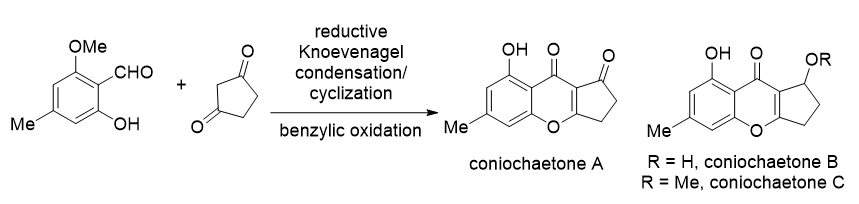
Coniochaetone类天然产物是一类具有稠合环戊烷环的色酮类衍生物, 最早从粪生真菌Coniochaeta saccardoi中分离获得. 其中, coniochaetone A表现出显著的细胞毒性和抗紫色色杆菌活性. 本研究中, 我们利用Ramachary发展的还原性Knoevenagel缩合/环化反应高效构建了三环核心骨架, 随后经过苄位氧化和官能团转化完成了coniochaetone类天然产物的合成, 并实现了其克级规模的放大, 为其生物活性研究奠定基础.
李铁鹏, 何海兵, 杨鲍潮, 高栓虎. Coniochaetone类天然产物的克级规模合成★[J]. 化学学报, 2026, 84(8): 1265-1271.
Tiepeng Li, Haibing He, Baochao Yang, Shuanhu Gao. Gram-scale Synthesis of Coniochaetones★[J]. Acta Chimica Sinica, 2026, 84(8): 1265-1271.
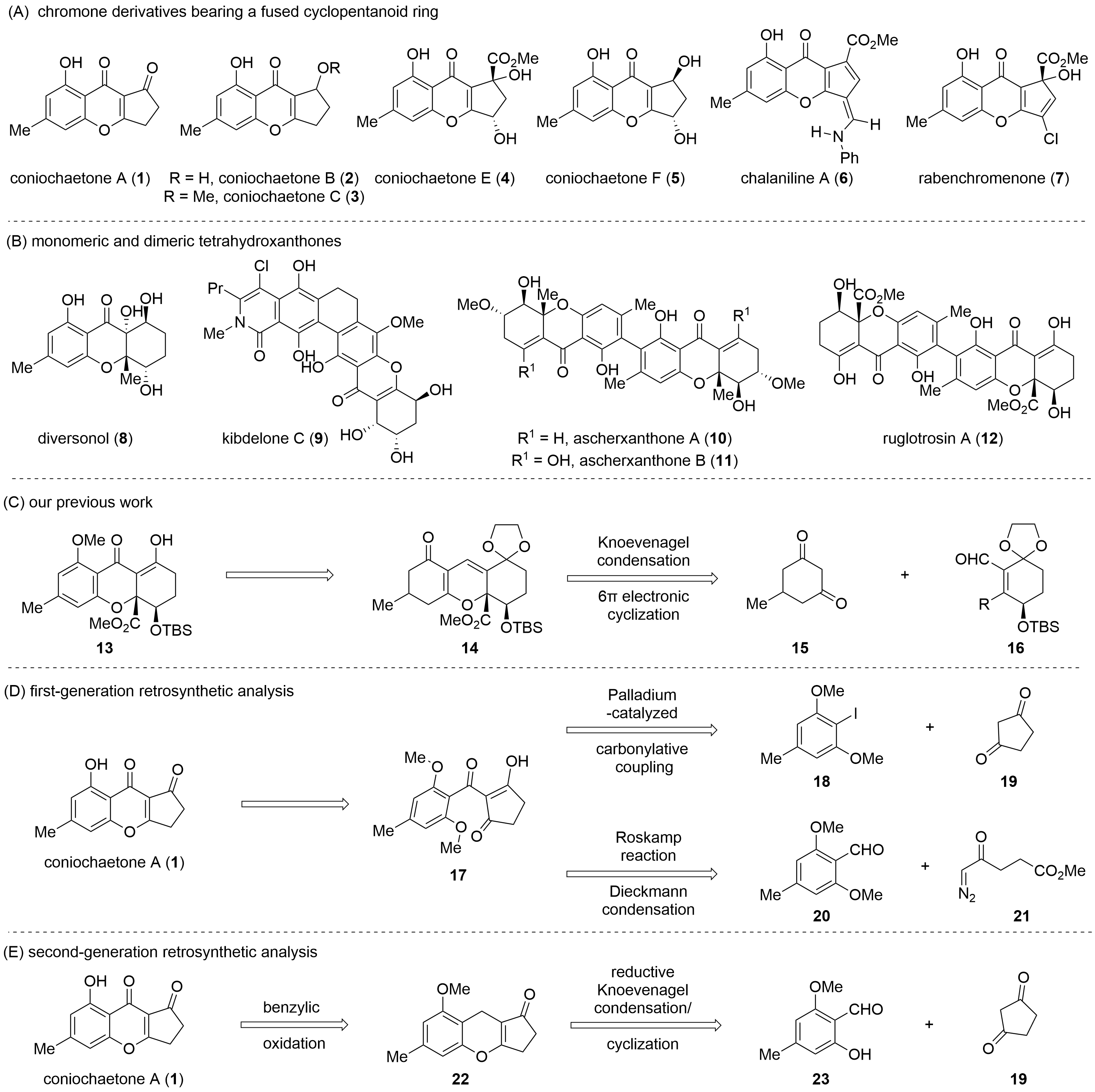
| Entry | [Pd] | Additive | Result |
|---|---|---|---|
| 1 | PdCl2(cod) | MgCl2 | 38% |
| 2 | PdCl2(dppf)•CH2Cl2 | MgCl2 | trace |
| 3 | PdCl2(dppf)•CH2Cl2 | K2CO3 | 54% |
| Entry | [Pd] | Additive | Result |
|---|---|---|---|
| 1 | PdCl2(cod) | MgCl2 | 38% |
| 2 | PdCl2(dppf)•CH2Cl2 | MgCl2 | trace |
| 3 | PdCl2(dppf)•CH2Cl2 | K2CO3 | 54% |
| Entry | Base | Additive | Solvent | Result |
|---|---|---|---|---|
| 1 | Et3N | TMSCN | CH3CN | NR |
| 2 | Et3N | acetone cyanohydrin | CH3CN | NR |
| 3 | K2CO3 | DMAP | DCE | 25 (75%) |
| 4 | NaOH | 15-crown-5 | DCE | 25 (7%, 88% brsm) |
| 5 | K2CO3 | 1,2,4-triazole | CH3CN | 26 (61%) |
| 6 | Li2CO3 | 1,2,4-triazole | CH3CN | 26 (10%, 77% brsm) |
| 7 | NaH | 1,2,4-triazole | CH3CN | 26 (66%) |
| Entry | Base | Additive | Solvent | Result |
|---|---|---|---|---|
| 1 | Et3N | TMSCN | CH3CN | NR |
| 2 | Et3N | acetone cyanohydrin | CH3CN | NR |
| 3 | K2CO3 | DMAP | DCE | 25 (75%) |
| 4 | NaOH | 15-crown-5 | DCE | 25 (7%, 88% brsm) |
| 5 | K2CO3 | 1,2,4-triazole | CH3CN | 26 (61%) |
| 6 | Li2CO3 | 1,2,4-triazole | CH3CN | 26 (10%, 77% brsm) |
| 7 | NaH | 1,2,4-triazole | CH3CN | 26 (66%) |
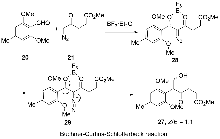
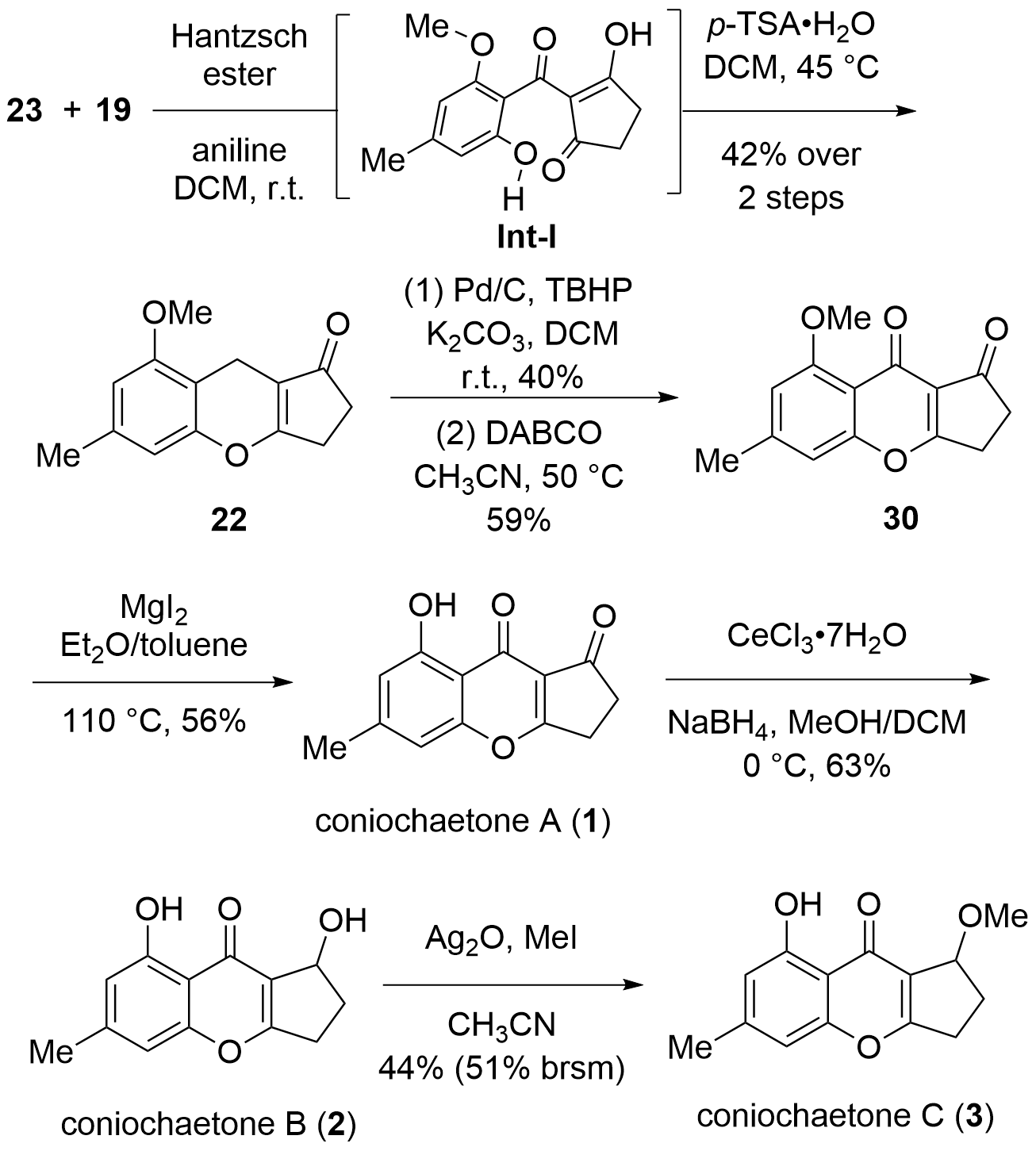
| Entry | Reagent | Solvent | Temperature | Result |
|---|---|---|---|---|
| 1 | SeO2 | 1,4-dioxane H2O | 110 ℃ | NR |
| 2 | CrO3 | AcOH/H2O | r.t. | decomposed |
| 3 | NHPI tBuONO | CH3CN | 80 ℃ | decomposed |
| 4 | DDQ | DCM/H2O | r.t. | decomposed |
| 5 | O2, Et3N | CH3CN | 80 ℃ | trace 30 |
| 6 | Mn(OAc)3 TBHP | EA | r.t. | NR |
| 7 | Co(acac)2 TBHP | acetone | r.t. | trace 31 33 (25%) |
| 8 | Pd/C, TBHP K2CO3 | DCM | r.t. | trace 31, 32 33 (40%) |
| Entry | Reagent | Solvent | Temperature | Result |
|---|---|---|---|---|
| 1 | SeO2 | 1,4-dioxane H2O | 110 ℃ | NR |
| 2 | CrO3 | AcOH/H2O | r.t. | decomposed |
| 3 | NHPI tBuONO | CH3CN | 80 ℃ | decomposed |
| 4 | DDQ | DCM/H2O | r.t. | decomposed |
| 5 | O2, Et3N | CH3CN | 80 ℃ | trace 30 |
| 6 | Mn(OAc)3 TBHP | EA | r.t. | NR |
| 7 | Co(acac)2 TBHP | acetone | r.t. | trace 31 33 (25%) |
| 8 | Pd/C, TBHP K2CO3 | DCM | r.t. | trace 31, 32 33 (40%) |
| [1] |
(a)
doi: 10.1016/0040-4039(95)01174-G pmid: 23495150 |
|
(b)
doi: 10.1016/j.tet.2012.07.060 pmid: 23495150 |
|
|
(c)
doi: 10.1016/j.fitote.2013.04.011 pmid: 23495150 |
|
|
(d)
doi: 10.1002/cbdv.201200321 pmid: 23495150 |
|
|
(e)
doi: 10.1002/cbdv.v16.6 pmid: 23495150 |
|
|
(f)
doi: 10.1080/14786419.2019.1610757 pmid: 23495150 |
|
|
(g)
doi: 10.1016/j.tetlet.2014.01.017 pmid: 23495150 |
|
|
(h)
doi: 10.1016/j.tet.2014.02.004 pmid: 23495150 |
|
|
(i)
doi: 10.3390/md13085219 pmid: 23495150 |
|
|
(j)
doi: 10.3390/molecules22121999 pmid: 23495150 |
|
|
(k)
doi: 10.1016/j.phytochem.2022.113311 pmid: 23495150 |
|
|
(l)
doi: 10.1002/cbdv.v23.5 pmid: 23495150 |
|
| [2] |
doi: 10.1080/14786419.2020.1799363 |
| [3] |
doi: 10.1038/s41598-023-42833-4 |
| [4] |
doi: 10.1021/acschembio.7b00268 pmid: 28530797 |
| [5] |
doi: 10.1021/acs.jnatprod.9b01017 |
| [6] |
(a)
doi: 10.1039/C3CC47426G |
|
(b)
doi: 10.1021/acs.orglett.7b00592 |
|
|
(c)
doi: 10.1021/acs.orglett.8b00901 |
|
|
(d)
doi: 10.1021/acs.orglett.0c00063 |
|
| [7] |
|
| [8] |
doi: 10.1039/b812551a |
| [9] |
doi: 10.1002/ejoc.v2013.12 |
| [10] |
(a)
doi: 10.1002/chem.v19.52 pmid: 23881598 |
|
(b)
doi: 10.1002/adsc.v356.17 pmid: 23881598 |
|
|
(c)
doi: 10.1002/anie.201304072 pmid: 23881598 |
|
|
(d)
doi: 10.1039/c4ob00568f pmid: 23881598 |
|
|
(e)
doi: 10.1021/acs.joc.5b02897 pmid: 23881598 |
|
| [11] |
(a)
doi: 10.1016/j.pestbp.2025.106692 pmid: 30684868 |
|
(b)
doi: S0223-5234(19)30042-X pmid: 30684868 |
|
| [12] |
pmid: 17286439 |
| [13] |
|
| [14] |
doi: 10.1039/D3OB01722B |
| [15] |
doi: 10.1002/chem.v19.39 |
| [16] |
doi: 10.1021/ja048078t |
| [17] |
doi: 10.1021/jacs.6b01428 pmid: 26963149 |
| [18] |
(a)
doi: 10.1002/cber.v18:2 |
|
(b)
|
|
| [19] |
doi: 10.1002/ejoc.v2012.5 |
| [20] |
(a)
|
|
(b)
doi: 10.1021/jacs.3c00884 |
|
|
(c)
doi: 10.1021/acs.joc.5c02900 |
|
|
(d)
doi: 10.1021/jo901799n |
|
| [21] |
doi: 10.6023/A25120425 |
|
(赵红艳,
doi: 10.6023/A25120425 |
|
| [22] |
doi: 10.1021/ol502675n |
| [23] |
pmid: 17533128 |
| [24] |
doi: 10.1021/acs.orglett.7b02731 |
| [25] |
doi: 10.1021/jacs.9b01261 |
| [26] |
doi: 10.1021/jo2021604 |
| [27] |
doi: 10.1016/j.bmcl.2015.03.071 |
| [28] |
(a)
doi: 10.1039/b907341h |
|
(b)
doi: 10.1021/ol0262340 |
|
|
(c)
doi: 10.1021/ja0340735 |
|
|
(d)
doi: 10.1021/ol050284y |
|
| [29] |
(a)
doi: 10.6023/cjoc202409012 |
|
(文国恩, 谷硕, 何海兵, 高栓虎, 有机化学, 2025, 45, 977.)
doi: 10.6023/cjoc202409012 |
|
|
(b)
doi: 10.6023/A25040131 |
|
|
(黄俊, 尹蓉, 曹婷婷, 化学学报, 2025, 83, 1424.)
doi: 10.6023/A25040131 |
|
| [30] |
(a)
doi: 10.1021/acs.orglett.7b02353 |
|
(b)
doi: 10.1039/C8QO01231H |
|
| [31] |
(a)
doi: 10.1021/ol201089f |
|
(b)
doi: 10.1021/jo025883m |
|
| [32] |
doi: 10.6023/cjoc202505029 |
|
(刘小宇, 许庭瑞, 秦勇, 有机化学, 2025, 45, 3098.)
doi: 10.6023/cjoc202505029 |
|
| [33] |
doi: 10.1002/ejoc.v2014.9 |
| [34] |
|
|
(李铁鹏, 何海兵, 高栓虎,CN 202511976707.0, 2025.)
|
| [1] | 赵馨雨, 韩燕楠, 徐吉磊, 安庆大, 肖作毅, 苏鑫, 黄家辉. 负载型离子液体催化生物基多元酸酯的制备[J]. 化学学报, 2026, 84(3): 341-352. |
| [2] | 方贤富, 鞠昀竹, 聂启桂, 范晓红, 王辉宏, 李杨峰, 张功, 李亦舟. 通过DNA兼容的Knoevenagel缩合合成5-亚芳基硫代乙内酰脲衍生物★[J]. 化学学报, 2025, 83(10): 1119-1123. |
| [3] | 徐袁利, 潘辉, 杨义, 左智伟. 连续流条件下蒽-铈协同催化的苄位碳氢键选择性氧化反应★[J]. 化学学报, 2023, 81(5): 435-440. |
| [4] | 何倩, 李杰, 喻思佳, 吴东坪, 叶剑良, 黄培强. 铱催化叔酰胺与呋喃硅醚间的类插烯Aldol缩合反应: γ-亚苄基-丁烯酸内酯的合成★[J]. 化学学报, 2023, 81(10): 1265-1270. |
| [5] | 李哲伟, 王骞阅, 蒲敏, 杨作银, 雷鸣. 含氮杂环协助的醛胺缩合反应机理的研究[J]. 化学学报, 2020, 78(5): 437-443. |
| [6] | 谭良骁, 谭必恩. 超交联微孔聚合物研究进展[J]. 化学学报, 2015, 73(6): 530-540. |
| [7] | 范溦, 李敏, 洪春雁, 潘才元. 含香豆素基团超支化星形聚合物的合成与表征[J]. 化学学报, 2015, 73(4): 330-336. |
| [8] | 张文建, 范溦, 李敏, 洪春雁, 潘才元. 多重响应性超支化星形聚合物的合成与组装以及控制释放研究[J]. 化学学报, 2012, 70(16): 1690-1696. |
| [9] | 唐翔, 唐先忠, 游英才, 任立轲, 王洋, 严立京. 含呋喃共轭桥有机非线性光学生色团的合成及性能研究[J]. 化学学报, 2012, 70(14): 1565-1568. |
| [10] | 周海超, 林益明, 柴纬明, 魏淑东, 廖蒙蒙. 反射模式与线性模式MALDI-TOF MS联合分析荔枝果核缩合单宁[J]. 化学学报, 2011, 69(24): 2981-2986. |
| [11] | 马亚军, 薛成虎. 吡啶氮桥联双环三唑鎓盐的合成及其在催化苯偶姻缩合、酯交换反应中的应用[J]. 化学学报, 2010, 68(9): 897-903. |
| [12] | 周志平,张际亮,盛维琛,颜德岳. 非等速率自缩合乙烯基聚合反应产物的支化度[J]. 化学学报, 2008, 66(22): 2547-2552. |
| [13] | 张朝欣,达世俊,张化冰,孙彬,李瀛. 雌舞毒蛾引诱剂: (+)-(7R,8S)-7,8-环氧-2-甲基十八烷的不对称全合成[J]. 化学学报, 2007, 65(21): 2433-2436. |
| [14] | 王郁文,钟凡,许亚萍,王学文. 牛磺酸与噻吩甲醛缩合形成Schiff碱反应机理的研究[J]. 化学学报, 2006, 64(8): 811-816. |
| [15] | 高春梅, 曹德榕, 徐社阳. 10,10-二苄基-9(10H)蒽醇的酸催化选择性环化反应[J]. 化学学报, 2006, 64(16): 1757-1760. |
| 阅读次数 | ||||||
|
全文 |
|
|||||
|
摘要 |
|
|||||
