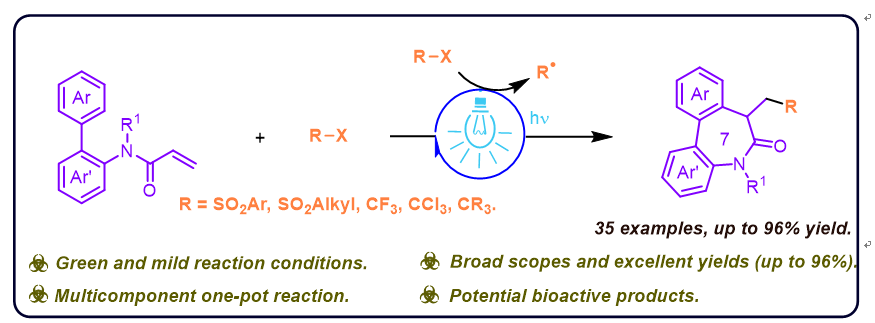
[1] (a) Wang Y.; Wang X.; Wang C.; Liu T.; Cai X.; Zhang M.; Aliper A.; Ren F.; Zhavoronkov A.; Ding, X. Bioorg. Med. Chem.2026, 135, 118582;(b) Jiang, J.; Zhang, M.; Luo, N.; Zhong, Z.; Zhou, Q.; Huang, J. ACS Catal. 2026, 16, 9706-9725
(c) Zubčić G.; Pavić K.; You J.; Vrček V.; Portada T.; Bešić E.; Šakić D. Acta Pharm.2024, 74, 725-737.
[2] (a) Guo T.; Hu P.; Li J.; Zhou Y.; Zhang P.; Zhao Y.; Zhu C. Green Chem.2024, 26, 3786-3790
(b) Zhang B.; Bao M.; Zeng C.; Zhong X.; Ni L.; Zeng Y.; Cai X. Org. Lett.2014, 16, 6400-6403;(c) Zaharevitz, W.; Gussio, R.; Leost, M.; Senderowicz, A. M.; Lahusen, T.; Kunick, C.; Meijer, L.; Sausville, E. A. Cancer Res. 1999, 59, 2566-2569., 2496-2510.
[3] Wong G. T.; Manfra D.; Poulet F. M.; Zhang Q.; Josien H.; Bara T.; Engstrom L.; Pinzon-Ortiz M.; Fine J. S.; Lee H. J.; Zhang L.; Higgins G. A.; Parker, E. M. J. Biol. Chem.2004, 279, 12876-12882.
[4] Nair J. S.; Sheikh T.; Ho A. L.; Schwartz, G. K. Anticancer Res.2013, 33, 1307-1316.
[5] (a) Keller L.; Beaumont S.; Liu J.-M.; Thoret S.; Bignon J. S.; Wdzieczak-Bakala J.; Dauban P.; Dodd, R. H. J. Med. Chem.2008, 51, 3414-3421
(b) Leost M.; Schultz C.; Link A.; Wu Y.-Z.; Biernat J.; Mandelkow E.-M.; Bibb J. A.; Snyder G. L.; Greengard P.; Zaharevitz D. W.; Gussio R.; Senderowicz A. M.; Sausville E. A.; Kunick C.; Meijer, L. Eur. J. Biochem.2000, 267, 5983-5994.(c) Yihuo, A.; Pu, M.; He, X.; Feng, X.; Dong, S.; Liu, X. CCS Chem. 2026, 8, DOI: 10.31635/ccschem.026.202607806.
[6] Wang Y.; Wang P.; Neumann H.; Beller M. ACS Catal.2023, 13, 6744-6753.
[7] (a) Bai P.; Huang X.-F.; Xu G.-D.; Huang Z.-Z. Org. Lett.2016, 18, 3058-3061
(b) Yuan Y.; Pan G.; Zhang X.; Li B.; Xiang S.; Huang, Q. J. Org. Chem.2019, 84, 14701-14711.
[8] Chowdhury D.; Dana S.; Maity S.; Baidya M. Org. Lett.2020, 22, 6760-6764.
[9] (a) Baudoin O.; Cesario M.; Guenard D.; Gueritte, F. J. Org. Chem. 2002, 67, 1199-1207. (b). Yan X.; Xia, Y. Chin. J. Org. Chem.2020, 40, 3988-3989.(in Chinese). (阎旭飞,夏莹,有机化学,2020, 40, 3988-3989).(c) Tao, X.; Guo, K.; Zhang, J.; Xie, M.; Wu, J. Chin. J. Org. Chem. 2025, 45, 2825-2835. (in Chinese). (陶星慧,郭凯悦,张继坦,谢美华,吴佳萍,有机化学,2025, 45#, 2825-2835).
[10] (a) Saget T.; Cramer, N. Angew. Chem. Int. Ed.2013, 52, 7865-7868
(b) Newton C. G.; Braconi E.; Kuziola J.; Wodrich M. D.; Cramer, N. Angew. Chem. Int. Ed.2018, 57, 11040-11044.
[11] Hu H.; Peng Y.; Yu T.; Cheng S.; Luo S.; Zhu Q. Org. Lett.2021, 23, 3636-3640.
[12] (a) Zheng D.; An Y.; Li Z.; Wu, J. Angew. Chem. Int. Ed.2014, 53, 2451-2454
(b) Zheng D.; Yu J.; Wu, J. Angew. Chem. Int. Ed.2016, 55, 11925-11929;(c) Xiao, W.; Chen, J.-Q.; Wu, J. Chem. Soc. Rev. 2025, 54, 6832-6926;, 8626-8631.
[13] (a) Huang J.; Liu F.; Zeng L.-H.; Li S.; Chen Z.; Wu J. Nat. Commun.2022, 13, 7081;(b) Huang, J.; Wang, C.; Wang, X.; Zhou, X.; Xiao, W.; Wu, J. Sci. China Chem. 2025, 68, 257-263
(c) Huang, J.; Xu, S.; Zhu, J.; Chen, Z.Adv. Synth. Catal. 2023, 365, 1179-1184.(d) Zhou, Q.; Jiang, J.; Luo, N.; Huang, J. Acta Chim. Sinica. 2025, 83, 274 (in Chinese). (周泉,蒋佳怡,罗年华,黄家翩,化学学报,2025, 83#, 274) (e) Zhang, M.; Jiang, J.; Wang, J.; Hong, Z.; Liu, Z.; Zhou, Q.; Huang, J.; Luo, N. Adv. Synth. Catal. #2026, 368#, e70690. (f) Zhang, M.; Jiang, J.; Qiu, Z.; Luo, N.; Huang, J. Acta Chim. Sinica# 2026, DOI: 10.6023/A26070250 (in Chinese). (张梦婷,蒋佳怡,邱芷欣,罗年华,黄家翩,化学学报,2026, DOI10.6023/A26070250.
[14] (a) Jiang J.; Zhang M.; Huang S.; Hong Z.; Xiao W.; Chen J.-Q.; Wang B.; Luo N.; Wu J.; Huang, J. J. Org. Chem.2026, 91, 9483-9492
(b) Xu S.; Xun F.; Huang J.; Wu J.; Chen Z. Green Synth and Catal.2026, 7, 303-307.
[15] CCDC 2547481 contains the supplementary crystallographic data for this paper. These data can be obtained free of charge from The Cambridge Crystallographic Data Centre via www.ccdc.cam.ac.uk/data_request/cif. |