有机化学 ›› 2026, Vol. 46 ›› Issue (5): 1871-1882.DOI: 10.6023/cjoc202510014 上一篇 下一篇
综述与进展
张梦媛*( ), 袁之敏
收稿日期:2025-10-20
修回日期:2025-11-24
发布日期:2026-01-23
基金资助:
Mengyuan Zhang*(), Zhimin Yuan
Received:2025-10-20
Revised:2025-11-24
Published:2026-01-23
Contact:
* E-mail: zmywf2021@163.com
Supported by:文章分享
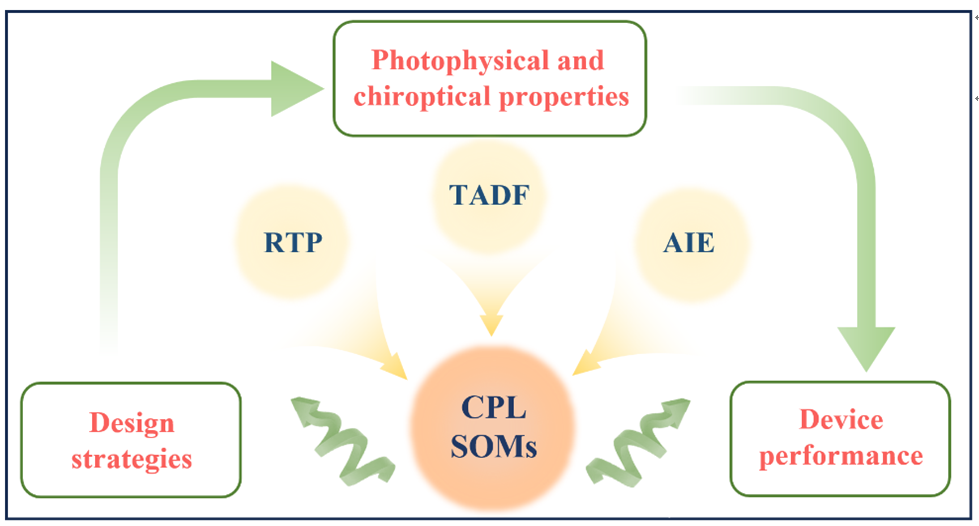
圆偏振发光材料在3D显示等领域展现出广阔的应用前景, 近年来备受关注. 其中, 有机小分子因其结构与性质关系明确等优势, 成为构建圆偏振发光材料的重要体系. 与此同时, 室温磷光及热活化延迟荧光材料可有效利用三重态激子, 聚集诱导发光材料则能避免聚集诱导淬灭现象. 因此, 具有室温磷光、热活化延迟荧光、聚集诱导发光性质的多功能圆偏振发光材料, 不仅显著提升了光学性能与器件效率, 也极大拓宽了其应用范围. 首先简要介绍圆偏振发光有机小分子的基本概念, 进而重点探究了多功能圆偏振发光有机小分子的设计策略、光学性质及器件性能, 最后总结并展望了该类材料当前面临的挑战及未来的研究方向.
张梦媛, 袁之敏. 多功能圆偏振发光有机小分子[J]. 有机化学, 2026, 46(5): 1871-1882.
Mengyuan Zhang, Zhimin Yuan. Multifunctional Circularly Polarized Luminescence of Small Organic Molecules[J]. Chinese Journal of Organic Chemistry, 2026, 46(5): 1871-1882.
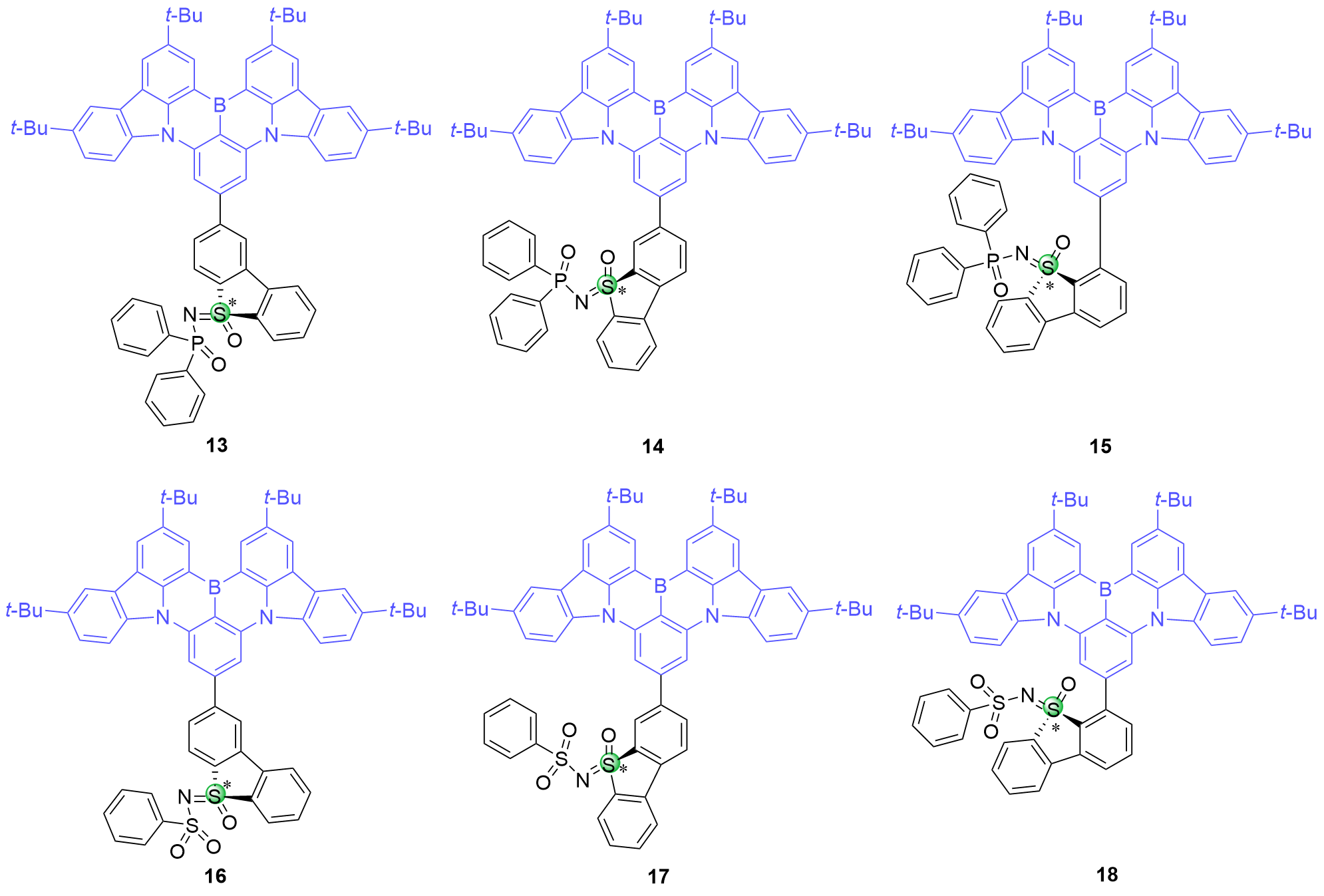
| Compd. | λPLa/nm | FWHMa/nm | ΔESTa/eV | ΦF b/% | |glum| c/10-3 |
|---|---|---|---|---|---|
| 13 | 497 | 26 | 0.03 | 90.9 | 2.9 |
| 14 | 505 | 28 | 0.05 | 86.5 | 4.7 |
| 15 | 495 | 25 | 0.03 | 92.0 | 1.9 |
| 16 | 503 | 29 | 0.10 | 92.7 | 1.7 |
| 17 | 509 | 29 | 0.09 | 91.2 | 5.4 |
| 18 | 496 | 25 | 0.11 | 92.8 | 0.6 |
| Compd. | λPLa/nm | FWHMa/nm | ΔESTa/eV | ΦF b/% | |glum| c/10-3 |
|---|---|---|---|---|---|
| 13 | 497 | 26 | 0.03 | 90.9 | 2.9 |
| 14 | 505 | 28 | 0.05 | 86.5 | 4.7 |
| 15 | 495 | 25 | 0.03 | 92.0 | 1.9 |
| 16 | 503 | 29 | 0.10 | 92.7 | 1.7 |
| 17 | 509 | 29 | 0.09 | 91.2 | 5.4 |
| 18 | 496 | 25 | 0.11 | 92.8 | 0.6 |


| [1] |
doi: 10.1021/cr60310a001 |
| [2] |
doi: 10.1002/tcr.v22.1 |
| [3] |
doi: 10.1002/anie.v62.20 |
| [4] |
doi: 10.1007/s11426-021-1146-6 |
| [5] |
doi: 10.1038/s41467-023-38801-1 |
| [6] |
doi: 10.1002/anie.v64.4 |
| [7] |
doi: 10.1016/j.cej.2022.138390 |
| [8] |
doi: 10.1002/adma.v32.41 |
| [9] |
doi: 10.1002/cptc.v6.3 |
| [10] |
doi: 10.1002/chir.v27.1 |
| [11] |
doi: 10.1002/asia.v19.9 |
| [12] |
doi: 10.1002/chem.v27.9 |
| [13] |
doi: 10.1021/acs.jpclett.0c03174 |
| [14] |
doi: 10.1002/anie.v60.2 |
| [15] |
doi: 10.1039/D5TC00097A |
| [16] |
doi: 10.1002/adom.v11.6 |
| [17] |
|
| [18] |
doi: 10.3390/nano12030424 |
| [19] |
doi: 10.1007/s11426-024-2084-1 |
| [20] |
doi: 10.1039/C9CC05109K |
| [21] |
doi: 10.1039/D4CC01698J |
| [22] |
doi: 10.6023/A17090440 |
|
(李猛, 林伟彬, 房蕾, 陈传峰, 化学学报, 2017, 75, 1150.)
doi: 10.6023/A17090440 |
|
| [23] |
|
|
(曹恒昱, 高之胜, 闫馨, 李欢欢, 陶冶, 化学进展, 2025, 37, 949.)
doi: 10.7536/PC240907 |
|
| [24] |
doi: 10.6023/cjoc202208023 |
|
(杨晓东, 郑小康, 董海亮, 孙静, 王华, 有机化学, 2023, 43, 1292.)
doi: 10.6023/cjoc202208023 |
|
| [25] |
doi: 10.1002/anie.v64.3 |
| [26] |
|
|
(于兰, 薛沛然, 李欢欢, 陶冶, 陈润锋, 黄维, 化学进展, 2022, 34, 1996.)
doi: 10.7536/PC210818 |
|
| [27] |
doi: 10.1016/j.ccr.2020.213329 |
| [28] |
doi: 10.1039/D3QM01125A |
| [29] |
doi: 10.1038/25954 |
| [30] |
doi: 10.1002/anie.v57.28 |
| [31] |
doi: 10.1039/D3TC04514E |
| [32] |
doi: 10.1021/acsami.0c17295 |
| [33] |
doi: 10.1039/D1TC03030B |
| [34] |
doi: 10.1002/adfm.v35.14 |
| [35] |
doi: 10.1002/chir.v35.7 |
| [36] |
|
| [37] |
doi: 10.1002/adfm.v23.27 |
| [38] |
doi: 10.1021/acs.jpclett.6b00554 pmid: 27058743 |
| [39] |
doi: 10.1002/anie.v61.30 |
| [40] |
doi: 10.1002/anie.v59.12 |
| [41] |
doi: 10.1002/smll.v19.46 |
| [42] |
doi: 10.1002/anie.v58.48 |
| [43] |
doi: 10.1038/s41566-024-01538-4 |
| [44] |
doi: 10.1002/adfm.v31.20 |
| [45] |
doi: 10.1002/tcr.v19.8 |
| [46] |
doi: 10.1002/adom.v13.1 |
| [47] |
doi: 10.1039/D2QO01383E |
| [48] |
doi: 10.1039/C5CC04105H |
| [49] |
doi: 10.1039/d4mh00605d pmid: 38990337 |
| [50] |
doi: 10.1007/s11426-024-2560-9 |
| [51] |
doi: 10.1002/adfm.v35.1 |
| [52] |
doi: 10.1002/anie.v64.40 |
| [53] |
doi: 10.1002/adom.v12.13 |
| [54] |
doi: 10.1021/acs.orglett.8b02995 |
| [55] |
|
| [56] |
doi: 10.1002/adma.v34.36 |
| [57] |
|
| [58] |
doi: 10.1002/anie.v63.18 |
| [59] |
|
| [60] |
doi: 10.1039/D3CS00698K |
| [61] |
doi: 10.1021/acs.chemrev.5b00263 pmid: 26492387 |
| [62] |
doi: 10.1007/s11237-018-9558-6 |
| [63] |
doi: 10.1360/972009-2307 |
|
(闫继明, 秦安军, 孙景志, 唐本忠, 科学通报, 2010, 55, 1206.)
|
|
| [64] |
doi: 10.1186/s43074-020-00012-y |
| [65] |
|
| [66] |
doi: 10.1002/chem.v20.47 |
| [67] |
doi: 10.1002/anie.v57.18 |
| [68] |
doi: 10.1039/C8CS00444G |
| [69] |
doi: 10.1021/acsami.7b12320 |
| [70] |
doi: 10.1039/b921610c |
| [71] |
doi: 10.1021/jacs.6b07087 |
| [72] |
doi: 10.1002/adom.v12.11 |
| [73] |
doi: 10.1016/j.dyepig.2023.111422 |
| [74] |
doi: 10.1002/anie.v59.9 |
| [75] |
doi: 10.1002/anie.v61.28 |
| [76] |
doi: 10.1002/adom.v12.16 |
| [77] |
doi: 10.1002/agt2.70069 |
| [1] | 周顺丽, 刘继, 雷婷, 杨斌全, 江世智. 2-芳基-2H-色烯类化合物的手性合成研究进展[J]. 有机化学, 2026, 46(3): 773-785. |
| [2] | 张继东, 王浩, 权校昕, 张胜海, 厍伟. 基于四苯乙烯结构的聚集诱导发光效应(AIE)有机多晶体合成: 分子构象和Cys检测性能研究[J]. 有机化学, 2026, 46(3): 934-940. |
| [3] | 朱俊宇, 廖金龙, 戴雷, 陈文铖, 霍延平. 基于间三联苯修饰的热活化延迟荧光主体材料的设计、合成及电致发光性能研究[J]. 有机化学, 2025, 45(9): 3390-3400. |
| [4] | 闫鹏泽, 高淑莉, 李天瑞, 苗金玲, 蒋绪川, 聂永. 碳硼烷聚集诱导发光化合物的合成研究进展[J]. 有机化学, 2025, 45(8): 2677-2697. |
| [5] | 江小妹, 谭海军, 平力文, 胡振光. 苯并咪唑类受体(A)-π-供体(D)型小分子蓝紫色传统荧光材料[J]. 有机化学, 2025, 45(8): 2896-2906. |
| [6] | 李艳秋, 贾亚薇, 陈磅宽. 手性共轭有机三芳基硼(Ar3B)发光材料研究进展[J]. 有机化学, 2025, 45(4): 1119-1136. |
| [7] | 高玉兰, 龙江琴, 王秋生. 9-芴基甲氧基羰基-酪氨酸掺杂聚乙烯醇室温磷光薄膜性质研究[J]. 有机化学, 2025, 45(4): 1261-1267. |
| [8] | 罗婷, 肖宇峰, 李珣, 夏雯, 张卡卡. 基于分子内电荷转移技术构建高效热激活延迟荧光型有机余辉材料[J]. 有机化学, 2025, 45(11): 4202-4209. |
| [9] | 代鸿宇, 孙红红, 魏培发, 管伟江. 高效聚集诱导发光光敏剂的合成策略[J]. 有机化学, 2025, 45(11): 4128-4142. |
| [10] | 宋青岳, 杨桂懿, 张樾, 丘子杰. 螺烯衍生物的合成及其光电性质研究进展[J]. 有机化学, 2025, 45(11): 3953-3973. |
| [11] | 孙翠萍, 薛雨婷, 陈磅宽. 杂螺烯圆偏振发光材料的研究进展[J]. 有机化学, 2025, 45(11): 4048-4069. |
| [12] | 陈紫薇, 段思康, 汪乙慧, 范华丹, 杨梦婕, 王思斯, 卢华. 外围基团诱导β-异靛蓝骨架氮杂-氟硼二吡咯(BODIPY)类似物的手性研究[J]. 有机化学, 2025, 45(11): 4163-4170. |
| [13] | 赵晨阳, 任静晓, 欧阳光辉, 刘鸣华. 手性双芘-谷氨酸两亲分子的超分子组装及圆偏振发光调控[J]. 有机化学, 2025, 45(11): 4171-4177. |
| [14] | 陈冰燕, 孙洁, 熊玲红, 何学文. 非典型核酸结构的荧光点亮成像检测[J]. 有机化学, 2025, 45(11): 4082-4107. |
| [15] | 陈怡萱, 赵征. 聚集诱导发光光敏剂用于光动力抗菌治疗[J]. 有机化学, 2025, 45(11): 3998-4012. |
| 阅读次数 | ||||||
|
全文 |
|
|||||
|
摘要 |
|
|||||


