有机化学 ›› 2026, Vol. 46 ›› Issue (8): 3202-3211.DOI: 10.6023/cjoc202603005 上一篇 下一篇
研究论文
许嘉龙a, 王旭锋b, 岳亭廷a, 李媛媛a, 姬小明a,*( ), 程彪a,*()
收稿日期:2026-03-04
修回日期:2026-04-24
发布日期:2026-05-13
基金资助:
Jialong Xua, Xufeng Wangb, Tingting Yuea, Yuanyuan Lia, Xiaoming Jia,*(), Biao Chenga,*()
Received:2026-03-04
Revised:2026-04-24
Published:2026-05-13
Contact:
*E-mail: xiaomingji@henau.edu.cn; chengbiao@henau.edu.cn
Supported by:文章分享
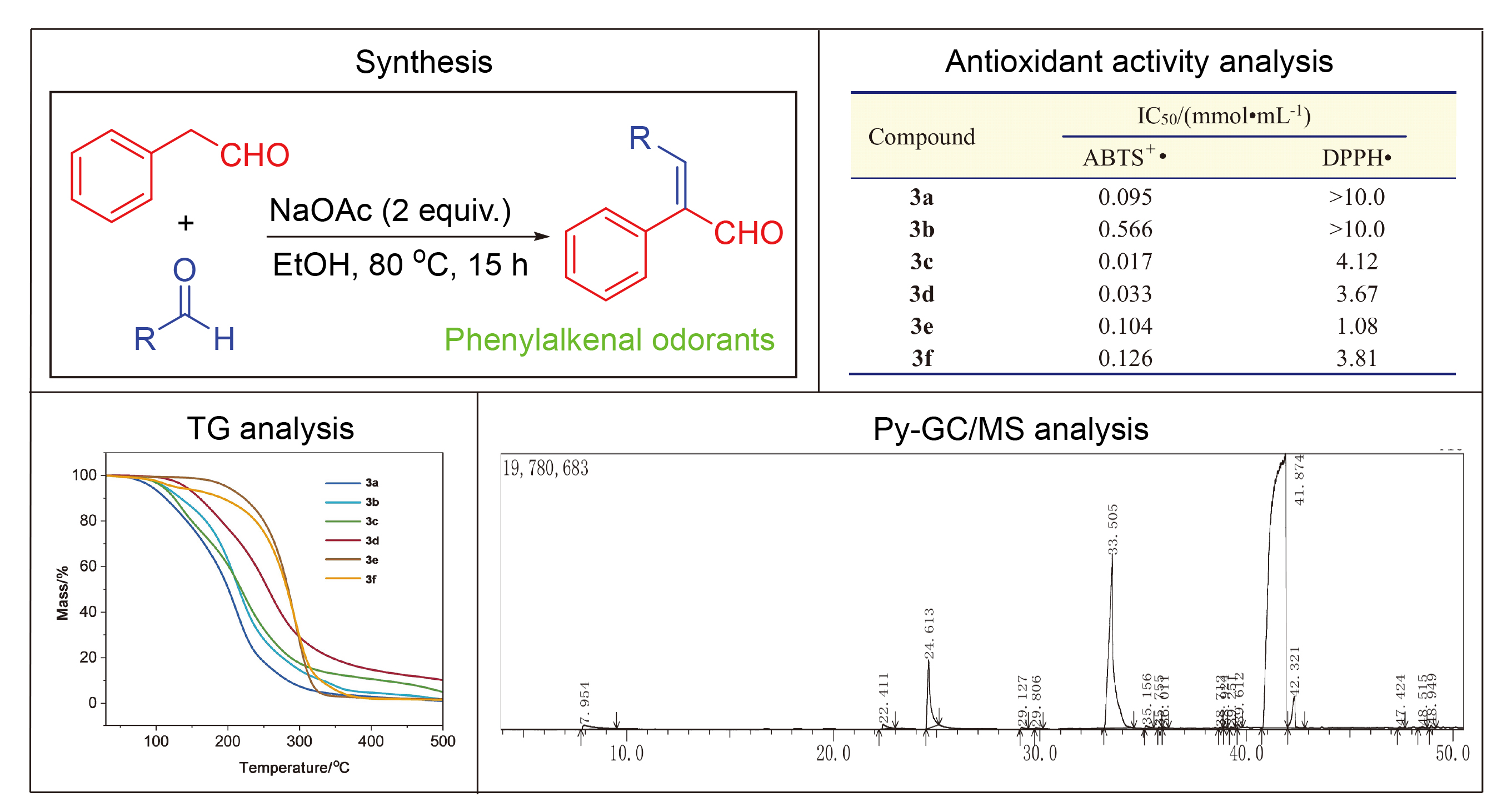
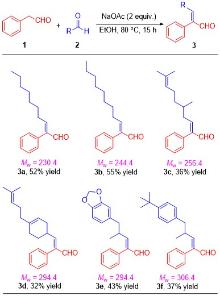
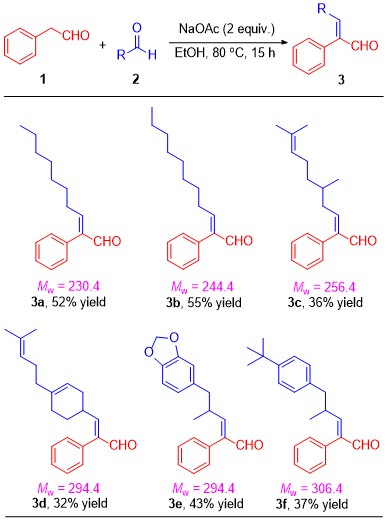
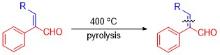
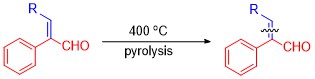
苯基烯醛类化合物因分子中含有芳环、醛基等致香基团, 在香精香料领域具有重要应用, 是一类关键的呈香物质. 以无水乙醇为溶剂, 乙酸钠为碱性试剂, 通过苯乙醛与不同烷基醛的交叉羟醛缩合反应, 合成了6种新型苯基烯醛类化合物. 采用核磁共振(1H NMR、13C NMR)、红外光谱(IR)和高分辨质谱(HRMS)对目标化合物的结构进行了表征. 通过感官评价小组评价了它们的香气特征. 利用热重-微商热重分析(TG-DTG)和热解-气相色谱/质谱联用技术(Py-GC/ MS)分析了它们的热行为. TG-DTG分析确定了90%质量损失对应的温度范围和最大质量损失速率对应的温度. 结果表明, 除化合物3d外, 其余5种化合物均满足加热不燃烧卷烟中香味成分的挥发性要求. 在400 ℃下进行的Py-GC/MS结果表明, 所有6种化合物均发生部分热解, 生成多种有助于丰富香韵的芳香产物. 抗氧化活性研究显示, 所有6种化合物均表现出显著的抗氧化活性. 其中, 化合物3c对ABTS+•自由基的清除能力最强, 化合物3e对DPPH•自由基的清除效率最高. 本研究为开发新型、特别是适用于加热不燃烧卷烟的风味物质提供了新的候选化合物, 其在烟草产品配方以及食品添加剂等领域具有良好的应用前景.
许嘉龙, 王旭锋, 岳亭廷, 李媛媛, 姬小明, 程彪. 苯基烯醛呈香物质的合成、热解及其抗氧化活性研究[J]. 有机化学, 2026, 46(8): 3202-3211.
Jialong Xu, Xufeng Wang, Tingting Yue, Yuanyuan Li, Xiaoming Ji, Biao Cheng. Synthesis, Pyrolysis, and Antioxidant Activity of Phenylalkenal Odorants[J]. Chinese Journal of Organic Chemistry, 2026, 46(8): 3202-3211.
| Compound | Odor description |
|---|---|
| 3a | Balsamic fragrance; cocoa fragrance |
| 3b | Balsamic fragrance; cocoa fragrance |
| 3c | Citrus green fragrance; cocoa fragrance |
| 3d | Citrus green fragrance; rose fragrance |
| 3e | Vanilla-like; sweet spicy |
| 3f | Fresh floral; sweet spicy |
| Compound | Odor description |
|---|---|
| 3a | Balsamic fragrance; cocoa fragrance |
| 3b | Balsamic fragrance; cocoa fragrance |
| 3c | Citrus green fragrance; cocoa fragrance |
| 3d | Citrus green fragrance; rose fragrance |
| 3e | Vanilla-like; sweet spicy |
| 3f | Fresh floral; sweet spicy |
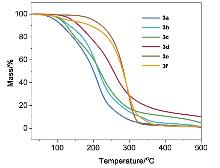
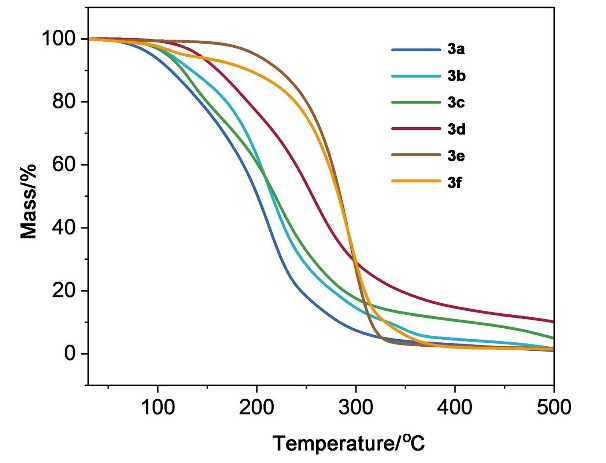
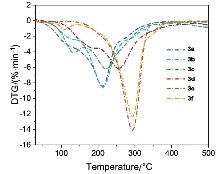
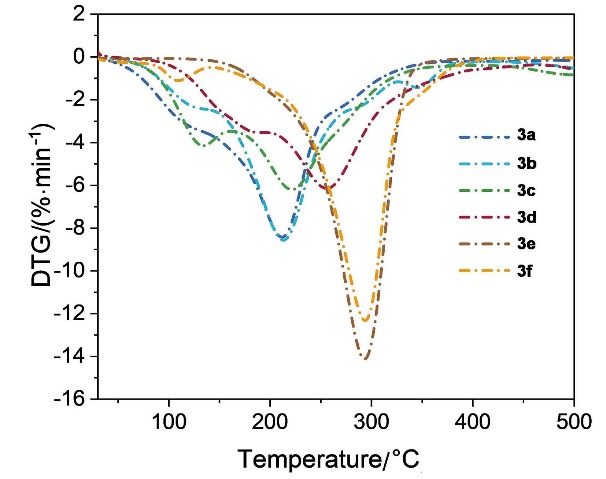
| Compound | Trangea/℃ | Tpb/℃ |
|---|---|---|
| 3a | 83~304 | 211 |
| 3b | 94~348 | 213 |
| 3c | 92~459 | 221 |
| 3d | 118~524 | 255 |
| 3e | 187~321 | 293 |
| 3f | 92~338 | 294 |
| Compound | Trangea/℃ | Tpb/℃ |
|---|---|---|
| 3a | 83~304 | 211 |
| 3b | 94~348 | 213 |
| 3c | 92~459 | 221 |
| 3d | 118~524 | 255 |
| 3e | 187~321 | 293 |
| 3f | 92~338 | 294 |
| Peak | r.t./min | Pyrolysis product | Structure | Match | Relative content/% |
|---|---|---|---|---|---|
| 1 | 8.38 | Octanal | | 98 | 8.3 |
| 2 | 12.78 | Octanoic acid | | 96 | 22.5 |
| 3 | 17.79 | 2-Phenyldecanal | | 85 | 17.7 |
| 4 | 18.15 | Compound 3a | | 96 | 30.2 |
| Peak | r.t./min | Pyrolysis product | Structure | Match | Relative content/% |
|---|---|---|---|---|---|
| 1 | 8.38 | Octanal | | 98 | 8.3 |
| 2 | 12.78 | Octanoic acid | | 96 | 22.5 |
| 3 | 17.79 | 2-Phenyldecanal | | 85 | 17.7 |
| 4 | 18.15 | Compound 3a | | 96 | 30.2 |
| Peak | r.t./min | Pyrolysis product | Structure | Match | Relative content/% |
|---|---|---|---|---|---|
| 1 | 10.27 | Nonanal | | 98 | 16.3 |
| 2 | 13.77 | Nonanoic acid | | 96 | 10.4 |
| 3 | 18.42 | 2-Phenylundecanal | | 82 | 17.0 |
| 4 | 18.74 | Compound 3b | | 95 | 43.0 |
| Peak | r.t./min | Pyrolysis product | Structure | Match | Relative content/% |
|---|---|---|---|---|---|
| 1 | 10.27 | Nonanal | | 98 | 16.3 |
| 2 | 13.77 | Nonanoic acid | | 96 | 10.4 |
| 3 | 18.42 | 2-Phenylundecanal | | 82 | 17.0 |
| 4 | 18.74 | Compound 3b | | 95 | 43.0 |
| Peak | r.t./min | Pyrolysis product | Structure | Match | Relative content/% |
|---|---|---|---|---|---|
| 1 | 11.07 | 3,7-Dimethyloct-6-enal | | 96 | 15.2 |
| 2 | 12.89 | 3,7-Dimethyloct-6-en-1-ol | | 89 | 22.7 |
| 3 | 18.86 | (Z)-5,9-Dimethyl-2-phenyldeca-2,8-dienal | | 90 | 16.5 |
| 4 | 19.51 | Compound 3c | | 95 | 18.8 |
| Peak | r.t./min | Pyrolysis product | Structure | Match | Relative content/% |
|---|---|---|---|---|---|
| 1 | 11.07 | 3,7-Dimethyloct-6-enal | | 96 | 15.2 |
| 2 | 12.89 | 3,7-Dimethyloct-6-en-1-ol | | 89 | 22.7 |
| 3 | 18.86 | (Z)-5,9-Dimethyl-2-phenyldeca-2,8-dienal | | 90 | 16.5 |
| 4 | 19.51 | Compound 3c | | 95 | 18.8 |
| Peak | r.t./min | Pyrolysis product | Structure | Match | Relative content/% |
|---|---|---|---|---|---|
| 1 | 15.83 | 4-(4-Methylpent-3-en-1-yl)cyclohex-3-ene- 1-carbaldehyde | | 92 | 15.9 |
| 2 | 20.68 | (Z)-3-(4-(4-methylpent-3-en-1-yl)cyclohex- 3-en-1-yl)-2-phenylacrylaldehyde | | 93 | 16.5 |
| 3 | 20.88 | Compound 3d | | 95 | 39.3 |
| Peak | r.t./min | Pyrolysis product | Structure | Match | Relative content/% |
|---|---|---|---|---|---|
| 1 | 15.83 | 4-(4-Methylpent-3-en-1-yl)cyclohex-3-ene- 1-carbaldehyde | | 92 | 15.9 |
| 2 | 20.68 | (Z)-3-(4-(4-methylpent-3-en-1-yl)cyclohex- 3-en-1-yl)-2-phenylacrylaldehyde | | 93 | 16.5 |
| 3 | 20.88 | Compound 3d | | 95 | 39.3 |
| Peak | r.t./min | Pyrolysis products | Structure | Match | Relative content/% |
|---|---|---|---|---|---|
| 1 | 24.61 | 3-(Benzo[d][1,3]dioxol-5-yl)-2-methylpropanal | | 93 | 3.89 |
| 2 | 33.51 | Methyl 3-(benzo[d][1,3]dioxol-5-yl)-2-methylpropanoate | | 82 | 16.48 |
| 3 | 41.87 | Compound 3e | | 92 | 75.82 |
| Peak | r.t./min | Pyrolysis products | Structure | Match | Relative content/% |
|---|---|---|---|---|---|
| 1 | 24.61 | 3-(Benzo[d][1,3]dioxol-5-yl)-2-methylpropanal | | 93 | 3.89 |
| 2 | 33.51 | Methyl 3-(benzo[d][1,3]dioxol-5-yl)-2-methylpropanoate | | 82 | 16.48 |
| 3 | 41.87 | Compound 3e | | 92 | 75.82 |
| Peak | r.t./min | Pyrolysis product | Structure | Match | Relative content/% |
|---|---|---|---|---|---|
| 1 | 23.37 | 3-(4-(tert-Butyl)phenyl)-2-methylpropanal | | 96 | 10.4 |
| 2 | 28.64 | 3-(4-(tert-Butyl)phenyl)-2-methylpropanoic acid | | 95 | 4.1 |
| 3 | 40.01 | Compound 3f | | 92 | 80.9 |
| Peak | r.t./min | Pyrolysis product | Structure | Match | Relative content/% |
|---|---|---|---|---|---|
| 1 | 23.37 | 3-(4-(tert-Butyl)phenyl)-2-methylpropanal | | 96 | 10.4 |
| 2 | 28.64 | 3-(4-(tert-Butyl)phenyl)-2-methylpropanoic acid | | 95 | 4.1 |
| 3 | 40.01 | Compound 3f | | 92 | 80.9 |
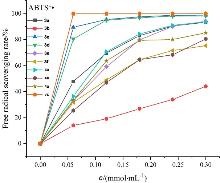
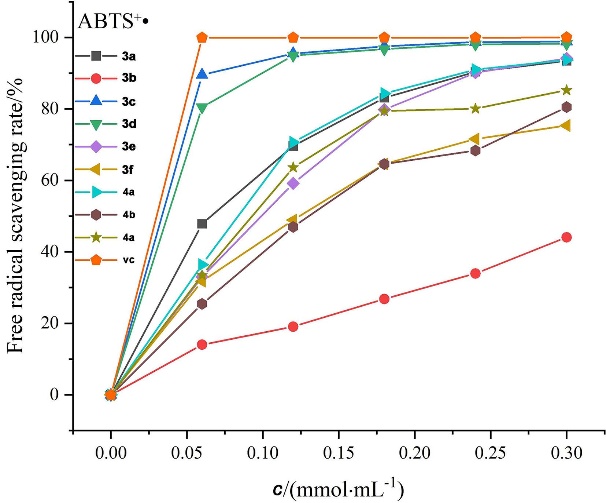
| Compound | Structure | IC50/(mol•L-1) | |
|---|---|---|---|
| ABTS+• | DPPH• | ||
| 3a | | 0.095 | >10.0 |
| 3b | | 0.566 | >10.0 |
| 3c | | 0.017 | 4.12 |
| 3d | | 0.033 | 3.67 |
| 3e | | 0.104 | 1.08 |
| 3f | | 0.126 | 3.81 |
| 4a | | 0.078 | >10.0 |
| 4b | | 0.126 | 0.03 |
| 4c | | 0.088 | 4.76 |
| Compound | Structure | IC50/(mol•L-1) | |
|---|---|---|---|
| ABTS+• | DPPH• | ||
| 3a | | 0.095 | >10.0 |
| 3b | | 0.566 | >10.0 |
| 3c | | 0.017 | 4.12 |
| 3d | | 0.033 | 3.67 |
| 3e | | 0.104 | 1.08 |
| 3f | | 0.126 | 3.81 |
| 4a | | 0.078 | >10.0 |
| 4b | | 0.126 | 0.03 |
| 4c | | 0.088 | 4.76 |
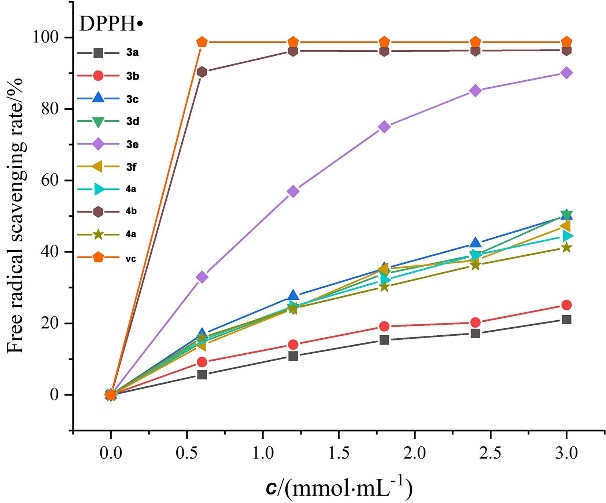
| [1] |
|
|
(刘树文, 合成香料技术手册, 中国轻工业出版社, 北京, 2000).
|
|
| [2] |
|
|
(凌关庭, 食品添加剂手册(第三版), 化学工业出版社, 北京, 2003).
|
|
| [3] |
|
|
(谢剑平, 烟草香原料,化学工业出版社, 北京, 2009.)
|
|
| [4] |
|
|
(谢剑平, 烟草香原料, 第二篇, 第五章, 化学工业出版社, 2009, p. 141.)
|
|
| [5] |
|
| [6] |
|
| [7] |
|
| [8] |
|
| [9] |
|
| [10] |
|
| [11] |
|
|
(张悠金, 金闻博, 烟用香料香精, 中国科学技术大学出版社, 合肥, 1996.)
|
|
| [12] |
|
|
(刘强, 候春, 李海涛, 宗永立, 宋瑜冰, 屈展, 李炎强, 杨春强, 中国烟草学报, 2008, 14, 1.)
|
|
| [13] |
|
|
(付培培, 赵铭钦, 来苗, 包晓容, 姬小明, 王鹏泽, 尤方芳, 陈发元, 烟草科技, 2015, 48, 63.)
|
|
| [14] |
|
|
(单园园, 来苗, 赵铭钦, 姬小明, 精细化工, 2017, 34, 1010.)
|
|
| [15] |
|
| [16] |
|
|
(梁德民, 张玮, 王嘉乐, 费婷, 李德国, 奚安, 顾文博, 吴达, 烟草科技, 2023, 56, 74.)
|
|
| [17] |
|
|
(张改红, 杜帅, 许航, 石栋栋, 尚紫博, 薛晶晶, 王梦瑶, 许志杰, 毛多斌, 烟草科技, 2024, 57, 1.)
|
|
| [18] |
|
|
(段海波, 解万翠, 姜黎, 杨乾栩, 冒德寿, 丁美玉, 李明爽, 杨锡洪, 雷声, 烟草科技, 2019, 52, 57.)
|
|
| [19] |
|
|
(张改红, 石栋栋, 许航, 杜帅, 尚紫博, 谢俊杰, 白冰, 毛多斌, 烟草科技, 2024, 57, 20.)
|
|
| [20] |
|
| [21] |
|
| [22] |
|
| [23] |
|
| [24] |
|
| [25] |
|
| [26] |
|
|
(张晓雨, 李欣燕, 崔冰, 邵志晖, 赵铭钦, 有机化学, 2023, 43, 2885.)
|
|
| [27] |
|
|
(单虹宇, 于雅静, 吕远平, 食品科技, 2018, 43, 197.)
|
|
| [28] |
|
|
(张培全, 曾和平, 有机化学, 2008, 28, 1035.)
|
| [1] | 于兆锦, 张展, 王海洋, 王波, 付光明, 张瑛, 杨晓朋, 董爱君, 姬小明. 乙基麦芽酚丁二酸双酯的合成、热解及抗氧化研究[J]. 有机化学, 2024, 44(5): 1526-1534. |
| [2] | 赵婷, 农旭华, 王佳莉, 许宽毓, 唐敏敏, 易继凌, 韩长日, 陈光英. 长花龙血树茎中抗氧化活性的木脂素类成分研究[J]. 有机化学, 2023, 43(8): 2968-2972. |
| [3] | 张晓雨, 李欣燕, 崔冰, 邵志晖, 赵铭钦. 四氢-β-咔啉衍生物的设计、合成及抗氧化性能研究[J]. 有机化学, 2023, 43(8): 2885-2894. |
| [4] | 全翌雯, 蒋心惠, 李文军, 汪舰. 借助有机催化去共轭-羟醛缩合反应来获得α-乙烯基-β-炔基取代的烯醛[J]. 有机化学, 2023, 43(6): 2120-2125. |
| [5] | 廖楚婕, 阮洪瑶, 姜峻峰, 罗伦, 胡扬根. 3-芳基-2-亚胺-苯并[e]-1,3-噁嗪-4-醇衍生物的合成及活性评价[J]. 有机化学, 2023, 43(2): 763-770. |
| [6] | 王斌, 曾尾女, 李杲钰, 肖媚, 韦方芳, 罗由萍, 钮智刚, 黄国雷, 郑彩娟. 红树来源真菌Daldinia eschscholtzii HJ004发酵产物中三个新的次级代谢产物[J]. 有机化学, 2023, 43(1): 332-337. |
| [7] | 易继凌, 施康琦, 吴冰林, 黎婉珊, 陈光英. 海洋来源真菌Eutypella sp. F0219次级代谢产物研究[J]. 有机化学, 2023, 43(1): 295-298. |
| [8] | 李蕾, 朱聪聪, 朱全刚, 陈中建, 高希珂. 愈创木薁衍生物的设计合成及其抗氧化、抗炎活性研究[J]. 有机化学, 2022, 42(9): 2906-2913. |
| [9] | 高娜, 初晓辉, 刘洋, 李家柱, 王进军. 焦脱镁叶绿酸的区域和立体选择性的芳(芳酰)亚甲基化及其叶绿素类二氢卟吩衍生物的合成[J]. 有机化学, 2022, 42(4): 1111-1122. |
| [10] | 毛雅君, 邵香敏, 李阳杰, 曹瑞梅, 冯亚莉, 翟广玉. 槲皮素衍生物的合成研究进展[J]. 有机化学, 2022, 42(11): 3588-3605. |
| [11] | 蔡瑾, 农旭华, 王斌, 曾尾女, 黄国雷, 张子怡, 郑彩娟. 红树来源真菌Eupenicillium sp. HJ002发酵产物中三个新的聚酮类化合物[J]. 有机化学, 2021, 41(7): 2905-2909. |
| [12] | 张晓平, 金桂勇, 陈芝飞, 王清福, 赵森森, 武志勇, 万帅, 席高磊, 赵旭. 吡嗪-噻唑联芳类化合物的合成及抗氧化性能研究[J]. 有机化学, 2021, 41(6): 2445-2453. |
| [13] | 张强健, 王芸芸, 赵雨珣, 马崇慧, 徐徐, 谷文, 杨益琴, 王石发. 樟脑磺酸噻唑腙类化合物的设计、合成及抗氧化应用[J]. 有机化学, 2019, 39(9): 2616-2624. |
| [14] | 吴建章, 李物兰, 陈玲姿, 楚生辉, 赵承光, 卫涛, 杨树林, 李校堃. 查尔酮及其螺杂环衍生物的合成、晶体结构、抗氧化活性研究[J]. 有机化学, 2012, 32(11): 2141-2147. |
| [15] | 荣良策, 魏贤勇, 路瑶, 宗志敏 . 无溶剂条件下简单、有效的合成多取代环己醇[J]. 有机化学, 2012, 32(10): 1999-2002. |
| 阅读次数 | ||||||
|
全文 |
|
|||||
|
摘要 |
|
|||||


