化学学报 ›› 2026, Vol. 84 ›› Issue (7): 1019-1024.DOI: 10.6023/A25110389 上一篇 下一篇
研究通讯
张帮红, 张恒, 张斯涵, 郝建博, 张野*( ), 王少华*()
投稿日期:2025-11-29
发布日期:2026-02-02
基金资助:
Banghong Zhang, Heng Zhang, Sihan Zhang, Jianbo Hao, Ye Zhang*(), Shaohua Wang*()
Received:2025-11-29
Published:2026-02-02
Contact:
* E-mail: zhang_ye@lzu.edu.cn;
wangshh@lzu.edu.cn
Supported by:文章分享
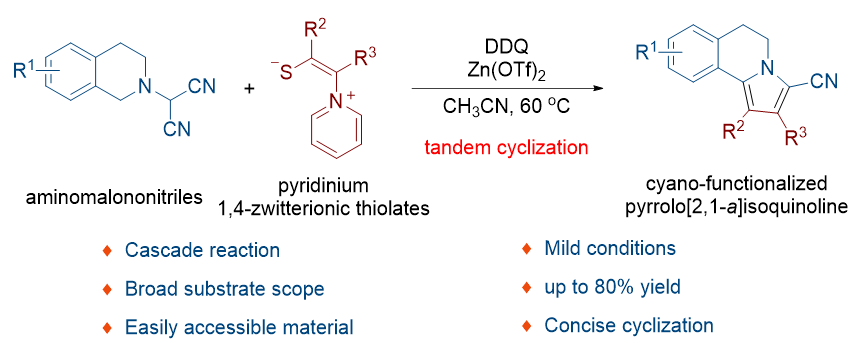
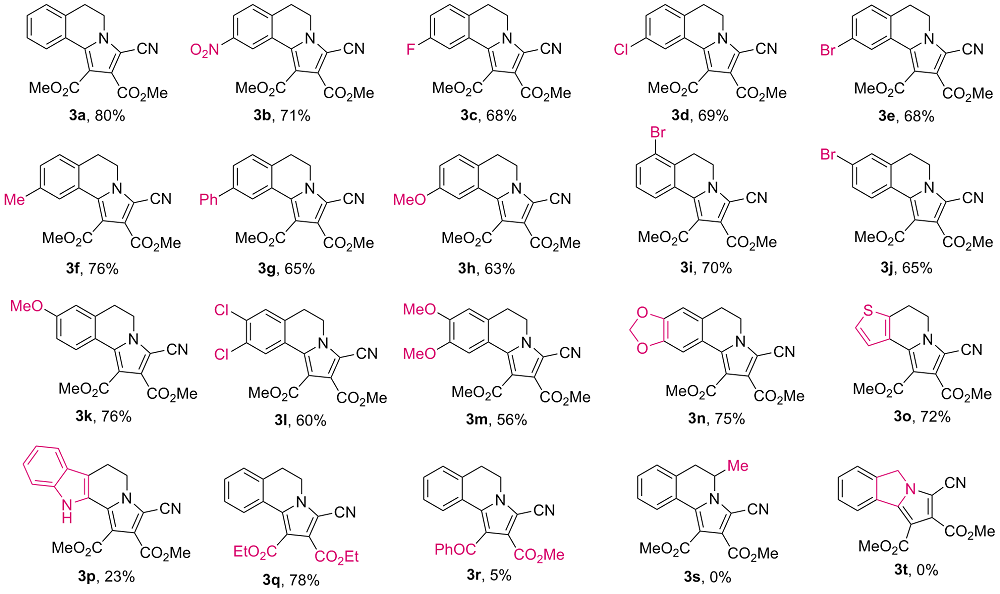
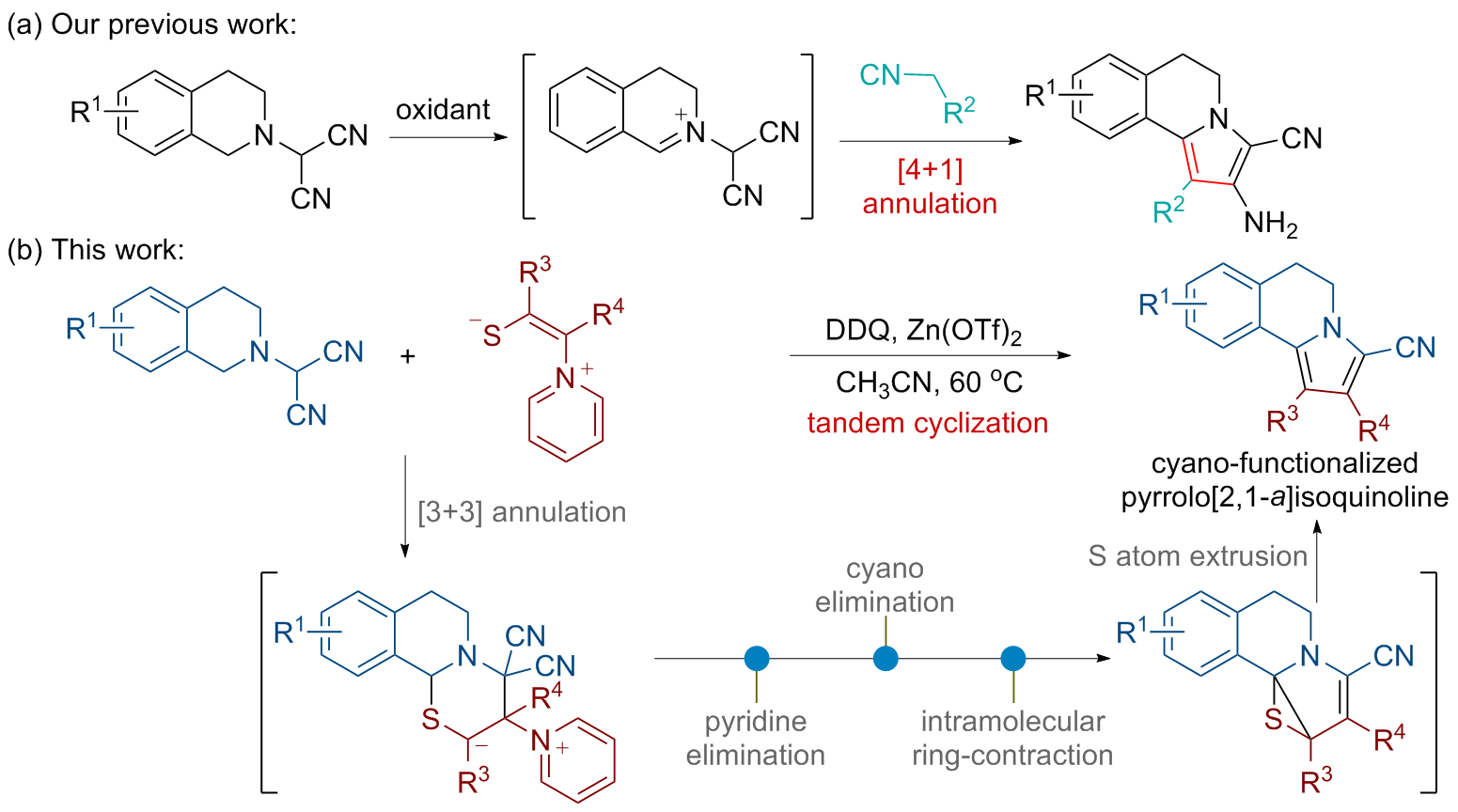
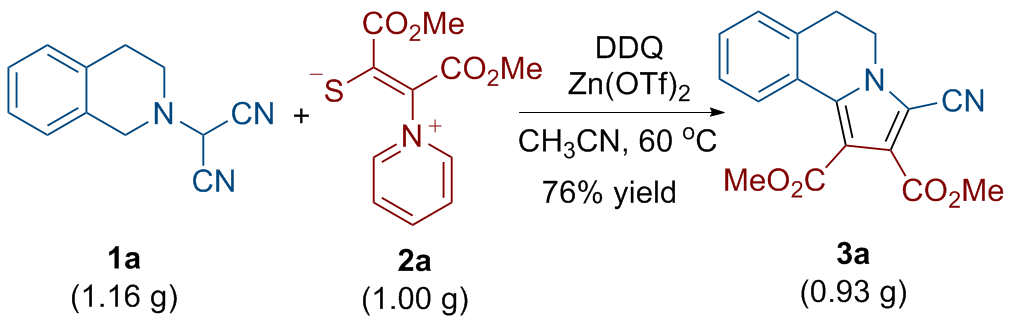
含氮杂环骨架广泛存在于生物活性分子与功能材料中, 因而推动其绿色、经济和高效合成是该领域的研究重点.发展了一种以氨基丙二腈为关键中间体的串联环化新方法, 用于构建此类骨架. 在2,3-二氯-5,6-二氰基-1,4-苯醌(DDQ)和Zn(OTf)2的协同作用下, 由四氢异喹啉衍生的氨基丙二腈原位生成1,3-偶极子, 进而与1,4-吡啶硫内鎓盐发生环化反应, 高效构建了一系列吡咯并[2,1-a]异喹啉衍生物. 该方法反应条件温和, 底物适用范围广, 为含氰基官能团的吡咯并[2,1-a]异喹啉杂环骨架的合成提供了一条简便高效的路径, 同时也拓展了氨基腈类化合物在转化中的应用. 实验结果表明, 氧化剂与Lewis酸催化剂的协同效应是实现该环化反应高效进行的关键.
张帮红, 张恒, 张斯涵, 郝建博, 张野, 王少华. 氨基丙二腈与1,4-吡啶硫内鎓盐的环化反应构建吡咯并[2,1-a]异喹啉衍生物[J]. 化学学报, 2026, 84(7): 1019-1024.
Banghong Zhang, Heng Zhang, Sihan Zhang, Jianbo Hao, Ye Zhang, Shaohua Wang. An Efficient Cyclization of Aminomalononitriles with Pyridinium 1,4-Zwitterionic Thiolates toward Pyrrolo[2,1-a]isoquinolines[J]. Acta Chimica Sinica, 2026, 84(7): 1019-1024.
| Entry | Cat. | Solvent | Ratio of 1a/2a | Temp./℃ | Yield/% |
|---|---|---|---|---|---|
| 1 | Cu(OTf)2 | MeCN | 1.5∶1 | 60 | 51 |
| 2 | Al(OTf)3 | MeCN | 1.5∶1 | 60 | 49 |
| 3 | Mg(OTf)2 | MeCN | 1.5∶1 | 60 | 63 |
| 4 | Sc(OTf)3 | MeCN | 1.5∶1 | 60 | 71 |
| 5 | In(OTf)3 | MeCN | 1.5∶1 | 60 | 64 |
| 6 | Al(OTf)3 | MeCN | 1.5∶1 | 60 | 55 |
| 7 | FeCl3 | MeCN | 1.5∶1 | 60 | n.d.d |
| 8 | Zn(OTf)2 | MeCN | 1.5∶1 | 60 | 80 |
| 9 | Zn(OTf)2 | DCE | 1.5∶1 | 60 | 43 |
| 10 | Zn(OTf)2 | THF | 1.5∶1 | 60 | 56 |
| 11 | Zn(OTf)2 | 1,4-Dioxane | 1.5∶1 | 60 | 37 |
| 12b | Zn(OTf)2 | MeCN | 1.5∶1 | 60 | 69 |
| 13c | Zn(OTf)2 | MeCN | 1.5∶1 | 60 | 51 |
| 14d | Zn(OTf)2 | MeCN | 1.5∶1 | 60 | 72 |
| 15 | Zn(OTf)2 | MeCN | 2∶1 | 60 | 76 |
| 16 | Zn(OTf)2 | MeCN | 1.2∶1 | 60 | 68 |
| 17 | Zn(OTf)2 | MeCN | 1∶1 | 60 | 53 |
| 18 | Zn(OTf)2 | MeCN | 1∶1.5 | 60 | 65 |
| 19 | Zn(OTf)2 | MeCN | 1.5∶1 | r.t. | n.d.d |
| 20 | Zn(OTf)2 | MeCN | 1.5∶1 | 100 | 59 |
| 21 | — | MeCN | 1.5∶1 | 60 | 23 |
| Entry | Cat. | Solvent | Ratio of 1a/2a | Temp./℃ | Yield/% |
|---|---|---|---|---|---|
| 1 | Cu(OTf)2 | MeCN | 1.5∶1 | 60 | 51 |
| 2 | Al(OTf)3 | MeCN | 1.5∶1 | 60 | 49 |
| 3 | Mg(OTf)2 | MeCN | 1.5∶1 | 60 | 63 |
| 4 | Sc(OTf)3 | MeCN | 1.5∶1 | 60 | 71 |
| 5 | In(OTf)3 | MeCN | 1.5∶1 | 60 | 64 |
| 6 | Al(OTf)3 | MeCN | 1.5∶1 | 60 | 55 |
| 7 | FeCl3 | MeCN | 1.5∶1 | 60 | n.d.d |
| 8 | Zn(OTf)2 | MeCN | 1.5∶1 | 60 | 80 |
| 9 | Zn(OTf)2 | DCE | 1.5∶1 | 60 | 43 |
| 10 | Zn(OTf)2 | THF | 1.5∶1 | 60 | 56 |
| 11 | Zn(OTf)2 | 1,4-Dioxane | 1.5∶1 | 60 | 37 |
| 12b | Zn(OTf)2 | MeCN | 1.5∶1 | 60 | 69 |
| 13c | Zn(OTf)2 | MeCN | 1.5∶1 | 60 | 51 |
| 14d | Zn(OTf)2 | MeCN | 1.5∶1 | 60 | 72 |
| 15 | Zn(OTf)2 | MeCN | 2∶1 | 60 | 76 |
| 16 | Zn(OTf)2 | MeCN | 1.2∶1 | 60 | 68 |
| 17 | Zn(OTf)2 | MeCN | 1∶1 | 60 | 53 |
| 18 | Zn(OTf)2 | MeCN | 1∶1.5 | 60 | 65 |
| 19 | Zn(OTf)2 | MeCN | 1.5∶1 | r.t. | n.d.d |
| 20 | Zn(OTf)2 | MeCN | 1.5∶1 | 100 | 59 |
| 21 | — | MeCN | 1.5∶1 | 60 | 23 |
| [1] |
(a)
pmid: 19467598 |
|
(b)
doi: 10.1016/j.bmcl.2008.09.110 pmid: 19467598 |
|
|
(c)
doi: 10.1016/j.bmcl.2009.05.012 pmid: 19467598 |
|
|
(d)
doi: 10.1016/j.ejmech.2011.02.066 pmid: 19467598 |
|
| [2] |
(a)
doi: 10.1021/ja00305a027 pmid: 18637692 |
|
(b)
pmid: 18637692 |
|
|
(c)
pmid: 18637692 |
|
|
(d)
doi: 10.1021/jo801150e pmid: 18637692 |
|
|
(e)
doi: 10.1021/cr078199m pmid: 18637692 |
|
| [3] |
(a)
doi: 10.1016/S0143-7208(00)00032-2 pmid: 12521267 |
|
(b)
pmid: 12521267 |
|
|
(c)
doi: 10.1016/j.synthmet.2005.07.342 pmid: 12521267 |
|
|
(d)
doi: 10.1002/poc.v19:7 pmid: 12521267 |
|
| [4] |
(a)
doi: 10.1007/BF02253103 pmid: 38187449 |
|
(b)
pmid: 38187449 |
|
|
(王炳祥, 徐助雄, 吴婧, 有机化学, 2006, 11, 1587.)
pmid: 38187449 |
|
|
(c)
pmid: 38187449 |
|
|
(d)
doi: 10.4155/fmc-2019-0136 pmid: 38187449 |
|
|
(e)
doi: 10.1007/s10593-019-02439-z pmid: 38187449 |
|
|
(f)
doi: 10.1002/ejoc.v2021.35 pmid: 38187449 |
|
|
(g)
pmid: 38187449 |
|
|
(孟苏志, 顾婕妤, 马晓明, 张跃, 严生虎, 合成化学, 2021, 29, 759.)
pmid: 38187449 |
|
|
(h)
doi: 10.1039/D2OB00209D pmid: 38187449 |
|
|
(i)
doi: 10.1039/D3NJ03713D pmid: 38187449 |
|
|
(j)
doi: 10.1039/d3ra07047f pmid: 38187449 |
|
| [5] |
(a)
doi: 10.2174/1568011043352939 |
|
(b)
doi: 10.1080/00304940509354977 |
|
|
(c)
doi: 10.2174/187152008785914789 |
|
| [6] |
(a)
doi: 10.1016/j.tet.2005.07.067 |
|
(b)
doi: 10.1021/jm049060w |
|
| [7] |
pmid: 10354398 |
| [8] |
(a)
doi: 10.3987/COM-04-10062 pmid: 16203019 |
|
(b)
doi: 10.1016/j.phytochem.2005.08.011 pmid: 16203019 |
|
| [9] |
(a)
doi: 10.1002/ptr.v23:7 |
|
(b)
doi: 10.1039/C6RA15810B |
|
| [10] |
(a)
doi: 10.1007/BF03189868 pmid: 20804202 |
|
(b)
doi: 10.1021/jm100762r pmid: 20804202 |
|
|
(c)
doi: 10.6023/cjoc1202132 pmid: 20804202 |
|
|
(王江, 柳红, 有机化学, 2012, 32, 1643.)
doi: 10.6023/cjoc1202132 pmid: 20804202 |
|
|
(d)
doi: 10.6023/A16080414 pmid: 20804202 |
|
|
(周泉泉, 刘丹, 肖文精, 陆良秋, 化学学报, 2017, 75, 110.)
doi: 10.6023/A16080414 pmid: 20804202 |
|
|
(e)
doi: 10.6023/cjoc202303002 pmid: 20804202 |
|
|
(蔡远林, 吕亚, 聂桂花, 金智超, 池永贵, 有机化学, 2023, 43, 3135.)
doi: 10.6023/cjoc202303002 pmid: 20804202 |
|
| [11] |
(a)
doi: 10.1039/d0ob00224k pmid: 32242607 |
|
(b)
pmid: 32242607 |
|
|
(c)
doi: 10.1039/D1QO01237A pmid: 32242607 |
|
|
(d)
doi: 10.1021/acs.joc.1c02175 pmid: 32242607 |
|
|
(e)
doi: 10.1039/D2QO00612J pmid: 32242607 |
|
|
(f)
doi: 10.1039/D2OB01749K pmid: 32242607 |
|
|
(g)
doi: 10.6023/cjoc202305013 pmid: 32242607 |
|
|
(侯学会, 李议慧, 张庆玲, 刘俊桃, 陈亚静, 有机化学, 2023, 43, 3844.)
doi: 10.6023/cjoc202305013 pmid: 32242607 |
|
|
(h)
doi: 10.3390/molecules28073059 pmid: 32242607 |
|
|
(i)
doi: 10.1039/D3QO00228D pmid: 32242607 |
|
|
(j)
doi: 10.1002/cjoc.v43.3 pmid: 32242607 |
|
| [12] |
For selected reviews, see: (a)
doi: 10.1039/a908290e |
|
(b)
|
|
|
(c)
doi: 10.1002/chem.v20.41 |
|
|
(d)
doi: 10.6023/cjoc201406038 |
|
|
(秦天游, 张晓安, 寮渭巍, 有机化学, 2014, 34, 2187.)
doi: 10.6023/cjoc201406038 |
|
|
(e)
doi: 10.1021/acscatal.6b01632 |
|
|
(f)
doi: 10.1016/j.tet.2018.01.005 |
|
|
(g)
doi: 10.1002/tcr.v20.9 |
|
|
(h)
doi: 10.3390/catal12101149 |
|
| [13] |
(a)
doi: 10.1021/acs.orglett.6b01883 |
|
(b)
doi: 10.1039/C7CC04610C |
|
|
(c)
doi: 10.1016/j.tetlet.2022.154072 |
|
| [14] |
(a)
doi: 10.1002/adsc.v362.14 |
|
(b)
doi: 10.6023/A20070296 |
|
|
(梁欢, 苟阿龙, 高珠鹏, 雷林生, 王博文, 余兰, 徐学涛, 王少华, 化学学报, 2020, 78, 1064.)
doi: 10.6023/A20070296 |
|
| [15] |
(a)
doi: 10.1016/j.tetlet.2020.152749 |
|
(b)
doi: 10.1021/acs.joc.5c00639 |
|
| [16] |
doi: 10.6023/A25050159 |
|
(左恒昕宇, 虎亚光, 乔霞, 张野, 王少华, 化学学报, 2025, 83, 981.)
doi: 10.6023/A25050159 |
|
| [17] |
(a)
doi: 10.1039/C0CC03186K |
|
(b)
doi: 10.1021/acs.orglett.6b01625 |
|
|
(c)
doi: 10.1039/D0OB01403F |
| [1] | 张华轩, 刘月, 苏绪娟, 谢新刚, 厍学功. Mizoroki-Heck反应在天然产物全合成中的应用进展★[J]. 化学学报, 2026, 84(6): 933-968. |
| [2] | 张亚, 周功兵, 孙为银. 基于含氮杂环配体的金属有机框架材料在电催化CO2还原中的应用与前景展望★[J]. 化学学报, 2026, 84(5): 755-774. |
| [3] | 王禾林, 曾庆乐. 氧膦对吲哚炔串联加成和环化合成二芳基膦酰基吲哚并[1,2-a]喹啉[J]. 化学学报, 2026, 84(2): 189-195. |
| [4] | 朱子琦, 叶乐华, 吴怡, 郭梓圻, 石枫. 邻亚甲基苯醌参与的化学选择性和非对映选择性[2+3]环化反应[J]. 化学学报, 2025, 83(12): 1465-1471. |
| [5] | 赵雅宸, 俞飚. Michael/aldol串联环化反应在天然产物合成中的应用[J]. 化学学报, 2025, 83(11): 1397-1413. |
| [6] | 杨爽, 王宁宜, 杭青青, 张宇辰, 石枫. 邻羟基苯基取代的对亚甲基苯醌参与的催化不对称反应研究进展★[J]. 化学学报, 2023, 81(7): 793-808. |
| [7] | 黄家翩, 刘飞, 吴劼. 二氟环丙烯参与的有机反应研究进展★[J]. 化学学报, 2023, 81(5): 520-532. |
| [8] | 李哲伟, 王骞阅, 蒲敏, 杨作银, 雷鸣. 含氮杂环协助的醛胺缩合反应机理的研究[J]. 化学学报, 2020, 78(5): 437-443. |
| [9] | 梁欢, 苟阿龙, 高珠鹏, 雷林生, 王博文, 余兰, 徐学涛, 王少华. 铜催化的α-氨基丙二腈的脱氰氧代反应:一种合成叔酰胺的新方法[J]. 化学学报, 2020, 78(10): 1064-1068. |
| [10] | 许健, 张世樊, 罗莹, 张荔, 张帆, 黄挺菁, 宋秋玲. 自由基促进硫甲基取代的炔酮的环化反应[J]. 化学学报, 2019, 77(9): 932-938. |
| [11] | 马星星, 轩晴晴, 宋秋玲. 含氮杂环的N—H和O—H二氟甲基化反应[J]. 化学学报, 2018, 76(12): 972-976. |
| [12] | 丁正伟, 谭启涛, 刘秉新, 张可, 许斌. 铜促进下腙的氧化胺化反应:1H-吲唑和1H-吡唑的合成[J]. 化学学报, 2015, 73(12): 1302-1306. |
| [13] | 赵金钵, 张前. 配位导向的分子内C(sp3)-H键胺化反应构建含氮杂环的新进展[J]. 化学学报, 2015, 73(12): 1235-1244. |
| [14] | 蔡忠建, 陆新谋, 汪顺义, 纪顺俊. 铜(I)催化条件下酮肟衍生物与苄烯丙二腈的环化反应构建2-氨基吡啶[J]. 化学学报, 2014, 72(8): 914-919. |
| [15] | 孙利辉, 梁志钦, 叶松. 氮杂环卡宾催化烯酮与氰基查尔酮的[4+2]不对称环加成反应[J]. 化学学报, 2014, 72(7): 841-844. |
| 阅读次数 | ||||||
|
全文 |
|
|||||
|
摘要 |
|
|||||