

化学学报 ›› 2026, Vol. 84 ›› Issue (4): 459-464.DOI: 10.6023/A25120423 上一篇 下一篇
研究通讯
张琳琳a, 袁浩轩b, 龙亿涛a, 郎超b,*( ), 应佚伦a,*()
投稿日期:2025-12-26
发布日期:2026-03-10
通讯作者:
郎超, 应佚伦
基金资助:
Lin-Lin Zhanga, Haoxuan Yuanb, Yi-Tao Longa, Chao Langb,*(), Yi-Lun Yinga,*()
Received:2025-12-26
Published:2026-03-10
Contact:
Chao Lang, Yi-Lun Ying
Supported by:文章分享
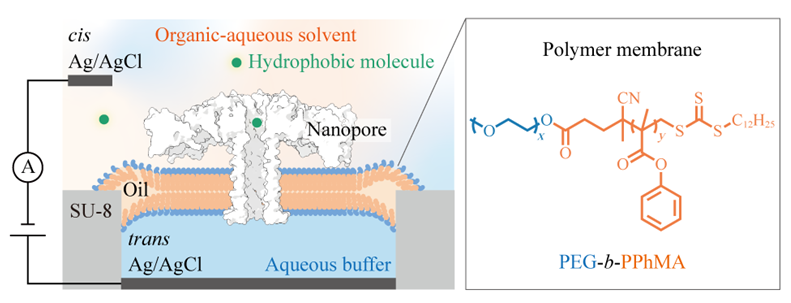
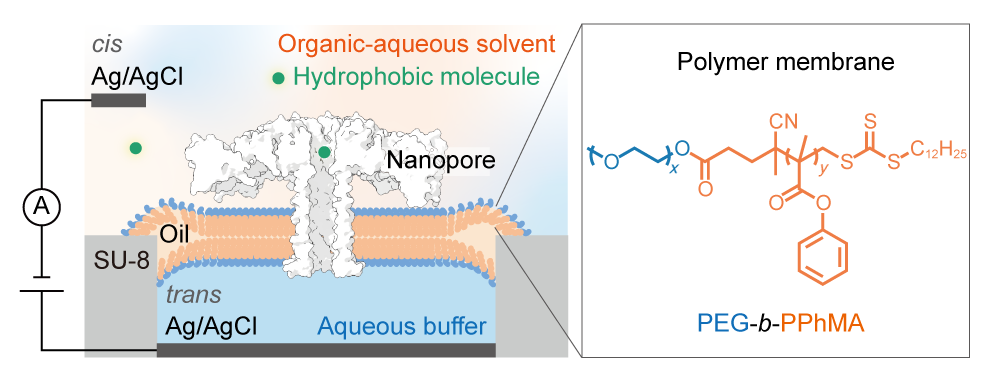
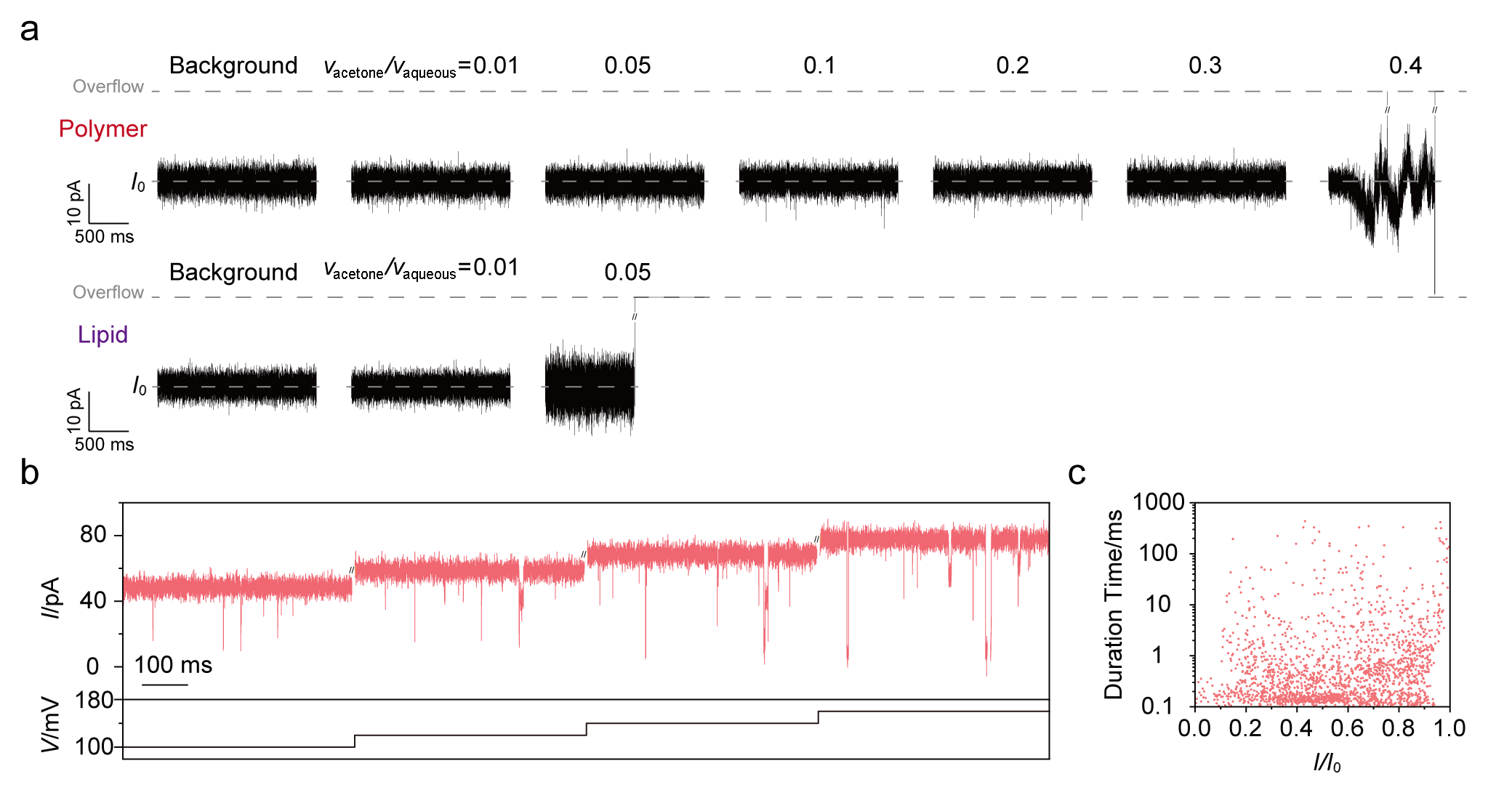
生物纳米孔道单分子电化学测量技术具有无标记、高灵敏和高分辨等优势, 已广泛应用于DNA、RNA、多肽及糖类等生物小分子的检测. 然而, 对于在水相中溶解度较低的疏水分子, 通常需引入有机溶剂以提高其溶解性, 而传统纳米孔道技术所采用的磷脂支撑膜对有机溶剂耐受性有限, 限制了该技术在疏水分子测量及相关研究中的应用. 为此, 本研究利用两亲性嵌段共聚物聚乙二醇-聚甲基丙烯酸苯酯(PEG-b-PPhMA), 构建了一种对有机溶剂具有良好耐受性的仿生双分子层聚合物膜. 通过调控聚合度和溶剂组成, 实现了膜体系的高稳定性和优良的隔绝离子传输性能, 可应用于气单胞菌溶素(Aerolysin)生物蛋白质纳米孔道的单分子测量研究. 结果表明, 在V丙酮/V水=0.3混合缓冲体系中, 该“膜-孔”系统仍可保持长期稳定测量并获得高信噪比离子电流信号, 从而实现了疏水有机小分子的单分子电化学测量. 本研究构建的聚合物膜有效解决了生物纳米孔道在水-有机体系中的稳定性难题, 拓展了纳米孔道技术在药物研发、生命分析、环境监测和单分子反应等研究中对疏水分子的测量潜力.
张琳琳, 袁浩轩, 龙亿涛, 郎超, 应佚伦. 用于水-有机溶剂体系单分子测量的聚合物膜-蛋白质纳米孔道系统[J]. 化学学报, 2026, 84(4): 459-464.
Lin-Lin Zhang, Haoxuan Yuan, Yi-Tao Long, Chao Lang, Yi-Lun Ying. Organic Solvent Tolerant Polymer Membrane-Biological Nanopore Sensing Platform for Single-Molecule Measurement[J]. Acta Chimica Sinica, 2026, 84(4): 459-464.
| Molecule | Molecular weight/kDa | Solvent a | Leakage current/pA b | Nanopore system c |
|---|---|---|---|---|
| DPhPC | 0.8 | decane | 1.6±0.8 | Y |
| PEG44-b-PPhMA52 | 8.7 | toluene | 29.5±1.9 | N |
| PEG44-b-PPhMA79 | 13.8 | toluene | 9.5±0.5 | N |
| PEG44-b-PPhMA135 | 20.3 | toluene Vtoluene/Vdecane=4 Vtoluene/Vdecane=1 Vtoluene/Voctane=1 | 16.2±0.1 10.4±2.7 2.5±0.4 1.9±1.0 | Y Y Y Y |
| PEG44-b-PPhMA170 | 30.5 | toluene | 4.5±0.5 | N |
| Molecule | Molecular weight/kDa | Solvent a | Leakage current/pA b | Nanopore system c |
|---|---|---|---|---|
| DPhPC | 0.8 | decane | 1.6±0.8 | Y |
| PEG44-b-PPhMA52 | 8.7 | toluene | 29.5±1.9 | N |
| PEG44-b-PPhMA79 | 13.8 | toluene | 9.5±0.5 | N |
| PEG44-b-PPhMA135 | 20.3 | toluene Vtoluene/Vdecane=4 Vtoluene/Vdecane=1 Vtoluene/Voctane=1 | 16.2±0.1 10.4±2.7 2.5±0.4 1.9±1.0 | Y Y Y Y |
| PEG44-b-PPhMA170 | 30.5 | toluene | 4.5±0.5 | N |
| [1] |
doi: 10.1038/s41565-022-01193-2 pmid: 36163504 |
| [2] |
doi: 10.6023/A25050179 |
|
(白宏震, 谭皓璟, 冯建东, 化学学报, 2025, 83, 1089.)
doi: 10.6023/A25050179 |
|
| [3] |
doi: 10.1038/nnano.2017.99 pmid: 28681859 |
| [4] |
doi: 10.1016/j.cis.2025.103417 |
| [5] |
|
|
(胡正利, 应佚伦, 王佳, 钟诚兵, 孔璇凤, 余晓冬, 章文伟, 张剑荣, 龙亿涛, 大学化学, 2025, 40, 11.)
|
|
| [6] |
|
|
(胡正利, 辛凯莉, 刘少创, 钟诚兵, 武雪原, 应佚伦, 孔璇凤, 余晓冬, 张剑荣, 龙亿涛, 大学化学, 2022, 37, 191.)
|
|
| [7] |
doi: 10.6023/A23040149 |
|
(马超凡, 徐伟, 刘巍, 徐昌晖, 沙菁㛃, 化学学报, 2023, 81, 857.)
doi: 10.6023/A23040149 |
|
| [8] |
doi: 10.1038/s41592-024-02208-7 pmid: 38443507 |
| [9] |
doi: 10.34133/research.0850 |
| [10] |
|
|
(郝文英, 吴海臣, 分析测试学报, 2025, 44, 1723.)
|
|
| [11] |
doi: 10.1002/anie.201503141 pmid: 26058458 |
| [12] |
doi: 10.6023/A23040154 |
|
(秦沛, 马海, 张发光, 马军安, 化学学报, 2023, 81, 697.)
doi: 10.6023/A23040154 |
|
| [13] |
doi: 10.1016/j.chemphyslip.2020.104932 |
| [14] |
doi: 10.1088/0957-4484/26/7/074002 |
| [15] |
doi: 10.1016/j.scib.2025.01.050 |
| [16] |
doi: 10.1039/D1SC06837G |
| [17] |
doi: 10.1038/s41557-025-01905-w |
| [18] |
doi: 10.1002/anie.v62.27 |
| [19] |
doi: 10.1038/s41565-024-01721-2 |
| [20] |
doi: 10.1016/S1872-2040(18)61089-8 |
|
(周硕, 唐鹏, 王赟姣, 王亮, 王德强, 分析化学, 2018, 46, 826.)
|
|
| [21] |
doi: 10.1016/j.molliq.2022.119697 |
| [22] |
doi: 10.1016/j.compbiolchem.2013.04.005 pmid: 23764528 |
| [23] |
doi: 10.1021/acs.langmuir.4c01499 |
| [24] |
doi: 10.1021/la000204t |
| [25] |
doi: 10.1021/acs.langmuir.6b03309 |
| [26] |
doi: 10.1002/adma.v37.15 |
| [27] |
doi: 10.1016/j.bpj.2021.02.019 |
| [28] |
doi: 10.1039/D4CP04782F |
| [29] |
doi: 10.1021/ja100245d |
| [30] |
doi: 10.1021/acssensors.8b01636 |
| [31] |
doi: 10.6023/A19060202 |
|
(李孟寅, 应佚伦, 龙亿涛, 化学学报, 2019, 77, 984.)
doi: 10.6023/A19060202 |
|
| [32] |
doi: 10.6023/A19060230 |
|
(牛红艳, 胡正利, 应佚伦, 龙亿涛, 化学学报, 2019, 77, 989.)
doi: 10.6023/A19060230 |
|
| [33] |
|
|
(李孟寅, 蒋杰, 牛红艳, 应佚伦, 龙亿涛, 科学通报, 2023, 68, 2148.)
|
|
| [34] |
|
|
(张晓君, 奇国栋, 杨淼森, 翁婷, 梁丽媛, 王德强, 分析化学, 2023, 51, 1867.)
|
|
| [35] |
doi: 10.1039/C8CS00162F |
| [36] |
doi: 10.1134/S0006350908050126 |
| [37] |
doi: 10.1021/acs.macromol.2c00739 |
| [38] |
|
| [39] |
|
|
(武雪原, 应佚伦, 龙亿涛, 高等学校化学学报, 2019, 40, 1825.)
doi: 10.7503/cjcu20190364 |
|
| [40] |
doi: 10.1016/j.jelechem.2022.116266 |
| [41] |
doi: 10.1039/D3SC06795E |
| [42] |
doi: 10.1039/C8GC03891K |
| [43] |
doi: 10.1016/j.memsci.2026.125245 |
| [1] | 白宏震, 谭皓璟, 冯建东. 纳米孔DNA单分子测序★[J]. 化学学报, 2025, 83(9): 1089-1102. |
| [2] | 高春, 张松涛, 庞欢. 金属有机框架复合材料★[J]. 化学学报, 2025, 83(8): 962-980. |
| [3] | 热孜古丽•玉努斯, 卡迪尔亚•阿布都外力, 罗时玮, 阿布都热西提•阿布力克木. 电化学条件下由二苄胺合成N-亚苄基苄胺及衍生化研究[J]. 化学学报, 2024, 82(8): 843-848. |
| [4] | 汪莎莎, 孟鹏辉, 李阳, 邓慧婵, 郭志翔, 刘一任, 石乃恩, 魏颖, 解令海. 静电纺丝法制备聚偏二氟乙烯-六氟丙烯电解质膜用于电化学执行器[J]. 化学学报, 2024, 82(6): 570-576. |
| [5] | 郝再涛, 赵健飞, 李慧同, 李展, 潘朗, 李江. 亲锌聚阴离子交联聚合物薄膜与铜刻蚀协同稳定锌负极[J]. 化学学报, 2024, 82(4): 416-425. |
| [6] | 王志强, 苏进展. 磷酸钴修饰Cu3V2O8/ZnO光阳极的动力学特性及光电化学水分解研究[J]. 化学学报, 2024, 82(1): 26-35. |
| [7] | 李萍, 杨琪玉, 曾婧, 张然, 陈秋燕, 闫飞. 氟掺杂对可逆固体氧化物电池性能的影响及相关动力学研究[J]. 化学学报, 2024, 82(1): 36-45. |
| [8] | 刘士琨, 邓程维, 姬峰, 闵宇霖, 李和兴. 高温质子交换膜燃料电池中阴极双催化层孔结构的设计研究★[J]. 化学学报, 2023, 81(9): 1135-1141. |
| [9] | 侯威, 么艳彩, 张礼知. 电化学还原去除水中含氧酸根离子研究进展★[J]. 化学学报, 2023, 81(8): 979-989. |
| [10] | 杨蓉婕, 周璘, 苏彬. 基于共价有机框架修饰电极的维生素A和C的选择性检测★[J]. 化学学报, 2023, 81(8): 920-927. |
| [11] | 倪雪, 辛凯莉, 胡正利, 蒋翠玲, 万永菁, 应佚伦, 龙亿涛. 一种时序信号分类算法在纳米孔道离子电流信号识别中的应用★[J]. 化学学报, 2023, 81(8): 912-919. |
| [12] | 刘坜, 郑刚, 范国强, 杜洪光, 谭嘉靖. 4-酰基/氨基羰基/烷氧羰基取代汉斯酯参与的有机反应研究进展[J]. 化学学报, 2023, 81(6): 657-668. |
| [13] | 坎比努尔•努尔买买提, 王超, 罗时玮, 阿布都热西提•阿布力克木. 电化学条件下α,α,α-三卤(氯, 溴)甲基酮类化合物的选择性脱卤反应研究[J]. 化学学报, 2023, 81(6): 582-587. |
| [14] | 张慧颖, 于淑艳, 李从举. 高分子聚合物基碳纳米膜的电催化降解污水性能及机理[J]. 化学学报, 2023, 81(4): 420-430. |
| [15] | 梁华润, 马浩轩, 段新荣, 于洁, 王灏珉, 李硕, 朱梦嘉, 陈爱兵, 郑晖, 张莹莹. 柔性电化学传感器及其在无创医学检测中的应用★[J]. 化学学报, 2023, 81(10): 1402-1419. |
| 阅读次数 | ||||||
|
全文 |
|
|||||
|
摘要 |
|
|||||
