

化学学报 ›› 2026, Vol. 84 ›› Issue (7): 1140-1152.DOI: 10.6023/A26040135 上一篇 下一篇
研究论文
冯丹宁a, 封波a, 万坤a, 谢颂海a, 裴燕a, 乔明华a,*( ), 宗保宁b,*()
投稿日期:2026-04-24
发布日期:2026-06-24
基金资助:
Danning Fenga, Bo Fenga, Kun Wana, Songhai Xiea, Yan Peia, Minghua Qiaoa,*(), Baoning Zongb,*()
Received:2026-04-24
Published:2026-06-24
Contact:
* E-mail: mhqiao@fudan.edu.cn;
zongbn.ripp@sinopec.com; Tel.: 021-31244679
Supported by:文章分享
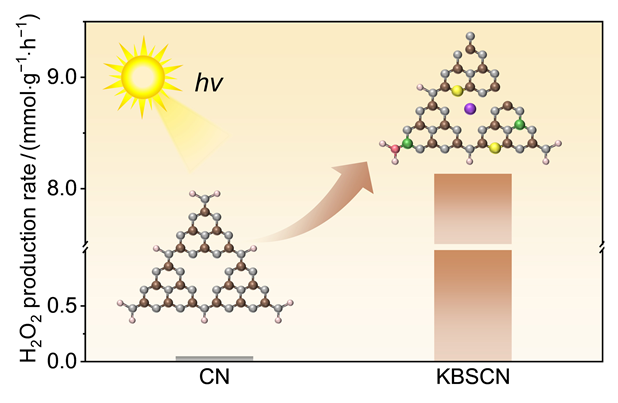
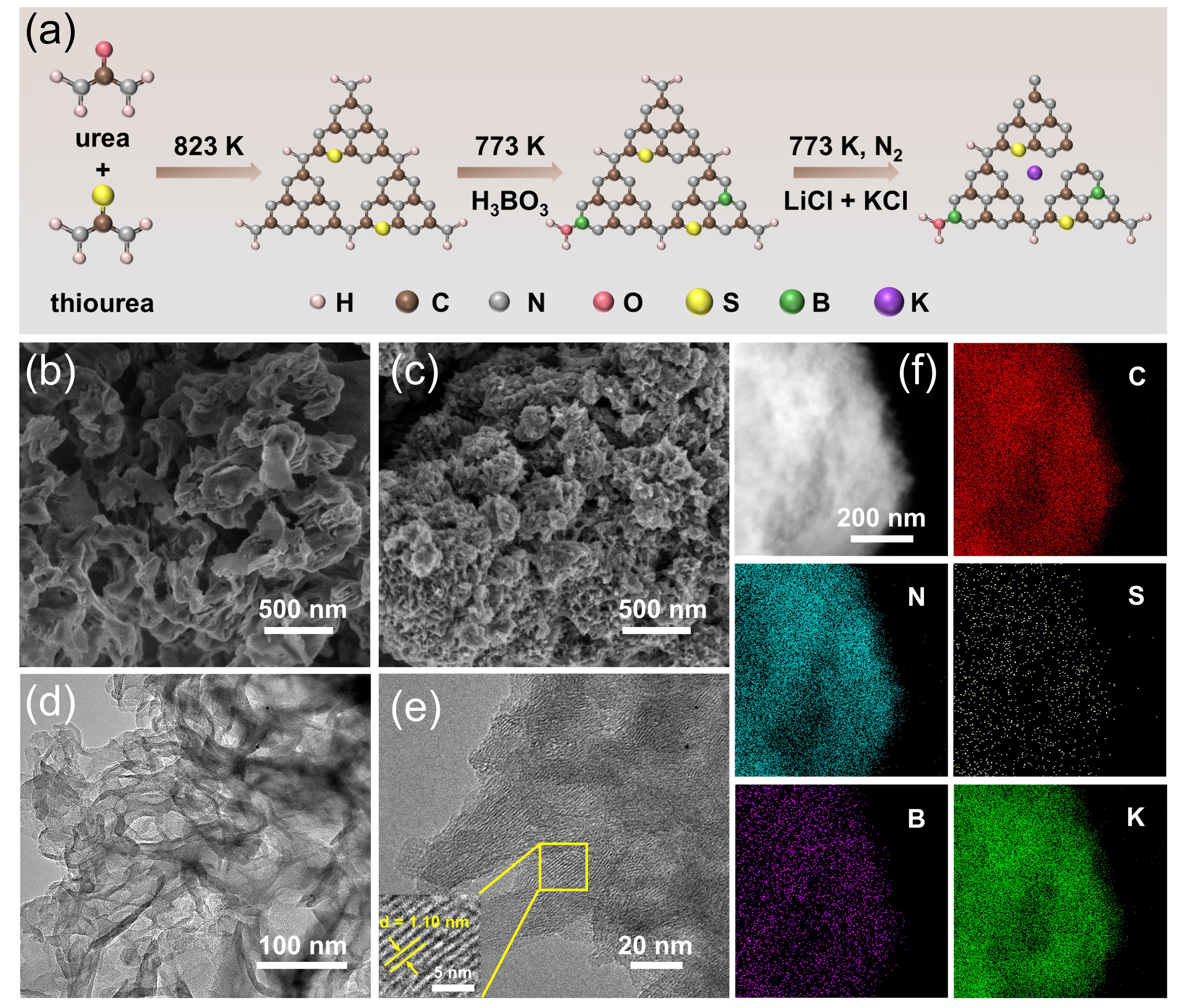
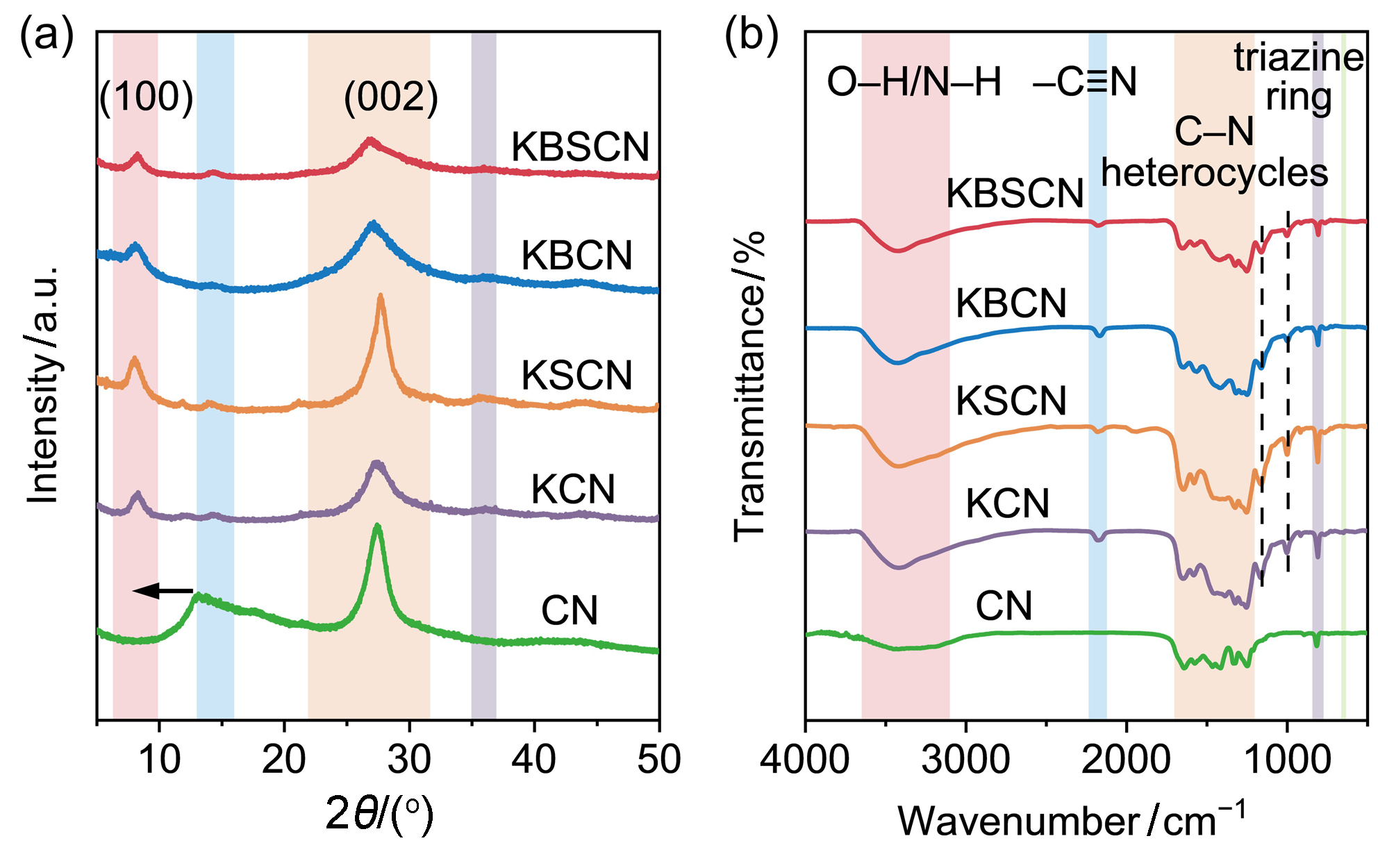
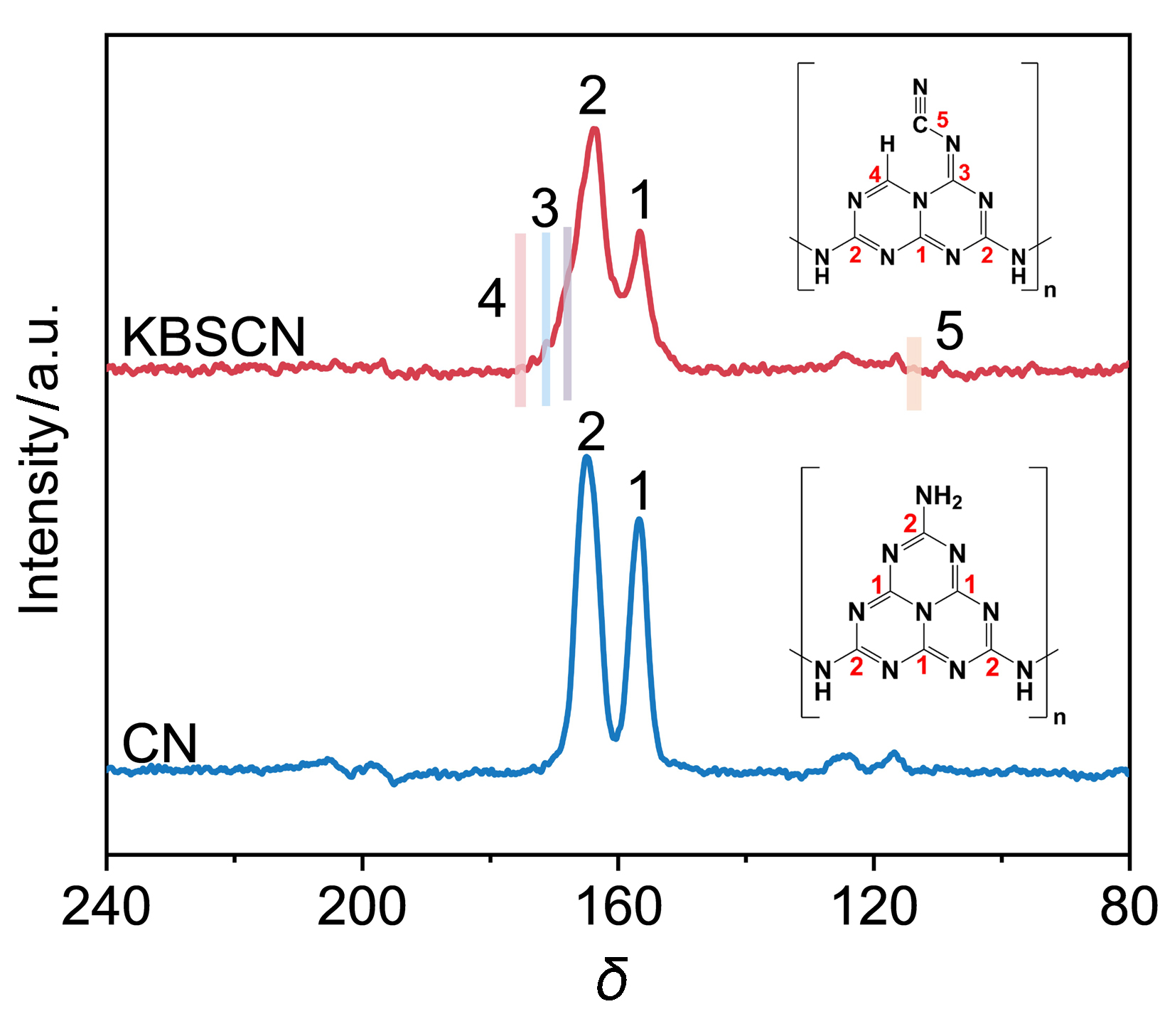
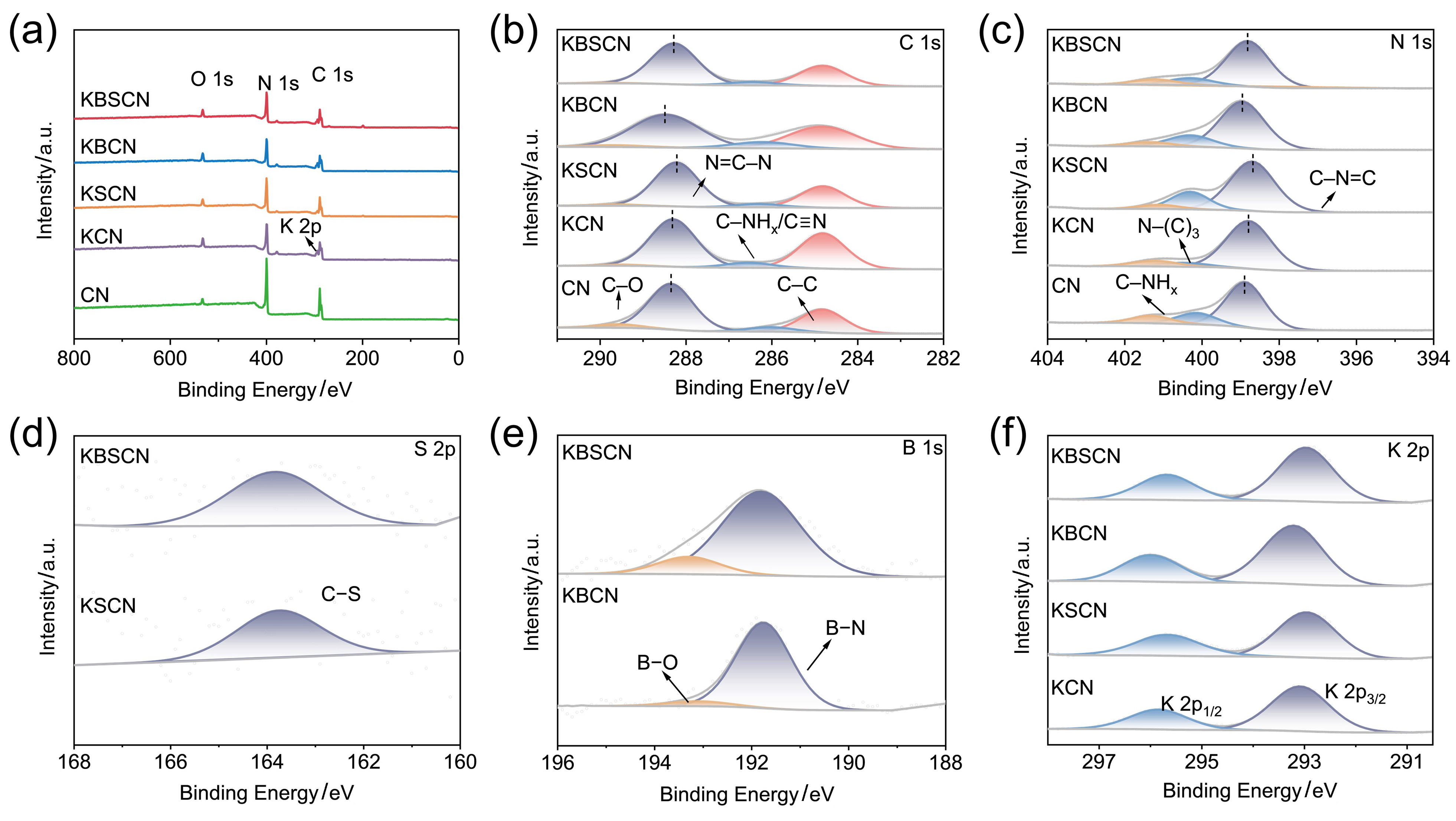
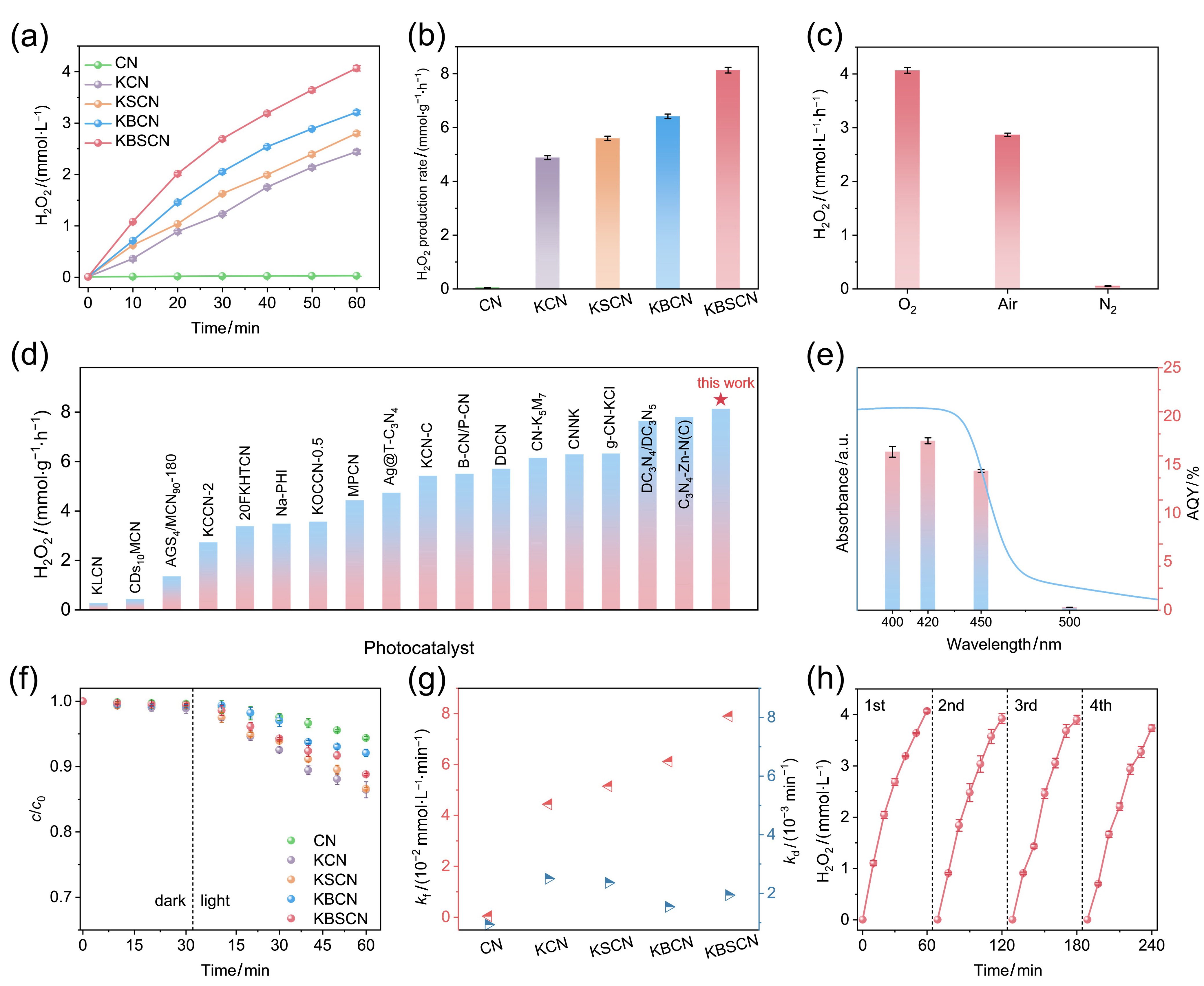
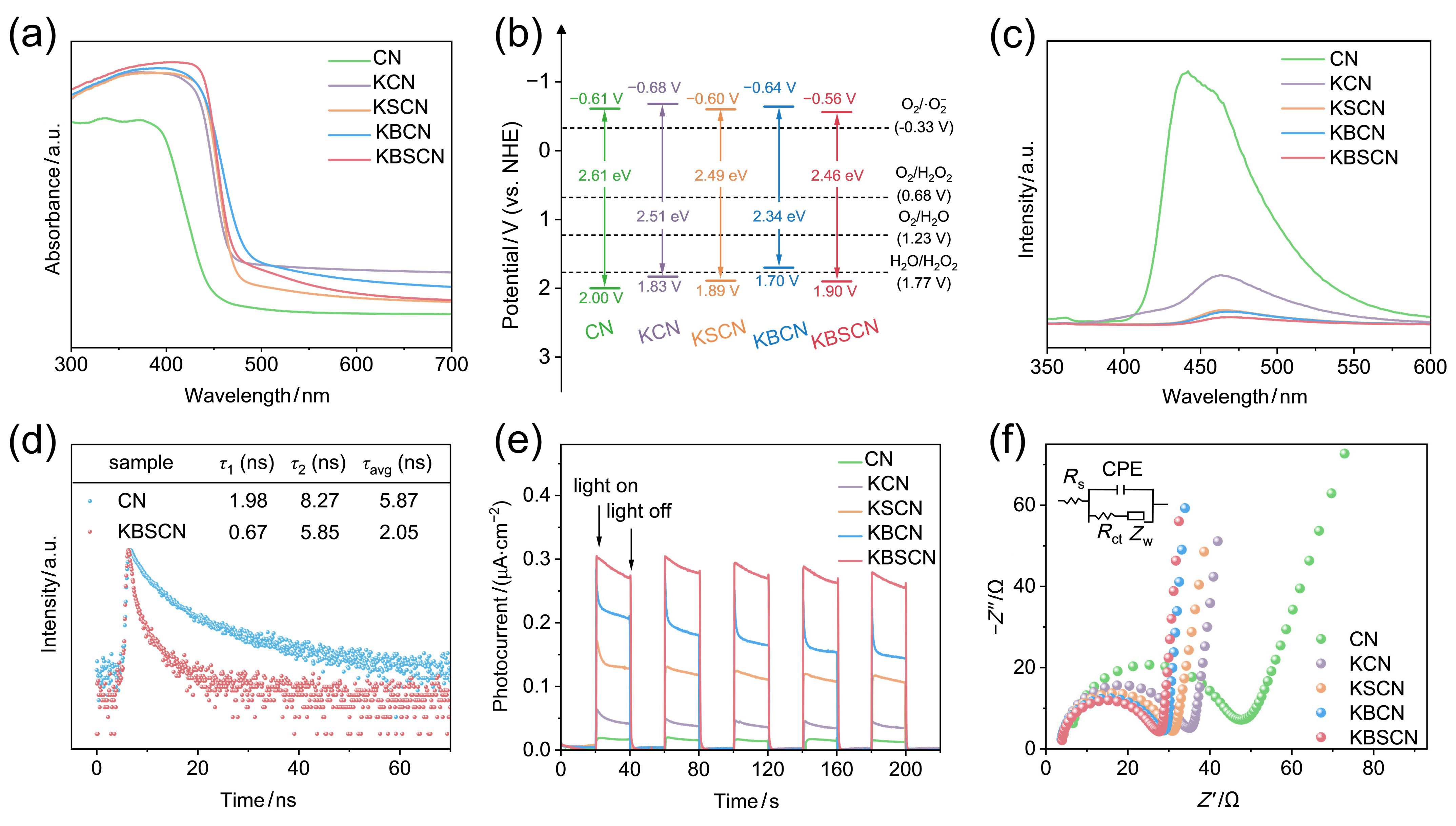
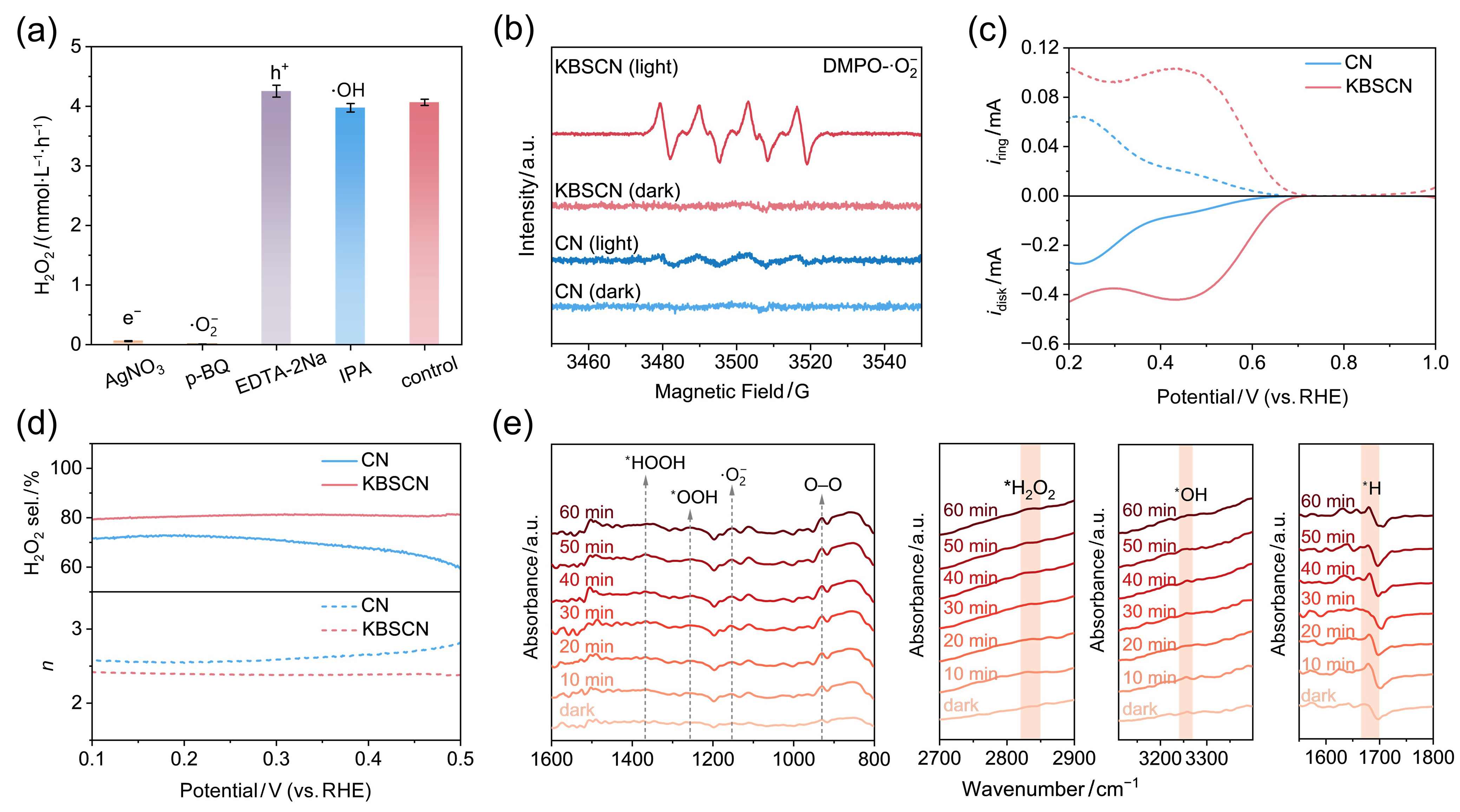
基于石墨相氮化碳(g-C3N4)光催化氧气(O2)还原合成过氧化氢(H2O2)具有重要的基础研究价值和实际应用价值. 针对g-C3N4电子结构对称性高、光生载流子复合严重、O2活化能力弱及光催化合成H2O2效率低的核心瓶颈, 本工作提出了一种多元素共掺杂协同缺陷工程调控电子结构的改性策略, 通过两步煅烧结合离子热处理, 成功制备了S/B/K三元共掺杂的g-C3N4催化剂(KBSCN). 该策略同步实现了富电子S、缺电子B和K在g-C3N4骨架内的均匀掺杂, 以及氰基(−C≡N)和氮空位(Nv)的原位引入. 系统开展了结构表征、光电性能测试与光催化性能评价, 并结合密度泛函理论(DFT)计算, 揭示了多元素掺杂对g-C3N4电子结构与反应动力学的协同调控机制. 研究结果表明, S/B/K三元共掺杂可有效打破g-C3N4的对称结构, 拓宽可见光响应范围. 光催化O2还原合成H2O2性能评价结果表明, 在可见光照射下, KBSCN催化剂上的H2O2生成速率高达8132 μmol•g−1•h−1, 为未改性g-C3N4(CN)生成速率的185倍. 机理研究表明, S/B/K三元共掺杂通过诱导最高占据分子轨道(HOMO)与最低未占据分子轨道(LUMO)的空间分离, 极大促进了光生载流子的分离与迁移. 此外, 结合自由基捕获实验、原位电子顺磁共振(EPR)、原位漫反射傅里叶变换红外(in situ DRIFT)表征与Bader电荷电子转移分析, S/B/K三元共掺杂可促进光催化O2还原反应(ORR)采取以超氧自由基(•O2−)为中间体的间接两电子还原路径, 从动力学上显著提升2e−-ORR的反应速率. 本工作通过对g-C3N4的电子结构与表面反应动力学的调控实现了可见光驱动下高效合成H2O2, 为低成本、高性能光催化合成H2O2催化剂的设计提供了新的思路.
冯丹宁, 封波, 万坤, 谢颂海, 裴燕, 乔明华, 宗保宁. S/B/K共掺杂调控氮化碳电子结构用于高效光催化合成H2O2[J]. 化学学报, 2026, 84(7): 1140-1152.
Danning Feng, Bo Feng, Kun Wan, Songhai Xie, Yan Pei, Minghua Qiao, Baoning Zong. Electronic Structure Engineering of g-C3N4 via S/B/K Co-Doping for Efficient Photocatalytic H2O2 Synthesis[J]. Acta Chimica Sinica, 2026, 84(7): 1140-1152.

| [1] |
doi: 10.1038/s41467-024-53482-0 |
| [2] |
doi: 10.1021/acscatal.4c06854 |
| [3] |
doi: 10.6023/A22010030 |
|
(王丹, 封波, 张晓昕, 刘亚楠, 裴燕, 乔明华, 宗保宁, 化学学报, 2022, 80, 772.)
doi: 10.6023/A22010030 |
|
| [4] |
doi: 10.1002/adma.v37.4 |
| [5] |
doi: 10.1038/s41467-020-20823-8 |
| [6] |
doi: 10.6023/A22040183 |
|
(解众舒, 薛中鑫, 许子文, 李倩, 王洪宇, 李维实, 化学学报, 2022, 80, 1231.)
doi: 10.6023/A22040183 |
|
| [7] |
doi: 10.1002/adfm.v34.38 |
| [8] |
doi: 10.1016/j.apcatb.2023.122879 |
| [9] |
doi: 10.1002/anie.202006747 pmid: 32430972 |
| [10] |
doi: 10.1021/acsnano.4c02387 |
| [11] |
doi: 10.1002/adma.v38.8 |
| [12] |
doi: 10.1002/anie.v58.46 |
| [13] |
doi: 10.6023/A23110484 |
|
(黄广峥, 李坤玮, 罗艳楠, 张强, 潘远龙, 高洪林, 化学学报, 2024, 82, 314.)
doi: 10.6023/A23110484 |
|
| [14] |
doi: 10.1002/smll.v21.17 |
| [15] |
doi: 10.1016/j.cej.2025.164108 |
| [16] |
doi: 10.1002/aenm.v14.23 |
| [17] |
doi: 10.1016/j.jcis.2025.137319 |
| [18] |
doi: 10.1016/j.apcatb.2019.01.069 |
| [19] |
doi: 10.1002/adma.v33.49 |
| [20] |
doi: 10.1002/smll.v21.20 |
| [21] |
doi: 10.1002/anie.v57.30 |
| [22] |
doi: 10.1016/j.cej.2024.158992 |
| [23] |
doi: 10.1016/j.cej.2025.169090 |
| [24] |
doi: 10.1002/adma.v29.32 |
| [25] |
|
| [26] |
doi: 10.1038/s41467-020-20521-5 |
| [27] |
doi: 10.1002/advs.v12.40 |
| [28] |
doi: 10.1021/acscatal.3c03628 |
| [29] |
doi: 10.1016/j.apcatb.2022.121574 |
| [30] |
doi: 10.1021/ja01002a035 |
| [31] |
doi: 10.1021/acscatal.5b02922 |
| [32] |
doi: 10.1016/j.apcatb.2024.123993 |
| [33] |
doi: 10.1016/j.ijhydene.2022.02.147 |
| [34] |
doi: 10.1021/acsaem.4c02367 |
| [35] |
doi: 10.1007/s12274-022-4976-0 |
| [36] |
doi: 10.1016/j.apcatb.2020.119064 |
| [37] |
|
| [38] |
doi: 10.1002/adma.v35.48 |
| [39] |
doi: 10.1016/j.cej.2025.163232 |
| [40] |
doi: 10.1016/j.apcatb.2022.121731 |
| [41] |
doi: 10.1016/j.cej.2024.152228 |
| [42] |
doi: 10.1016/j.cej.2021.132032 |
| [43] |
doi: 10.1002/ente.v7.3 |
| [44] |
doi: 10.1002/anie.v63.52 |
| [45] |
doi: 10.1002/adfm.v35.24 |
| [46] |
doi: 10.1016/j.apcatb.2024.123872 |
| [47] |
doi: 10.1002/anie.v64.21 |
| [48] |
doi: 10.1002/anie.v63.18 |
| [49] |
doi: 10.1038/s41467-023-42887-y pmid: 37932292 |
| [50] |
doi: 10.1002/adfm.v36.28 |
| [51] |
doi: 10.1021/jacs.5c22625 |
| [52] |
doi: 10.1021/jacs.4c12339 pmid: 39418115 |
| [53] |
doi: 10.1002/anie.v64.45 |
| [54] |
doi: 10.1016/j.apsusc.2023.156523 |
| [55] |
doi: 10.1016/j.seppur.2024.128577 |
| [56] |
doi: 10.1038/s41467-023-44261-4 pmid: 38191599 |
| [57] |
doi: 10.1002/adma.v37.27 |
| [1] | 徐慧妍, 王爱珠, 丁龙华, 于欣. 基于苝二酰亚胺的光催化抗菌体系及其应用进展[J]. 化学学报, 2026, 84(7): 1197-1210. |
| [2] | 曾子杰, 彭子凌, 王晨, 谈发堂, 王新云, 王保强, 王维. 氮化碳的氮空位与可见光催化产H2O2研究[J]. 化学学报, 2026, 84(6): 879-887. |
| [3] | 陈慧滢, 黄宁宇, 廖培钦. 基于银−碳键的新型金属有机框架用于高效光催化合成过氧化氢★[J]. 化学学报, 2026, 84(5): 626-630. |
| [4] | 陈中胜, 雷天灏, 彭炜, 陈娴琳, 燕春培, 罗峰. 共价有机框架材料在海水提铀中的研究进展★[J]. 化学学报, 2026, 84(5): 736-754. |
| [5] | 宋玉朋, 华紫辉, 葛介超, 王春儒, 吴波. 具有强大内建电场的C60@TpPa共价有机框架材料高效光催化产氢[J]. 化学学报, 2026, 84(3): 370-376. |
| [6] | 汪晨程, 欧阳班来, 钟品勇, 张莺瑢, 刘晋彪. 光催化2-氨基苯甲醇与异硫氰酸酯脱硫环化合成2-氨基-1,3-苯并噁嗪[J]. 化学学报, 2026, 84(1): 1-7. |
| [7] | 史同同, 李佳, 殷一樊, 孙凯. 光化学驱动α-三氟甲基烯烃的多样性转化[J]. 化学学报, 2026, 84(1): 135-159. |
| [8] | 彭琼慧, 彭佳, 蔡迎丽, 王祖利, 易荣楠, 沈超, 何卫民. 二苯醚介导氧化铈半多相光催化2-异腈基联苯氟烷基化反应[J]. 化学学报, 2025, 83(9): 1013-1017. |
| [9] | 闫生荣, 刘文浩, 段芳, 陈明清, 东为富, 陆双龙, 杜明亮. 基于sp2-碳连接具有D-A结构共价有机框架的构筑及其光催化产双氧水性能研究[J]. 化学学报, 2025, 83(7): 685-693. |
| [10] | 李文静, 杨黎燕, 关丽, 张雪娇, 尤静, 沈思语, 赵钰琦, 段琛. 可见光/硫酚催化烯烃C=C双键的氧化裂解反应[J]. 化学学报, 2025, 83(6): 596-601. |
| [11] | 崔雨琪, 李军玉, 孙建科. 多孔有机笼用于能源转换及储存的研究进展[J]. 化学学报, 2025, 83(6): 624-638. |
| [12] | 罗雅玲, 庄展洋, 范峰滔, 李灿. Al掺杂SrTiO3的合成调控及其光催化全分解水性能[J]. 化学学报, 2025, 83(6): 608-615. |
| [13] | 卢一林, 董盛杰, 崔方超, 薄婷婷, 毛卓. 希托夫紫磷烯/SnS2范德华异质结作为直接全解水光催化剂的理论构建[J]. 化学学报, 2025, 83(4): 377-389. |
| [14] | 李国凯, 朱滨锋, 胡涛, 樊瑞峰, 孙蔚青, 和振秀, 陈景超, 樊保敏. 光催化叔胺的脱烷基酰化反应[J]. 化学学报, 2025, 83(3): 199-205. |
| [15] | 胡国伟, 王晓欢, 原志鹏, 新巴雅尔, 乌力吉贺希格. Ag掺杂对铁酸铋系化合物光催化性能的影响[J]. 化学学报, 2025, 83(3): 229-236. |
| 阅读次数 | ||||||
|
全文 |
|
|||||
|
摘要 |
|
|||||
