化学学报 ›› 2026, Vol. 84 ›› Issue (9): 1399-1404.DOI: 10.6023/A26070262 上一篇 下一篇
研究通讯
彭佳a,†, 杨云a,†, 蔡迎丽a, 易荣楠b,*( ), 姜东方c, 唐裕才d,e, 吴超a,*(), 叶龙武a,*(), 何卫民a,*()
投稿日期:2026-07-23
发布日期:2026-08-17
通讯作者:
易荣楠, 吴超, 叶龙武, 何卫民
作者简介:† 共同第一作者
基金资助:
Jia Penga, Yun Yanga, Yingli Caia, Rongnan Yib,*(), Dongfang Jiangc, Yucai Tangd,e, Chao Wua,*(), Longwu Yea,*(), Weimin Hea,*()
Received:2026-07-23
Published:2026-08-17
Contact:
Rongnan Yi, Chao Wu, Longwu Ye, Weimin He
About author:† The authors contributed equally to this work.
Supported by:文章分享
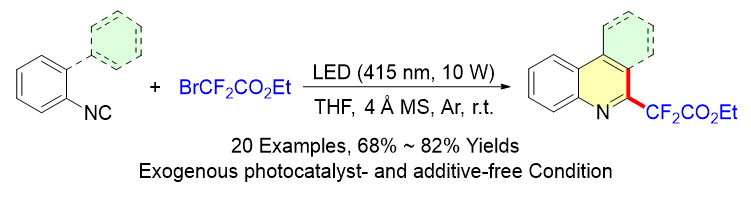
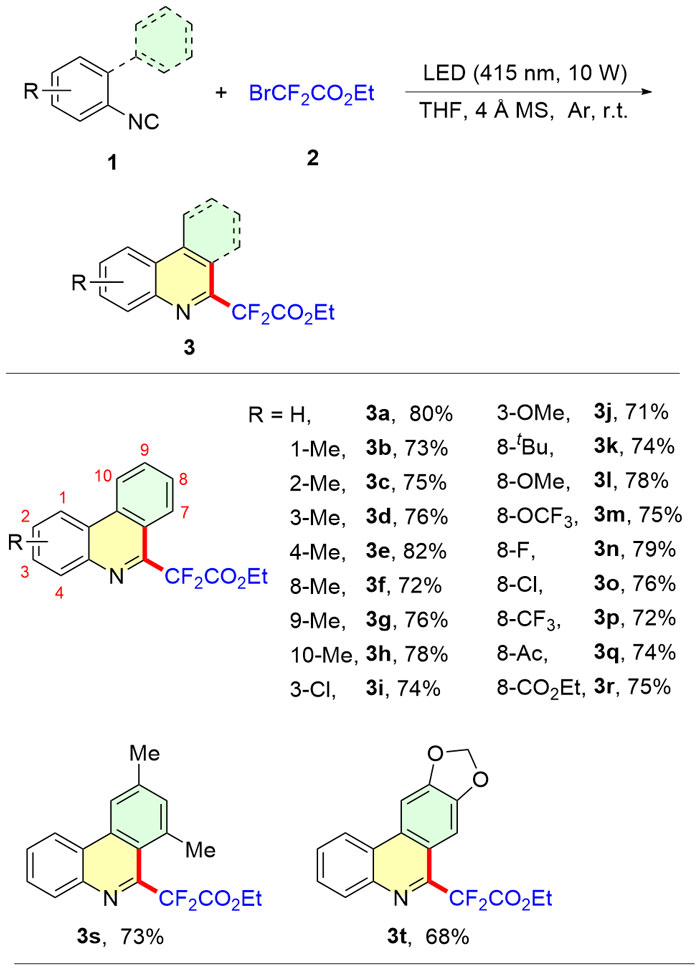
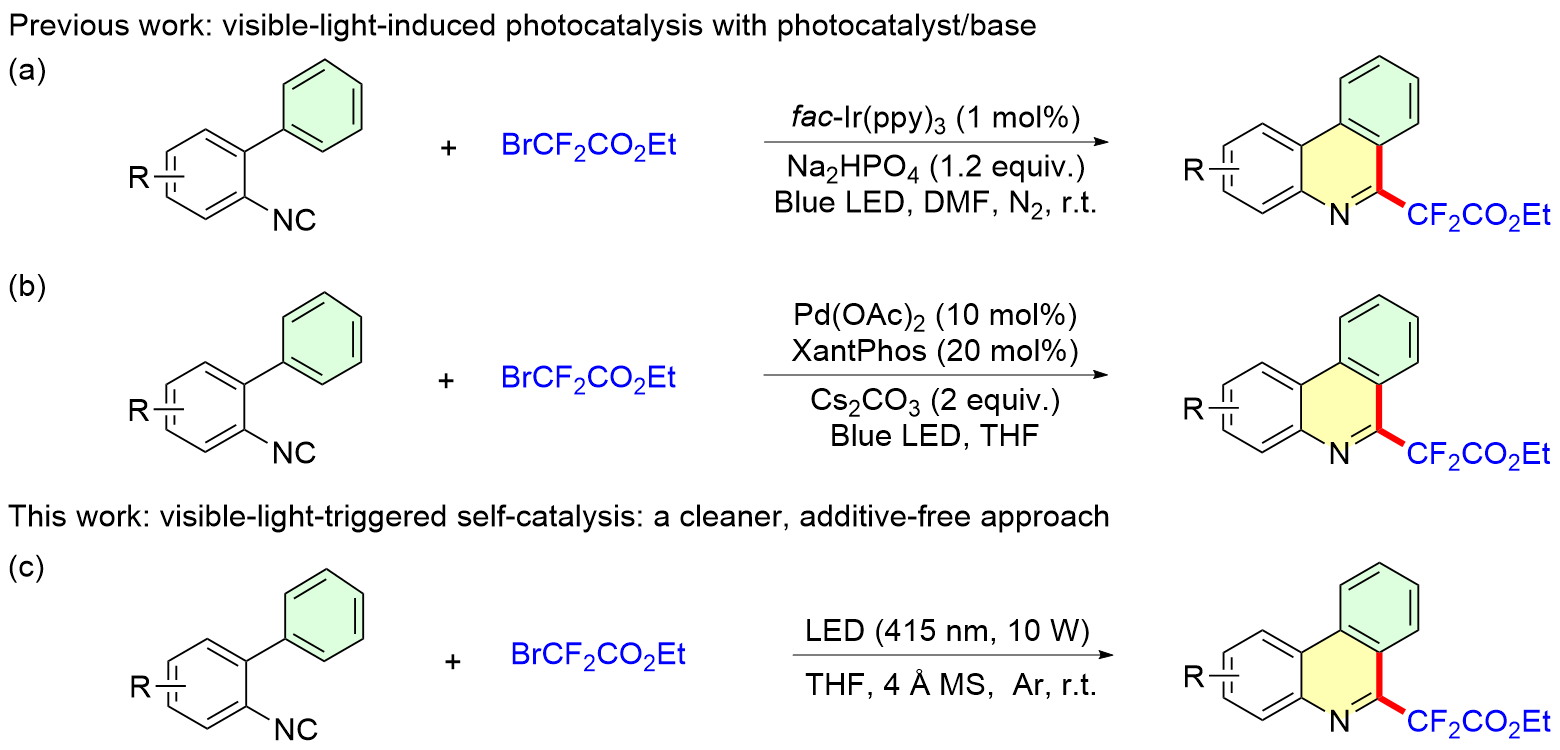
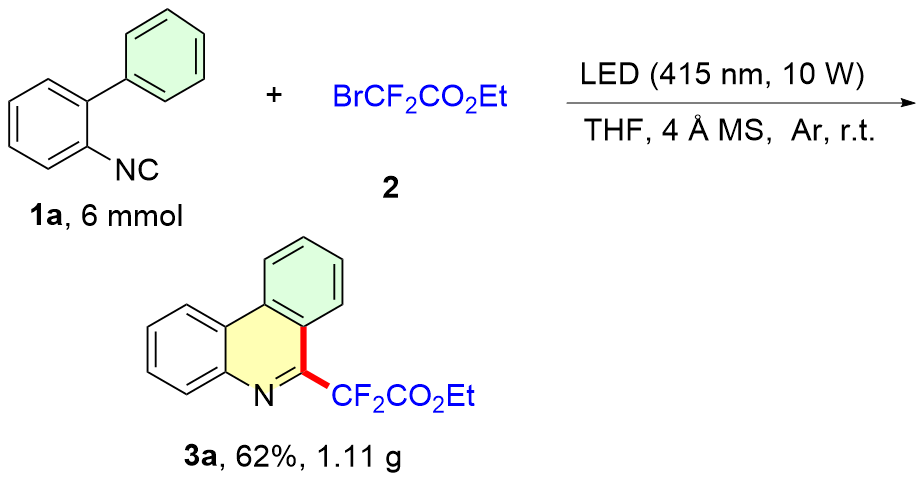
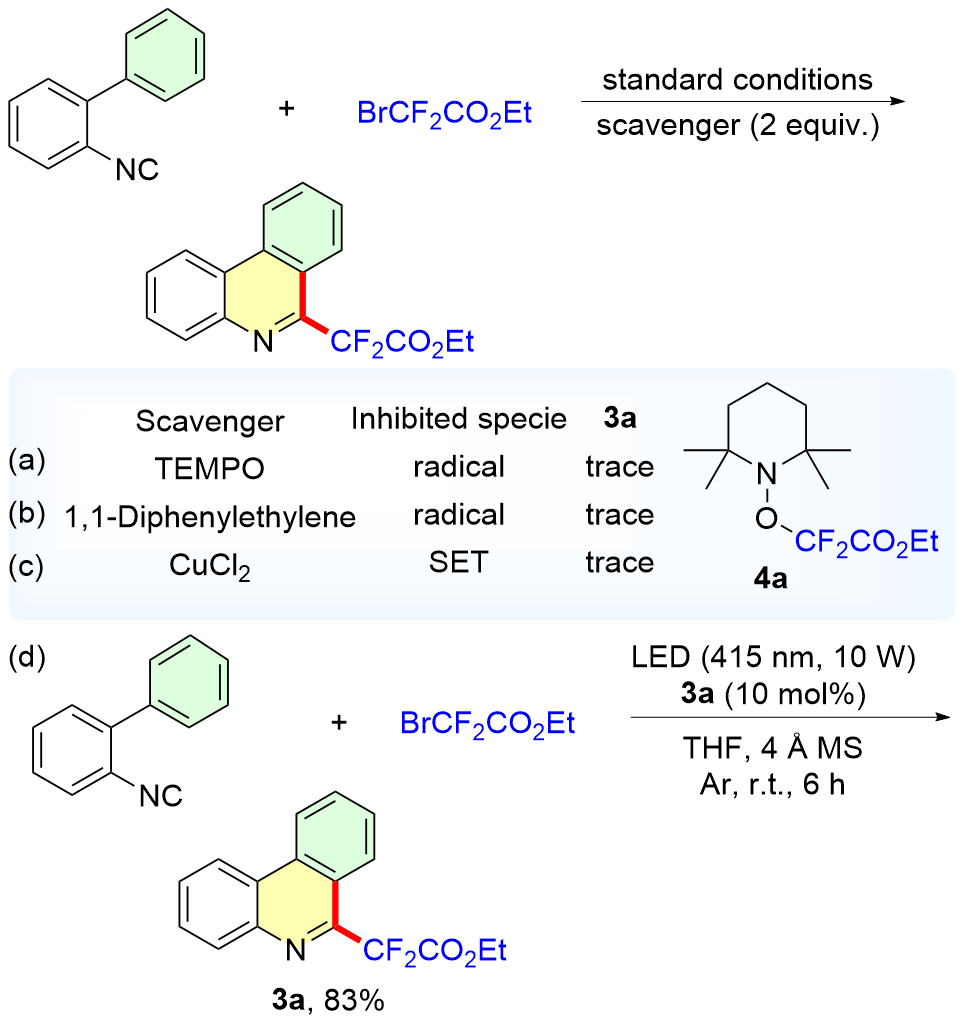
可见光催化将光能转化为化学能, 在温和条件下实现化学键的断裂与重组, 完成诸多传统热化学路径难以驱动的转化, 具有环境友好及官能团耐受性高等优点, 已在复杂功能分子合成中展现出显著的催化效率和工业应用潜力. 然而, 现有方法多依赖外源光催化剂, 存在回收困难或活性不足等问题. 为此, 本文以2-异氰基联苯为底物、二氟溴乙酸酯为烷氧基羰基二氟甲基化试剂, 利用底物和产物自身充当光敏剂, 发展了一种无需外源光敏剂及添加剂的可见光触发自催化烷氧基羰基二氟甲基化/环化串联反应, 以68%~82%的分离收率获得20种6-烷氧基羰基二氟甲基菲啶化合物, 并可实现克级规模制备. 该策略不仅简化了反应体系并降低了分离难度, 同时具有操作简便和底物适用范围广等优势, 为6-烷氧基羰基二氟甲基菲啶类化合物的绿色可持续合成提供了新路径, 高度契合绿色化学的原子经济性和步骤经济性原则.
彭佳, 杨云, 蔡迎丽, 易荣楠, 姜东方, 唐裕才, 吴超, 叶龙武, 何卫民. 可见光触发2-异氰基联苯与二氟溴乙酸酯自催化二氟甲基化/环化串联反应[J]. 化学学报, 2026, 84(9): 1399-1404.
Jia Peng, Yun Yang, Yingli Cai, Rongnan Yi, Dongfang Jiang, Yucai Tang, Chao Wu, Longwu Ye, Weimin He. Visible-Light-Triggered Self-Catalyzed Tandem Difluoromethylation/Cyclization of 2-Isocyanobiphenyls with Alkyl Bromodifluoroacetates[J]. Acta Chimica Sinica, 2026, 84(9): 1399-1404.
| Entry | Varying from the standard conditions | Yieldb/% |
|---|---|---|
| 1 | None | 83 |
| 2 | LED (405 nm, 10 W) was used | 76 |
| 3 | LED (385 nm, 10 W) was used | 71 |
| 4 | LED (425 nm, 10 W) was used | 68 |
| 5 | LED (455 nm, 10 W) was used | 60 |
| 6 | LED (415 nm, 8 W) was used | 61 |
| 7 | 2-MeTHF was used | 78 |
| 8 | 1,4-Dioxane was used | 33 |
| 9 | MeCN was used | 39 |
| 10 | DCE was used | N.R. |
| 11 | DMSO was used | N.R. |
| 12 | Without 4 Å MS | 43 |
| 13 | Without light | N.R. |
| 14 | Under Air | Trace |
| Entry | Varying from the standard conditions | Yieldb/% |
|---|---|---|
| 1 | None | 83 |
| 2 | LED (405 nm, 10 W) was used | 76 |
| 3 | LED (385 nm, 10 W) was used | 71 |
| 4 | LED (425 nm, 10 W) was used | 68 |
| 5 | LED (455 nm, 10 W) was used | 60 |
| 6 | LED (415 nm, 8 W) was used | 61 |
| 7 | 2-MeTHF was used | 78 |
| 8 | 1,4-Dioxane was used | 33 |
| 9 | MeCN was used | 39 |
| 10 | DCE was used | N.R. |
| 11 | DMSO was used | N.R. |
| 12 | Without 4 Å MS | 43 |
| 13 | Without light | N.R. |
| 14 | Under Air | Trace |
| [1] |
(a)
doi: 10.1021/acs.chemrev.1c00311 |
|
(b)
doi: 10.1016/j.cclet.2024.110469 |
|
|
(c)
doi: 10.6023/A24030090 |
|
|
(李康葵, 龙先扬, 黄岳, 祝诗发, 化学学报, 2024, 82, 658.)
doi: 10.6023/A24030090 |
|
|
(d)
doi: 10.1039/D6OB00896H |
|
|
(e)
|
|
| [2] |
(a)
doi: 10.6023/A24100329 |
|
(辛翠, 蒋俊, 邓紫微, 欧丽娟, 何卫民, 化学学报, 2024, 82, 1109.)
doi: 10.6023/A24100329 |
|
|
(b)
doi: 10.1016/j.cclet.2024.110568 |
|
|
(c)
doi: 10.1016/j.cclet.2025.111070 |
|
|
(d)
doi: 10.1016/j.cclet.2024.110446 |
|
|
(e)
doi: 10.1039/D5OB01627D |
|
|
(f)
doi: 10.1021/acs.orglett.6c00194 |
|
|
(g)
doi: 10.1038/s41467-026-68969-1 |
|
|
(h)
doi: 10.1016/S1872-2067(26)65170-4 |
|
| [3] |
(a)
doi: 10.1021/acs.orglett.3c02073 |
|
(b)
doi: 10.1021/acs.joc.5c02108 |
|
|
(c)
doi: 10.1039/D5QO00540J |
|
|
(d)
doi: 10.1021/acs.joc.5c02090 |
|
|
(e)
doi: 10.1039/D5CC04878H |
|
|
(f)
doi: 10.6023/cjoc202511006 |
|
|
(鄢东, 何卫保, 唐裕才, 辛翠, 杨梓, 陈祥, 有机化学, 2026, 46, 2327.)
doi: 10.6023/cjoc202511006 |
|
|
(g)
doi: 10.1002/ejoc.v29.34 |
|
|
(h)
|
|
| [4] |
(a)
doi: 10.1039/D3CC03317A |
|
(b)
|
|
|
(c)
doi: 10.1016/j.cclet.2024.109514 |
|
|
(d)
doi: 10.1039/D5CC04758G |
|
|
(e)
|
|
|
(f)
doi: 10.1021/acs.joc.6c00202 |
|
|
(g)
doi: 10.1021/acs.orglett.6c01403 |
|
|
(h)
doi: 10.1021/acs.orglett.6c00743 |
|
| [5] |
(a)
|
|
(徐毅栲, 王泽树, 何卫民, 叶龙武, 有机化学, 2024, 44, 2049.)
doi: 10.6023/cjoc202400029 |
|
|
(b)
doi: 10.6023/cjoc202400014 |
|
|
易荣楠, 何卫民, 有机化学, 2024, 44, 1035.
doi: 10.6023/cjoc202400014 |
|
|
(c)
doi: 10.1016/S1872-2067(23)64615-7 |
|
|
(d)
doi: 10.1016/S1872-2067(25)64764-4 |
|
|
(e)
doi: 10.1021/acs.joc.5c01813 |
|
|
(f)
doi: 10.6023/cjoc202500013 |
|
|
(鄢东, 何卫民, 有机化学, 2025, 45, 1781.)
doi: 10.6023/cjoc202500013 |
|
|
(g)
doi: 10.1021/acs.orglett.6c02556 |
|
|
(h)
doi: 10.1021/acs.orglett.5c04925 |
|
| [6] |
(a)
doi: 10.1021/acs.joc.5c02498 |
|
(b)
doi: 10.1021/acs.joc.5c02000 |
|
|
(c)
doi: 10.1021/acs.joc.6c00085 |
|
|
(d)
doi: 10.1016/j.cclet.2025.111402 |
|
|
(e)
doi: 10.1016/j.cclet.2025.111776 |
|
|
(f)
doi: 10.1039/D5OB01848J |
|
|
(g)
doi: 10.1021/acs.joc.6c00230 |
|
| [7] |
(a)
doi: 10.1039/D3CS00190C |
|
(b)
doi: 10.1039/D4QO00249K |
|
|
(c)
doi: 10.1021/acs.joc.5c01659 |
|
|
(d)
doi: 10.1021/acs.orglett.5c00220 |
|
|
(e)
doi: 10.1039/D6QO00369A |
|
|
(f)
doi: 10.6023/cjoc202601030 |
|
|
(李婷, 欧阳文韬, 易荣楠, 唐欲才, 杨梓, 吴超, 何卫民, 有机化学, 2026, 46, 1668.)
doi: 10.6023/cjoc202601030 |
|
|
(g)
doi: 10.1021/acs.joc.6c01356 |
|
|
(h)
doi: 10.1021/acs.joc.6c01501 |
|
| [8] |
(a)
doi: 10.6023/A23080386 |
|
(李珊, 路俊欣, 刘杰, 蒋绿齐, 易文斌, 化学学报, 2024, 82, 110.)
doi: 10.6023/A23080386 |
|
|
(b)
doi: 10.1016/j.cclet.2024.109986 |
|
|
(c)
doi: 10.1016/j.jfluchem.2026.110527 |
|
| [9] |
(a)
|
|
(b)
doi: 10.1021/acs.joc.5c01666 |
|
|
(c)
doi: 10.1021/acs.orglett.6c00531 |
|
|
(d)
doi: 10.1039/D6CC01889K |
|
|
(e)
|
|
| [10] |
doi: 10.1021/jm300943r |
| [11] |
(a)
doi: 10.1007/s11030-023-10743-2 |
|
(b)
doi: 10.6023/A25040113 |
|
|
(唐俊鸿, 周聪颖, 王成明, 化学学报, 2025, 83, 557.)
doi: 10.6023/A25040113 |
|
|
(c)
doi: 10.6023/A25060202 |
|
|
(彭琼慧, 彭佳, 蔡迎丽, 王祖利, 易荣楠, 沈超, 何卫民, 化学学报, 2025, 83, 1013.)
doi: 10.6023/A25060202 |
|
|
(d)
|
|
|
(e)
doi: 10.1002/cjoc.v43.12 |
|
|
(f)
doi: 10.1021/acs.joc.5c02796 |
|
| [12] |
(a)
doi: 10.1021/ol501081h |
|
(b)
doi: 10.1021/acs.orglett.5b02739 |
|
|
(c)
doi: 10.1002/ejoc.v2017.22 |
|
|
(d)
doi: 10.1039/C8QO00887F |
|
|
(e)
doi: 10.1021/acs.orglett.2c03148 |
|
| [13] |
doi: 10.1002/anie.201308376 pmid: 24222447 |
| [14] |
doi: 10.1016/j.tet.2022.132939 |
| [15] |
(a)
doi: 10.6023/cjoc202401010 |
|
(王家晟, 王泽树, 何卫民, 叶龙武, 有机化学, 2024, 44, 1786.)
doi: 10.6023/cjoc202401010 |
|
|
(b)
doi: 10.6023/cjoc202506034 |
|
|
(何卫保, 易荣楠, 杨梓, 伍智林, 何卫民, 有机化学, 2025, 45, 3534.)
|
|
|
(c)
doi: 10.6023/A25050173 |
|
|
(文延萃, 朱丽君, 易荣楠, 沈超, 祝海涛, 王祖利, 何卫民, 化学学报, 2025, 83, 1124.)
doi: 10.6023/A25050173 |
|
|
(d)
doi: 10.1016/j.cclet.2025.111795 |
|
|
(e)
doi: 10.6023/cjoc202501016 |
|
|
(伍智林, 罗伟, 丁柔, 辛翠, 王从洋, 何卫民, 有机化学, 2025, 45, 3691.)
|
|
|
(f)
doi: 10.1021/acs.joc.6c00337 |
|
|
(g)
doi: 10.1021/acs.joc.6c01075 |
|
| [16] |
(a)
doi: 10.1039/D2QO02019J |
|
(b)
doi: 10.1021/acs.joc.3c02781 |
|
|
(c)
doi: 10.1039/D0GC03761C |
| [1] | 曾子杰, 彭子凌, 王晨, 谈发堂, 王新云, 王保强, 王维. 氮化碳的氮空位与可见光催化产H2O2研究[J]. 化学学报, 2026, 84(6): 879-887. |
| [2] | 汪晨程, 欧阳班来, 钟品勇, 张莺瑢, 刘晋彪. 光催化2-氨基苯甲醇与异硫氰酸酯脱硫环化合成2-氨基-1,3-苯并噁嗪[J]. 化学学报, 2026, 84(1): 1-7. |
| [3] | 唐俊鸿, 周聪颖, 王成明. 氮杂环卡宾催化酰基肟生成亚胺自由基: 一种快速合成菲啶的方法[J]. 化学学报, 2025, 83(6): 557-562. |
| [4] | 李文静, 杨黎燕, 关丽, 张雪娇, 尤静, 沈思语, 赵钰琦, 段琛. 可见光/硫酚催化烯烃C=C双键的氧化裂解反应[J]. 化学学报, 2025, 83(6): 596-601. |
| [5] | 李飞, 丁汇丽, 李超忠. 基于氟仿衍生的三氟甲基硼络合物参与的烯烃氢三氟甲基化反应[J]. 化学学报, 2023, 81(6): 577-581. |
| [6] | 徐袁利, 潘辉, 杨义, 左智伟. 连续流条件下蒽-铈协同催化的苄位碳氢键选择性氧化反应★[J]. 化学学报, 2023, 81(5): 435-440. |
| [7] | 杨民, 叶柏柏, 陈健强, 吴劼. 可见光催化烷基磺酰自由基启动芳酰肼的烷基磺酰化反应[J]. 化学学报, 2022, 80(1): 11-15. |
| [8] | 马智烨, 叶丽, 吴雨桓, 赵彤. B,N-SnO2/TiO2光催化剂的制备及其光催化性能研究[J]. 化学学报, 2021, 79(9): 1173-1179. |
| [9] | 董奎, 刘强, 吴骊珠. 放氢交叉偶联反应[J]. 化学学报, 2020, 78(4): 299-310. |
| [10] | 陈奕霖, 常亮, 左智伟. 可见光催化诱导的Smiles重排研究进展[J]. 化学学报, 2019, 77(9): 794-802. |
| [11] | 杨俊航, 傅晓波, 卢增辉, 朱钢国. 可见光催化烯烃砜基化启动的远程醛基碳-氢键直接硫化反应[J]. 化学学报, 2019, 77(9): 901-905. |
| [12] | 张振, 龚莉, 周晓渝, 颜思顺, 李静, 余达刚. 二氧化碳参与的自由基型烯烃双官能团化反应[J]. 化学学报, 2019, 77(9): 783-793. |
| [13] | 戴建玲, 雷文龙, 刘强. 可见光驱使铜盐催化芳香烃二氟烷基化反应[J]. 化学学报, 2019, 77(9): 911-915. |
| [14] | 刘茹雪, 何小燕, 牛力同, 吕柏霖, 余菲, 张哲, 杨志旺. 具有分级纳米结构的In2S3/CdIn2S4在可见光下催化苯甲胺的氧化偶联反应[J]. 化学学报, 2019, 77(7): 653-660. |
| [15] | 孟双艳, 杨红菊, 朱楠, 杨娇, 杨瑞瑞, 杨志旺. BiOCl-ov/坡缕石复合可见光催化剂的制备及其对醇类的选择性氧化研究[J]. 化学学报, 2019, 77(5): 461-468. |
| 阅读次数 | ||||||
|
全文 |
|
|||||
|
摘要 |
|
|||||