有机化学 ›› 2025, Vol. 45 ›› Issue (6): 1995-2006.DOI: 10.6023/cjoc202409003 上一篇 下一篇
综述与进展
林天星a, 刘天飞a,b,*( )
)
收稿日期:2024-09-01
修回日期:2024-12-01
发布日期:2025-01-03
通讯作者:
刘天飞
基金资助:
Tianxing Lina, Tianfei Liua,b,*()
Received:2024-09-01
Revised:2024-12-01
Published:2025-01-03
Contact:
Tianfei Liu
Supported by:文章分享

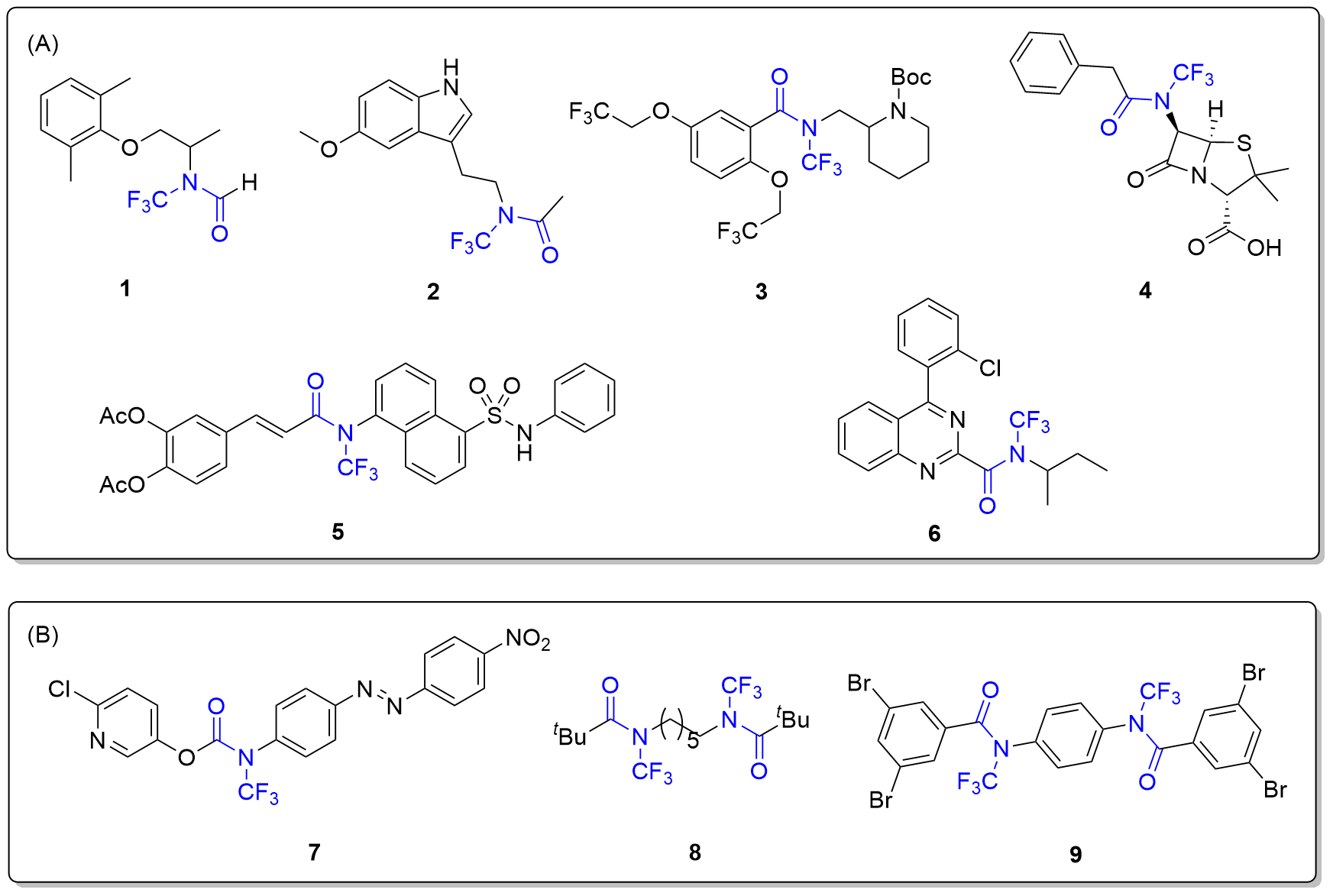
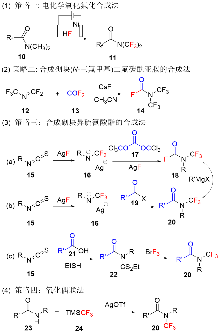
N-三氟甲基酰胺及其衍生物的分子含有可以带来独特物化性能的酰胺官能团和N-CF3官能团, 在物理学和生命科学上具有重要的研究意义, 近年来越来越引起药物化学家、材料化学家和有机合成化学家的兴趣和重视. 然而从丰富易得的底物出发, 开发高效合成N-三氟甲基酰胺的新方法, 目前仍然是一个具有挑战性的科学问题, 正受到人们的持续关注. 在过去七十年中, 针对该类化合物的合成方法的开发取得了显著的发展, 这些合成方法可以归纳为以下四种策略: (1)电化学氧化氟化合成法, (2)应用(N-三氟甲基)二氟碳酰亚胺的合成砌块法, (3)应用异硫氰酸酯的合成砌块法, (4)氧化偶联法. 此综述专注于N-三氟甲基酰胺的合成研究, 总结了该类化合物的合成策略, 概述了近年来合成方法的发展现状, 对不同的合成策略进行了梳理与比较, 并且展望了未来可能的N-三氟甲基酰胺合成方法发展方向.
林天星, 刘天飞. N-三氟甲基酰胺合成方法的研究进展[J]. 有机化学, 2025, 45(6): 1995-2006.
Tianxing Lin, Tianfei Liu. Research Advances in the Synthetic Methodologies of N-Trifluoromethylamides[J]. Chinese Journal of Organic Chemistry, 2025, 45(6): 1995-2006.























| [1] |
|
| [2] |
|
| [3] |
|
| [4] |
|
| [5] |
|
| [6] |
|
| [7] |
|
| [8] |
|
| [9] |
|
| [10] |
|
| [11] |
|
| [12] |
|
| [13] |
|
| [14] |
|
| [15] |
|
| [16] |
|
| [17] |
|
| [18] |
|
| [19] |
|
| [20] |
|
| [21] |
(a)
|
|
(b)
|
|
| [22] |
|
| [23] |
|
| [24] |
|
| [25] |
|
| [26] |
|
| [27] |
|
| [28] |
|
| [29] |
|
| [30] |
|
| [31] |
|
| [32] |
|
| [33] |
|
| [34] |
|
| [35] |
|
| [39] |
|
| [40] |
|
| [41] |
|
| [42] |
|
| [43] |
|
| [44] |
|
| [36] |
|
| [37] |
|
| [38] |
|
| [1] | 李闯, 张成, 刘小宇, 秦勇. 二萜生物碱全合成研究进展[J]. 有机化学, 2025, 45(3): 881-895. |
| [2] | 曹素芳, 刘云云, 万结平. α-三氟甲基酮的合成及其脱氟转化反应研究进展[J]. 有机化学, 2025, 45(1): 86-103. |
| [3] | 张雅芳, 黄轩, 林琪, 钟海琼, 翁志强, 吴伟. 噻唑类化合物的合成研究进展[J]. 有机化学, 2024, 44(5): 1458-1479. |
| [4] | 关丽, 周艳艳, 毛永爆, 付恺森, 关文惠, 付义乐. 甲川链修饰菁染料的合成研究进展[J]. 有机化学, 2023, 43(8): 2682-2698. |
| [5] | 宋树勇, 徐森苗. 三氟甲基烯烃的选择性C-F键活化最新进展[J]. 有机化学, 2023, 43(2): 411-425. |
| [6] | 刘鹏, 钟富明, 廖礼豪, 谭伟强, 赵晓丹. 炔烃参与的去芳构化反应构建螺环己二烯酮类化合物的研究进展[J]. 有机化学, 2023, 43(12): 4019-4035. |
| [7] | 刘文启, 沈振陆, 徐森苗. 三苯基砷/铱催化的非活化一级碳氢键的双硼化反应合成1,1-偕二硼烷[J]. 有机化学, 2022, 42(4): 1101-1110. |
| [8] | 龚婷婷, 陈智斌, 刘妙昌, 成江. 2-苯并呋喃-1(3H)-酮的合成研究进展[J]. 有机化学, 2022, 42(4): 1085-1100. |
| [9] | 孔媛芳, 杨彬, 庄严, 张京玉, 孙德梅, 董春红. 基于二肽基肽酶4 (DPP-4)靶点设计的五种降糖活性杂环合成及构效关系研究进展[J]. 有机化学, 2022, 42(3): 770-784. |
| [10] | 郭檬檬, 于子伦, 陈玉兰, 葛丹华, 马猛涛, 沈志良, 褚雪强. 二氟烯醇硅醚作为含氟砌块在构建有机氟化物中的研究进展[J]. 有机化学, 2022, 42(11): 3562-3587. |
| [11] | 张永红, 唐承宗, 刘永红, 刘晨江. 芳基三氮烯作为芳基前体和芳基偶氮前体在有机合成中的应用研究进展[J]. 有机化学, 2021, 41(7): 2587-2600. |
| [12] | 邹晓亮, 徐森苗. 铱催化的(杂)芳烃远端区域选择性C—H硼化反应的最新进展[J]. 有机化学, 2021, 41(7): 2610-2620. |
| [13] | 刘路华, 杜荣荣, 徐森苗. 无配体参与的铱催化的苄位二级碳氢键的硼化反应[J]. 有机化学, 2021, 41(4): 1572-1581. |
| [14] | 杜玉英, 肖业元, 田福利, 韩利民, 顾彦龙, 竺宁. 吲哚多样化环化合成咔唑衍生物研究进展[J]. 有机化学, 2021, 41(2): 521-528. |
| [15] | 刘亮, 刘文波, 崔冬梅, 曾明. 芳酮类化合物的合成研究进展[J]. 有机化学, 2021, 41(11): 4289-4305. |
| 阅读次数 | ||||||
|
全文 |
|
|||||
|
摘要 |
|
|||||


