有机化学 ›› 2026, Vol. 46 ›› Issue (4): 1146-1165.DOI: 10.6023/cjoc202512019 上一篇 下一篇
综述与进展
叶富a, 袁伟明b,*( )
)
收稿日期:2025-12-16
修回日期:2026-01-24
发布日期:2026-02-06
通讯作者:
袁伟明
基金资助:
Fu Yea, Weiming Yuanb,*()
Received:2025-12-16
Revised:2026-01-24
Published:2026-02-06
Contact:
Weiming Yuan
Supported by:文章分享
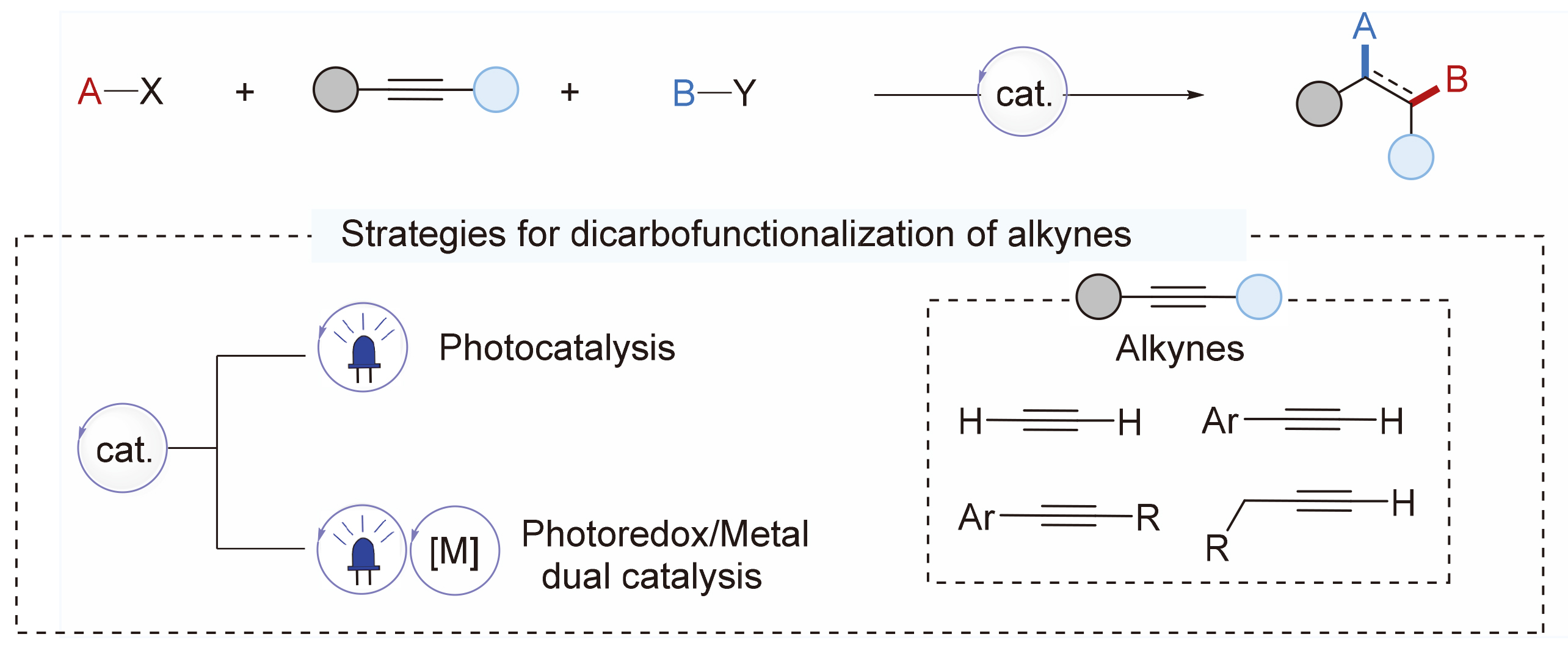
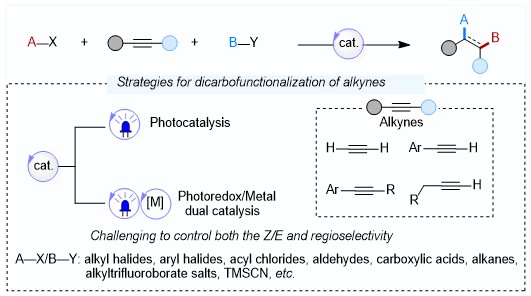
光氧化还原催化炔烃的双碳官能团化反应是有机合成领域的前沿研究方向之一. 该策略通过单电子转移、能量转移或质子耦合电子转移等机制活化底物, 实现炔烃的高效、高选择性双碳官能团化. 与传统方法相比, 可见光催化策略具有条件温和、底物适用范围广、官能团兼容性和反应选择性好等优势, 为多取代烯烃、环状骨架及生物活性分子的高效合成提供了新范式. 系统综述了可见光催化炔烃双碳官能团化的最新研究进展, 重点阐述了底物适用范围、反应机理、选择性调控策略以及合成应用, 并对未来发展趋势进行了展望.
叶富, 袁伟明. 光氧化还原催化炔烃的双碳官能团化反应进展[J]. 有机化学, 2026, 46(4): 1146-1165.
Fu Ye, Weiming Yuan. Recent Advances in Dicarbofunctionalization of Alkynes via Photoredox Catalysis[J]. Chinese Journal of Organic Chemistry, 2026, 46(4): 1146-1165.
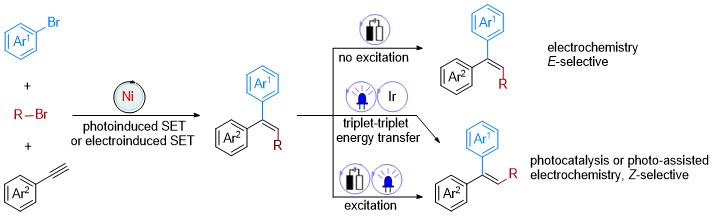
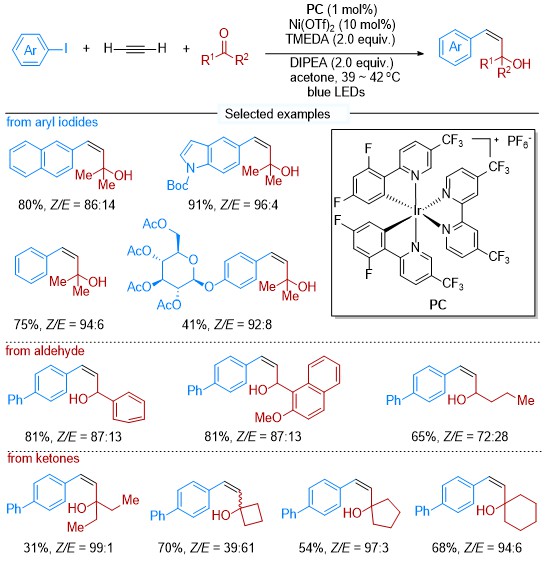
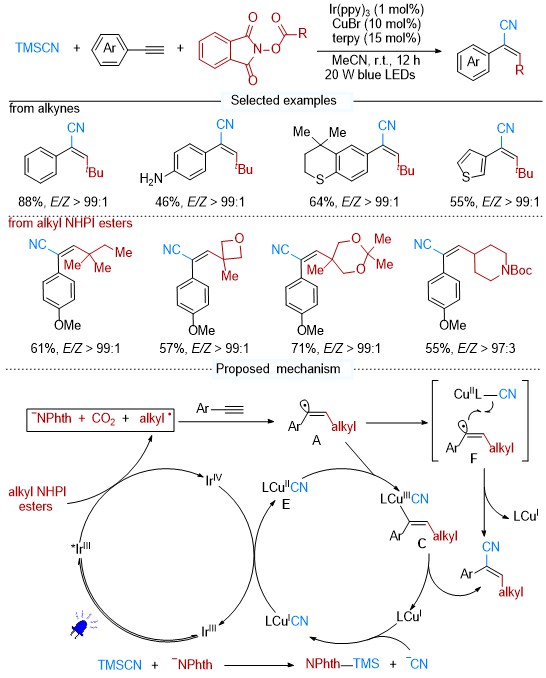
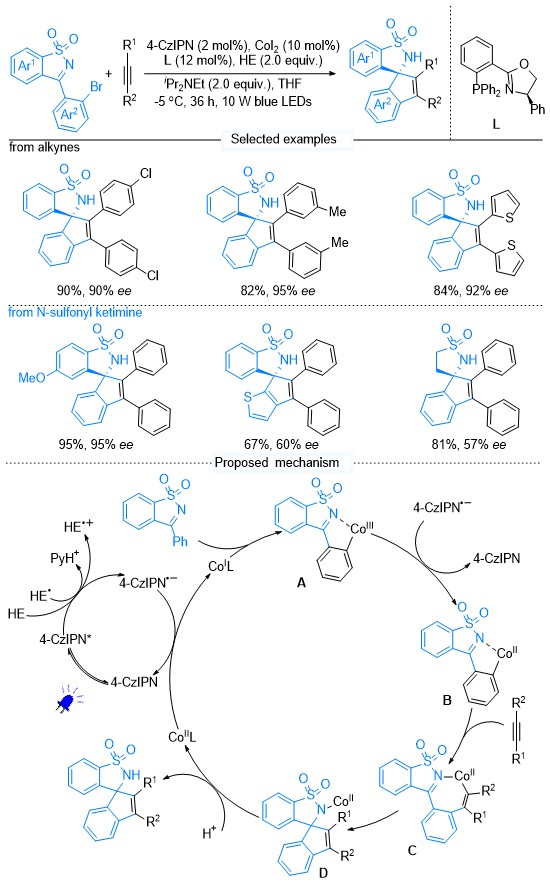
| [1] |
(a)
|
|
(b)
|
|
|
(c)
|
|
|
(d)
|
|
|
(e)
|
|
| [2] |
(a)
|
|
(b)
|
|
|
(c)
|
|
| [3] |
(a)
|
|
(b)
|
|
|
(c)
|
|
| [4] |
(a)
|
|
(李康葵, 龙先扬, 黄岳, 祝诗发, 化学学报, 2024, 82, 658.)
|
|
|
(b)
|
|
| [5] |
(a)
|
|
(b)
|
|
|
(c)
|
|
|
(d)
|
|
| [6] |
(a)
|
|
(b)
|
|
|
(c)
|
|
|
(徐磊, 王方, 陈凡, 朱圣卿, 储玲玲, 有机化学, 2022, 42, 1.)
|
|
| [7] |
(a)
|
|
(b)
|
|
|
(c)
|
|
|
(平媛媛, 宋海霞, 孔望清, 有机化学, 2022, 42, 3302.)
|
|
|
(d)
|
|
|
(e)
|
|
|
(f)
|
|
|
(g)
|
|
| [8] |
|
| [9] |
(a)
|
|
(b)
|
|
|
(c)
|
|
|
(d)
|
|
| [10] |
(a)
|
|
(b)
|
|
|
(c)
|
|
|
(d)
|
|
| [11] |
|
| [12] |
|
| [13] |
(a)
|
|
(b)
|
|
| [14] |
|
| [15] |
|
| [16] |
|
| [17] |
(a)
|
|
(b)
|
|
| [18] |
|
| [19] |
(a)
|
|
(b)
|
|
|
(c)
|
|
|
(d)
|
|
|
(e)
|
|
|
(乐柏佟, 吴新鑫, 朱晨, 有机化学, 2022, 42, 458.)
|
|
|
(f)
|
|
|
(g)
|
|
|
(h)
|
|
| [20] |
|
| [21] |
|
| [22] |
|
| [23] |
|
| [24] |
|
| [25] |
(a)
|
|
(b)
|
|
|
(c)
|
|
| [26] |
|
| [27] |
|
| [28] |
(a)
|
|
(b)
|
|
|
(c)
|
|
| [29] |
|
| [30] |
|
| [31] |
|
| [32] |
(a)
|
|
(b)
|
|
| [33] |
|
| [34] |
|
| [35] |
(a)
|
|
(b)
|
|
| [36] |
|
| [37] |
|
| [38] |
|
| [39] |
|
| [40] |
|
| [1] | 孟令旭, 申霖, 罗祥玲, 林玉妹, 龚磊. 具有光活性的铬、钴配合物的设计及其在有机合成中的应用进展[J]. 有机化学, 2026, 46(4): 1513-1528. |
| [2] | 张轶翕, 庞利娟, 黄华文. 可见光诱导氧气氧化喹喔啉酮与醛的脱氢偶联[J]. 有机化学, 2026, 46(4): 1730-1738. |
| [3] | 刘水林, 陈镤, 贺晶, 刘宁, 黄华文. 过渡金属催化自由基介导1,3-二烯的选择性双官能团化研究进展[J]. 有机化学, 2026, 46(4): 1330-1359. |
| [4] | 赵丽玮, 张梁, 胡鹏. 氢原子迁移(HAT)介导的官能团迁移反应[J]. 有机化学, 2026, 46(4): 1284-1302. |
| [5] | 张晋瑜, 卢志刚, 刘喆, 王聪. 过渡金属催化亚甲基环丙烷的硅氢化和硼化反应[J]. 有机化学, 2026, 46(3): 806-816. |
| [6] | 梁新宇, 米春春, 郭福军, 谢文斌, 史钦钦, 黄辉. 芳基亚磺酸钠与芳基硫鎓盐的脱硫交叉偶联反应[J]. 有机化学, 2026, 46(3): 1000-1007. |
| [7] | 刘颖杰, 闵来生, 杨锐蓉, 宋冬雪, 彭瑞, 梁德强. CuI催化C—C键偶联反应构建2-羰基-1,4-二酮[J]. 有机化学, 2026, 46(2): 603-611. |
| [8] | 韩天娇, 师迁迁, 符运栋, 梅光建. 三酮烯烃与硝酮的反常区域选择性[3+2]环加成反应研究[J]. 有机化学, 2026, 46(1): 146-155. |
| [9] | 陈艺林, 岳佳怡, 林依鸣, 刘兵妮, 戴闻, 朱红平. 硅杂环丙烯的合成和表征[J]. 有机化学, 2026, 46(1): 128-134. |
| [10] | 李欢乐, 潘其, 娄绍杰, 毛羊杰, 许丹倩. 基于氢原子迁移(HAT)过程的胺类化合物选择性C—H键转化反应研究进展[J]. 有机化学, 2025, 45(9): 3213-3243. |
| [11] | 缪尹盛, 张磊, 陈建圻, 王丽丽, 段征. 双季鏻盐催化芳基炔烃与N-亚胺(异)喹啉叶立德合成吡唑并(异)喹啉衍生物[J]. 有机化学, 2025, 45(8): 2876-2884. |
| [12] | 任揽星, 徐阿娜, 肖锡林, 游恒志, 宋利娟. 溶剂效应对Ir催化的不对称氢化反应对映选择性影响的理论研究[J]. 有机化学, 2025, 45(8): 2904-2912. |
| [13] | 陈明, 张敬. 芳基羧酸无痕导向官能化反应的研究进展[J]. 有机化学, 2025, 45(8): 2660-2676. |
| [14] | 杜一鸣, 贾均松, 李玉龙, 舒伟. 手性α-芳基酮的催化合成研究进展[J]. 有机化学, 2025, 45(6): 1838-1870. |
| [15] | 苏雷, 杨熙, 闫捷, 蒋元力, 陈丽娟, 郑庆舒, 刘家旺. 不对称羰基化偶联反应研究进展[J]. 有机化学, 2025, 45(6): 2007-2047. |
| 阅读次数 | ||||||
|
全文 |
|
|||||
|
摘要 |
|
|||||