有机化学 ›› 2025, Vol. 45 ›› Issue (8): 2660-2676.DOI: 10.6023/cjoc202502006 上一篇 下一篇
综述与进展
陈明, 张敬*( )
)
收稿日期:2025-03-31
修回日期:2025-04-08
发布日期:2025-04-16
基金资助:
Ming Chen, Jing Zhang*()
Received:2025-03-31
Revised:2025-04-08
Published:2025-04-16
Contact:
*E-mail:jzhangwhu@whu.edu.cn
Supported by:文章分享

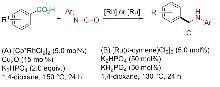
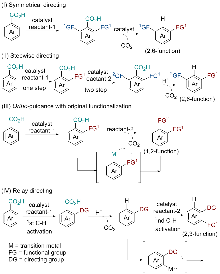
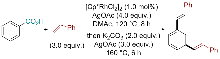
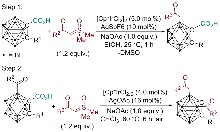
从简单、易得的原料高效构建复杂、高价值的有机分子是有机合成的核心目标. 近年来, 导向基团辅助的过渡金属催化的C—H键活化已成为实现位点选择性官能化的重要策略. 其中, 芳基羧酸因其结构多样性、稳定性和易获取性, 成为备受关注的合成原料. 特别是, 其羧基作为无痕导向基团, 有效避免了额外的导向基团引入和去除步骤, 显著提高了反应的原子和步骤经济性. 得益于这些优势, 过渡金属催化的芳基羧酸无痕导向C—H键单官能化反应已取得显著进展. 与之相比, 相应的双官能化转化在复杂分子构建中展现出重要的合成价值和应用前景, 但是这类反应研究进展相对滞后. 本综述总结了近年来羧基无痕导向的单官能化和双官能化的研究进展, 并探讨了该领域的挑战与未来发展方向.
陈明, 张敬. 芳基羧酸无痕导向官能化反应的研究进展[J]. 有机化学, 2025, 45(8): 2660-2676.
Ming Chen, Jing Zhang. Recent Progress in Traceless Directed Functionalization Reactions of Arylcarboxylic Acids[J]. Chinese Journal of Organic Chemistry, 2025, 45(8): 2660-2676.































| [1] |
|
| [2] |
|
| [3] |
|
| [4] |
|
|
(余金权, 丁奎岭, 化学学报, 2015, 73, 1223.)
doi: 10.6023/A1512E001 |
|
| [5] |
|
| [6] |
doi: 10.1021/ja1033167 pmid: 20509671 |
| [7] |
|
| [8] |
|
| [9] |
|
| [10] |
doi: 10.1039/c8ra03230k pmid: 35541005 |
| [11] |
|
| [12] |
|
| [13] |
doi: 10.1021/acs.orglett.9b03182 pmid: 31596098 |
| [14] |
|
| [15] |
|
| [16] |
|
| [17] |
|
| [18] |
|
| [19] |
|
| [20] |
|
|
(付拯江, 曹晰晗, 尹健, 苟振宇, 伊学政, 蔡琥, 有机化学, 2022, 42, 67.)
doi: 10.6023/cjoc202106024 |
|
| [21] |
doi: 10.1021/acs.chemrev.6b00516 pmid: 28266216 |
| [22] |
|
| [23] |
|
| [24] |
|
| [25] |
|
| [26] |
|
| [27] |
pmid: 27934340 |
| [28] |
|
| [29] |
|
| [30] |
|
| [31] |
doi: 10.1039/c1cs15088j pmid: 21731956 |
| [32] |
|
| [33] |
|
| [34] |
|
| [35] |
|
| [36] |
|
| [37] |
|
| [38] |
|
| [39] |
|
| [40] |
|
| [41] |
|
| [42] |
|
| [43] |
|
| [44] |
|
| [45] |
|
| [46] |
|
| [47] |
|
| [48] |
|
| [49] |
|
| [50] |
doi: 10.1038/nchem.2602 pmid: 27874862 |
| [51] |
|
| [52] |
|
| [53] |
|
| [54] |
|
| [55] |
|
| [56] |
doi: 10.1039/d0sc01138j pmid: 34122883 |
| [57] |
(a)
pmid: 28726425 |
|
(b)
doi: 10.1021/acs.orglett.7b01964 pmid: 28726425 |
|
|
(c)
pmid: 28726425 |
|
|
(d)
doi: 10.1002/cctc.201900444 pmid: 28726425 |
|
| [58] |
|
| [59] |
(a)
|
|
(b)
|
|
|
(c)
|
|
|
(d)
|
|
| [60] |
|
| [61] |
|
| [62] |
|
| [63] |
|
| [64] |
|
| [65] |
|
| [66] |
|
| [67] |
|
| [68] |
|
| [69] |
|
| [70] |
|
| [71] |
|
| [72] |
|
| [73] |
doi: 10.1021/acs.joc.8b00042 pmid: 29554415 |
| [74] |
|
| [75] |
|
| [76] |
|
| [77] |
|
| [78] |
|
| [79] |
doi: 10.1002/asia.201901213 |
| [80] |
|
| [81] |
|
| [82] |
|
| [83] |
doi: 10.1021/acs.orglett.9b02008 pmid: 31294996 |
| [84] |
|
| [85] |
|
| [86] |
|
| [87] |
|
| [88] |
doi: 10.1002/adsc.201900919 |
| [89] |
|
| [90] |
|
| [91] |
|
| [92] |
doi: 10.1021/jo9016698 pmid: 19719122 |
| [93] |
|
| [94] |
|
| [95] |
|
| [96] |
pmid: 11710221 |
| [97] |
|
| [98] |
|
| [99] |
|
| [1] | 任揽星, 徐阿娜, 肖锡林, 游恒志, 宋利娟. 溶剂效应对Ir催化的不对称氢化反应对映选择性影响的理论研究[J]. 有机化学, 2025, 45(8): 2904-2912. |
| [2] | 苏雷, 杨熙, 闫捷, 蒋元力, 陈丽娟, 郑庆舒, 刘家旺. 不对称羰基化偶联反应研究进展[J]. 有机化学, 2025, 45(6): 2007-2047. |
| [3] | 杜一鸣, 贾均松, 李玉龙, 舒伟. 手性α-芳基酮的催化合成研究进展[J]. 有机化学, 2025, 45(6): 1838-1870. |
| [4] | 王霜, 毛羊杰, 娄绍杰, 许丹倩. 基于氧化型导向基团的不对称C—H键官能团化反应研究进展[J]. 有机化学, 2025, 45(6): 1961-1994. |
| [5] | 周强, 杨宝臻, 郝贵林, 罗木鹏, 曹石, 赵蓓, 袁华, 王守国. 铑(III)催化的非活化烯烃与α-重氮羰基化合物的对映选择性烯丙位C—H键烷基化反应[J]. 有机化学, 2025, 45(6): 2109-2120. |
| [6] | 刘泽水, 郭桢桢, 牛俊龙. 过渡金属催化C—H键硅基化反应构建硅杂环研究进展[J]. 有机化学, 2025, 45(2): 423-447. |
| [7] | 杨俊峰, 赵艳秋, 时磊. 电子供体-受体(EDA)复合物驱动的N-α位C—H键活化[J]. 有机化学, 2025, 45(2): 559-573. |
| [8] | 王曼曼, 习文慧, 吴昊, 白大昌. 过渡金属催化碳氢键活化合成烷基氟烷基化合物的研究进展[J]. 有机化学, 2025, 45(2): 516-530. |
| [9] | 田勋, 邓国刚, 羊晓东. 钴催化C(sp2)—H活化构建苯并含氮杂环骨架的研究进展[J]. 有机化学, 2025, 45(2): 655-667. |
| [10] | 张朝威, 徐兵斌, 刘文龙, 赵敬, 段伟良. 钯催化不对称碳氢键活化合成平面手性二茂铁磺酰胺化合物[J]. 有机化学, 2025, 45(2): 707-716. |
| [11] | 李梦倩, 吕喆, 王少君, 韩宇轩, 崔秀灵. 可见光引发炔烃双官能化反应构筑菲类化合物[J]. 有机化学, 2025, 45(2): 686-693. |
| [12] | 张腾飞, 常喆, 陈春霞, 彭进松. 过渡金属催化氮原子α位Csp3—H键官能团化反应研究进展[J]. 有机化学, 2025, 45(1): 168-188. |
| [13] | 陆玲依, 邱晓东. 自由基形式烯烃双烷基化反应研究进展[J]. 有机化学, 2024, 44(6): 1701-1718. |
| [14] | 郭凯杰, 符昕姝, 李靖, 陈艳, 胡美丽, 堵锡华, 谢屿阳, 何燕. 过渡金属催化C—S键活化与转化研究进展[J]. 有机化学, 2024, 44(4): 1124-1150. |
| [15] | 李晨龙, 余志祥. 一氧化碳参与的过渡金属催化的插羰环加成反应研究进展[J]. 有机化学, 2024, 44(4): 1045-1068. |
| 阅读次数 | ||||||
|
全文 |
|
|||||
|
摘要 |
|
|||||


