有机化学 ›› 2026, Vol. 46 ›› Issue (3): 866-871.DOI: 10.6023/cjoc202510002 上一篇 下一篇
研究论文
刘琳a, 周璐璐a, 梁天宇a, 钟克利a,*( ), 燕小梅b, 汤立军a,*()
收稿日期:2025-10-07
修回日期:2025-12-18
发布日期:2026-01-15
基金资助:
Lin Liua, Lulu Zhoua, Tianyu Lianga, Keli Zhonga,*(), Xiaomei Yanb, Lijun Tanga,*()
Received:2025-10-07
Revised:2025-12-18
Published:2026-01-15
Contact:
*E-mail: Supported by:文章分享
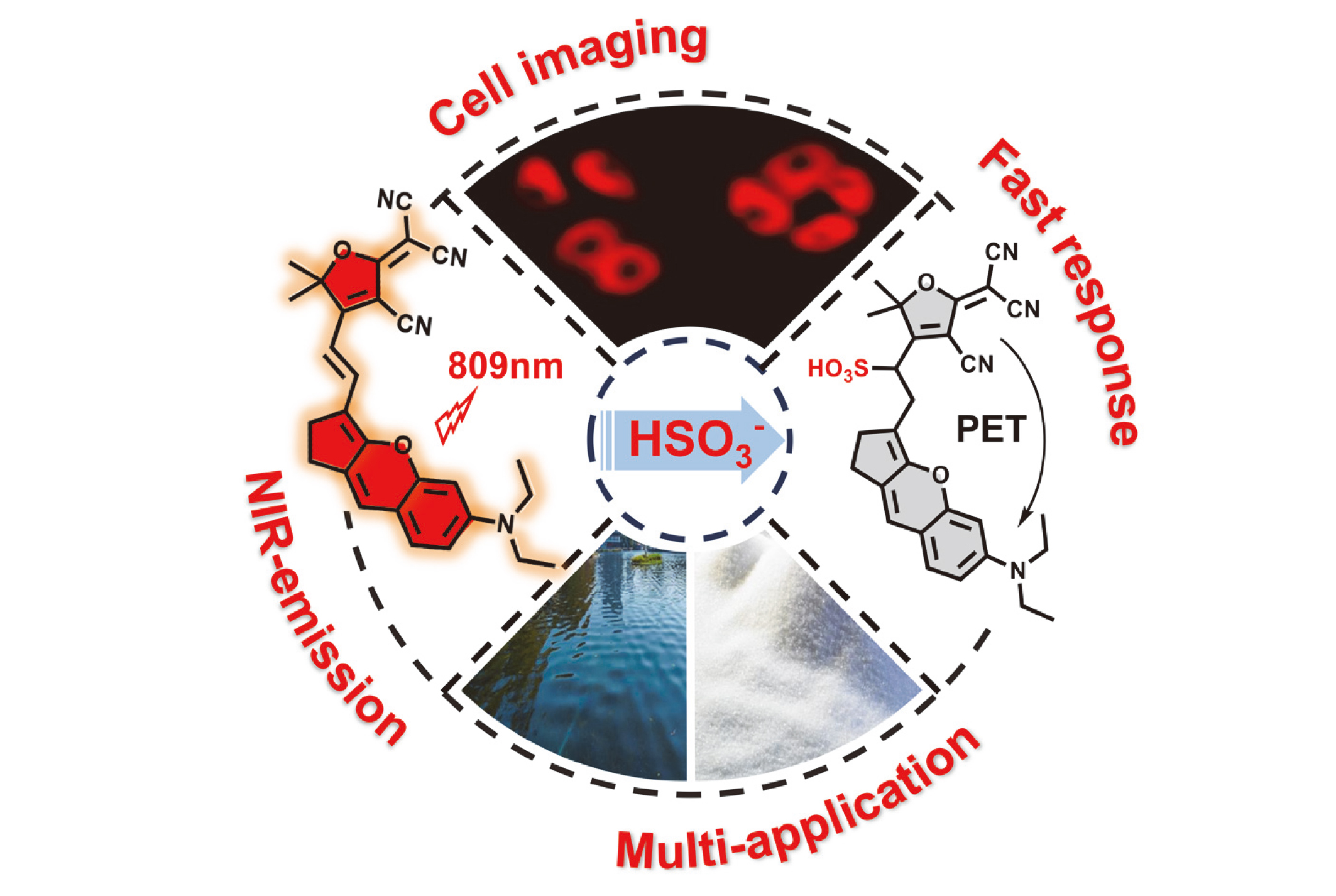
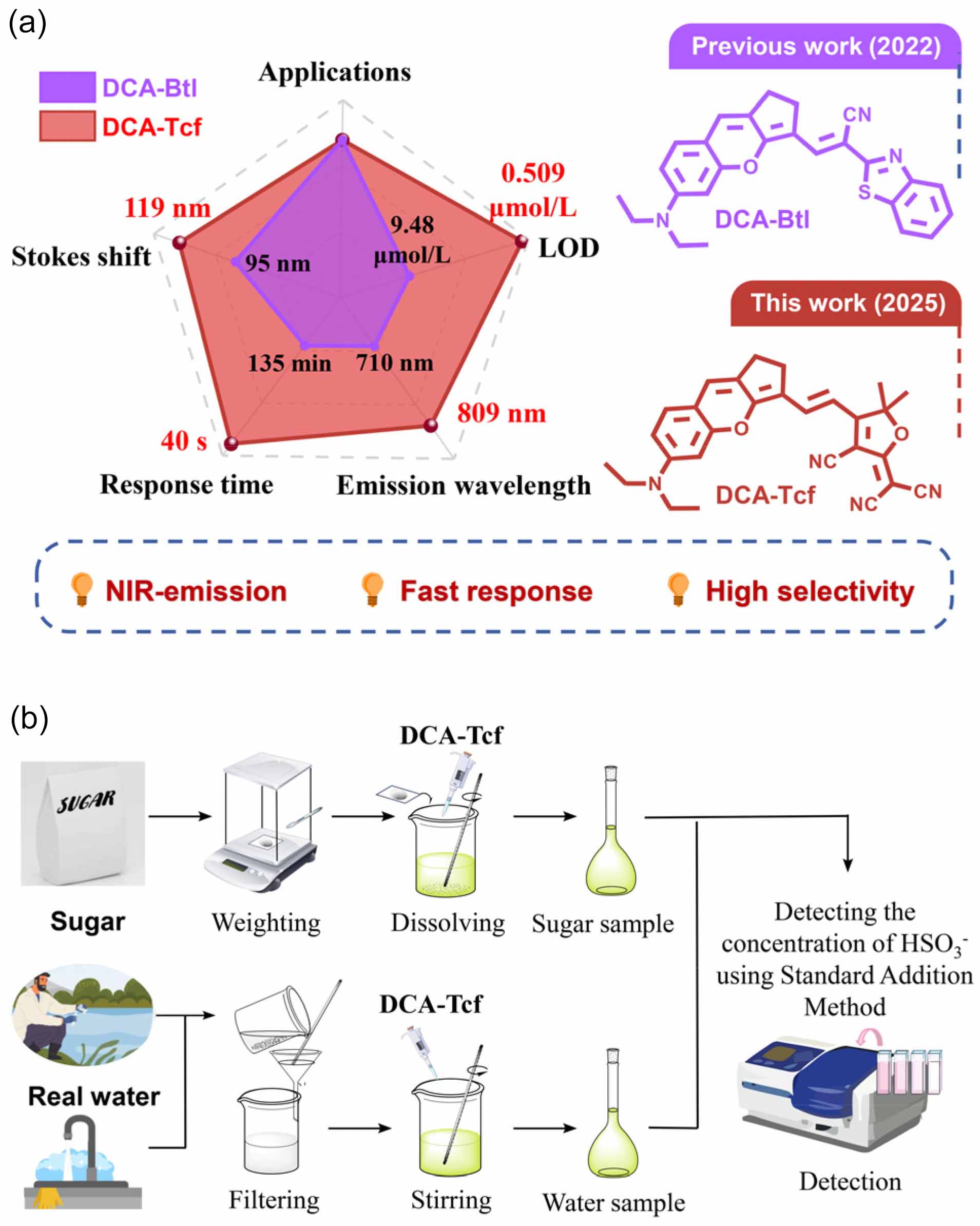
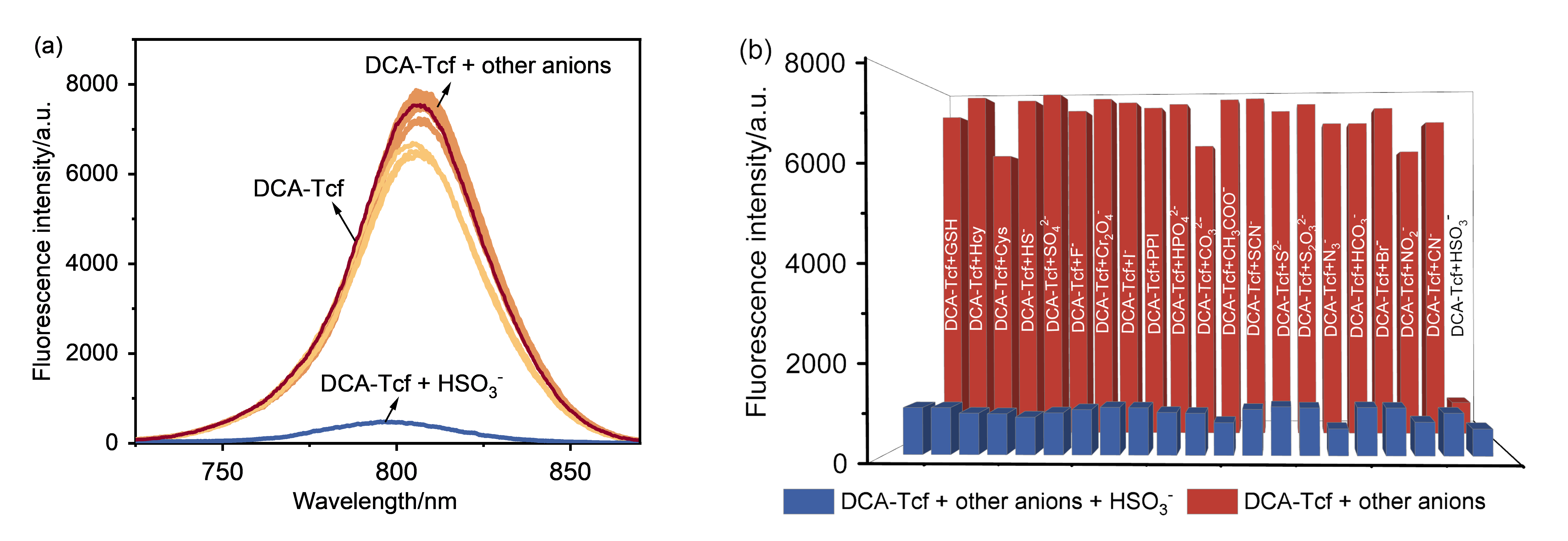
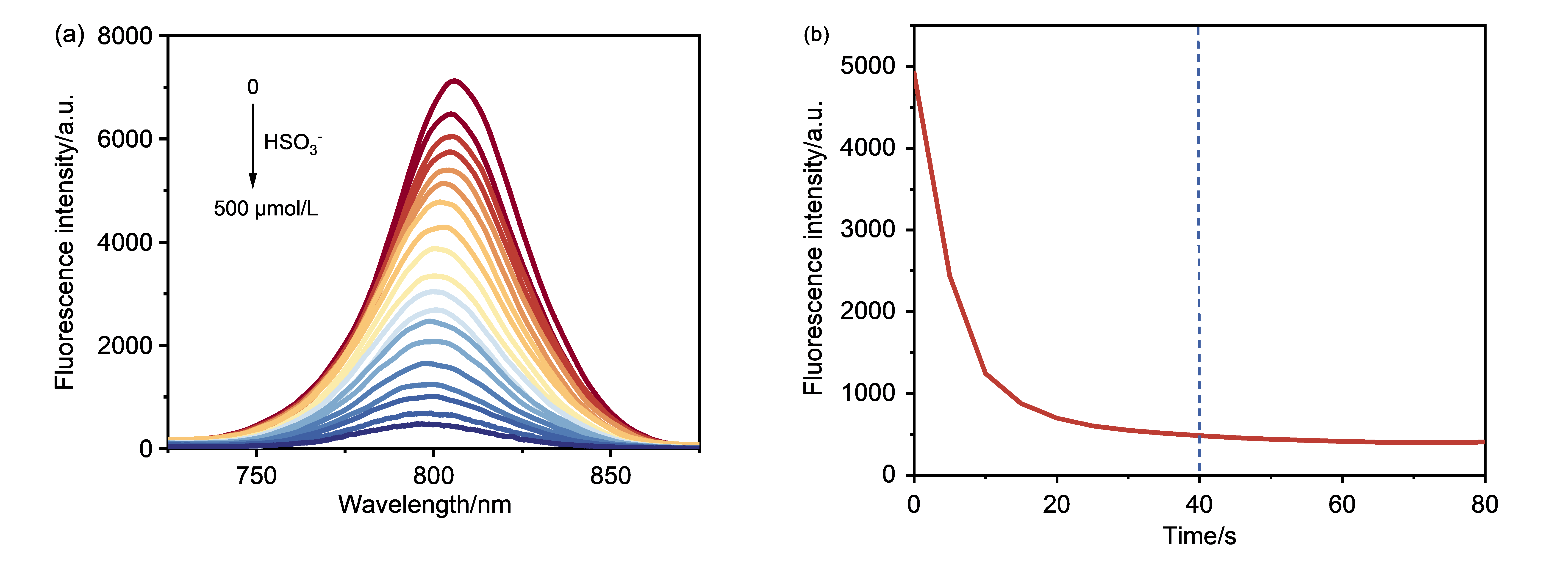
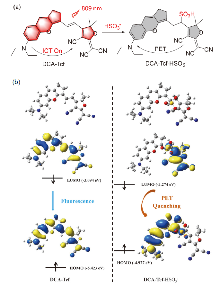
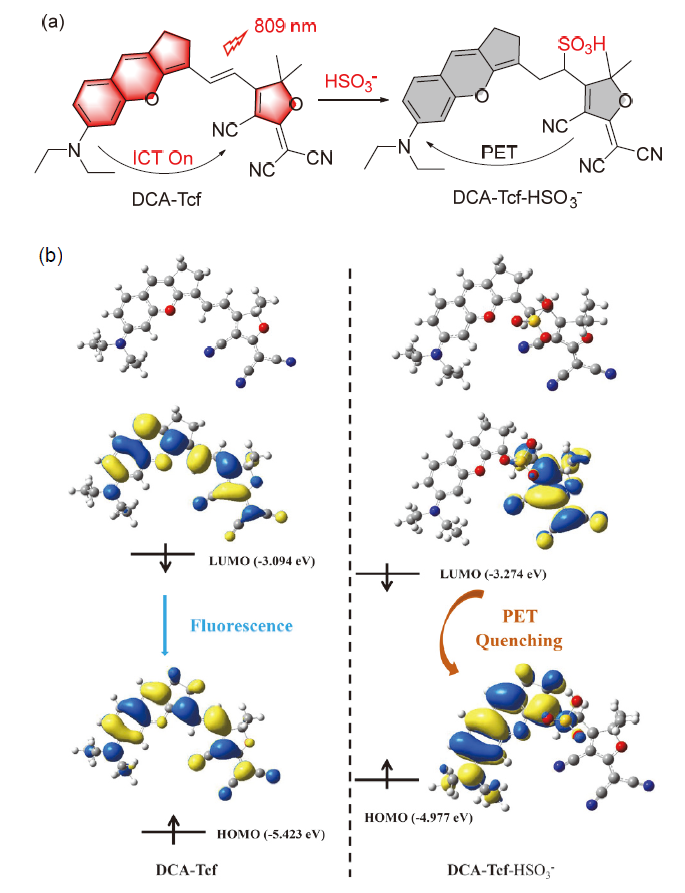
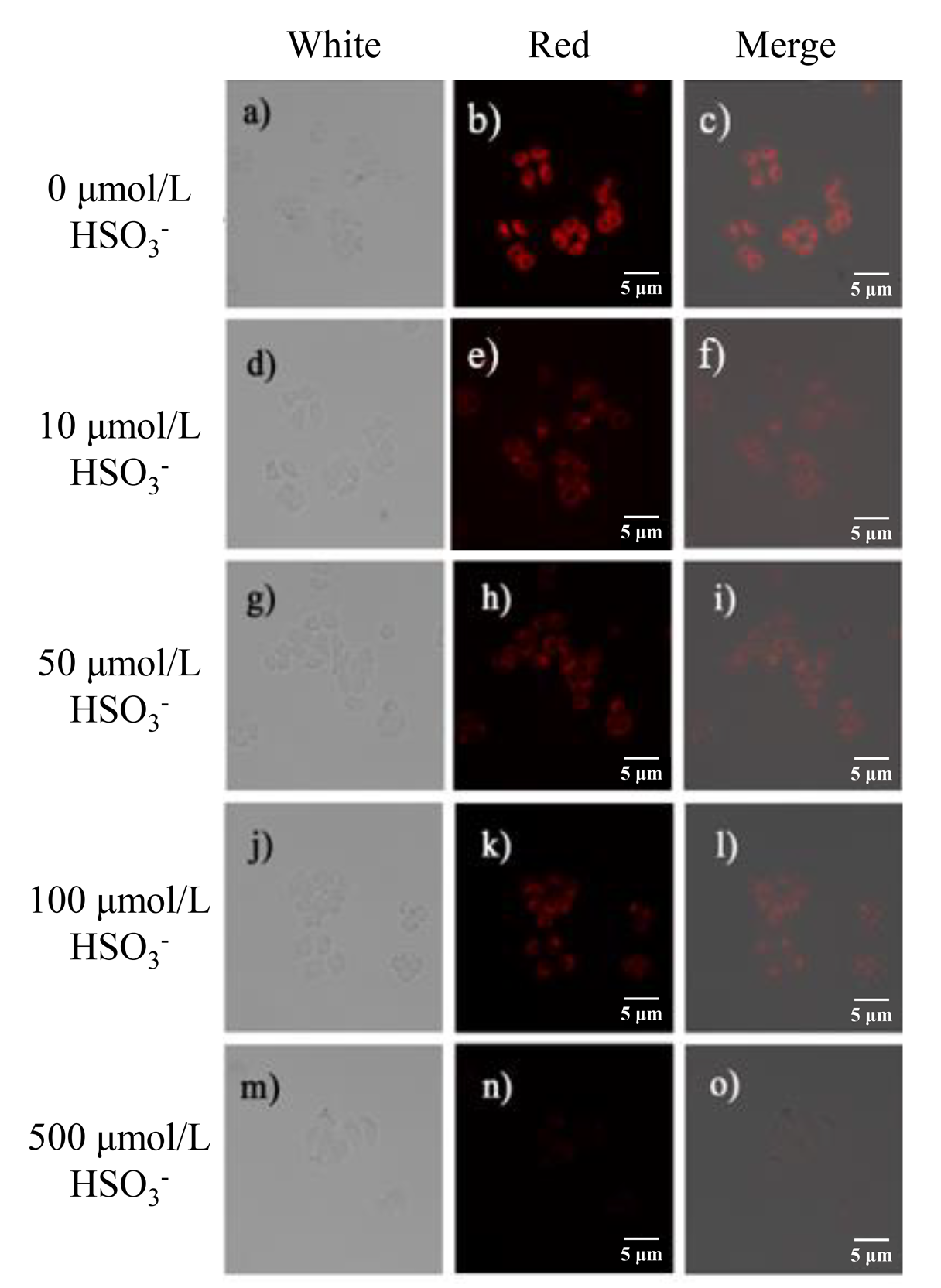
开发了一种近红外(NIR)荧光探针DCA-Tcf用于检测生物体系和食品样本中的二氧化硫衍生物($\mathrm{HSO}_{3}^{-} / \mathrm{SO}_{3}^{2-}$). 该探针以6-(二乙基氨基)-1,2-二氢环戊烯[b]苯并吡喃为荧光团, 通过引入吸电子基, 使其发射波长延伸至809 nm, 突破了小分子探针通常难以逾越的800 nm波长限制. 该发射波长可有效增强组织穿透深度并降低背景荧光干扰, 使该探针在生物成像应用中更具优势. 探针DCA-Tcf识别$\mathrm{HSO}_{3}^{-} / \mathrm{SO}_{3}^{2-}$表现出高选择性、快速响应(40 s)以及低至0.509 μmol/L的检测限, 并在真实水样和糖样中成功检测$\mathrm{HSO}_{3}^{-}$, 在活细胞荧光成像中展示出应用潜力. 本研究开发的DCA-Tcf在食品安全检测和生物成像领域可成为一种有力工具.
刘琳, 周璐璐, 梁天宇, 钟克利, 燕小梅, 汤立军. 基于苯并吡喃衍生物的近红外荧光探针用于二氧化硫衍生物的高灵敏检测与生物成像[J]. 有机化学, 2026, 46(3): 866-871.
Lin Liu, Lulu Zhou, Tianyu Liang, Keli Zhong, Xiaomei Yan, Lijun Tang. Near-Infrared Fluorescent Probe Based on Benzopyran Derivative for Highly Sensitive Detection of SO2 Derivative and Bioimaging[J]. Chinese Journal of Organic Chemistry, 2026, 46(3): 866-871.
| Sample | c/(μmol•L-1) | Recovery/% | RSD/% (n=3) | |
|---|---|---|---|---|
| Added | Found | |||
| Granulated sugar 1 | 5 | 5.12 | 102.41 | 0.18 |
| 6 | 6.09 | 101.50 | 0.06 | |
| 7 | 6.97 | 99.57 | 0.08 | |
| Granulated sugar 2 | 5 | 4.88 | 97.60 | 0.09 |
| 6 | 6.23 | 103.83 | 0.09 | |
| 7 | 7.19 | 102.71 | 0.15 | |
| Tap water | 5 | 5.23 | 104.58 | 0.23 |
| 6 | 6.43 | 107.17 | 0.40 | |
| 7 | 7.19 | 102.67 | 0.31 | |
| Lake water | 5 | 4.94 | 98.81 | 0.30 |
| 6 | 6.09 | 101.55 | 0.45 | |
| 7 | 7.14 | 101.97 | 0.15 | |
| River water | 5 | 5.22 | 104.40 | 0.39 |
| 6 | 6.14 | 102.27 | 0.18 | |
| 7 | 6.95 | 99.31 | 0.13 | |
| Sample | c/(μmol•L-1) | Recovery/% | RSD/% (n=3) | |
|---|---|---|---|---|
| Added | Found | |||
| Granulated sugar 1 | 5 | 5.12 | 102.41 | 0.18 |
| 6 | 6.09 | 101.50 | 0.06 | |
| 7 | 6.97 | 99.57 | 0.08 | |
| Granulated sugar 2 | 5 | 4.88 | 97.60 | 0.09 |
| 6 | 6.23 | 103.83 | 0.09 | |
| 7 | 7.19 | 102.71 | 0.15 | |
| Tap water | 5 | 5.23 | 104.58 | 0.23 |
| 6 | 6.43 | 107.17 | 0.40 | |
| 7 | 7.19 | 102.67 | 0.31 | |
| Lake water | 5 | 4.94 | 98.81 | 0.30 |
| 6 | 6.09 | 101.55 | 0.45 | |
| 7 | 7.14 | 101.97 | 0.15 | |
| River water | 5 | 5.22 | 104.40 | 0.39 |
| 6 | 6.14 | 102.27 | 0.18 | |
| 7 | 6.95 | 99.31 | 0.13 | |
| [1] |
doi: 10.1016/j.snb.2023.134870 |
| [2] |
|
| [3] |
doi: 10.1016/j.foodchem.2022.135031 |
| [4] |
doi: 10.1016/j.foodres.2024.115613 |
| [5] |
doi: 10.1016/j.jhazmat.2024.134003 |
| [6] |
doi: 10.1016/j.aca.2023.341783 |
| [7] |
doi: 10.1021/acs.analchem.2c05737 pmid: 36913654 |
| [8] |
doi: 10.3390/molecules28020515 |
| [9] |
doi: 10.1016/j.snb.2024.135864 |
| [10] |
doi: 10.1016/j.talanta.2024.126977 |
| [11] |
|
| [12] |
doi: 10.1016/j.tet.2024.134355 |
| [13] |
doi: 10.6023/cjoc202210030 |
|
(李宜芳, 王耀, 牛华伟, 陈秀金, 李兆周, 王永国, 有机化学, 2023, 43, 1952.)
doi: 10.6023/cjoc202210030 |
|
| [14] |
doi: 10.1016/j.jphotochem.2023.114684 |
| [15] |
doi: 10.1016/j.molstruc.2023.137168 |
| [16] |
doi: 10.1016/j.saa.2023.122882 |
| [17] |
doi: 10.6023/cjoc202311014 |
|
(刘琳, 陈琳, 胡晓玲, 钟克利, 张璟琳, 汤立军, 有机化学, 2024, 44, 2027.)
doi: 10.6023/cjoc202311014 |
|
| [18] |
doi: 10.6023/cjoc202206043 |
|
(李阳阳, 孙小飞, 胡晓玲, 任源远, 钟克利, 燕小梅, 汤立军, 有机化学, 2023, 43, 320.)
doi: 10.6023/cjoc202206043 |
|
| [19] |
|
|
(杨雅馨, 陈琳, 胡晓玲, 钟克利, 李世迪, 燕小梅, 张璟琳, 汤立军, 有机化学, 2023, 43, 308.)
doi: 10.6023/cjoc202207011 |
|
| [20] |
doi: 10.1016/j.jfoodeng.2025.112614 |
| [21] |
doi: 10.1016/j.ccr.2024.216232 |
| [22] |
doi: 10.1016/j.snb.2024.135795 |
| [23] |
doi: 10.1016/j.jhazmat.2024.136291 |
| [24] |
doi: 10.1016/j.dyepig.2023.111901 |
| [25] |
doi: 10.1016/j.snb.2022.131962 |
| [26] |
doi: 10.1016/j.dyepig.2025.112767 |
| [27] |
doi: 10.1016/j.saa.2024.124501 |
| [28] |
doi: 10.1016/j.foodchem.2023.137987 |
| [29] |
doi: 10.1016/j.jhazmat.2023.133165 |
| [30] |
doi: 10.1016/j.aca.2024.342993 |
| [31] |
doi: 10.1039/D1AY00918D |
| [32] |
doi: 10.1007/s10895-022-03050-w |
| [33] |
doi: 10.1039/D0CC07398A |
| [34] |
doi: 10.1016/j.molstruc.2022.132413 |
| [35] |
doi: 10.1021/acs.jafc.2c04571 |
| [1] | 张继东, 王浩, 权校昕, 张胜海, 厍伟. 基于四苯乙烯结构的聚集诱导发光效应(AIE)有机多晶体合成: 分子构象和Cys检测性能研究[J]. 有机化学, 2026, 46(3): 934-940. |
| [2] | 孙小飞, 张海媛, 李娟, 马骥, 王若溪, 钟克利, 李学鹏, 梁天宇, 汤立军, 励建荣. 基于“OFF-ON”型荧光探针的智能一体化平台在三文鱼肉新鲜度监测中的应用[J]. 有机化学, 2026, 46(2): 586-593. |
| [3] | 彭澳霈, 李扬, 朱园园, 吴广文, 古双喜. 席夫碱型荧光探针对氨基酸化学选择性识别研究进展[J]. 有机化学, 2025, 45(9): 3301-3313. |
| [4] | 李兆周, 谢亚芳, 陶健, 魏雪冰, 黎乐乐, 李亚娟, 唐嘉敏, 牛华伟, 陈秀金, 高红丽, 李芳, 于慧春, 袁云霞, 古绍彬, 康怀彬, 孙晓菲, 任国艳, 吴影. 半胱氨酸荧光探针的构建及其在病理学检验中的应用[J]. 有机化学, 2025, 45(7): 2335-2349. |
| [5] | 沈晴, 曾玉, 黎忠昊, 曹西颖, 郭玉婷, 叶蕴仪, 汪朝阳. 基于共价键形成与切断的反应型小分子荧光探针的研究进展[J]. 有机化学, 2025, 45(4): 1194-1205. |
| [6] | 张文博, 苏思铭, 杨鹏. 新型杯[3]咔唑衍生物的合成及其对羟喜树碱识别与检测研究[J]. 有机化学, 2025, 45(4): 1395-1401. |
| [7] | 相韩悦, 魏少荫, 王玉记, 肖猱. 基于N-氧化物结构Fe2+荧光探针的研究进展[J]. 有机化学, 2025, 45(4): 1137-1152. |
| [8] | 程晓红, 张仁杰, 游军, 付文斌, 沈文洁, 罗运强, 王松. 基于催化反应的荧光探针及其在气体发生剂中铜含量的检测应用[J]. 有机化学, 2025, 45(11): 4195-4201. |
| [9] | 陈冰燕, 孙洁, 熊玲红, 何学文. 非典型核酸结构的荧光点亮成像检测[J]. 有机化学, 2025, 45(11): 4082-4107. |
| [10] | 杨建业, 周佩, 申起飞, 张珮娟, 胥艳子, 赵炳捷, 党东锋. 有机自由基材料在生物医学领域的研究进展[J]. 有机化学, 2025, 45(11): 4013-4025. |
| [11] | 吕朦朦, 贾宵雪, 王建国. G-四链体荧光探针的应用进展[J]. 有机化学, 2025, 45(11): 4070-4081. |
| [12] | 何春, 刘姝祺, 成奋民, 郝远强, 陈述, 张培盛, 曾荣今. 具有双态发光性质的双光子丹磺酰类荧光探针的合成及其在硫化氢检测中的应用研究[J]. 有机化学, 2024, 44(9): 2869-2875. |
| [13] | 曾玉, 黎忠昊, 邓思威, 陈祖佳, 陈璧瑜, 宇世伟, 沈晴, 汪朝阳. 氰基乙烯类化合物的制备与应用研究进展[J]. 有机化学, 2024, 44(9): 2722-2731. |
| [14] | 黄凯航, 尹理, 姜青云, 汪乾, 石光, 许炳佳. 具有聚集诱导发光性质的高效热激活延迟荧光材料用于脂滴成像[J]. 有机化学, 2024, 44(8): 2479-2486. |
| [15] | 苏小龙, 李健鹏, 刘孟鑫, 邹莉, 杨得锁, 冯海涛. 四苯乙烯酰胺类化合物的合成及其高灵敏度、高选择性识别Cu2+[J]. 有机化学, 2024, 44(8): 2581-2587. |
| 阅读次数 | ||||||
|
全文 |
|
|||||
|
摘要 |
|
|||||


