

化学学报 ›› 2026, Vol. 84 ›› Issue (2): 240-247.DOI: 10.6023/A25080281 上一篇 下一篇
研究论文
徐冬青a, 童海姗a, 史路延a, 张婷b,*( )
)
投稿日期:2025-08-17
发布日期:2025-11-10
基金资助:
Dongqing Xua, Haishan Donga, Luyan Shia, Ting Zhangb,*()
Received:2025-08-17
Published:2025-11-10
Contact:
*E-mail: zhangt@ahstu.edu.cn
Supported by:文章分享
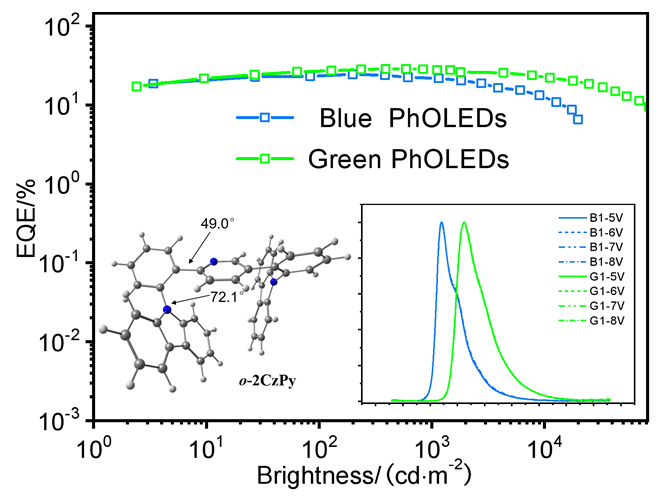
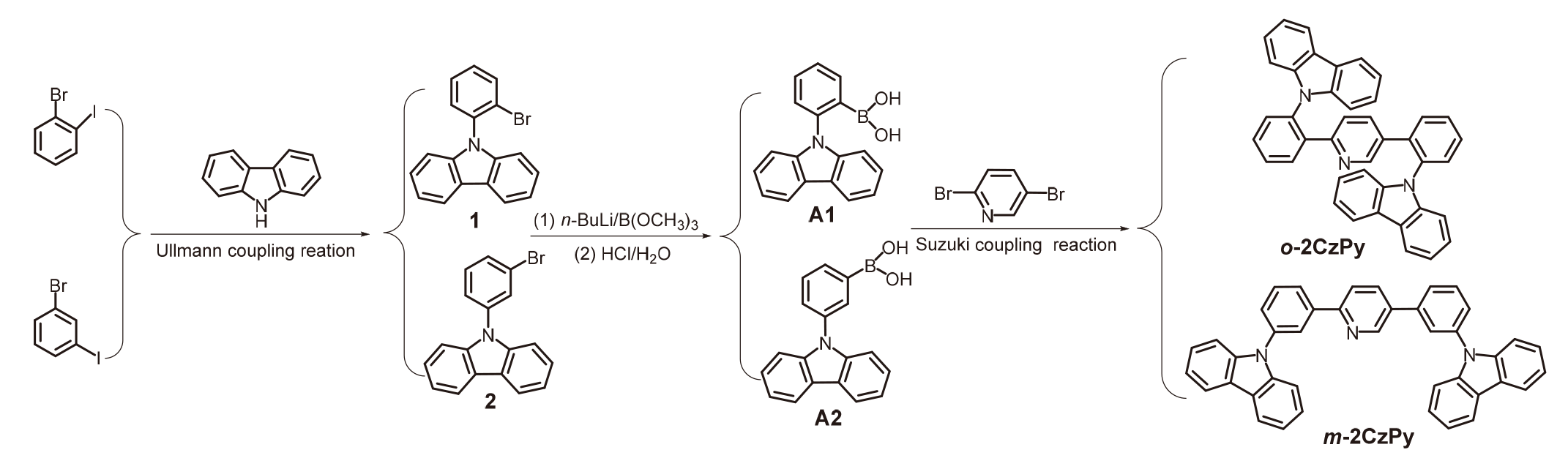
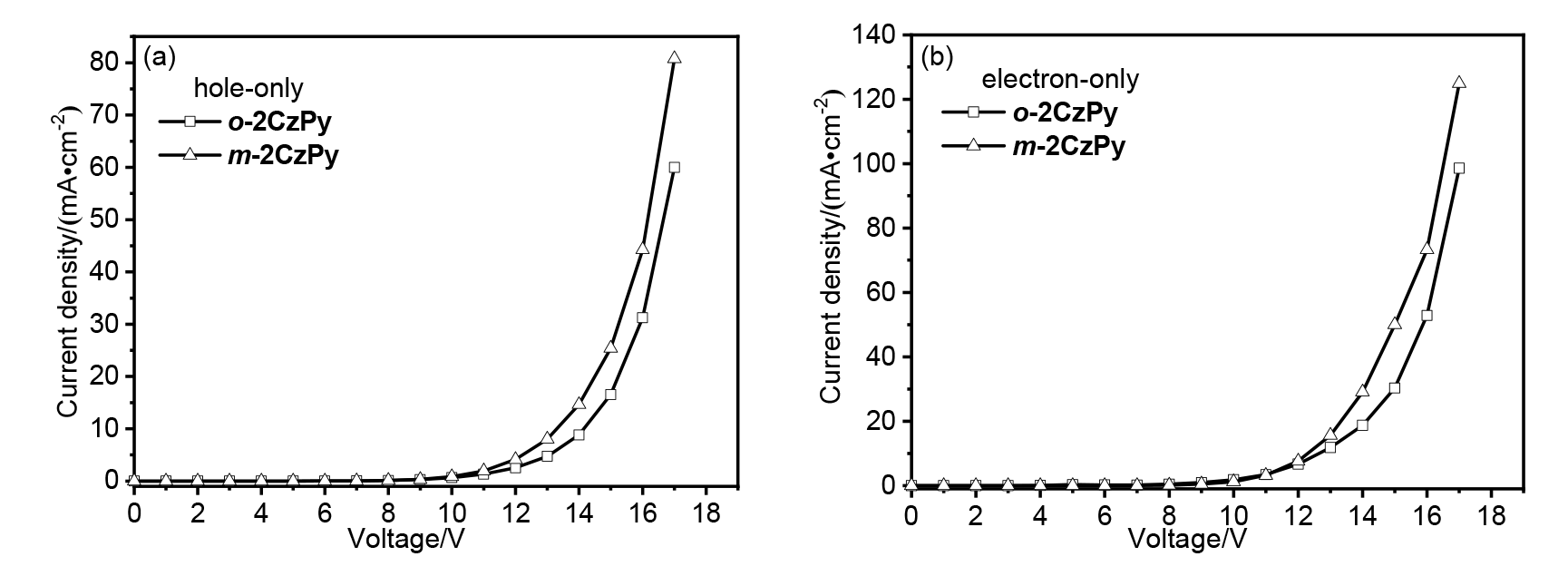
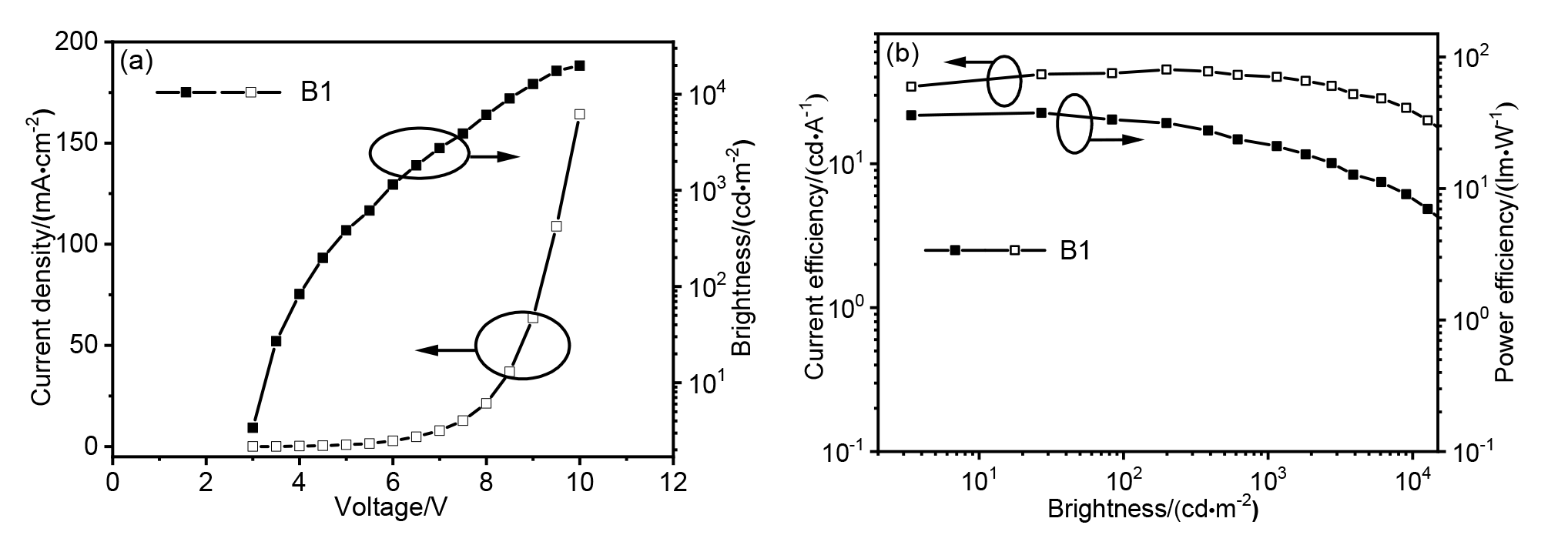
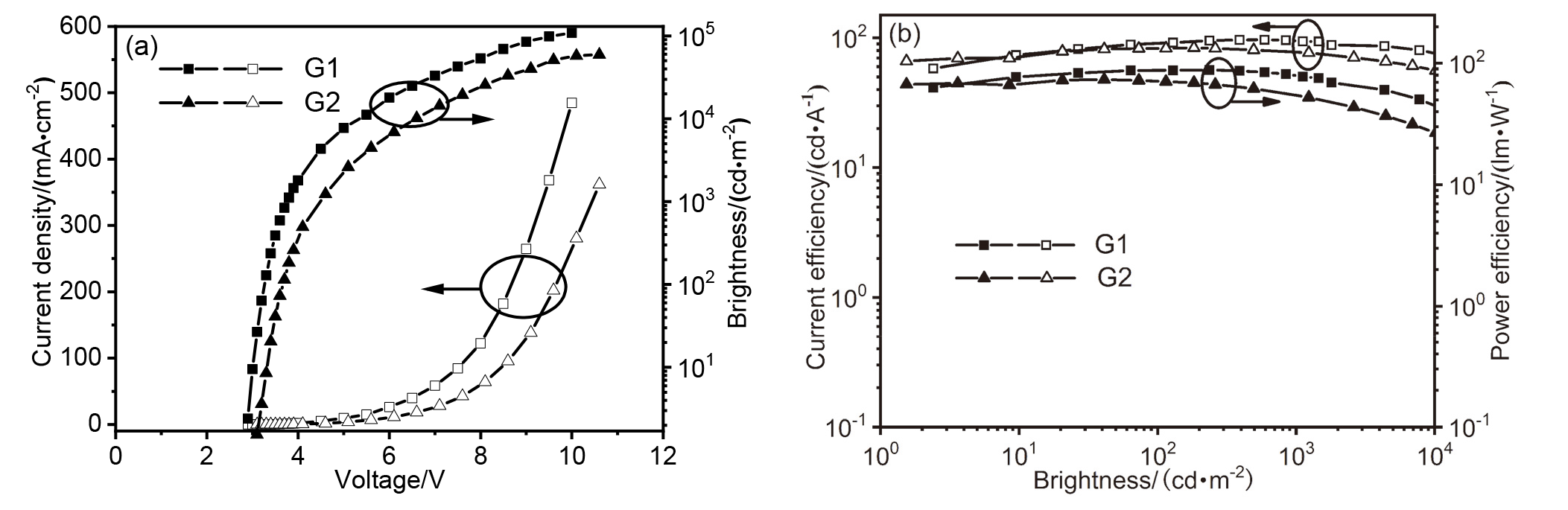
在平板显示和白光照明领域, 同时具有高效率和低效率滚降仍然是有机电致发光器件(OLED)必须满足的关键要求. 因此以咔唑为空穴传输单元(p-型基团), 亚苯基作为连接单元, 将吡啶引入分子结构中作为电子传输单元(n-型基团), 通过邻位和间位的连接形式设计并制备了两种双偶极主体材料o-2CzPy和m-2CzPy. 这两种主体材料具有良好的热稳定性和双偶极电荷传输能力, 掺杂FIrpic和Ir(ppy)3的蓝色和绿色磷光器件获得了高色纯度、高效率和低效率滚降. 其中, 基于o-2CzPy的蓝光器件最大外量子效率和电流效率分别达到了24.44%和45.16 cd•A−1, 接近于目前文献报道的掺杂FIrpic蓝色磷光器件中的最佳数据. 此外, 基于o-2CzPy的绿光器件也获得了较高的外量子效率和电流效率, 分别为28.58%和96.91 cd•A−1; 稳定的发光颜色, CIEy变化不超过0.0001. 这些结果表明这些主体材料有望在高效率且稳定的OLED显示领域中得到实际应用.
徐冬青, 童海姗, 史路延, 张婷. 吡啶类双偶极主体材料及有机电致磷光器件[J]. 化学学报, 2026, 84(2): 240-247.
Dongqing Xu, Haishan Dong, Luyan Shi, Ting Zhang. Pyridine-Based Bipolar Host Materials for Phosphorescent Organic Light-emitting Diodes[J]. Acta Chimica Sinica, 2026, 84(2): 240-247.

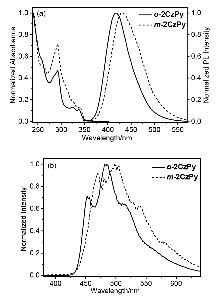
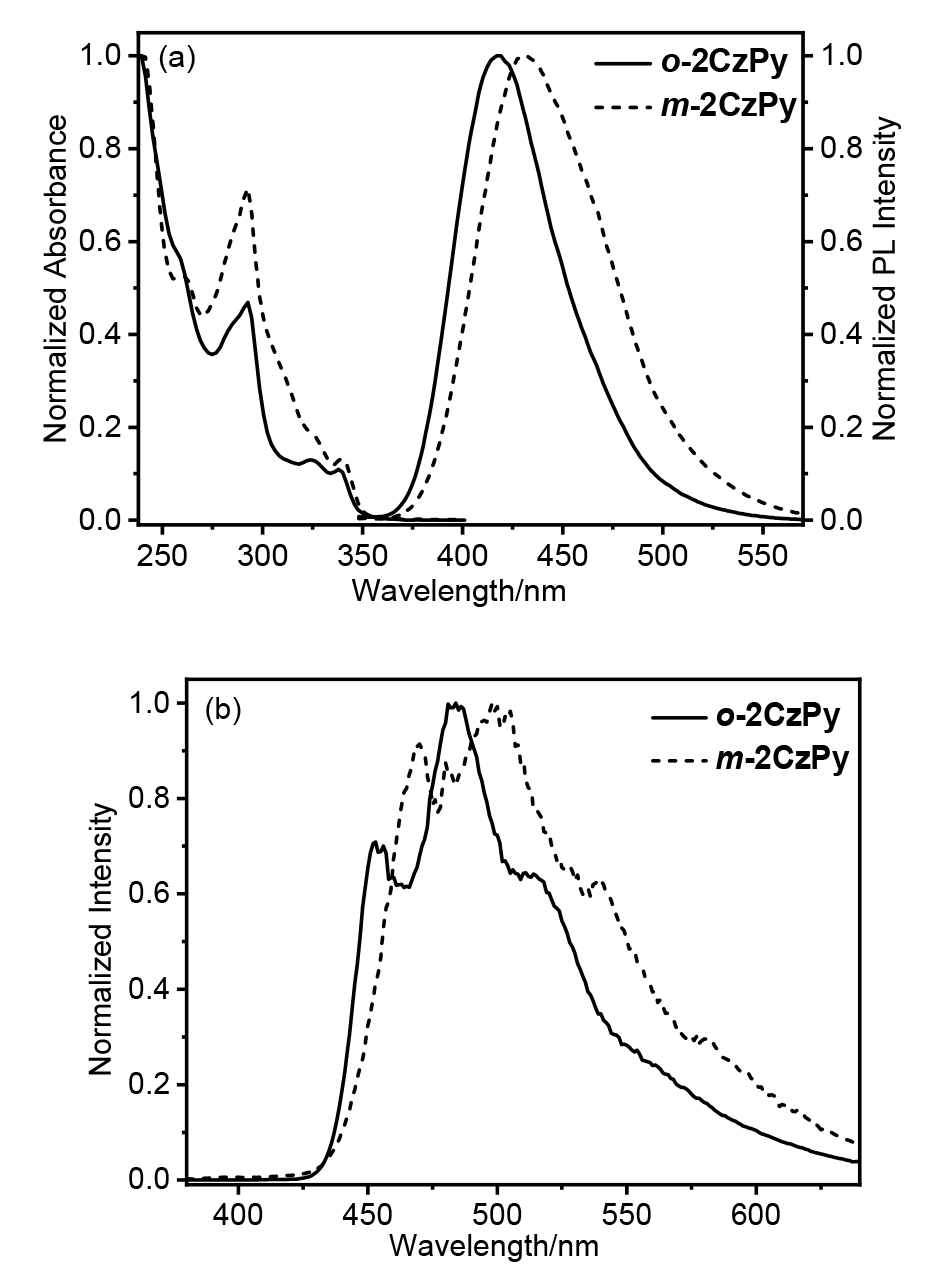
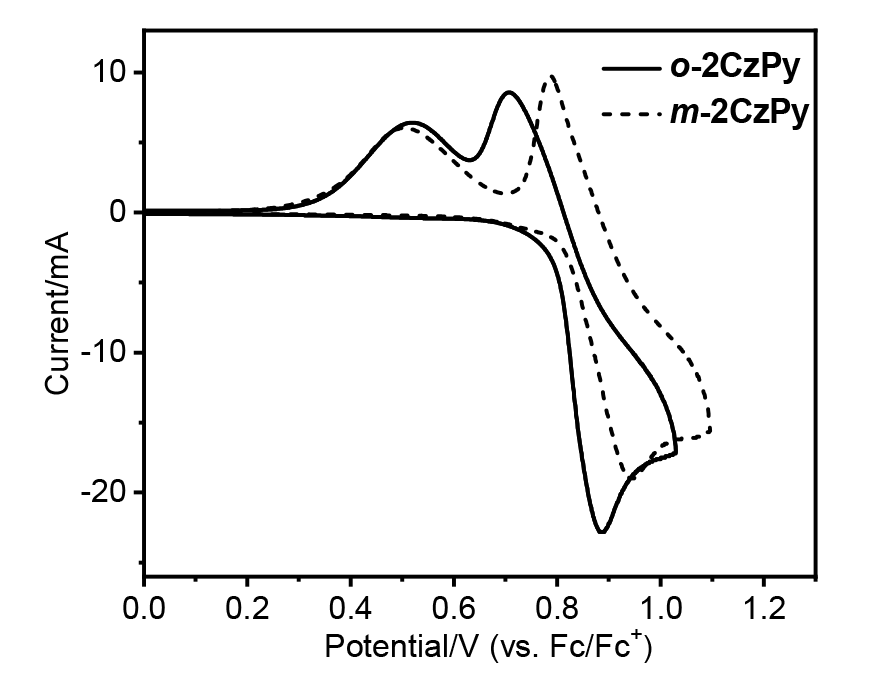
| Compd. | $ \lambda_{\max }^{\mathrm{abs}}$/nm | $ \lambda_{\text {max }}^{\mathrm{em}}$/nm | Ega/eV | ETb/eV | HOMO/eV | Tg/℃ | Td/℃ |
|---|---|---|---|---|---|---|---|
| CH2Cl2 | |||||||
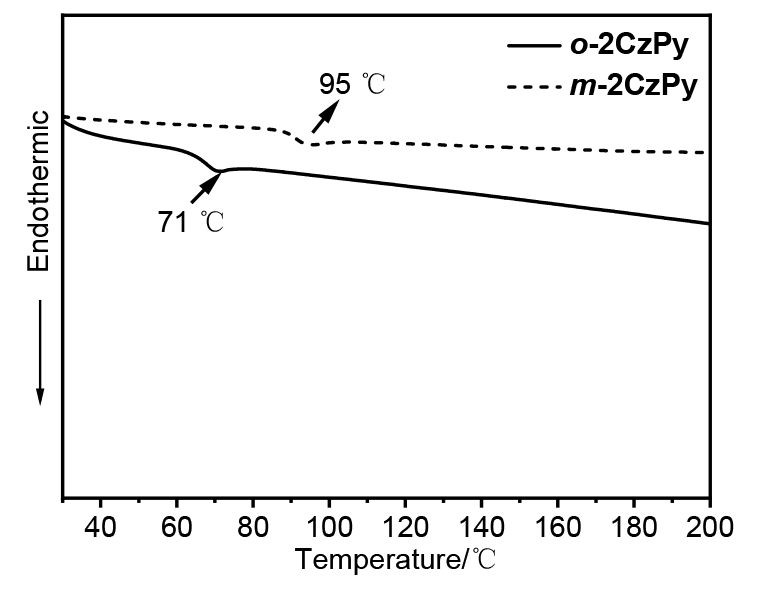
| o-2CzPy | 293, 324, 338 | 417 | 3.48 | 2.74 | -5.59 | 71 | 365 |
| m-2CzPy | 293, 326, 340 | 431 | 3.47 | 2.64 | -5.61 | 95 | 417 |
| Compd. | $ \lambda_{\max }^{\mathrm{abs}}$/nm | $ \lambda_{\text {max }}^{\mathrm{em}}$/nm | Ega/eV | ETb/eV | HOMO/eV | Tg/℃ | Td/℃ |
|---|---|---|---|---|---|---|---|
| CH2Cl2 | |||||||
| o-2CzPy | 293, 324, 338 | 417 | 3.48 | 2.74 | -5.59 | 71 | 365 |
| m-2CzPy | 293, 326, 340 | 431 | 3.47 | 2.64 | -5.61 | 95 | 417 |
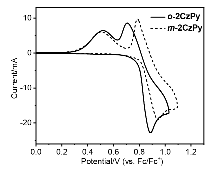

| Device | Host | Dopant | Vona/V | Lmax/(cd•m−2) | ηcb/(cd•A−1) | ηp,max/(lm•W−1) | ηextb/% | FWHM/nm | CIE (x, y) at 6 V | ΦPLQYc/% | τc/μs |
|---|---|---|---|---|---|---|---|---|---|---|---|
| B1 | o-2CzPy | FIrpic | 2.9 | 19880 | 45.16, 40.54, 28.62 | 37.60 | 24.44, 21.94, 15.49 | 46 | (0.14, 0.28) | 92.0 | 2.21 |
| G1 | o-2CzPy | Ir(ppy)3 | 2.9 | 108810 | 96.91, 95.05, 83.74 | 88.22 | 28.58, 28.03, 24.70 | 56 | (0.28, 0.63) | 95.4 | 0.92 |
| G2 | m-2CzPy | Ir(ppy)3 | 3.1 | 59386 | 83.84, 78.99, 62.77 | 73.56 | 24.48, 23.06, 18.33 | 60 | (0.29, 0.63) | 80.8 | 1.14 |
| Device | Host | Dopant | Vona/V | Lmax/(cd•m−2) | ηcb/(cd•A−1) | ηp,max/(lm•W−1) | ηextb/% | FWHM/nm | CIE (x, y) at 6 V | ΦPLQYc/% | τc/μs |
|---|---|---|---|---|---|---|---|---|---|---|---|
| B1 | o-2CzPy | FIrpic | 2.9 | 19880 | 45.16, 40.54, 28.62 | 37.60 | 24.44, 21.94, 15.49 | 46 | (0.14, 0.28) | 92.0 | 2.21 |
| G1 | o-2CzPy | Ir(ppy)3 | 2.9 | 108810 | 96.91, 95.05, 83.74 | 88.22 | 28.58, 28.03, 24.70 | 56 | (0.28, 0.63) | 95.4 | 0.92 |
| G2 | m-2CzPy | Ir(ppy)3 | 3.1 | 59386 | 83.84, 78.99, 62.77 | 73.56 | 24.48, 23.06, 18.33 | 60 | (0.29, 0.63) | 80.8 | 1.14 |
| [1] |
doi: 10.1038/25954 |
| [2] |
doi: 10.1039/C8TC05462B |
| [3] |
doi: 10.1016/j.dyepig.2023.111920 |
| [4] |
doi: 10.1002/adom.v10.1 |
| [5] |
doi: 10.1016/j.orgel.2022.106715 |
| [6] |
doi: 10.1016/j.dyepig.2021.109426 |
| [7] |
doi: 10.1039/c2jm32717a |
| [8] |
doi: 10.1360/032013-50 |
|
(顾宇, 朱丽萍, 金勇, 李逸帆, 龚少龙, 马东阁, 秦金贵, 杨楚罗, 中国科学: 化学, 2013, 43, 472.)
|
|
| [9] |
doi: 10.1039/C6CC02856J |
| [10] |
doi: 10.1002/adom.v8.2 |
| [11] |
|
| [12] |
doi: 10.1002/adfm.v28.39 |
| [13] |
doi: 10.1021/jp100034r |
| [14] |
|
| [15] |
doi: 10.1002/adma.v24.21 |
| [16] |
doi: 10.1021/acsami.9b06995 |
| [17] |
doi: 10.1002/adfm.v19:16 |
| [18] |
|
|
(林丹燕, 宋森川, 陈智勇, 郭鹏然, 陈江韩, 史华红, 麦裕良, 宋化灿, 有机化学, 2018, 38, 103.)
|
|
| [19] |
doi: 10.1002/aenm.v15.2 |
| [20] |
doi: 10.1039/C5TC02997J |
| [21] |
doi: 10.6023/A23020051 |
|
(葛凤洁, 张开志, 曹清鹏, 徐慧, 周涛, 张文浩, 班鑫鑫, 张晓波, 李娜, 朱鹏, 化学学报, 2023, 81, 1157.)
doi: 10.6023/A23020051 |
|
| [22] |
doi: 10.6023/A15090603 |
|
(张振宇, 李婉君, 叶开其, 张红雨, 化学学报, 2016, 74, 179.)
doi: 10.6023/A15090603 |
|
| [23] |
doi: 10.1021/acsami.4c06324 |
| [24] |
|
| [25] |
doi: 10.1002/adfm.v24.26 |
| [26] |
doi: 10.1039/C6SC01797E |
| [27] |
|
| [28] |
doi: 10.1016/j.cej.2023.145023 |
| [1] | 薛虎, 徐姗, 王福周, 陈昶乐. 大位阻亚胺吡啶镍催化乙烯链行走聚合制备支化聚乙烯蜡★[J]. 化学学报, 2025, 83(12): 1480-1487. |
| [2] | 孟凡荣, 李国锋, 赵杰, 肖文精, 石德清, 陈加荣. 光催化氮自由基参与的乙烯基环丙烷加成/环化反应合成四氢吡啶★[J]. 化学学报, 2025, 83(12): 1472-1479. |
| [3] | 闫安, 许世攀, 杜旭洋, 刘文平, 赵堃翔, 李胜利, 钟道昆, 周桂江, 杨晓龙, 孙源慧. 位阻诱导扭曲结构的蓝光材料合成及其在蓝色有机发光二极管(OLED)中的应用[J]. 化学学报, 2025, 83(11): 1317-1323. |
| [4] | 张妞, 韩书冉, 马宏伟, 陈磅宽. 基于联二萘酚的手性有机发光分子合成与性能研究[J]. 化学学报, 2025, 83(1): 10-16. |
| [5] | 王敏, 陈帮塘, 陈桥林, 王俊, 陈名钊, 蒋志龙, 王平山. 6,6″-二(2,6-二甲氧基苯)-三联吡啶及其衍生物金属配位自组装的研究进展[J]. 化学学报, 2024, 82(3): 336-347. |
| [6] | 王镜焱, 马海燕. 2,6-二亚甲基吡啶桥联双(氨基酚氧基)钠、钾配合物的合成及催化外消旋丙交酯开环聚合研究[J]. 化学学报, 2024, 82(10): 1058-1068. |
| [7] | 陶鹏, 郑小康, 王国良, 盛星浩, 姜贺, 李文桃, 靳继彪, 王瑞鸿, 苗艳勤, 王华, 黄维扬. 新型双极传输特性橙光铱(III)配合物的设计、合成及其电致发光★[J]. 化学学报, 2023, 81(8): 891-897. |
| [8] | 李志凯, 罗思琪, 陈敏, 於秀君, 李霄鹏. 双三联吡啶钌配合物的研究进展★[J]. 化学学报, 2023, 81(10): 1447-1461. |
| [9] | 栾雪菲, 王聪芝, 夏良树, 石伟群. 铀酰与羧酸和肟基类配体相互作用的理论研究[J]. 化学学报, 2022, 80(6): 708-713. |
| [10] | 朱凤巧, 王文贵, 瞿旭东, 王守锋. 硫肽类抗生素化学半合成修饰研究进展[J]. 化学学报, 2022, 80(10): 1448-1462. |
| [11] | 金艳梅, 蒙叶, 李远, 史建华, 邓雷. 对称二环己基取代六元瓜环与3-吡啶甲酰肼的超分子自组装[J]. 化学学报, 2022, 80(1): 44-48. |
| [12] | 穆博帅, 张志豪, 武文彪, 余金生, 周剑. 手性1,2-二氢吡啶化合物的合成研究进展[J]. 化学学报, 2021, 79(6): 685-693. |
| [13] | 王志强, 白美丹, 张明, 张智强, 冯勋, 郑才俊. 基于新型电子受体1,3,5-三苯酰基苯的两种热活化延迟荧光材料的合成及性能研究[J]. 化学学报, 2020, 78(2): 140-146. |
| [14] | 叶盛青, 吴劼. 4-取代的汉斯酯(Hantzsch Esters)作为烷基化试剂参与的有机反应[J]. 化学学报, 2019, 77(9): 814-831. |
| [15] | 靳继康, 张凤莲, 汪义丰. 路易斯碱-硼自由基促进的邻苯二甲酰亚胺类羧酸酯的Giese反应和Barton脱羧反应研究[J]. 化学学报, 2019, 77(9): 889-894. |
| 阅读次数 | ||||||
|
全文 |
|
|||||
|
摘要 |
|
|||||
