

化学学报 ›› 2026, Vol. 84 ›› Issue (9): 1475-1486.DOI: 10.6023/A26040128 上一篇 下一篇
研究论文
万浩波a, 谢文斌a, 杨磊a,*( ), 冉雪琴b,*(), 冯全友a,*(), 解令海a,*()
投稿日期:2026-04-20
发布日期:2026-06-23
通讯作者:
杨磊, 冉雪琴, 冯全友, 解令海
基金资助:
Haobo Wana, Wenbin Xiea, Lei Yanga,*(), Xueqin Ranb,*(), Quanyou Fenga,*(), Linghai Xiea,*()
Received:2026-04-20
Published:2026-06-23
Contact:
Lei Yang, Xueqin Ran, Quanyou Feng, Linghai Xie
Supported by:文章分享
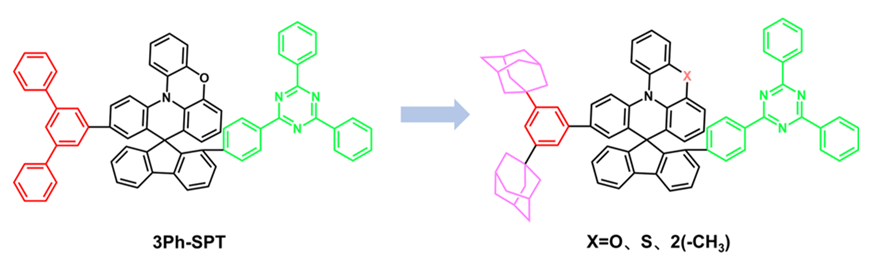
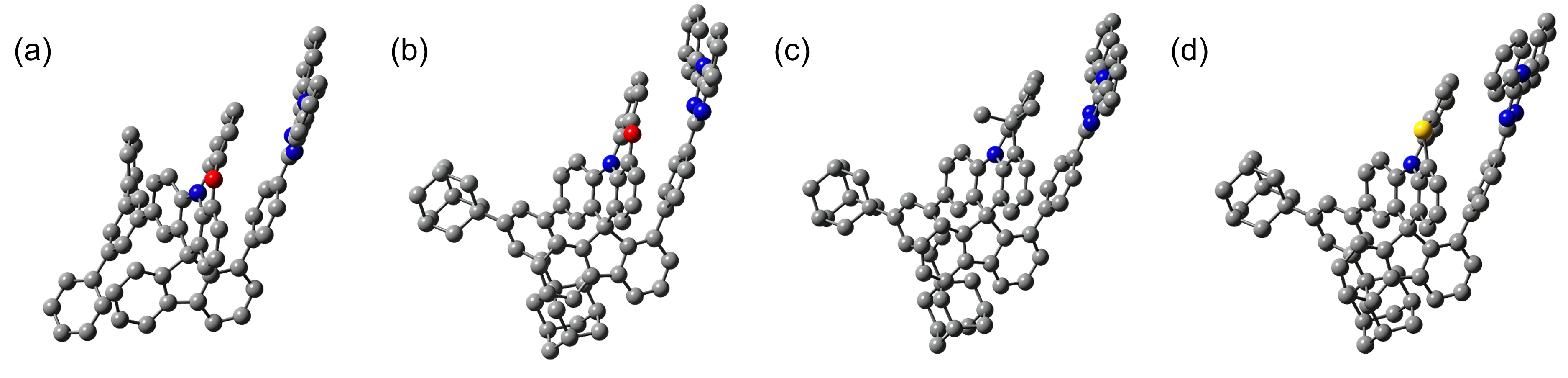
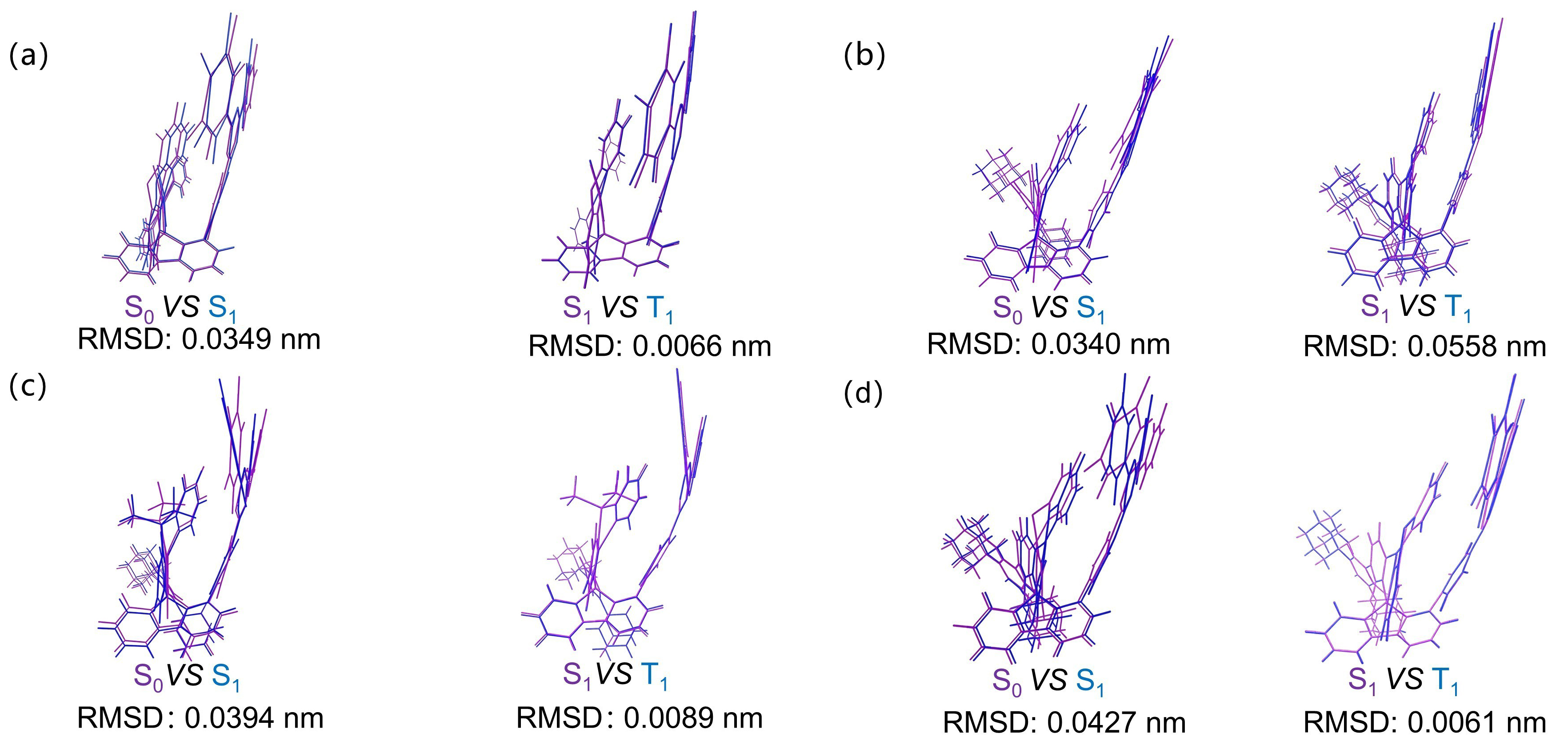
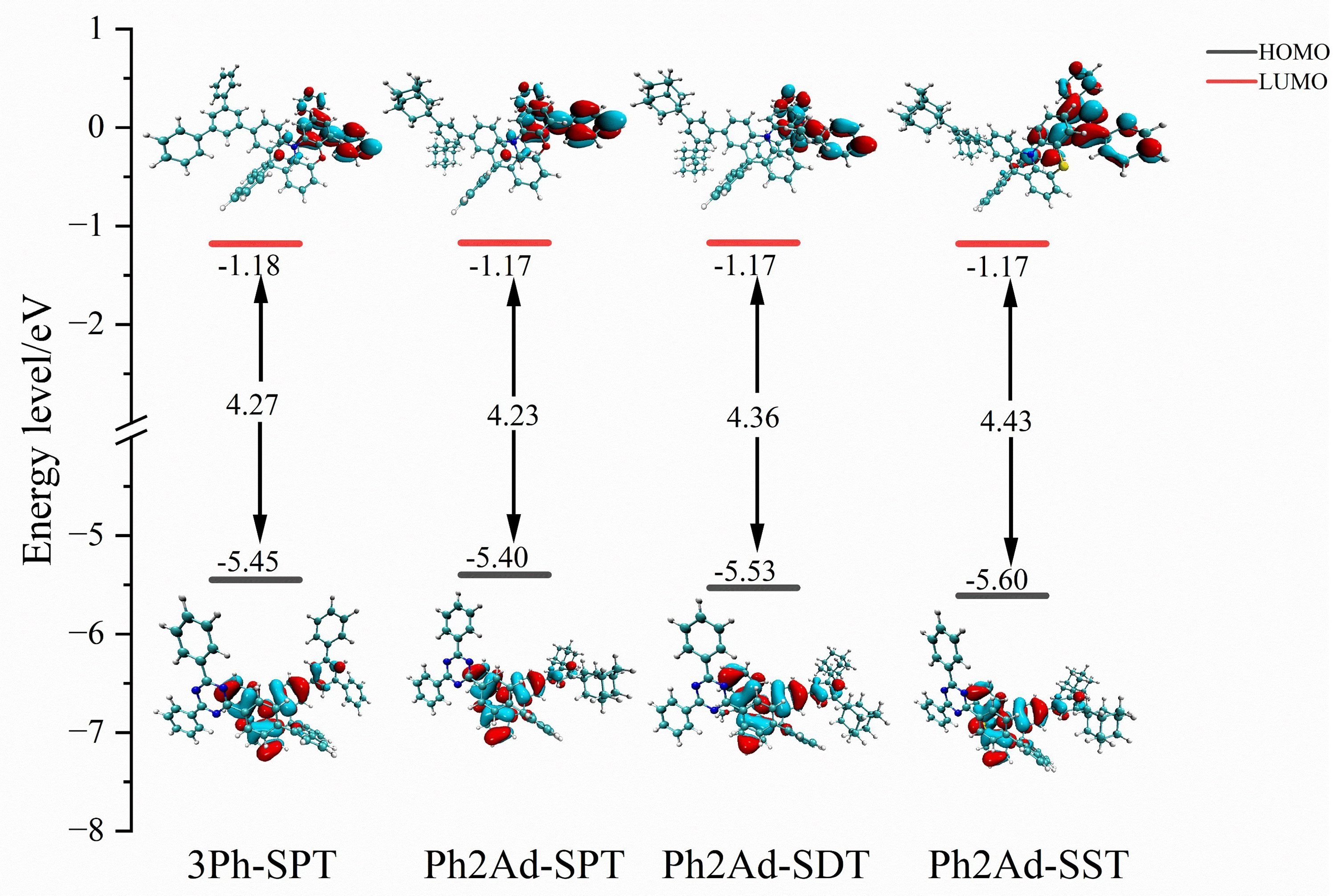
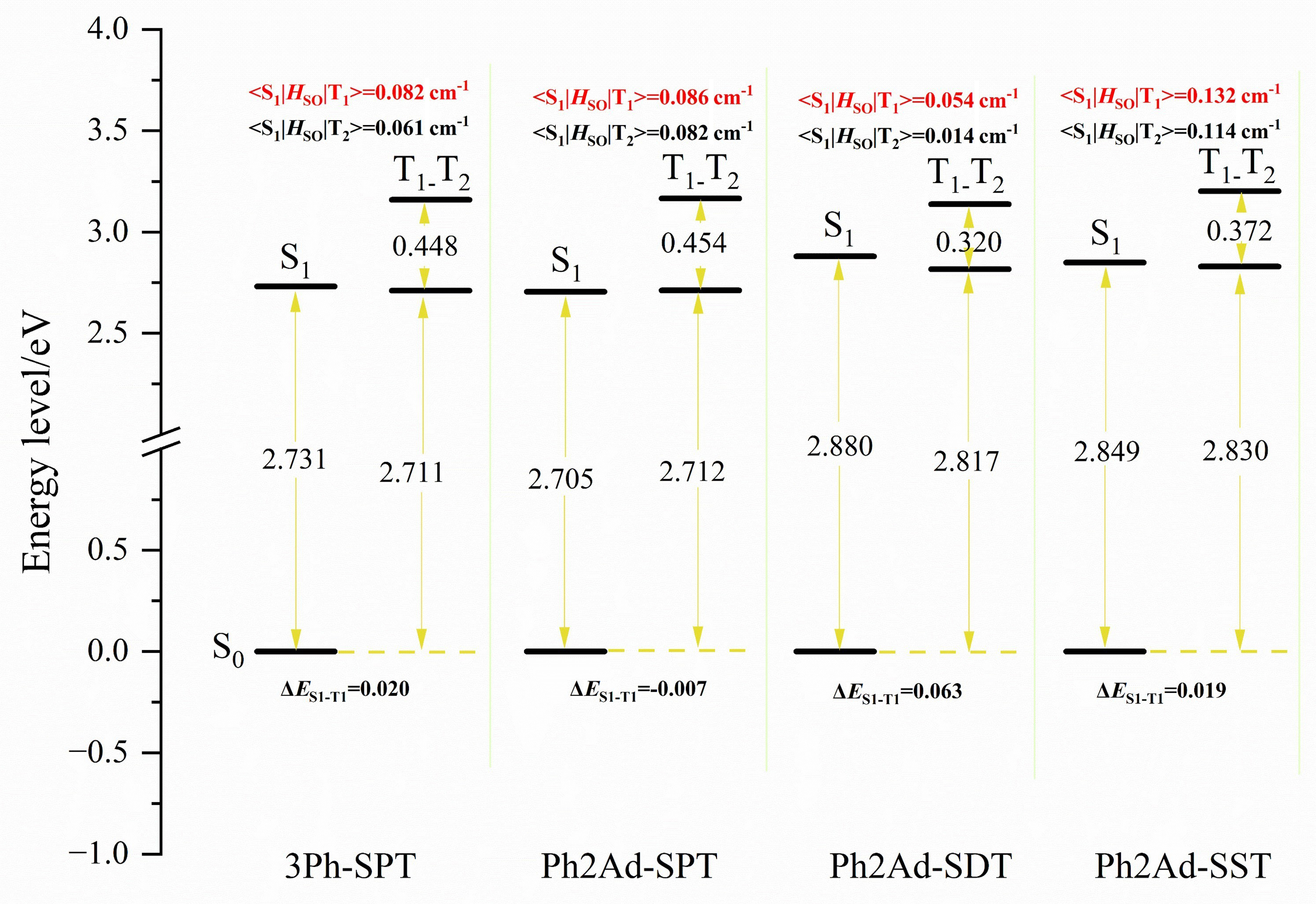
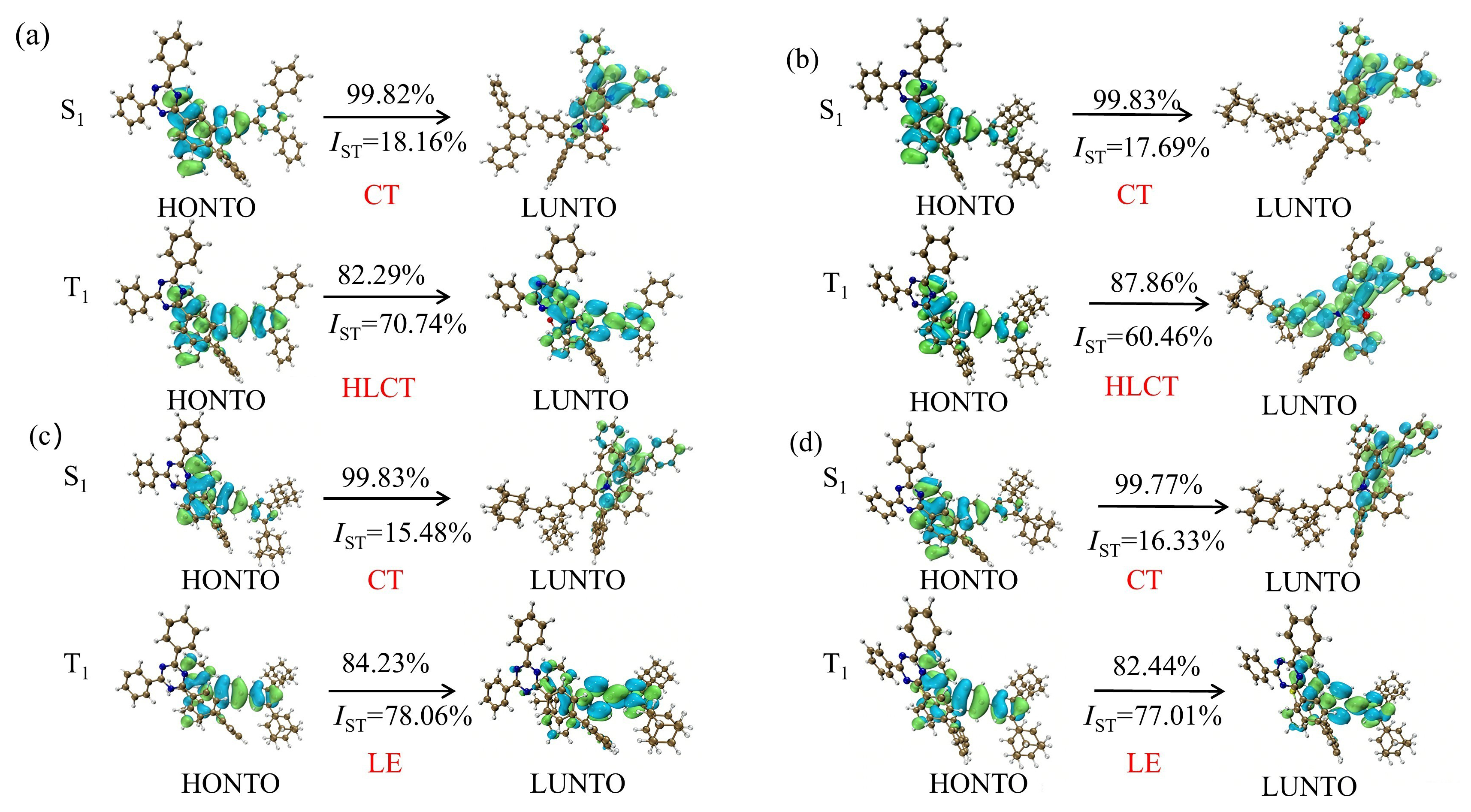
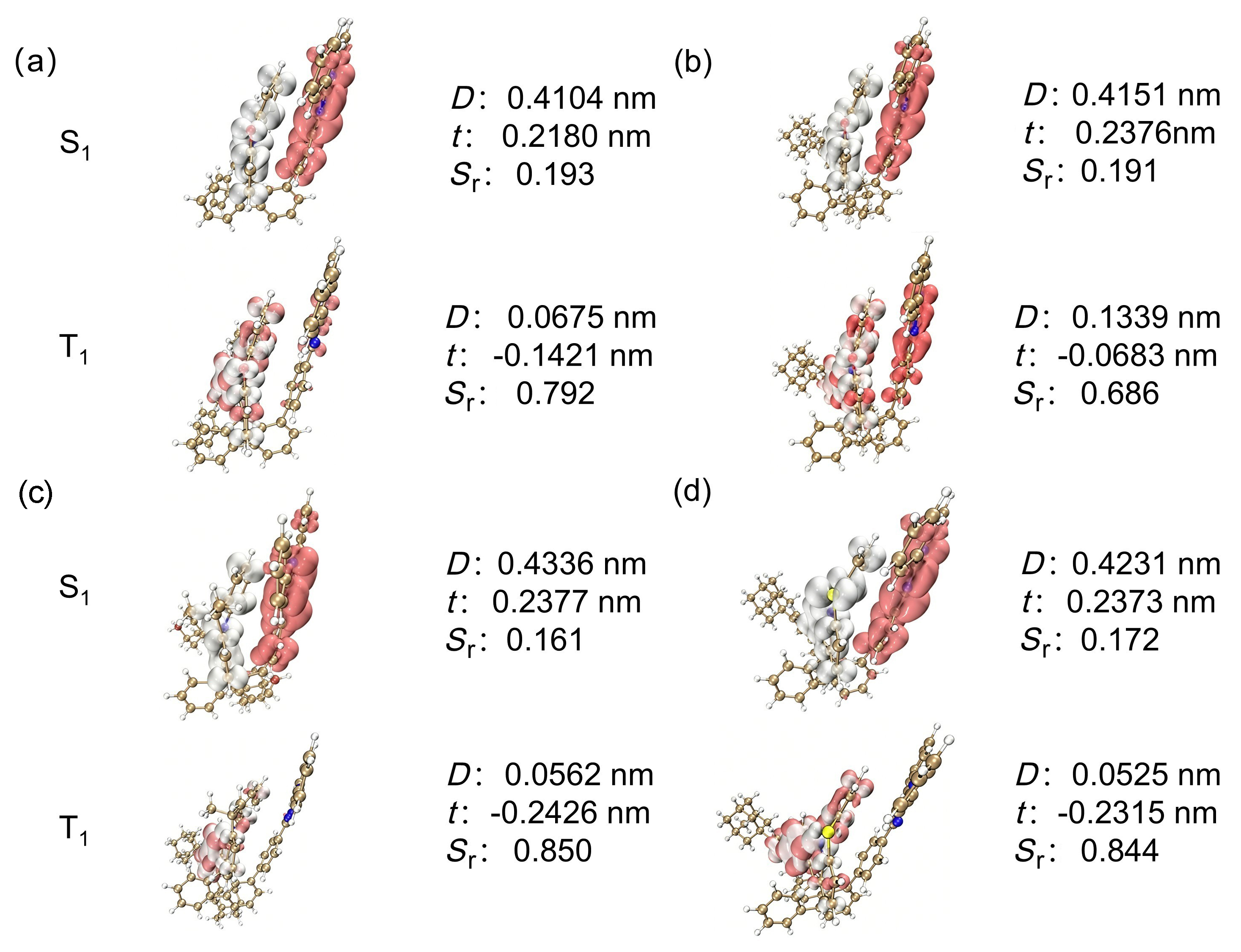
本研究基于密度泛函理论(DFT)和极化连续介质模型(PCM), 以实验报道的高效分子3Ph-SPT为起点, 通过理论设计构建了Ph2Ad-SPT、Ph2Ad-SDT与Ph2Ad-SST等一系列衍生分子以揭示中性基团工程与给体原子工程对通过空间电荷转移热激活延迟荧光(TSCT-TADF)材料性能的协同调控机制, 系统分析了它们的几何结构、电子特性、吸收/发射行为、系间窜越(ISC/RISC)过程以及辐射/非辐射衰减动力学. 结果表明, 中性基团工程(以金刚烷苯基替换三联苯)可有效调控激发态能级与几何结构, 将单重态-三重态能隙降至-0.007 eV, 并抑制S1→S0的几何弛豫. 进一步的给体原子工程呈现差异化影响: O→2(-CH3)取代则因增大的ΔEST与减弱的SOC而导致性能下降; O→S取代则能协同优化自旋轨道耦合(SOC增至0.132 cm−1)并显著降低重组能, 从而使RISC速率提升至2.10×10⁷ s−1, 展现出超越原型分子的优越性能, 而其在薄膜态初步研究也预期具有优异的TADF性能. 本研究从理论上阐明了通过中性基团工程与给体原子工程来协同调控TSCT-TADF材料性能的微观机制, 为理性设计兼具高激子利用率与高发光效率的非掺杂TADF材料提供了明确的理论指导.
万浩波, 谢文斌, 杨磊, 冉雪琴, 冯全友, 解令海. 空间电荷转移型热激活延迟荧光性能的理论研究[J]. 化学学报, 2026, 84(9): 1475-1486.
Haobo Wan, Wenbin Xie, Lei Yang, Xueqin Ran, Quanyou Feng, Linghai Xie. Theoretical Study on the Performance of Through-Space Charge-Transfer Thermally Activated Delayed Fluorescence[J]. Acta Chimica Sinica, 2026, 84(9): 1475-1486.
| S0/S1 | ||||
|---|---|---|---|---|
| 3Ph-SPT | Ph2Ad-SPT | Ph2Ad-SDT | Ph2Ad-SST | |
| ϕ1 | -60.3/-60.2 | -60.6/-66.3 | -61.6/-69.5 | -61.1/-68.8 |
| ϕ2 | -99.7/-103.0 | -101.2/-105.5 | -105.3/-122.4 | -109.9/-114.3 |
| |ϕ1-ϕ2| | 39.4/42.8 | 40.6/39.2 | 43.7/52.9 | 48.8/45.5 |
| MPPD | 0.035/0.033 | 0.035/0.034 | 0.067/0.061 | 0.052/0.045 |
| MPPA | 0.016/0.016 | 0.016/0.017 | 0.016/0.027 | 0.020/0.022 |
| l | 0.530/0.525 | 0.532/0.527 | 0.510/0.515 | 0.544/0.523 |
| S0/S1 | ||||
|---|---|---|---|---|
| 3Ph-SPT | Ph2Ad-SPT | Ph2Ad-SDT | Ph2Ad-SST | |
| ϕ1 | -60.3/-60.2 | -60.6/-66.3 | -61.6/-69.5 | -61.1/-68.8 |
| ϕ2 | -99.7/-103.0 | -101.2/-105.5 | -105.3/-122.4 | -109.9/-114.3 |
| |ϕ1-ϕ2| | 39.4/42.8 | 40.6/39.2 | 43.7/52.9 | 48.8/45.5 |
| MPPD | 0.035/0.033 | 0.035/0.034 | 0.067/0.061 | 0.052/0.045 |
| MPPA | 0.016/0.016 | 0.016/0.017 | 0.016/0.027 | 0.020/0.022 |
| l | 0.530/0.525 | 0.532/0.527 | 0.510/0.515 | 0.544/0.523 |
| S0-S1 | S1-S0 | ||||||||||
|---|---|---|---|---|---|---|---|---|---|---|---|
| λabs/nm | ΔE/eV | Main transition | λem/nm | ΔE/eV | Main transition | ||||||
| 3Ph-SPT | 338 | 3.67 | HOMO→L+2 (74%) | 523 | 2.37 | HOMO→LUMO (98%) | |||||
| Ph2Ad-SPT | 335 | 3.69 | HOMO→L+3 (91%) | 530 | 2.34 | HOMO→LUMO (98%) | |||||
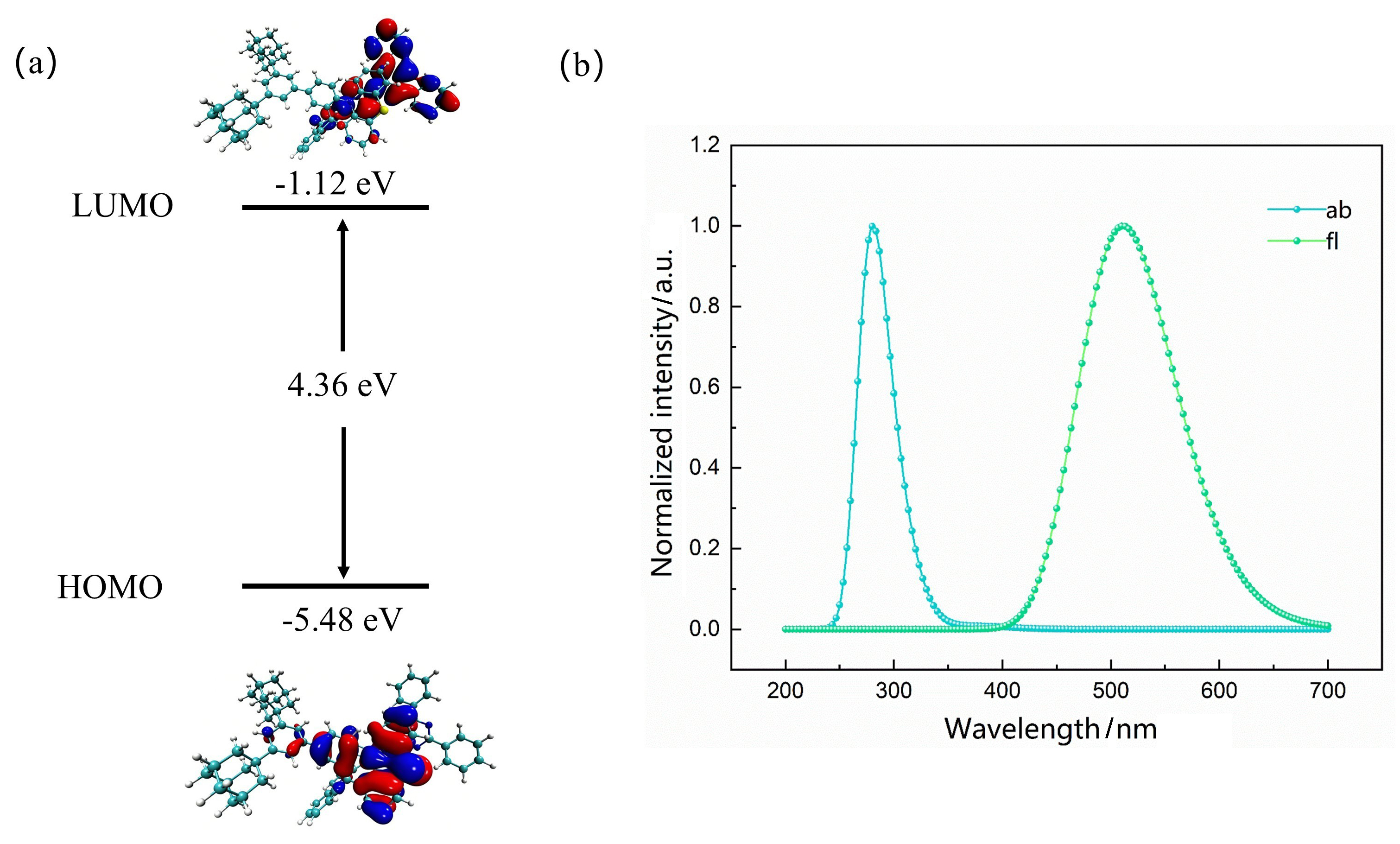
| Ph2Ad-SDT | 284 | 4.35 | H-3→L+1 (54%) | 488 | 2.54 | HOMO→LUMO (97%) | |||||
| Ph2Ad-SST | 283 | 4.38 | HOMO→LUMO (29%) | 512 | 2.42 | HOMO→LUMO (98%) | |||||
| S0-S1 | S1-S0 | ||||||||||
|---|---|---|---|---|---|---|---|---|---|---|---|
| λabs/nm | ΔE/eV | Main transition | λem/nm | ΔE/eV | Main transition | ||||||
| 3Ph-SPT | 338 | 3.67 | HOMO→L+2 (74%) | 523 | 2.37 | HOMO→LUMO (98%) | |||||
| Ph2Ad-SPT | 335 | 3.69 | HOMO→L+3 (91%) | 530 | 2.34 | HOMO→LUMO (98%) | |||||
| Ph2Ad-SDT | 284 | 4.35 | H-3→L+1 (54%) | 488 | 2.54 | HOMO→LUMO (97%) | |||||
| Ph2Ad-SST | 283 | 4.38 | HOMO→LUMO (29%) | 512 | 2.42 | HOMO→LUMO (98%) | |||||
| λISC | λRISC | λS0-S1 | E(S1)* | E(T1)* | ΔEST* | f | SOC | |
|---|---|---|---|---|---|---|---|---|
| 3Ph-SPT | 0.009 | 0.004 | 34.803 | 2.731 | 2.711 | 0.020 | 0.0055 | 0.082 |
| Ph2Ad-SPT | 0.035 | 0.060 | 33.388 | 2.705 | 2.712 | -0.007 | 0.0056 | 0.086 |
| Ph2Ad-SDT | 0.018 | 0.007 | 32.953 | 2.880 | 2.817 | 0.063 | 0.0051 | 0.054 |
| Ph2Ad-SST | 0.015 | 0.007 | 41.489 | 2.849 | 2.830 | 0.019 | 0.0051 | 0.132 |
| λISC | λRISC | λS0-S1 | E(S1)* | E(T1)* | ΔEST* | f | SOC | |
|---|---|---|---|---|---|---|---|---|
| 3Ph-SPT | 0.009 | 0.004 | 34.803 | 2.731 | 2.711 | 0.020 | 0.0055 | 0.082 |
| Ph2Ad-SPT | 0.035 | 0.060 | 33.388 | 2.705 | 2.712 | -0.007 | 0.0056 | 0.086 |
| Ph2Ad-SDT | 0.018 | 0.007 | 32.953 | 2.880 | 2.817 | 0.063 | 0.0051 | 0.054 |
| Ph2Ad-SST | 0.015 | 0.007 | 41.489 | 2.849 | 2.830 | 0.019 | 0.0051 | 0.132 |
| kISC/s⁻1 | kRISC/s⁻1 | kr/s⁻1 | |
|---|---|---|---|
| 3Ph-SPT | 7.39×10⁶ | 6.79×10⁶ | 1.35×10⁶ |
| Ph2Ad-SPT | 6.27×10⁶ | 4.95×10⁶ | 1.33×10⁶ |
| Ph2Ad-SDT | 1.63×10⁵ | 1.00×10⁴ | 1.43×10⁶ |
| Ph2Ad-SST | 1.74×10⁷ | 2.10×10⁷ | 1.30×10⁶ |
| kISC/s⁻1 | kRISC/s⁻1 | kr/s⁻1 | |
|---|---|---|---|
| 3Ph-SPT | 7.39×10⁶ | 6.79×10⁶ | 1.35×10⁶ |
| Ph2Ad-SPT | 6.27×10⁶ | 4.95×10⁶ | 1.33×10⁶ |
| Ph2Ad-SDT | 1.63×10⁵ | 1.00×10⁴ | 1.43×10⁶ |
| Ph2Ad-SST | 1.74×10⁷ | 2.10×10⁷ | 1.30×10⁶ |
| [1] |
(a)
|
|
(b)
|
|
|
(c)
|
|
|
(d)
doi: 10.6023/A24100296 |
|
|
(张妞, 韩书冉, 马宏伟, 陈磅宽, 化学学报, 2025, 83, 10.)
doi: 10.6023/A24100296 |
|
| [2] |
(a)
doi: 10.1038/nature11687 |
|
(b)
doi: 10.1039/c3tc30699b |
|
|
(c)
doi: 10.1021/jacs.7b10257 |
|
|
(d)
doi: 10.6023/A25010010 |
|
|
(方素琴, 童恺宁, 陈思浛, 张千峰, 童碧海, 冯敏强, 孔辉, 化学学报, 2025, 83, 471.)
doi: 10.6023/A25010010 |
|
|
(e)
doi: 10.6023/A24100310 |
|
|
(马金珠, 李阳, 高珊, 赵越, 丁磊, 周东营, 樊健, 化学学报, 2025, 83, 17.)
doi: 10.6023/A24100310 |
|
|
(f)
doi: 10.6023/A24040148 |
|
|
(张登朝, 贾吉慧, 梁栋, 蔡显宝, 赵雨晴, 胡祥龙, 江钰冰, 卢灿忠, 化学学报, 2024, 82, 887.)
doi: 10.6023/A24040148 |
|
| [3] |
(a)
doi: 10.1021/acs.macromol.0c02235 |
|
(b)
doi: 10.1039/D2TC05402G |
|
|
(c)
doi: 10.1080/15980316.2020.1788657 |
|
| [4] |
(a)
doi: 10.1002/adom.v10.22 |
|
(b)
doi: 10.6023/A23040186 |
|
|
(王一诺, 邵世洋, 王利祥, 化学学报, 2023, 81, 1202.)
doi: 10.6023/A23040186 |
|
|
(c)
doi: 10.1002/adfm.v33.12 |
|
| [5] |
doi: 10.1021/acs.orglett.7b01281 |
| [6] |
doi: 10.1021/jacs.7b00873 pmid: 28345346 |
| [7] |
(a)
doi: 10.1002/anie.v56.47 |
|
(b)
doi: 10.1016/j.dyepig.2016.08.023 |
|
| [8] |
(a)
doi: 10.1039/C8CC04594A |
|
(b)
doi: 10.1039/C8SC04991B |
|
| [9] |
|
| [10] |
doi: 10.1039/D5SC02235E |
| [11] |
doi: 10.1016/j.cej.2025.169199 |
| [12] |
(a)
doi: 10.1016/j.cej.2020.127418 |
|
(b)
doi: 10.1002/adom.v9.16 |
|
|
(c)
doi: 10.1016/j.cej.2024.153511 |
|
| [13] |
doi: 10.1039/D1TC03345J |
| [14] |
doi: 10.1016/j.comptc.2023.114277 |
| [15] |
(a)
doi: 10.1063/1.1480445 |
|
(b)
doi: 10.1016/0009-2614(96)00349-1 |
|
| [16] |
doi: 10.1021/ct700248k pmid: 26620661 |
| [17] |
doi: 10.1063/1.478522 |
| [18] |
doi: 10.1021/ar700111a |
| [19] |
doi: 10.1021/ct800308k pmid: 26620472 |
| [20] |
|
| [21] |
doi: 10.1016/j.cplett.2004.06.011 |
| [22] |
|
| [23] |
(a)
doi: 10.1002/adfm.v28.34 |
|
(b)
doi: 10.1038/s41566-020-0668-z |
|
| [24] |
doi: 10.1063/1.1677816 |
| [25] |
(a)
|
|
(b)
doi: 10.1002/wcms.v2.1 |
|
|
(c)
|
|
| [26] |
doi: 10.1021/ja00237a007 |
| [27] |
doi: 10.1119/1.12937 |
| [28] |
doi: 10.1016/j.carbon.2020.05.023 |
| [29] |
(a)
doi: 10.1002/jcc.v33.5 |
|
(b)
doi: 10.1016/j.jmgm.2012.07.004 |
|
| [30] |
|
| [31] |
|
| [32] |
doi: 10.1021/acs.jpca.4c00010 |
| [33] |
|
| [34] |
doi: 10.1007/s40843-023-2563-2 |
| [35] |
(a)
doi: 10.1016/j.cej.2023.146659 |
|
(b)
doi: 10.1002/adfm.v29.20 |
|
|
(c)
doi: 10.1039/D1TC00592H |
|
| [36] |
doi: 10.1038/s41563-020-0710-z |
| [37] |
doi: 10.1038/s41598-017-05339-4 |
| [1] | 汪庆辉, 任正, 张凯, 周东营, 樊健. 基于3,6-二苯硒基咔唑的多重共振热活化延迟荧光分子[J]. 化学学报, 2026, 84(2): 248-256. |
| [2] | 姚志豪, 张巍, 周昭仪, 李丹聪, 张凯凯, 刘涛, 胡文凯, 程守安, 胡铭轩, 刘昱佳. Sr/Fe协同调控LaMnO3电子结构及CO选择性催化还原反应机理研究[J]. 化学学报, 2026, 84(1): 30-42. |
| [3] | 楼一淳, 何承溧, 王霖锐, 崔晓莉. 常温常压下N2、CO2和H2O体系TiO2机械化学合成尿素的实验与理论研究[J]. 化学学报, 2026, 84(1): 73-85. |
| [4] | 王鑫, 史燚威, 杨瑞杰, 宋志国, 王敏. 含苯磺酸类配体的单核Cd(II)配合物催化无溶剂“一锅法”Biginelli反应[J]. 化学学报, 2025, 83(7): 674-684. |
| [5] | 方素琴, 童恺宁, 陈思浛, 张千峰, 童碧海, 冯敏强, 孔辉. 基于呫吨酮电子受体的高效圆偏振热活化延迟荧光材料[J]. 化学学报, 2025, 83(5): 471-478. |
| [6] | 卢一林, 董盛杰, 崔方超, 薄婷婷, 毛卓. 希托夫紫磷烯/SnS2范德华异质结作为直接全解水光催化剂的理论构建[J]. 化学学报, 2025, 83(4): 377-389. |
| [7] | 陈铭晖, 张博心, 魏滔, 孙兆雪, 冯亚青, 张宝. 三嗪共价骨架材料的层间位错行为及其光生载流子动力学理论研究[J]. 化学学报, 2025, 83(2): 93-100. |
| [8] | 张乃心, 石伟群, 王聪芝. 二价锕系配合物AnB8的理论研究[J]. 化学学报, 2025, 83(12): 1523-1529. |
| [9] | 马莹, 陈维希, 刘羽辰, 刘子义, 吴涛, 陆安慧, 王东琪. 六方氮化硼氧化模式的密度泛函理论研究[J]. 化学学报, 2025, 83(1): 52-59. |
| [10] | 马金珠, 李阳, 高珊, 赵越, 丁磊, 周东营, 樊健. 基于吩嗪受体单元的高效近红外热激活延迟荧光[J]. 化学学报, 2025, 83(1): 17-24. |
| [11] | 王治业, 肖博怀. 利用平面σ-芳香性增强电子输运能力[J]. 化学学报, 2024, 82(5): 520-526. |
| [12] | 赵雨晴, 梁栋, 贾吉慧, 余荣民, 卢灿忠. 具有双吸电子基团D-A型配体的Ag(I)发光配合物的合成与性能研究[J]. 化学学报, 2024, 82(5): 486-492. |
| [13] | 赵玉强, 张霞, 杨芸如, 朱立平, 周莹. 聚集诱导发射光笼分子的设计合成及原位光激活成像研究[J]. 化学学报, 2024, 82(3): 265-273. |
| [14] | 黄广龙, 薛小松. “陈试剂”作为三氟甲基源机理的理论研究[J]. 化学学报, 2024, 82(2): 132-137. |
| [15] | 黄伊晨, 聂长明, 王聪芝, 陈树森, 宋艳, 李昊, 石伟群. 羟基和氨基取代偕胺肟用于海水提铀的理论研究[J]. 化学学报, 2024, 82(10): 1050-1057. |
| 阅读次数 | ||||||
|
全文 |
|
|||||
|
摘要 |
|
|||||
