化学学报 ›› 2026, Vol. 84 ›› Issue (3): 287-292.DOI: 10.6023/A26010011 上一篇 下一篇
研究论文
刘洪昤a, 刘艺婷a, 王新华a, 何福生a,*( ), 吴劼a,b,*()
投稿日期:2026-01-08
发布日期:2026-03-03
基金资助:
Liu Honglinga, Liu Yitinga, Wang Xinhuaa, He Fu-Shenga,*(), Wu Jiea,b,*()
Received:2026-01-08
Published:2026-03-03
Contact:
*E-mail: hefs@tzc.edu.cn;
jie_wu@fudan.edu.cn
Supported by:文章分享
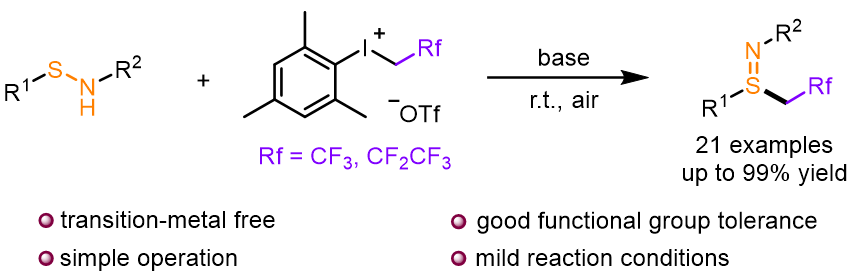
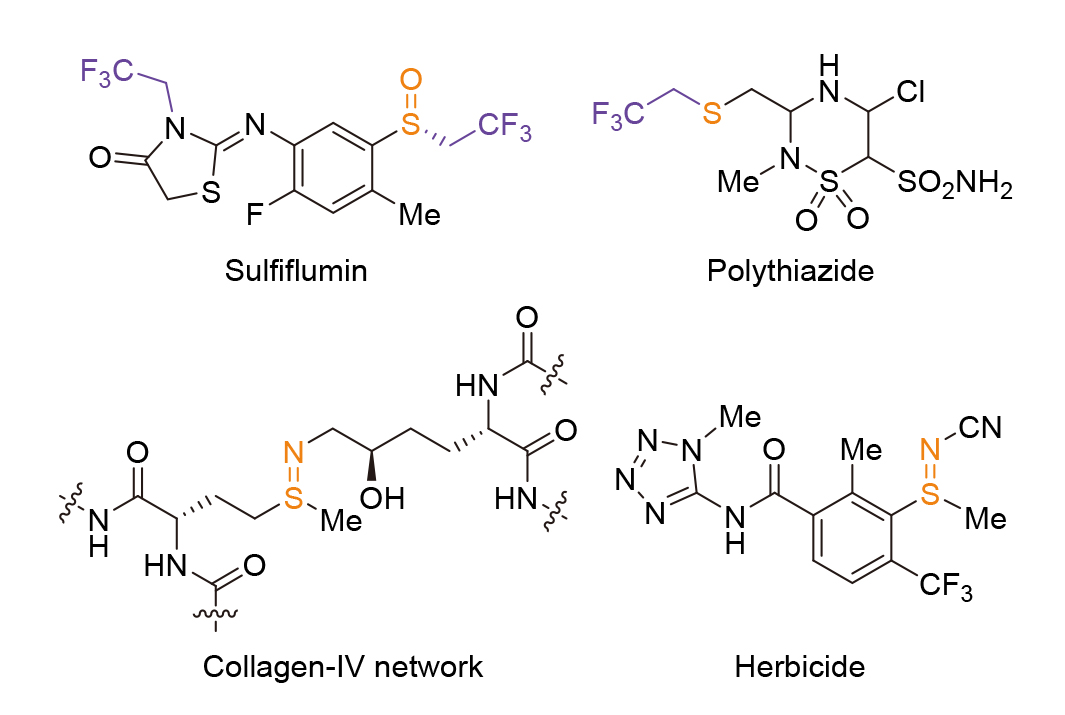
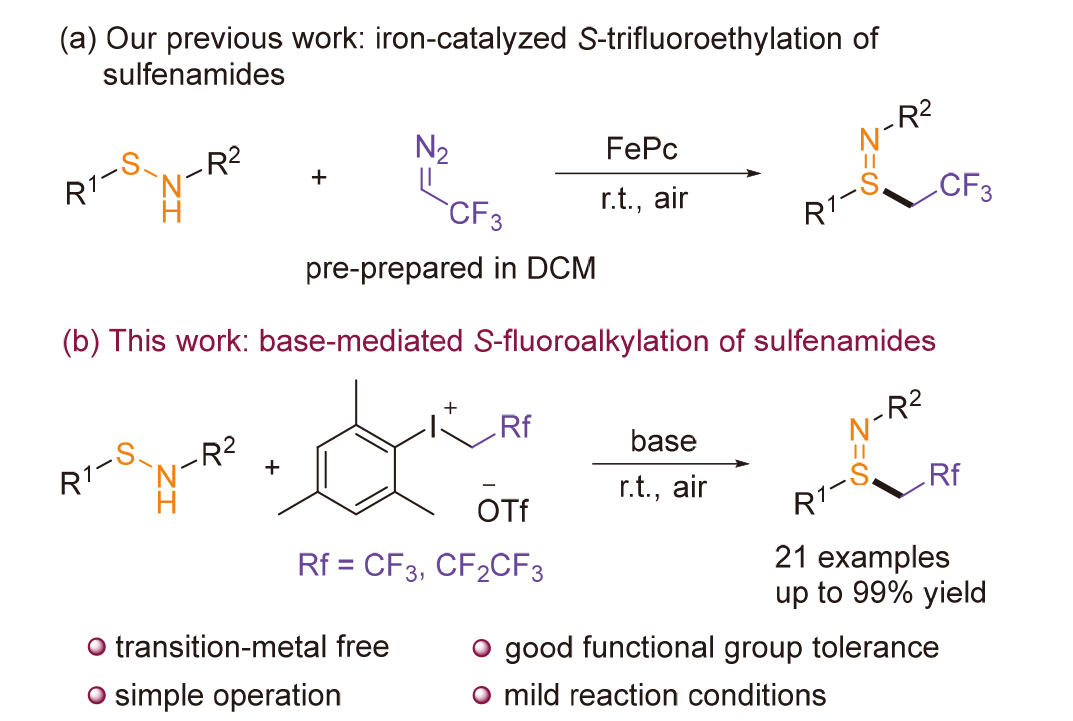
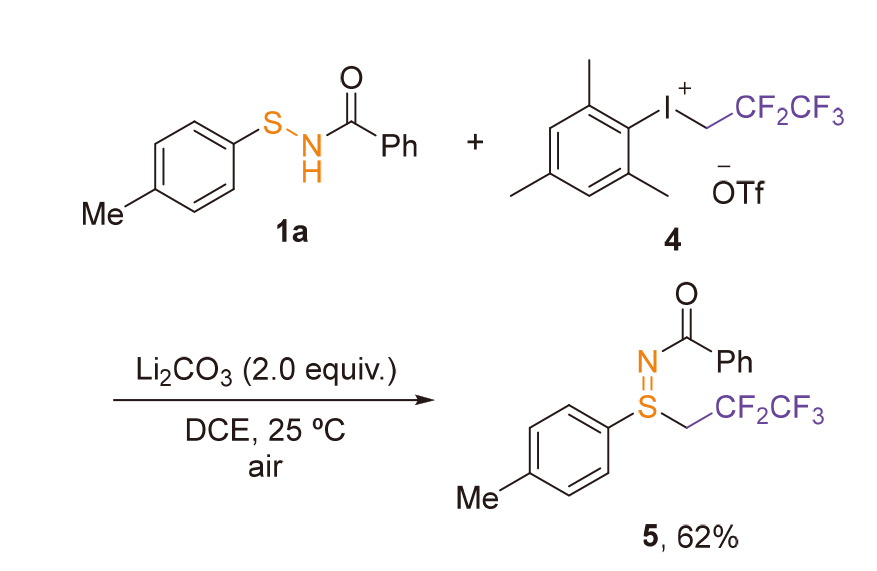
三氟乙基和硫亚胺是两类重要的药效团和结构单元, 广泛存在于许多生物活性分子中. 然而, 将这两类骨架同时引入到分子中的方法目前仍非常有限. 此研究发展了一种无金属参与的合成策略, 在室温和空气氛围下实现了碱促进磺酰胺与高价碘(III)试剂的硫-三氟乙基化反应, 以中等至良好的产率构建了结构多样的三氟乙基硫亚胺衍生物. 此外, 五氟丙基高价碘(III)试剂同样适用于该反应, 实现五氟丙基硫亚胺类化合物的高效合成. 该方法避免了过渡金属的使用, 具有原料易得、条件温和、操作简便和官能团兼容性高等优势, 为氟烷基硫亚胺衍生物的合成提供了新思路.
刘洪昤, 刘艺婷, 王新华, 何福生, 吴劼. 碱促进次磺酰胺与高价碘(III)试剂的硫-氟烷基化反应[J]. 化学学报, 2026, 84(3): 287-292.
Liu Hongling, Liu Yiting, Wang Xinhua, He Fu-Sheng, Wu Jie. Base-Mediated S-Fluoroalkylation of Sulfenamides with Iodine(III) Salts[J]. Acta Chimica Sinica, 2026, 84(3): 287-292.
| Entry | Base | Solvent | Yieldb/% |
|---|---|---|---|
| 1 | Cs2CO3 | PhCF3 | 34 |
| 2 | NaOH | PhCF3 | 22 |
| 3 | K3PO4 | PhCF3 | 38 |
| 4 | LiOtBu | PhCF3 | 22 |
| 5 | Li2CO3 | PhCF3 | 66 |
| 6 | LiOAc | PhCF3 | 59 |
| 7 | NaOAc | PhCF3 | 73 |
| 8 | NaOAc | DMSO | n.d. |
| 9 | NaOAc | MeCN | 12 |
| 10 | NaOAc | 1,4-Dioxane | 11 |
| 11 | NaOAc | Toluene | 80 |
| 12 | NaOAc | DCE | 90 (83) |
| 13c | NaOAc | DCE | 74 |
| 14d | NaOAc | DCE | 89 |
| 15e | NaOAc | DCE | 95 (88) |
| Entry | Base | Solvent | Yieldb/% |
|---|---|---|---|
| 1 | Cs2CO3 | PhCF3 | 34 |
| 2 | NaOH | PhCF3 | 22 |
| 3 | K3PO4 | PhCF3 | 38 |
| 4 | LiOtBu | PhCF3 | 22 |
| 5 | Li2CO3 | PhCF3 | 66 |
| 6 | LiOAc | PhCF3 | 59 |
| 7 | NaOAc | PhCF3 | 73 |
| 8 | NaOAc | DMSO | n.d. |
| 9 | NaOAc | MeCN | 12 |
| 10 | NaOAc | 1,4-Dioxane | 11 |
| 11 | NaOAc | Toluene | 80 |
| 12 | NaOAc | DCE | 90 (83) |
| 13c | NaOAc | DCE | 74 |
| 14d | NaOAc | DCE | 89 |
| 15e | NaOAc | DCE | 95 (88) |
| [1] |
(a)
doi: 10.1021/acs.jmedchem.5b00258 pmid: 26200936 |
|
(b)
doi: 10.1021/jm401375q pmid: 26200936 |
|
|
(c)
doi: 10.6023/A23030088 pmid: 26200936 |
|
|
(黄家翩, 刘飞, 吴劼, 化学学报, 2023, 81, 520.)
doi: 10.6023/A23030088 pmid: 26200936 |
|
| [2] |
doi: 10.1021/acs.chemrev.5b00120 |
| [3] |
doi: 10.1002/anie.v52.32 |
| [4] |
(a)
doi: 10.1039/C1CS15084G pmid: 18197347 |
|
(b)
doi: 10.1039/b711844a pmid: 18197347 |
|
| [5] |
(a)
pmid: 17034117 |
|
(b)
doi: 10.1021/jm050373g pmid: 17034117 |
|
| [6] |
doi: 10.1039/D3GC03702A |
| [7] |
(a)
doi: 10.1021/cr60307a005 |
|
(b)
doi: 10.1021/acs.jmedchem.4c02714 |
|
| [8] |
(a)
doi: 10.1021/jacs.2c04627 pmid: 10824144 |
|
(b)
pmid: 10824144 |
|
|
(c)
doi: 10.1038/s41557-022-00997-y pmid: 10824144 |
|
| [9] |
doi: 10.1126/science.1176811 pmid: 19729652 |
| [10] |
For selected examples, see: (a)
doi: 10.1039/D4QO01963F |
|
(b)
|
|
| [11] |
For selected examples, see: (a)
doi: 10.1021/jacs.2c09158 pmid: 36939573 |
|
(b)
doi: 10.1021/acs.orglett.4c02402 pmid: 36939573 |
|
|
(c)
doi: 10.1021/jacs.5c03841 pmid: 36939573 |
|
|
(d)
doi: 10.1021/acs.orglett.4c01086 pmid: 36939573 |
|
|
(e)
doi: 10.1021/acs.orglett.3c01077 pmid: 36939573 |
|
|
(f)
doi: 10.1021/acs.orglett.3c00604 pmid: 36939573 |
|
|
(g)
pmid: 36939573 |
|
|
(h)
pmid: 36939573 |
|
|
(i)
doi: 10.1021/acscatal.5c00082 pmid: 36939573 |
|
|
(j)
doi: 10.1038/s41557-025-01970-1 pmid: 36939573 |
|
|
(k)
pmid: 36939573 |
|
|
(l)
pmid: 36939573 |
|
| [12] |
(a)
doi: 10.1039/D3GC03528J |
|
(b)
doi: 10.1016/j.jfluchem.2023.110219 |
|
|
(c)
doi: 10.1021/acs.orglett.4c03116 |
|
|
(d)
doi: 10.1021/acs.joc.3c00961 |
|
|
(e)
doi: 10.1021/acs.orglett.3c01918 |
|
|
(f)
doi: 10.1039/D5CC07259J |
|
| [13] |
For selected examples, see: (a)
doi: 10.1021/jacs.2c12947 |
|
(b)
doi: 10.1021/acs.orglett.3c00779 |
|
|
(c)
doi: 10.1021/acs.orglett.3c01874 |
|
|
(d)
doi: 10.1021/acs.orglett.3c01436 |
|
|
(e)
doi: 10.1021/acs.orglett.3c02217 |
|
|
(f)
doi: 10.1021/acs.orglett.3c02785 |
|
|
(g)
doi: 10.1038/s41929-024-01213-5 |
|
|
(h)
|
|
|
(i)
|
|
|
(j)
doi: 10.1021/acs.orglett.5c01776 |
|
|
(k)
doi: 10.1038/s41467-025-57474-6 |
|
|
(l)
doi: 10.1021/acs.joc.5c01081 |
|
|
(m)
doi: 10.1021/acs.orglett.5c01145 |
|
|
(n)
doi: 10.1021/acs.orglett.5c00132 |
|
|
(o)
doi: 10.1021/jacs.5c15479 |
|
| [14] |
doi: 10.1021/acs.chemrev.4c00303 pmid: 39269928 |
| [15] |
doi: 10.1021/jacs.9b11298 |
| [16] |
For selected examples, see: (a)
doi: 10.1002/anie.v55.6 |
|
(b)
doi: 10.1021/acs.orglett.7b01859 |
|
|
(c)
doi: 10.1039/C7CC01274H |
|
|
(d)
doi: 10.1002/ajoc.v8.5 |
|
|
(e)
doi: 10.6023/cjoc201808029 |
|
|
(韩秋燕, 赵成龙, 张成潘, 有机化学, 2019, 39, 84).
doi: 10.6023/cjoc201808029 |
|
|
(f)
doi: 10.6023/cjoc202104007 |
|
|
(颜廷勋, 陈超, 文丽荣, 有机化学, 2021, 41, 3660).
|
|
| [17] |
For selected reviews, see: (a)
doi: 10.1016/j.ejmech.2020.112885 |
|
(b)
doi: 10.1021/acs.jmedchem.0c00960 |
|
|
(c)
doi: 10.1039/C8QO01233D |
|
|
(d)
doi: 10.1021/acscatal.5c01027 |
| [1] | 彭琼慧, 彭佳, 蔡迎丽, 王祖利, 易荣楠, 沈超, 何卫民. 二苯醚介导氧化铈半多相光催化2-异腈基联苯氟烷基化反应[J]. 化学学报, 2025, 83(9): 1013-1017. |
| [2] | 朱子琦, 叶乐华, 吴怡, 郭梓圻, 石枫. 邻亚甲基苯醌参与的化学选择性和非对映选择性[2+3]环化反应[J]. 化学学报, 2025, 83(12): 1465-1471. |
| [3] | 戴建玲, 雷文龙, 刘强. 可见光驱使铜盐催化芳香烃二氟烷基化反应[J]. 化学学报, 2019, 77(9): 911-915. |
| [4] | 张衡, 牟学清, 陈弓, 何刚. 铜催化苯甲酰亚胺高烯丙酯的分子内胺化全氟烷基化反应[J]. 化学学报, 2019, 77(9): 884-888. |
| [5] | 田亚伟, 周刚, 赵晓明, 淡文彦. 2-氨基吡嗪衍生物在水相中的选择性氟化反应研究[J]. 化学学报, 2018, 76(12): 962-966. |
| [6] | 荣健, 倪传法, 王云泽, 匡翠文, 顾玉诚, 胡金波. 可见光促进下氟烷基砜对芳基烯烃的自由基氟烷基化反应[J]. 化学学报, 2017, 75(1): 105-109. |
| 阅读次数 | ||||||
|
全文 |
|
|||||
|
摘要 |
|
|||||