有机化学 ›› 2026, Vol. 46 ›› Issue (4): 1111-1145.DOI: 10.6023/cjoc202512022 上一篇 下一篇
综述与进展
唐玉青a, 杨紫娴a, 杨兵a, 王毅b,*( ), 杜炳南a,*()
收稿日期:2025-12-17
修回日期:2026-02-06
发布日期:2026-02-28
通讯作者:
王毅, 杜炳南
基金资助:
Yuqing Tanga, Zixian Yanga, Bing Yanga, Yi Wangb,*(), Bingnan Dua,*()
Received:2025-12-17
Revised:2026-02-06
Published:2026-02-28
Contact:
Yi Wang, Bingnan Du
Supported by:文章分享
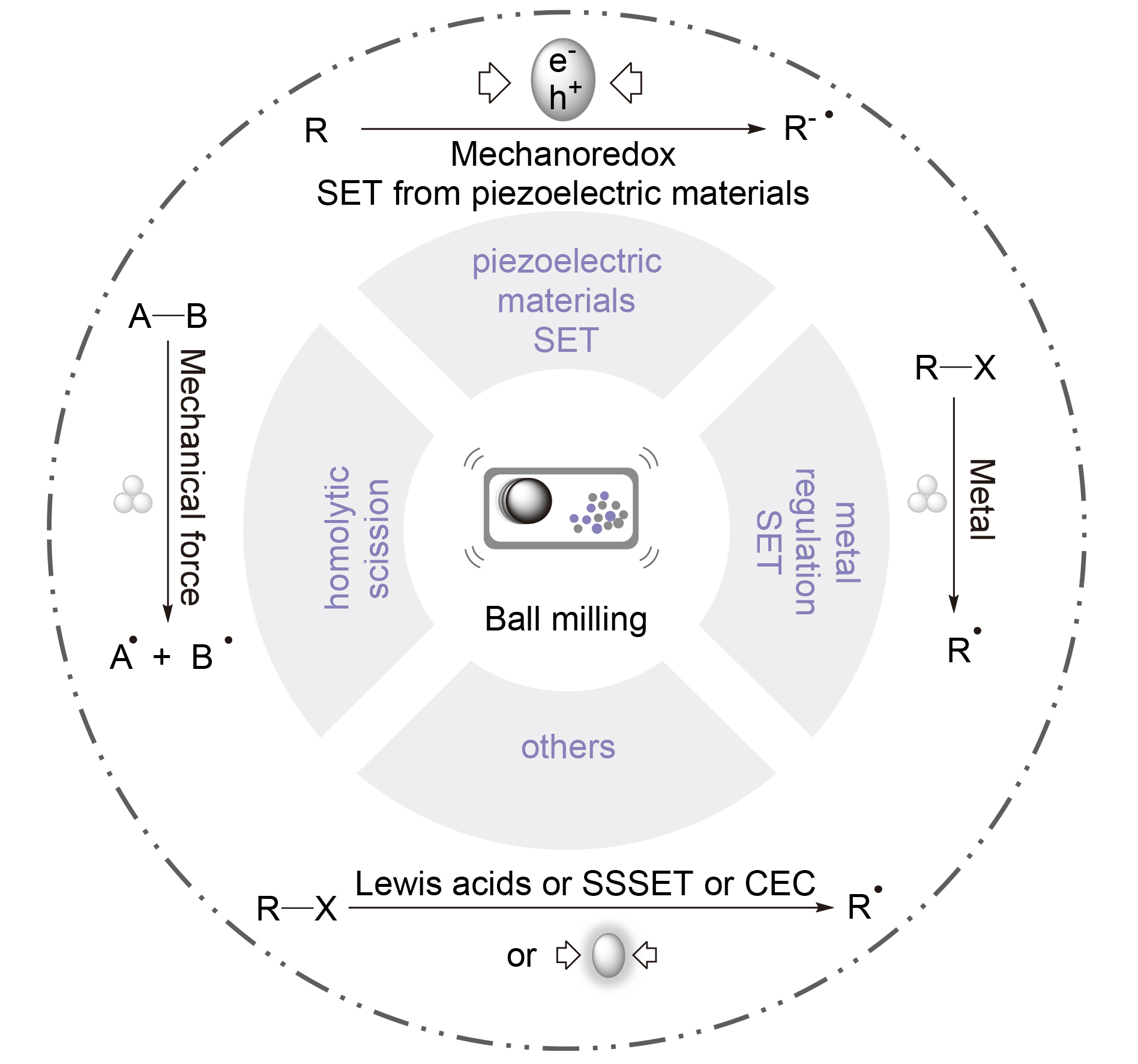
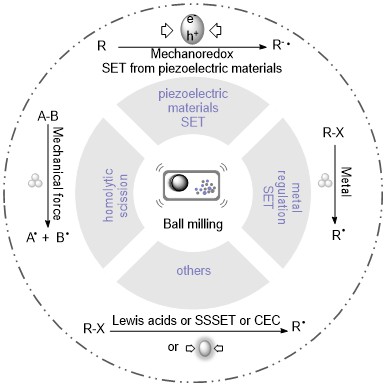
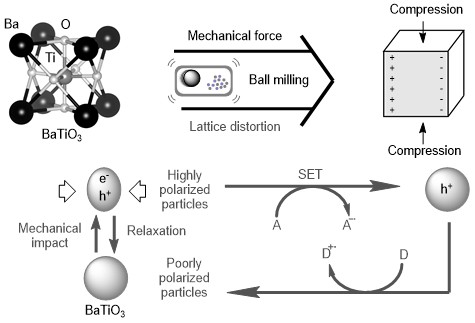
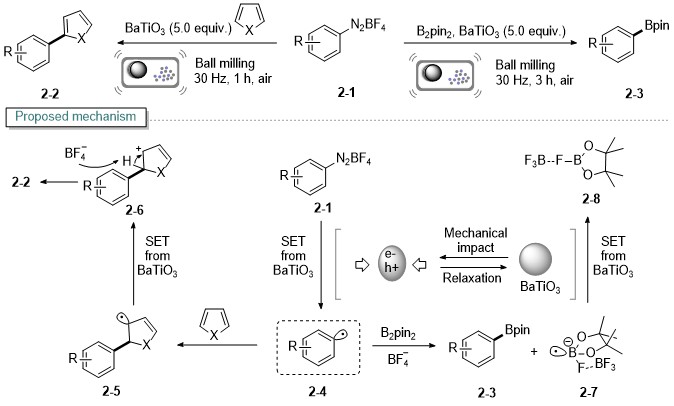
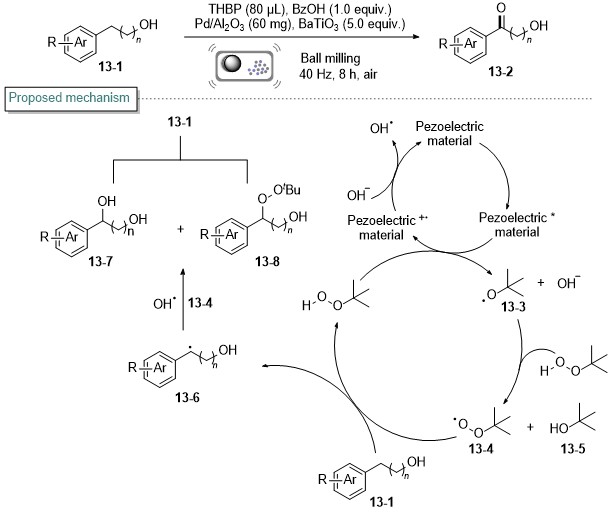
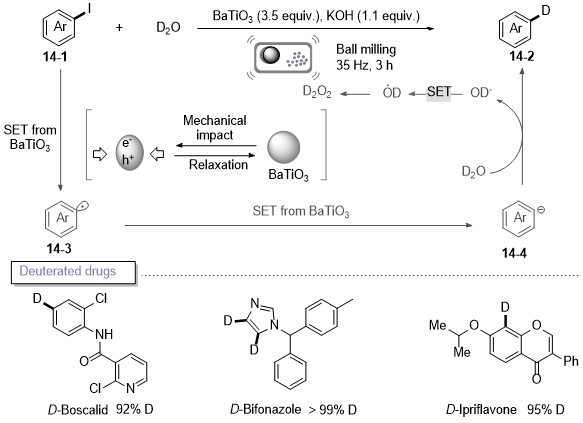
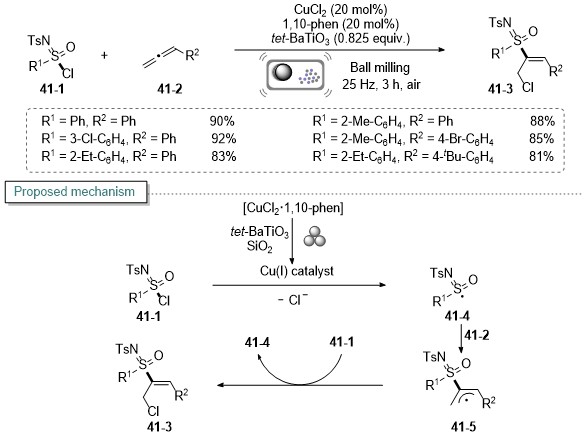
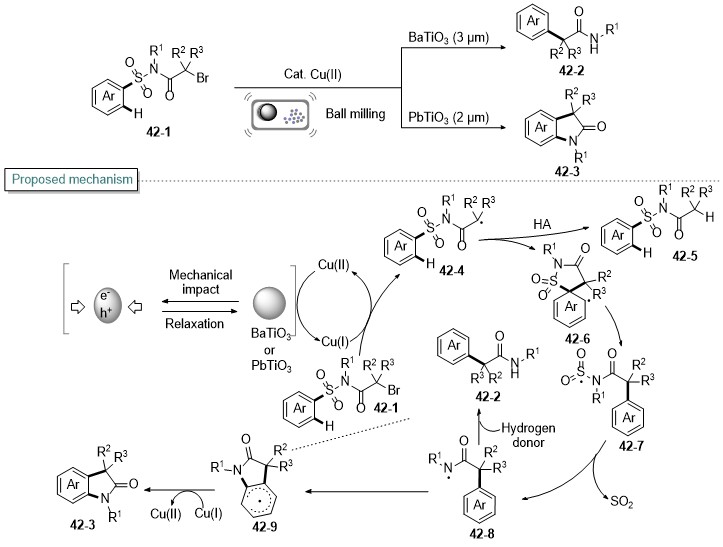
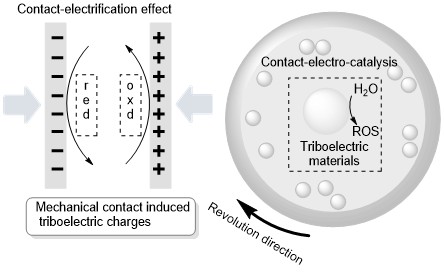
随着绿色合成观念深入人心, 机械化学凭借其无溶剂、低能耗和环境友好等特点受到科研工作者的广泛关注. 其中机械力驱动的自由基反应得益于其独特的反应环境, 往往能够获得溶剂条件下难以或无法生成的中间体和产物, 在有机合成领域展现出广阔前景. 此文系统整理了近十年来球磨条件下机械力驱动的自由基反应研究进展, 根据引发机制差异将其划分为三类: (1)机械力压电材料介导的单电子转移(SET)反应, (2)机械力诱导的化学键均裂反应, (3)机械力促进的金属调控反应. 在此基础上结合代表性案例, 阐述各类机制的核心特征与适用范围, 并对该领域应用前景与未来发展方向进行展望.
唐玉青, 杨紫娴, 杨兵, 王毅, 杜炳南. 球磨条件下机械力驱动的自由基反应研究进展[J]. 有机化学, 2026, 46(4): 1111-1145.
Yuqing Tang, Zixian Yang, Bing Yang, Yi Wang, Bingnan Du. Research Progress in Mechanically Driven Radical Reactions under Ball Milling Conditions[J]. Chinese Journal of Organic Chemistry, 2026, 46(4): 1111-1145.
| [1] |
|
| [2] |
|
| [3] |
|
| [4] |
|
| [5] |
|
| [6] |
|
| [7] |
|
| [8] |
|
|
(王浩, 应娉, 俞静波, 苏为科, 有机化学, 2021, 41, 1897.)
|
|
| [9] |
|
|
(周琨, 毛羊杰, 吴峰伟, 娄绍杰, 许丹倩, 有机化学, 2021, 41, 4623.)
|
|
| [10] |
|
| [11] |
|
| [12] |
|
|
(王娜娜, 王官武, 化学进展, 2020, 32, 1076.)
|
|
| [13] |
|
|
(陈丹丹, 衣晓虹, 王崇臣, 无机化学学报, 2020, 36, 1805.)
|
|
| [14] |
|
| [15] |
|
| [16] |
|
| [17] |
|
| [18] |
|
| [19] |
|
| [20] |
|
| [21] |
|
| [22] |
|
| [23] |
|
| [24] |
|
| [25] |
|
| [26] |
|
| [27] |
|
| [28] |
|
| [29] |
|
| [30] |
|
| [31] |
|
| [32] |
|
| [33] |
|
| [34] |
|
| [35] |
|
| [36] |
|
| [37] |
|
| [38] |
|
| [39] |
|
| [40] |
|
| [41] |
|
| [42] |
|
| [43] |
|
| [44] |
|
| [45] |
|
| [46] |
|
| [47] |
|
| [48] |
|
| [49] |
|
| [50] |
|
| [51] |
|
| [52] |
|
| [53] |
|
| [54] |
|
| [55] |
|
| [56] |
|
| [57] |
|
| [58] |
|
| [59] |
|
| [60] |
|
| [61] |
|
| [62] |
|
| [63] |
|
| [64] |
|
| [65] |
|
| [66] |
|
| [67] |
|
| [68] |
|
| [69] |
|
| [70] |
|
| [71] |
|
| [72] |
|
| [73] |
|
| [74] |
|
| [75] |
|
| [76] |
|
| [77] |
|
| [78] |
|
| [79] |
|
| [80] |
|
| [81] |
|
| [82] |
|
| [83] |
|
| [84] |
|
| [85] |
|
| [86] |
|
| [87] |
|
| [88] |
|
| [89] |
|
| [90] |
|
| [91] |
|
| [92] |
|
| [93] |
|
| [94] |
|
| [95] |
|
| [96] |
|
| [97] |
|
| [1] | 侯馨怡, 史同同, 李泽江, 董庆昊, 孙凯, 王薪. 可见光诱导的磷酰化环化合成磷酰基取代的吲哚并二氮䓬[J]. 有机化学, 2026, 46(4): 1776-1787. |
| [2] | 邹震雷, 李益凡, 陈晨, 陈王哲, 张为钢, 王毅. 关于亚磺酰基砌块法合成亚砜的研究进展[J]. 有机化学, 2026, 46(4): 1635-1658. |
| [3] | 王齐翔, 陈圣希, 王静, 陈栋, 鲍晓光, 吴新鑫. 无金属参与的多烯选择性氯代反应[J]. 有机化学, 2026, 46(4): 1750-1762. |
| [4] | 郑婧斐, 吕琪妍, 孙凯, 陈晓岚, 屈凌波, 王金泉, 於兵. 自由基介导的6-氮杂尿嘧啶官能团化研究进展[J]. 有机化学, 2026, 46(4): 1603-1620. |
| [5] | 刘世峥, 窦明煜, 崔玉, 窦建民, 魏文廷. 自由基硒磺酰化研究进展[J]. 有机化学, 2026, 46(4): 1621-1634. |
| [6] | 赵雨晴, 朱先进, 石凌宇, 魏鸣宇, 徐紫涵, 石永佳, 李旭锋, 杨道山. 环硫鎓盐开环官能化反应的研究进展[J]. 有机化学, 2026, 46(4): 1572-1602. |
| [7] | 杨珊, 陈亚苏, 朱晨. 自由基介导的官能团迁移-环化构建含氮稠杂芳烃[J]. 有机化学, 2026, 46(4): 1739-1749. |
| [8] | 陈嘉豪, 占贝贝, 张夏衡. 自由基介导的1,n-氮迁移反应研究进展[J]. 有机化学, 2026, 46(4): 1560-1571. |
| [9] | 卢琳玉, 亓雨彤, 张庭珲, 金胜男, 曹中艳, 张洪伟. 自由基介导烯烃的1,2,n-三官能团化反应研究进展[J]. 有机化学, 2026, 46(4): 1540-1559. |
| [10] | 董建洋, 薛东. 自由基途径的[1.1.1]螺桨烷官能化研究进展[J]. 有机化学, 2026, 46(4): 1464-1480. |
| [11] | 缪宇辰, 杞航, 黄焕明. 可见光/铬协同催化的对映选择性转化反应研究进展[J]. 有机化学, 2026, 46(4): 1481-1495. |
| [12] | 王小曼, 王泽, 吴劼, 胡燚, 叶盛青. 水相中的自由基反应研究进展[J]. 有机化学, 2026, 46(4): 1496-1512. |
| [13] | 李明强, 周磊. Dowd-Beckwith反应: 从卤原子转移到现代引发策略[J]. 有机化学, 2026, 46(4): 1428-1439. |
| [14] | 王钰涓, 朱峰, 杨波. 完全未保护糖的自由基糖基化反应[J]. 有机化学, 2026, 46(4): 1529-1539. |
| [15] | 于琛, 李宁, 薛琦, 李杨, 汪苇航, 李金恒. 自由基介导双C—H键转化的烯烃官能团化反应研究进展[J]. 有机化学, 2026, 46(4): 1440-1463. |
| 阅读次数 | ||||||
|
全文 |
|
|||||
|
摘要 |
|
|||||


