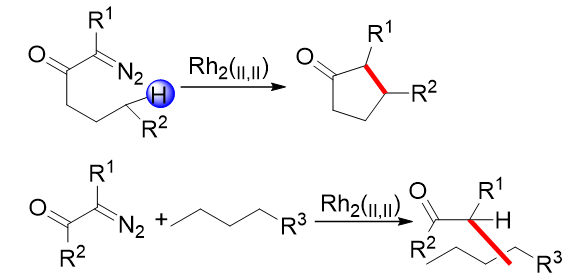
[1] Davies, H. M. L. J. Org. Chem.2019, 84, 12722.
[2] Davies H. M. L.; Liao, K. Nat. Rev. Chem.2019, 3, 347.
[3] Kaur R.; Jain, N. Chem. Asian J.2022, 17, e202200944.
[4] Liu C.-X.; Yin S.-Y.; Zhao F.; Yang H.; Feng Z.; Gu Q.; You S.-L. Chem. Rev.2023, 123, 10079.
[5] Wu R.; Xu Z.; Zhu D.; Zhu, S. Acc. Chem. Res.2025, 58, 799.
[6] Doraghi F.; Baghershahi P.; Ghasemi M.; Mahdavi M.; Al-Harrasi A. RSC Adv.2024, 14, 39337.
[7] Feng L.; Feng Y.-Y.; Dai Y. S.; Chen H. L.; Gao A. L.; Liu, G. H. Precious Met.2025, 46, 1. (in Chinese)
(冯璐; 冯洋洋; 戴云生; 陈洪来; 高安丽; 刘桂华. 贵金属.2025, 46, 1.)
[8] Wu R.; Zhu D.; Zhu, S. Org. Chem. Front.2023, 10, 2849.
[9] Paulissen R.; Hayez E.; Hubert A. J.; Teyssie P. Tetrahedron Lett.1974, 15, 607.
[10] Paulissen R.; Reimlinger H.; Hayez E.; Hubert A.J.; Teyssié P. Tetrahedron Lett.1973, 14, 2233.
[11] Nguyen T. T. H.; Shimabukuro K.; Musaev D. G.; Bacsa J.; Navarro A.; Davies, H. M. L. J. Am. Chem. Soc.2025, 147, 28098.
[12] Laconsay C. J.; Pla-Quintana A.; Tantillo D. J. Organometallics2021, 40, 4120.
[13] Nakamura E.; Yoshikai N.; Yamanaka, M. J. Am. Chem. Soc.2002, 124, 7181.
[14] Werlé C.; Goddard R.; Philipps P.; Farès C.; Fürstner, A. Angew. Chem. Int. Ed.2016, 55, 10760.
[15] Zhou M.; Springborg, M. Phys. Chem. Chem. Phys.2020, 22, 9561.
[16] Wertz B.; Ren Z.; Bacsa J.; Musaev D. G.; Davies, H. M. L. J. Org. Chem.2020, 85, 12199.
[17] Tantillo D. J.Acc. Chem. Res. 2024, 57, 1931.
[18] Hare S. R.; Tantillo, D. J. Chem. Sci.2017, 8, 1442.
[19] Qin C.; Davies, H. M. L. J. Am. Chem. Soc.2014, 136, 9792.
[20] Lamb K. N.; Squitieri R. A.; Chintala S. R.; Kwong A. J.; Balmond E. I.; Soldi C.; Dmitrenko O.; Castiñeira Reis M.; Chung R.; Addison J. B.; et al. Chem. Eur. J.2017, 23, 11843.
[21] Tantillo, D. J. J. Phys. Org. Chem.2008, 21, 561.
[22] Dishman S. N.; Laconsay C. J.; Fettinger J. C.; Tantillo D. J.; Shaw, J. T. Chem. Sci.2022, 13, 1030.
[23] Saito T.; Navarro A.; Davies, H. M. L. J. Am. Chem. Soc.2026, 148, 11352.
[24] Hashimoto S.; Watanabe N.; Sato T.; Shiro M.; Ikegami S.Tetrahedron Lett. 1993, 34, 5109.
[25] Demonceau A.; Noels A. F.; Hubert A. J.; Teyssié P. Chem. Commun.1981, 17, 688.
[26] Doyle M. P.; Van Oeveren A.; Westrum L. J.; Protopopova M. N.; Clayton, T. W., Jr. J. Am. Chem. Soc.1991, 113, 8982.
[27] Doyle M. P.; Dyatkin A. B.; Roos G. H. P.; Canas F.; Pierson D. A.; Van Basten A.; Mueller P.; Polleux, P. J. Am. Chem. Soc.1994, 116, 4507.
[28] Wang P.; Adams, J. J. Am. Chem. Soc.1994, 116, 3296.
[29] Taber D. F.; You K. K.; Rheingold, A. L. J. Am. Chem. Soc.1996, 118, 547.
[30] Doyle M. P.; Phillips, I. M. Tetrahedron Lett.2001, 42, 3155.
[31] Gois P. M. P.; Afonso, C. A. M. Eur. J. Org. Chem.2003, 19, 3798.
[32] Minami K.; Saito H.; Tsutsui H.; Nambu H.; Anada M.; Hashimoto, S. Adv. Synth. Catal.2005, 347, 1483.
[33] Hashimoto S.; Anada M.; Miyazawa T.; Imai K.; Ito M.; Takeda K.; Matsunaga S. Heterocycles2017, 95, 1211.
[34] DeAngelis A.; Dmitrenko O.; Yap G. P. A.; Fox, J. M. J. Am. Chem. Soc.2009, 131, 7230.
[35] Soldi C.; Lamb K. N.; Squitieri R. A.; González-López M.; Di Maso M. J.; Shaw, J. T. J. Am. Chem. Soc.2014, 136, 15142.
[36] Natori Y.; Tsutsui H.; Sato N.; Nakamura S.; Nambu H.; Shiro M.; Hashimoto, S. J. Org. Chem.2009, 74, 4418.
[37] Zhou Q.; Li S.; Zhang Y.; Wang, J. Angew. Chem. Int. Ed.2017, 56, 16013.
[38] Murai T.; Lu W.; Kuribayashi T.; Morisaki K.; Ueda Y.; Hamada S.; Kobayashi Y.; Sasamori T.; Tokitoh N.; Kawabata T.; Furuta T. ACS Catal.2020, 11, 568.
[39] Yamashita K.; Sato K.; Tanji Y.; Hasegawa J. Y.; Fujihara, T. Chem. Asian J.2023, 18, e202300223.
[40] Ruzhylo I.; Vorozhbian A.; Vincendeau S.; Saget T.; Mallet-Ladeira S.; Dauban P.; Manoury E.; Labande A. ChemCatChem2024, 17, e202400874.
[41] Bosse A.; Hunt L.; Suarez C.; Casselman T.; Goldstein E.; Wright A.; Park H.; Virgil S.; Yu J.; Stoltz B.; Davies, H. M. L. Science2024, 386, 641.
[42] Davies H. M. L.; Hedley S. J.; Bohall, B. R. J. Org. Chem.2005, 70, 10737.
[43] Guptill D. M.; Davies, H. M. L. J. Am. Chem. Soc.2014, 136, 17718.
[44] Liao K.; Yang Y. F.; Li Y.; Sanders J. N.; Houk K. N.; Musaev D. G.; Davies, H. M. L. Nat. Chem.2018, 10, 1048.
[45] Naeem Y.; Matsuo B. T.; Davies, H. M. L. ACS Catal.2023, 14, 124.
[46] Davies H. M. L.; Hansen T.; Rutberg J.; Bruzinski, P. R. Tetrahedron Lett.1997, 38, 1741.
[47] Davies, M H.; Venkataramani C. Org. Lett.2001, 3, 1773.
[48] Davies H. M. L.; Ren P.; Jin Q. Org. Lett.2001, 3, 3587.
[49] Liao K.; Negretti S.; Musaev D. G.; Bacsa J.; Davies, H. M. L. Nature2016, 533, 230.
[50] Liu W.; Ren Z.; Bosse A. T.; Liao K.; Goldstein E. L.; Bacsa J.; Musaev D. G.; Stoltz B. M.; Davies, H. M. L. J. Am. Chem. Soc.2018, 140, 12247.
[51] Ninomiya R.; Arai K.; Chen G.; Morisaki K.; Kawabata T.; Ueda Y. Chem. Commun.2020, 56, 5759.
[52] Korvorapun K.; Boni Y. T.; Maier T. C.; Bauer A.; Licher T.; Macor J. E.; Derdau V.; Davies, H. M. L. ACS Catal.2023, 13, 2359.
[53] Nguyen T. T. H.; Bosse A. T.; Ly D.; Suarez C. A.; Fu J.; Shimabukuro K.; Musaev D. G.; Davies, H. M. L. J. Am. Chem. Soc.2024, 146, 8447.
[54] Ly D.; Boni Y. T.; Korvorapun K.; Derdau V.; Bacsa J.; Musaev D. G.; Davies, H. M. L. J. Am. Chem. Soc.2025, 147, 23891.
[55] Ly D.; Chen Z.; Musaev D.; Davies H. ACS Catal.2026, 16, 6057.
[56] Espino C. G.; Fiori K. W.; Kim M.; Du Bois, J. J. Am. Chem. Soc.2004, 126, 15378.
[57] Liang C.; Collet F.; Robert-Peillard F.; Müller P.; Dodd R. H.; Dauban, P. J. Am. Chem. Soc.2008, 130, 343.
[58] Liao K.; Pickel T. C.; Boyarskikh V.; Bacsa J.; Musaev D. G.; Davies, H. M. L. Nature.2017, 551, 609.
[59] Brunard E.; Boquet V.; Van Elslande E.; Saget T.; Dauban, P. J. Am. Chem. Soc.2021, 143, 6407.
[60] Tracy W. F.; Sharland J. C.; Ly D.; Davies G. H. M.; Musaev D. G.; Fang H.; Moreno J.; Cherney E. C.; Davies, H. M. L. J. Am. Chem. Soc.2025, 147, 11336.
[61] Hartwig J. F. Chem. Soc. Rev. 2011, 40, 1992.
[62] Ackermann, L. Chem. Rev. 2011, 111, 1315.
[63] Takeda K.; Oohara T.; Anada M.; Nambu H.; Hashimoto, S. Angew. Chem., Int. Ed.2010, 49, 6979.
[64] Chepiga K. M.; Feng Y.; Brunelli N. A.; Jones C. W.; Davies, H. M. L. Org. Lett.2013, 15, 6136.
[65] Bayrakdar T. A. C. A.; Lescot C. ChemSusChem2023, 16, e202300596.
[66] Yan Q.; Li X.; Zhang Y. Molecules2022, 27, 6204.
[67] Tran D. N.; Battilocchio C.; Lou S. B.; Hawkins J. M.; Ley, S. V. Chem. Sci.2015, 6, 1120.
[68] Carter C. F.; Lange H.; Ley S. V.; Baxendale I. R.; Wittkamp B.; Goode J. G.; Gaunt, N. L. Org. Process Res. Dev.2010, 14, 393.
[69] Prat D.; Hayler J.; Wells A. Green Chem.2014, 16, 4546.
[70] Lamb M. C.; Steiniger K. A.; Trigoura L. K.; Wu J.; Kundu G.; Huang H.; Lambert, T. H. Chem. Rev.2024, 124, 12264. |