有机化学 ›› 2026, Vol. 46 ›› Issue (5): 2112-2120.DOI: 10.6023/cjoc202510032 上一篇 下一篇
研究论文
杨鹏飞*( ), 马雨婷, 徐婉欣, 孙雨蒙, 仰海凌
收稿日期:2025-10-30
修回日期:2026-01-22
发布日期:2026-02-06
基金资助:
Pengfei Yang*(), Yuting Ma, Wanxin Xu, Yumeng Sun, Hailing Yang
Received:2025-10-30
Revised:2026-01-22
Published:2026-02-06
Contact:
* E-mail: Pengfeiyang_bbu@163.com
Supported by:文章分享

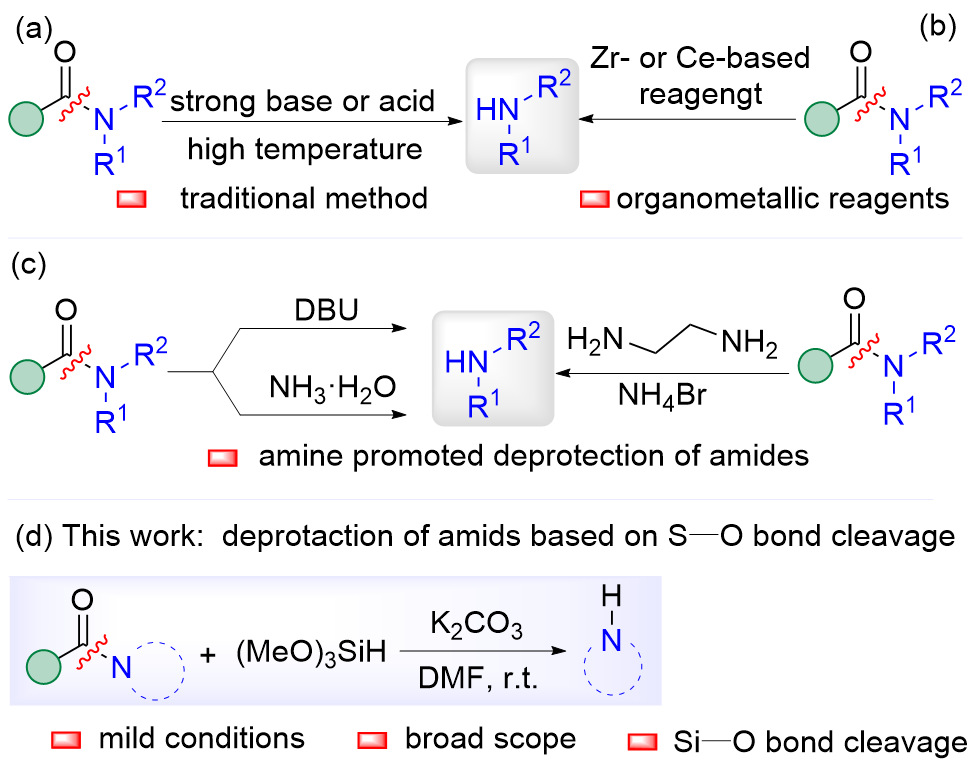
保护基策略在有机合成与药物合成领域占据重要地位, 其中酰胺的脱保护一直受到广泛关注. 然而, 由于酰胺键的稳定性较高, 在脱除酰基保护基时通常需要苛刻的条件. 为了解决这一难题, 发展了一种温和条件下脱除酰基保护基的方法, 即烷氧基硅烷促进的N-酰基吲哚类化合物的酰胺键断裂反应. 硅烷的Si—O键发生断裂, 原位产生亲核试剂进攻酰胺键, 成功地实现了酰基保护基的脱除. 该反应具有条件温和、底物适用范围广、操作简单、产率高以及所用试剂廉价易得等优点, 可以为脱去酰胺的酰基保护基提供一种绿色且实用的新方法.
杨鹏飞, 马雨婷, 徐婉欣, 孙雨蒙, 仰海凌. 基于硅氧键断裂的N-酰基吲哚类酰胺的脱保护[J]. 有机化学, 2026, 46(5): 2112-2120.
Pengfei Yang, Yuting Ma, Wanxin Xu, Yumeng Sun, Hailing Yang. Deprotection of N-Acyl Indole-Type Amides Based on Si—O Bond Cleavage[J]. Chinese Journal of Organic Chemistry, 2026, 46(5): 2112-2120.
| Entry | Deviation from standard conditions | Yieldb/% |
|---|---|---|
| 1 | None | 95 (90)c |
| 2 | w/o silane | N.R. |
| 3 | w/o K2CO3 | N.R. |
| 4 | (EtO)3SiH instead of (MeO)3SiH | 93 |
| 5 | (EtO)4Si instead of (MeO)3SiH | 67 |
| 6 | 2.0 equiv. of (EtO)4Si instead of (MeO)3SiH | 94 |
| 7 | Ph2SiH2 instead of (MeO)3SiH | N.R. |
| 8 | Et3SiH instead of (MeO)3SiH | N.R. |
| 9 | NaHCO3 instead of K2CO3 | N.R. |
| 10 | KHCO3 instead of K2CO3 | N.R. |
| 11 | Na2CO3 instead of K2CO3 | N.R. |
| 12 | CsCO3 instead of K2CO3 | 94 |
| 13 | Toluene instead of DMF | N.R. |
| 14 | Ethyl acetate instead of DMF | 6 |
| 15 | CH2Cl2 instead of DMF | 5 |
| 16 | THF instead of DMF | 15 |
| 17 | 0.50 mL of DMF | 90 |
| Entry | Deviation from standard conditions | Yieldb/% |
|---|---|---|
| 1 | None | 95 (90)c |
| 2 | w/o silane | N.R. |
| 3 | w/o K2CO3 | N.R. |
| 4 | (EtO)3SiH instead of (MeO)3SiH | 93 |
| 5 | (EtO)4Si instead of (MeO)3SiH | 67 |
| 6 | 2.0 equiv. of (EtO)4Si instead of (MeO)3SiH | 94 |
| 7 | Ph2SiH2 instead of (MeO)3SiH | N.R. |
| 8 | Et3SiH instead of (MeO)3SiH | N.R. |
| 9 | NaHCO3 instead of K2CO3 | N.R. |
| 10 | KHCO3 instead of K2CO3 | N.R. |
| 11 | Na2CO3 instead of K2CO3 | N.R. |
| 12 | CsCO3 instead of K2CO3 | 94 |
| 13 | Toluene instead of DMF | N.R. |
| 14 | Ethyl acetate instead of DMF | 6 |
| 15 | CH2Cl2 instead of DMF | 5 |
| 16 | THF instead of DMF | 15 |
| 17 | 0.50 mL of DMF | 90 |
| [1] |
(a)
doi: 10.1021/jm501100b pmid: 27689804 |
|
(b)
doi: 10.1021/acs.accounts.5b00284 pmid: 27689804 |
|
|
(c)
pmid: 27689804 |
|
|
(d)
doi: 10.2174/0113852728296565240221082253 pmid: 27689804 |
|
|
(e)
doi: 10.6023/cjoc202100022 pmid: 27689804 |
|
|
(易荣楠, 何卫民, 有机化学, 2021, 41, 1267.)
doi: 10.6023/cjoc202100022 pmid: 27689804 |
|
|
(f)
doi: 10.6023/cjoc202102035 pmid: 27689804 |
|
|
(葛雅欣, 闫芹芹, 田云飞, 王海军, 张春芳, 李泽江, 有机化学, 2021, 41, 3106.)
doi: 10.6023/cjoc202102035 pmid: 27689804 |
|
|
(g)
doi: 10.6023/cjoc202003022 pmid: 27689804 |
|
|
(王向阳, 徐学涛, 王振华, 方萍, 梅天胜, 有机化学, 2020, 40, 3738.)
doi: 10.6023/cjoc202003022 pmid: 27689804 |
|
| [2] |
(a)
doi: 10.1016/0040-4039(96)01752-2 |
|
(b)
doi: 10.1002/slct.v5.23 |
|
| [3] |
(a)
pmid: 12095326 |
|
(b)
doi: 10.1039/D0CS00082E pmid: 12095326 |
|
|
(c)
doi: 10.6023/cjoc202100068 pmid: 12095326 |
|
|
(江晓莉, 朱少林, 有机化学, 2021, 41, 3745.)
pmid: 12095326 |
|
|
(d)
doi: 10.1002/anie.v62.26 pmid: 12095326 |
|
|
(e)
doi: 10.1038/s44160-024-00609-2 pmid: 12095326 |
|
| [4] |
(a)
|
|
(b)
doi: 10.1002/slct.v3.5 |
|
| [5] |
(a)
pmid: 15496055 |
|
(b)
doi: 10.1021/ol802482d pmid: 15496055 |
|
|
(c)
doi: 10.1007/s11426-019-9665-5 pmid: 15496055 |
|
|
(d)
doi: 10.1002/adsc.v355.17 pmid: 15496055 |
|
|
(e)
doi: 10.1039/D5QO00603A pmid: 15496055 |
|
|
(f)
doi: 10.1021/acs.joc.4c02711 pmid: 15496055 |
|
| [6] |
doi: 10.1039/C3OB41971A |
| [7] |
doi: 10.1016/j.cclet.2015.05.033 |
| [8] |
doi: 10.1081/SCC-120002011 |
| [9] |
|
| [10] |
doi: 10.6023/cjoc202112007 |
|
(韩群, 徐坤, 田发宁, 黄胜阳, 曾程初, 有机化学, 2022, 42, 1123.)
doi: 10.6023/cjoc202112007 |
|
| [11] |
(a)
doi: 10.1002/anie.201606832 pmid: 27612210 |
|
(b)
doi: 10.1002/anie.v57.33 pmid: 27612210 |
|
|
(c)
doi: 10.1021/acscatal.2c02892 pmid: 27612210 |
|
|
(d)
pmid: 27612210 |
|
|
(e)
doi: 10.1021/acscatal.2c00665 pmid: 27612210 |
|
| [12] |
(a)
doi: 10.1021/acs.orglett.8b02323 |
|
(b)
doi: 10.1007/s11426-020-9883-3 |
|
| [13] |
doi: 10.1039/C7CC00852J |
| [14] |
doi: 10.1002/anie.v56.11 |
| [15] |
doi: 10.1021/acs.joc.3c02768 |
| [16] |
doi: 10.1021/acs.orglett.0c01963 |
| [17] |
doi: 10.1021/acs.organomet.2c00509 |
| [18] |
doi: 10.1021/acs.orglett.3c04294 |
| [19] |
doi: 10.1021/acs.orglett.6b03466 |
| [20] |
doi: 10.1021/acs.orglett.9b01971 |
| [21] |
doi: 10.1021/acs.orglett.2c04346 |
| [22] |
doi: 10.1039/D5OB00030K |
| [23] |
doi: 10.1021/acs.joc.1c00314 |
| [24] |
doi: 10.1021/jo00039a028 |
| [25] |
doi: 10.1021/ja4085463 pmid: 24032593 |
| [1] | 罗倩婷, 焦丽萍, 种雪兰, 张建欣, 王庆兵, 何华锋. 碱促进的酰胺与炔丙基卤代物串联环化高效构建噁唑骨架[J]. 有机化学, 2026, 46(5): 2010-2016. |
| [2] | 唐玉青, 杨紫娴, 杨兵, 王毅, 杜炳南. 球磨条件下机械力驱动的自由基反应研究进展[J]. 有机化学, 2026, 46(4): 1111-1145. |
| [3] | 李伟, 王奕森, 周荣, 高文超. 光催化胺与二硫化碳合成硫脲[J]. 有机化学, 2025, 45(1): 240-245. |
| [4] | 高晋彬, 陆颖琪, 张辉, 高利柱, 熊兴泉. 生物质基催化剂在CO2化学转化中的应用[J]. 有机化学, 2024, 44(9): 2732-2741. |
| [5] | 李阳, 袁锦鼎, 赵頔. 低共熔溶剂1,3-二甲基脲/L-(+)-酒石酸中(E)-2-苯乙烯基喹啉-3-羧酸类衍生物的绿色合成[J]. 有机化学, 2023, 43(9): 3268-3276. |
| [6] | 纪健, 刘进华, 管丛, 陈绪文, 赵芸, 刘顺英. 原位生成的磺酸催化N-磺酰基-1,2,3-三氮唑与醇偶联高区域选择性合成N2-取代1,2,3-三氮唑[J]. 有机化学, 2023, 43(3): 1168-1176. |
| [7] | 李硕, 王明亮, 周来运, 王兰芝. 磁性纳米负载对甲苯磺酸催化串联合成稠合多环的1,5-苯并氧氮杂䓬类化合物[J]. 有机化学, 2023, 43(11): 3977-3988. |
| [8] | 程飞, 孙琪雯, 卢江溶, 王兴兰, 张吉泉. 芳基二硫醚作为自由基硫试剂构建C—S键研究进展[J]. 有机化学, 2023, 43(11): 3728-3744. |
| [9] | 乃比江•赛米, 张蕾, 买地娜•沙拉木, 曾竟, 阿布都热西提•阿布力克木. 硫代磺酸酯和磺酰卤的绿色合成研究[J]. 有机化学, 2023, 43(1): 236-243. |
| [10] | 张建涛, 张聪, 郑梓栋, 周鹏, 刘卫兵. 亚砜叶立德参与构建五/六元氮杂环的反应研究进展[J]. 有机化学, 2022, 42(9): 2745-2759. |
| [11] | 潘振涛, 刘彤, 马永敏, 颜剑波, 王亚军. 布朗斯特酸/可见光氧化还原接力催化构建喹唑啉(硫)酮[J]. 有机化学, 2022, 42(9): 2823-2831. |
| [12] | 高润烨, 左玲玲, 王芳, 李传莹, 蒋华江, 李品华, 王磊. 无外加光催化剂下可见光促进的可控有机反应进展[J]. 有机化学, 2022, 42(7): 1883-1903. |
| [13] | 韩群, 徐坤, 田发宁, 黄胜阳, 曾程初. 一种利用酰胺基转移反应脱除酰基保护基的实用方法[J]. 有机化学, 2022, 42(4): 1123-1128. |
| [14] | 左鸿华, 钟芳锐. 亚稳醌类分子的活性调控与仿生催化反应[J]. 有机化学, 2022, 42(3): 665-678. |
| [15] | 王明亮, 尹刘燕, 温甜甜, 张晓, 高杰, 王兰芝. 多官能团化的1,5-苯并二氮杂䓬类化合物的绿色合成[J]. 有机化学, 2022, 42(1): 160-171. |
| 阅读次数 | ||||||
|
全文 |
|
|||||
|
摘要 |
|
|||||