

化学学报 ›› 2026, Vol. 84 ›› Issue (5): 667-672.DOI: 10.6023/A26010034 上一篇 下一篇
所属专题: “框架材料化学”合集
研究论文
张杨, 张金莉, 庞建东*( ), 卜显和*()
投稿日期:2026-01-30
发布日期:2026-03-17
作者简介:★“框架材料化学”专辑
基金资助:
Yang Zhang, Jinli Zhang, Jiandong Pang*(), Xian-He Bu*()
Received:2026-01-30
Published:2026-03-17
Contact:
* E-mail: jdpang@nankai.edu.cn;buxh@nankai.edu.cn
About author:★ For the VSI “Chemistry of Framework Materials”.
Supported by:文章分享
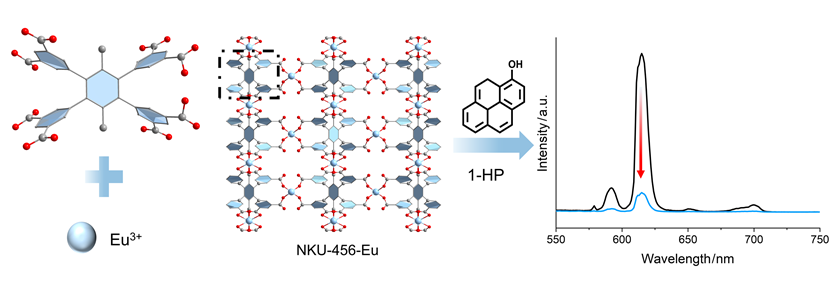
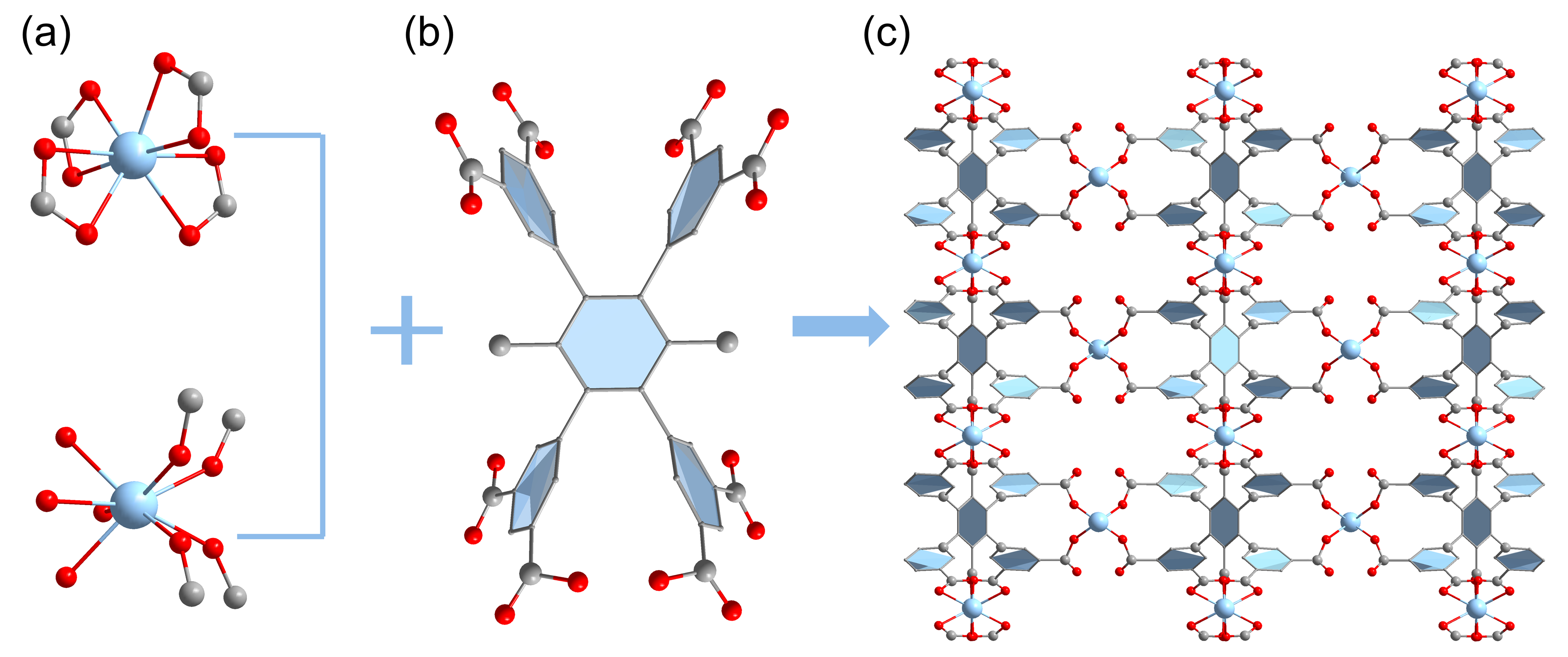
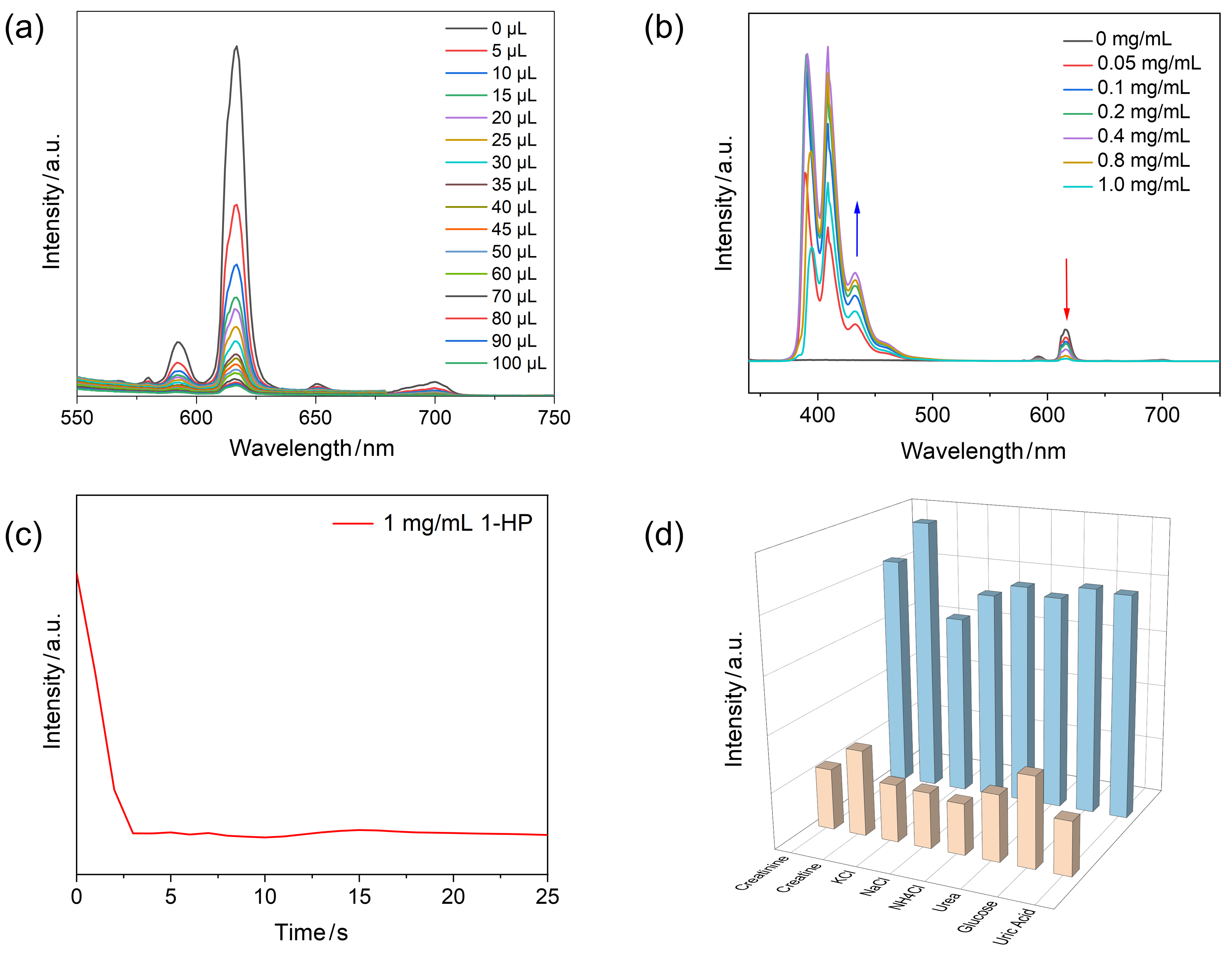
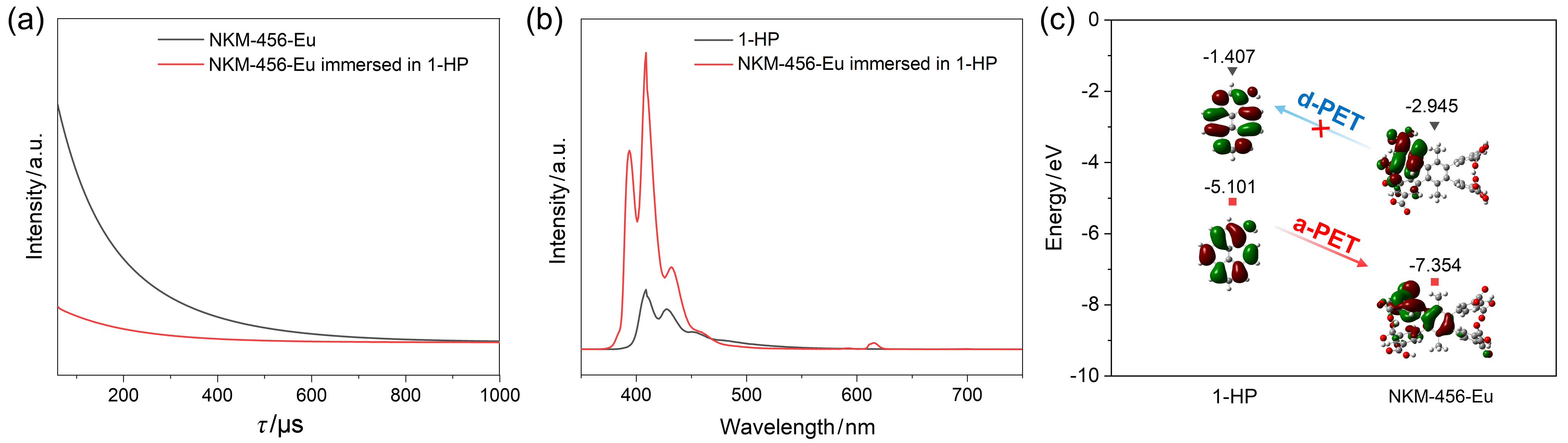
1-羟基芘(1-HP)是人体内多环芳烃(PAHs)代谢的终产物, 可作为一项生物学指标用于监测人类暴露于具有遗传毒性的PAHs的情况. 然而开发兼具高选择性、超高灵敏度与快速响应特性的1-HP检测方法仍面临重大挑战. 本研究成功构建了一种基于稀土金属铕(Eu3+)和刚性八羧酸配体H8HPA-2Me的金属-有机框架(MOF)材料NKM-456-Eu. 值得注意的是, NKM-456-Eu被证明是一种卓越的发光传感器, 可以识别N,N-二乙基甲酰胺(DEF)溶液和人尿液中的1-HP, 具有快速响应性(5 s)、高猝灭效率Ksv (83280 L/mol)、低检测限(0.0061 μmol/L)和基于肉眼可观察的发光猝灭性能, 并且对尿液中的其他成分具有良好的抗干扰能力. 该Eu-MOF具有可调的天线效应, 在432 nm(配体π→π*跃迁)和616 nm(配体到金属电荷转移, LMCT)处表现出双发射, 在1-HP存在时实现了高效的荧光猝灭. 本研究为探索基于MOFs的潜在发光传感器提供了一种新策略, 这一具有可调天线效应的Eu-MOF开创性设计将积极推动高性能MOF荧光材料和器件的发展.
张杨, 张金莉, 庞建东, 卜显和. 高灵敏Eu-MOF荧光探针用于尿液中1-羟基芘的检测★[J]. 化学学报, 2026, 84(5): 667-672.
Yang Zhang, Jinli Zhang, Jiandong Pang, Xian-He Bu. High-sensitivity Eu-MOF Fluorescent Probe for the Detection of 1-Hydroxypyrene in Urine★[J]. Acta Chimica Sinica, 2026, 84(5): 667-672.
| [1] |
doi: 10.1016/S0140-6736(19)30019-4 |
| [2] |
doi: 10.1016/j.jhazmat.2024.136102 |
| [3] |
doi: 10.1016/j.semcancer.2021.07.001 pmid: 34242741 |
| [4] |
doi: 10.1021/acs.est.7b02963 |
| [5] |
doi: 10.1016/j.trac.2020.115878 |
| [6] |
doi: 10.1016/j.jhazmat.2020.124531 |
| [7] |
doi: 10.1021/es030588k |
| [8] |
doi: 10.1021/es9000642 |
| [9] |
doi: 10.1016/j.jhazmat.2025.137799 |
| [10] |
doi: 10.1016/j.apcatb.2024.124718 |
| [11] |
doi: 10.1021/acs.est.3c01663 |
| [12] |
doi: 10.1016/j.bios.2016.04.071 |
| [13] |
doi: 10.1016/j.bios.2017.06.018 |
| [14] |
doi: 10.1016/j.aca.2017.10.026 |
| [15] |
doi: 10.1016/j.trac.2018.11.002 |
| [16] |
doi: 10.1016/j.saa.2020.118131 |
| [17] |
doi: 10.1016/j.dyepig.2025.113282 |
| [18] |
doi: 10.1093/nsr/nwac091 |
| [19] |
doi: 10.1016/j.ccr.2025.216470 |
| [20] |
doi: 10.6023/A25050193 |
|
(江惠星, 郑丽彬, 陈小丰, 张珍珍, 陈秋水, 杨黄浩, 化学学报, 2025, 83, 987.)
doi: 10.6023/A25050193 |
|
| [21] |
doi: 10.1039/C7CS00861A pmid: 29546889 |
| [22] |
doi: 10.1016/j.ccr.2019.213113 |
| [23] |
doi: 10.1093/nsr/nwaf326 |
| [24] |
doi: 10.1002/adma.v30.34 |
| [25] |
doi: 10.1016/j.snb.2026.139474 |
| [26] |
doi: 10.1016/j.ccr.2024.216102 |
| [27] |
doi: 10.1007/s11426-024-2457-y |
| [28] |
doi: 10.1007/s11426-024-2458-3 |
| [29] |
doi: 10.1002/adma.v37.44 |
| [30] |
doi: 10.1002/anie.v64.27 |
| [31] |
doi: 10.1002/smll.v21.11 |
| [32] |
doi: 10.1021/acs.inorgchem.5b00917 |
| [33] |
doi: 10.1021/acscatal.3c04100 |
| [34] |
doi: 10.1016/j.dyepig.2018.01.018 |
| [35] |
doi: 10.6023/A20080399 |
|
(任江波, 王蕾, 郭锐, 唐永和, 周红梅, 林伟英, 化学学报, 2021, 79, 87.)
doi: 10.6023/A20080399 |
|
| [36] |
doi: 10.1002/adma.v37.29 |
| [37] |
doi: 10.1007/s40843-024-3097-4 |
| [38] |
doi: 10.1021/acs.inorgchem.3c01290 |
| [39] |
doi: 10.1039/D5MH00689A |
| [40] |
doi: 10.1016/j.ccr.2025.216574 |
| [41] |
doi: 10.1016/j.ccr.2023.215454 |
| [42] |
doi: 10.1016/j.ccr.2023.215043 |
| [43] |
doi: 10.1039/D4TC03317E |
| [44] |
doi: 10.1016/j.molstruc.2025.143869 |
| [45] |
doi: 10.1021/jacs.9b11429 |
| [46] |
doi: 10.1016/j.foodchem.2023.135639 |
| [47] |
doi: 10.1016/j.cej.2020.125012 |
| [48] |
doi: 10.1039/D5CC02537K |
| [49] |
doi: 10.1016/j.jhazmat.2024.134742 |
| [50] |
doi: 10.1016/j.snb.2025.139290 |
| [51] |
doi: 10.1021/acs.inorgchem.4c05281 |
| [1] | 王赵兴, 王新超, 郑晨阳, 李尚达, 张健. 基于天然樟脑酸构筑的阶梯状手性金属-有机框架及其协同不对称催化★[J]. 化学学报, 2026, 84(5): 619-625. |
| [2] | 李颖果, 岳小艺, 付萌萌, 于超, 巩伟. 锆基金属-有机框架的合成后配体插入工程研究进展★[J]. 化学学报, 2026, 84(5): 709-722. |
| [3] | 孙天凯, 韩宗甦, 程鹏, 师唯. 手性金属-有机框架的合成与性质研究进展★[J]. 化学学报, 2026, 84(5): 723-735. |
| [4] | 赵玉强, 那迪, 和晓波, 朱立平, 周莹, 曾广智, 樊保敏. 无需催化剂的光介导生物正交荧光探针实例[J]. 化学学报, 2025, 83(8): 816-826. |
| [5] | 孟倩, 张琪伟. 用于神经递质检测与生物成像的有机小分子荧光探针★[J]. 化学学报, 2025, 83(10): 1252-1266. |
| [6] | 刘童, 皮慧慧, 陈冰昆, 张小玲. 近红外二区硫系银量子点制备方法及癌症诊疗应用研究进展[J]. 化学学报, 2024, 82(9): 1001-1012. |
| [7] | 蒋励, 陈子晗, 凡勇. 近红外二区荧光探针在活体多重成像中的研究进展[J]. 化学学报, 2024, 82(10): 1069-1085. |
| [8] | 武虹乐, 郭锐, 迟涵文, 唐永和, 宋思睿, 葛恩香, 林伟英. 喹啉基粘度荧光探针的合成及其检测应用[J]. 化学学报, 2023, 81(8): 905-911. |
| [9] | 汪阳, 阎敬灵. 不同配体的稀土金属配合物在烯烃聚合领域的研究进展[J]. 化学学报, 2023, 81(3): 275-288. |
| [10] | 贺晓梦, 袁方, 张素雅, 张健健. 基于尼罗红类ONOO–近红外荧光探针的开发及其成像应用[J]. 化学学报, 2023, 81(11): 1515-1521. |
| [11] | 孙丽, 王亚静, 李涛, 郭英姝, 张书圣. 金纳米笼探针用于线粒体成像和光热损伤细胞★[J]. 化学学报, 2023, 81(10): 1301-1310. |
| [12] | 宋思睿, 唐永和, 孙良广, 郭锐, 姜冠帆, 林伟英. 基于香豆素荧光团的新型极性检测荧光探针的开发及其成像应用[J]. 化学学报, 2022, 80(9): 1217-1222. |
| [13] | 王怡戈, 李航越, 吕泽伟, 韩敏芳, 孙凯华. 工业尺寸固体氧化物燃料电池高效及阳极安全运行条件研究[J]. 化学学报, 2022, 80(8): 1091-1099. |
| [14] | 吕天天, 马文, 詹冬笋, 邹燕敏, 李继龙, 冯美玲, 黄小荥. 两例新的镧系金属-有机框架化合物高效去除Cs+离子研究※[J]. 化学学报, 2022, 80(5): 640-646. |
| [15] | 吴志芬, 柯建熙, 刘永升, 孙蓬明, 洪茂椿. 稀土近红外二区纳米荧光影像探针及其生物医学应用※[J]. 化学学报, 2022, 80(4): 542-552. |
| 阅读次数 | ||||||
|
全文 |
|
|||||
|
摘要 |
|
|||||
