

化学学报 ›› 2026, Vol. 84 ›› Issue (5): 723-735.DOI: 10.6023/A26020039 上一篇 下一篇
所属专题: “框架材料化学”合集
综述
孙天凯, 韩宗甦, 程鹏, 师唯*( )
)
投稿日期:2026-02-01
发布日期:2026-04-14
作者简介: |
孙天凯, 博士研究生. 2019年毕业于南开大学(分子科学与工程专业), 获理学学士和工学学士学位. 2019年起在南开大学化学学院攻读博士学位. 主要研究方向为手性金属-有机框架的设计及其在对映异构体识别中的应用. |
 |
韩宗甦, 2016年在南开大学化学学院获理学学士学位, 2022年在南开大学化学学院获理学博士学位. 主要研究方向为金属-有机框架的孔道编辑工程及其在荧光识别中的应用. |
 |
程鹏, 南开大学化学学院教授, 博士生导师, 教育部“长江学者”计划特聘教授, 国家自然科学基金杰出青年科学基金获得者. 主要从事配位化学相关的研究工作. |
 |
师唯, 南开大学化学学院教授, 博士生导师, 入选教育部新世纪优秀人才支持计划, 国家自然科学基金优秀青年科学基金获得者. 主要从事功能配合物化学相关的研究工作. |
★ “框架材料化学”专辑.
基金资助:
Tiankai Sun, Zongsu Han, Peng Cheng, Wei Shi*()
Received:2026-02-01
Published:2026-04-14
Contact:
* E-mail: shiwei@nankai.edu.cn
About author:★ For the VSI “Chemistry of Framework Materials”.
Supported by:文章分享
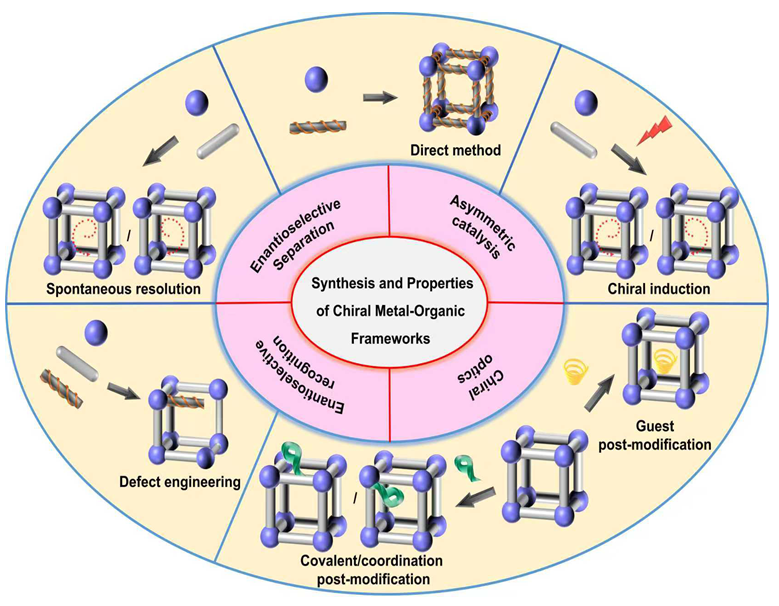
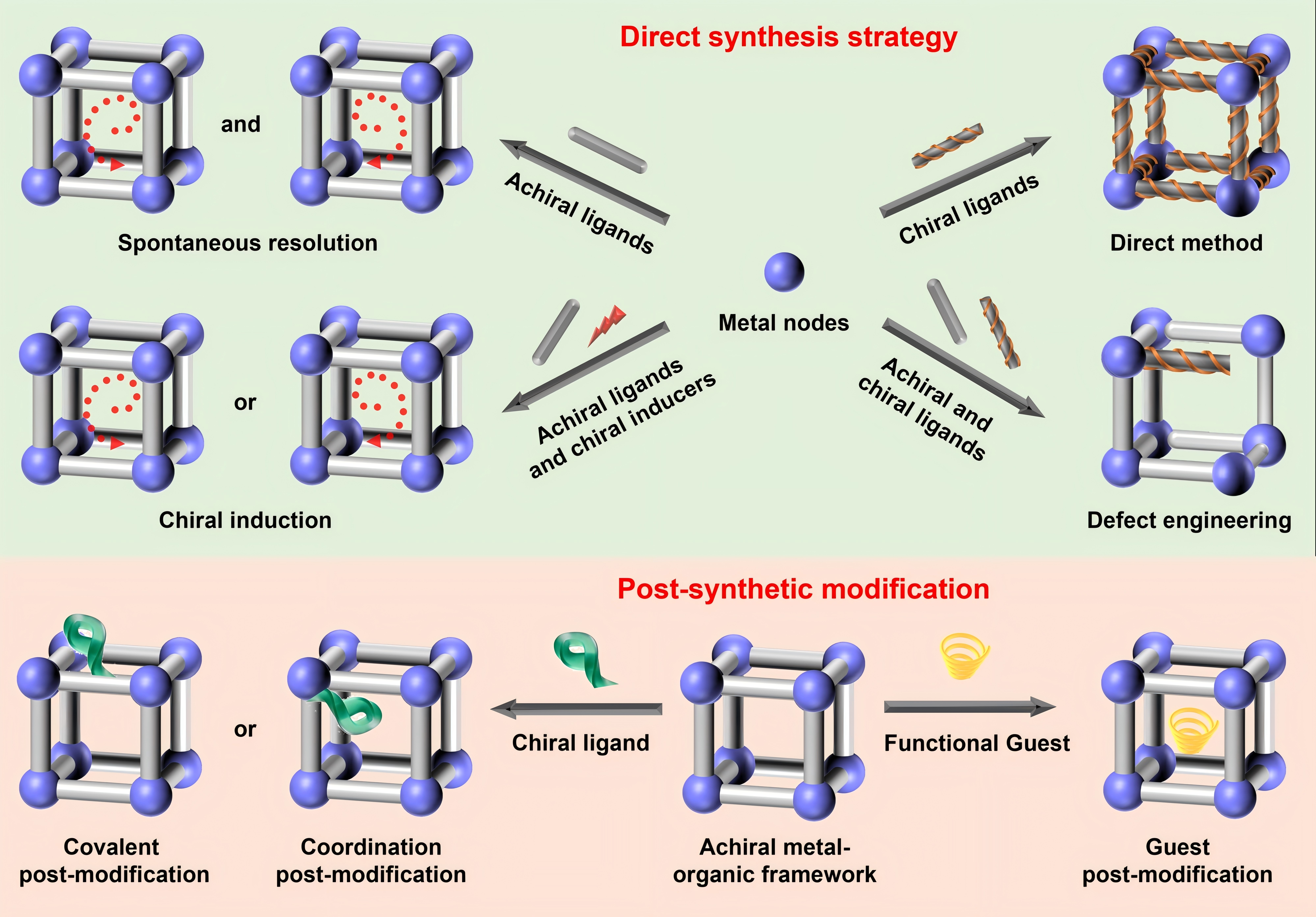
手性金属-有机框架作为一类结构高度可调控的先进手性微孔材料, 在医学、生物和光学等领域展现出诱人的应用前景. 近年来, 关于手性金属-有机框架的研究取得了系列重要进展, 但随着相关研究与诸多领域的交叉融合, 也产生了新的挑战, 如手性配体和手性金属-有机框架的高效合成, 在潜在应用场景中的稳定性和在对映选择性应用中的分子机制等. 本综述讨论了手性金属-有机框架的直接合成策略(基于手性配体直接合成、基于非手性配体的自发拆分、手性模版诱导和手性缺陷工程合成)和后修饰合成策略(金属离子节点后修饰、有机配体后修饰和功能客体后修饰), 并对近五年手性金属-有机框架在对映选择性传感、对映异构体分离、不对称催化和手性光学等方面的进展进行了总结和展望.
孙天凯, 韩宗甦, 程鹏, 师唯. 手性金属-有机框架的合成与性质研究进展★[J]. 化学学报, 2026, 84(5): 723-735.
Tiankai Sun, Zongsu Han, Peng Cheng, Wei Shi. Research Progress in the Synthesis and Properties of Chiral Metal-Organic Frameworks★[J]. Acta Chimica Sinica, 2026, 84(5): 723-735.
| [1] |
doi: 10.1126/science.abo5048 |
| [2] |
|
| [3] |
doi: 10.1021/acs.chemrev.3c00010 pmid: 37417731 |
| [4] |
doi: 10.1021/acs.chemrev.5c00177 |
| [5] |
doi: 10.1038/s41586-023-05877-0 |
| [6] |
doi: 10.1021/acs.chemrev.2c00879 |
| [7] |
doi: 10.1016/j.esci.2023.100189 |
| [8] |
doi: 10.31635/ccschem.024.202404999 |
| [9] |
doi: 10.1002/adma.v35.52 |
| [10] |
doi: 10.1039/D3CS00939D |
| [11] |
doi: 10.1002/advs.v8.12 |
| [12] |
doi: 10.1021/jacs.1c12117 pmid: 35148083 |
| [13] |
doi: 10.1038/s44160-025-00909-1 |
| [14] |
doi: 10.1016/j.ccr.2024.215859 |
| [15] |
doi: 10.1016/j.ccr.2022.214852 |
| [16] |
doi: 10.1016/j.ccr.2025.216536 |
| [17] |
doi: 10.1016/j.cclet.2017.09.050 |
| [18] |
doi: 10.1016/j.ccr.2021.214083 |
| [19] |
doi: 10.1021/acs.chemrev.1c00740 |
| [20] |
doi: 10.1016/j.ccr.2023.215120 |
| [21] |
doi: 10.1039/D2CS00129B |
| [22] |
doi: 10.1016/j.nantod.2024.102227 |
| [23] |
doi: 10.1021/acs.accounts.4c00795 |
| [24] |
pmid: 11671527 |
| [25] |
doi: 10.1038/35010088 |
| [26] |
doi: 10.1021/acs.chemrev.5b00317 pmid: 26402470 |
| [27] |
doi: 10.1021/acs.accounts.5b00530 |
| [28] |
doi: 10.1021/acs.chemrev.3c00409 pmid: 38408451 |
| [29] |
doi: 10.1016/j.esen.2025.100005 |
| [30] |
doi: 10.1021/jacs.0c13005 |
| [31] |
doi: 10.1016/j.chempr.2022.02.004 |
| [32] |
doi: 10.1021/jacs.2c02351 |
| [33] |
doi: 10.1021/jacs.3c03036 pmid: 37311062 |
| [34] |
doi: 10.1021/jacs.3c11733 |
| [35] |
doi: 10.1021/jacs.0c02097 pmid: 32393016 |
| [36] |
doi: 10.1038/s41557-023-01277-z |
| [37] |
doi: 10.1002/anie.v60.6 |
| [38] |
doi: 10.1002/anie.v64.6 |
| [39] |
doi: 10.1002/anie.v62.30 |
| [40] |
doi: 10.1021/jacs.7b03633 |
| [41] |
doi: 10.1016/j.chempr.2023.05.004 |
| [42] |
doi: 10.1021/jacs.0c00637 pmid: 32363868 |
| [43] |
doi: 10.1021/acsmaterialsau.4c00139 pmid: 40385958 |
| [44] |
|
| [45] |
doi: 10.1021/acs.chemmater.3c00652 |
| [46] |
doi: 10.1021/jacs.4c03728 |
| [47] |
doi: 10.6023/A25040117 |
|
(高春, 张松涛, 庞欢, 化学学报, 2025, 83, 962.)
doi: 10.6023/A25040117 |
|
| [48] |
doi: 10.1038/s41467-019-13090-9 |
| [49] |
doi: 10.1002/advs.v11.40 |
| [50] |
doi: 10.1002/adfm.v32.34 |
| [51] |
doi: 10.1021/acsnano.3c05265 |
| [52] |
doi: 10.1002/anie.v61.25 |
| [53] |
doi: 10.1002/adfm.v35.26 |
| [54] |
doi: 10.1021/jacs.4c04164 |
| [55] |
doi: 10.1002/adfm.v35.36 |
| [56] |
doi: 10.1039/D4TA08001G |
| [57] |
doi: 10.1016/j.talanta.2026.129686 |
| [58] |
doi: 10.1016/j.esci.2025.100378 |
| [59] |
doi: 10.1021/jacs.1c03277 |
| [60] |
doi: 10.1002/anie.v62.2 |
| [61] |
doi: 10.1016/j.cej.2025.164745 |
| [62] |
doi: 10.1002/anie.v62.10 |
| [63] |
doi: 10.1002/adma.v36.25 |
| [64] |
doi: 10.1002/adma.v37.4 |
| [65] |
|
|
(张妍, 李浩玉, 刘才, 张荣月, 何晓囡, 乔娟, 分析化学, 2025, 53, 1751.)
|
|
| [66] |
|
| [67] |
| [1] | 王赵兴, 王新超, 郑晨阳, 李尚达, 张健. 基于天然樟脑酸构筑的阶梯状手性金属-有机框架及其协同不对称催化★[J]. 化学学报, 2026, 84(5): 619-625. |
| [2] | 李颖果, 岳小艺, 付萌萌, 于超, 巩伟. 锆基金属-有机框架的合成后配体插入工程研究进展★[J]. 化学学报, 2026, 84(5): 709-722. |
| [3] | 张杨, 张金莉, 庞建东, 卜显和. 高灵敏Eu-MOF荧光探针用于尿液中1-羟基芘的检测★[J]. 化学学报, 2026, 84(5): 667-672. |
| [4] | 甘定伟, 周儒森, 应见喜, 周仁武. 等离子体放电在生命化学起源中的研究进展[J]. 化学学报, 2026, 84(2): 257-263. |
| [5] | 李斌, 张静枫, 聂慧芳, 卢泽星, 杨贵东, 张生勇. Mn(0)催化酮的不对称氢化反应[J]. 化学学报, 2025, 83(7): 661-666. |
| [6] | 潘禹州, 殷炜杰, 张雨霞. 手性超分子组装圆偏振室温磷光材料的研究进展[J]. 化学学报, 2025, 83(6): 639-654. |
| [7] | 李晖, 殷亮. 手性有机硒化合物的催化不对称合成研究进展[J]. 化学学报, 2025, 83(10): 1237-1251. |
| [8] | 张妞, 韩书冉, 马宏伟, 陈磅宽. 基于联二萘酚的手性有机发光分子合成与性能研究[J]. 化学学报, 2025, 83(1): 10-16. |
| [9] | 王玉, 于聪, 夏艳芳, 林蓝, 陈强, 王新波. 一种手性自具微孔聚合物的合成及手性荧光识别[J]. 化学学报, 2024, 82(8): 914-918. |
| [10] | 江杏杏, 武卫龙, 任慧莹, 张凤, 莫文枝, 卢志强. 新型手性三齿PNN配体锰配合物催化的芳香酮类化合物的不对称氢化反应研究[J]. 化学学报, 2024, 82(7): 736-741. |
| [11] | 李小贞, 孙庆福. 稀土圆偏振发光材料研究进展[J]. 化学学报, 2024, 82(6): 707-730. |
| [12] | 郑灏宁, 刘金宇. 有机催化吲哚碳环官能团化研究进展[J]. 化学学报, 2024, 82(6): 641-657. |
| [13] | 高炜洋, 邓伟超, 高扬, 梁仁校, 贾义霞. 吲哚分子间不对称去芳构化氧化Heck反应[J]. 化学学报, 2024, 82(1): 1-4. |
| [14] | 蔡新红, 陈建中, 张万斌. 镍催化不对称氢化构建手性C—X键的研究进展★[J]. 化学学报, 2023, 81(6): 646-656. |
| [15] | 韩叶强, 史炳锋. 钯(II)催化不对称C(sp3)—H键官能团化研究进展★[J]. 化学学报, 2023, 81(11): 1522-1540. |
| 阅读次数 | ||||||
|
全文 |
|
|||||
|
摘要 |
|
|||||
