

化学学报 ›› 2026, Vol. 84 ›› Issue (6): 812-819.DOI: 10.6023/A26020054 上一篇 下一篇
研究论文
杨广慧a,b, 韩捷b, 迟清水a, 李佳轩a, 王雨鹏a, 田霞a, 苏伟a, 许应桩a, 韩建荣a,*( )
)
投稿日期:2026-02-10
发布日期:2026-03-24
基金资助:
Guanghui Yanga,b, Jie Hanb, Qingshui Chia, Jiaxuan Lia, Yupeng Wanga, Xia Tiana, Wei Sua, Yingzhuang Xua, Jianrong Hana,*()
Received:2026-02-10
Published:2026-03-24
Contact:
E-mail: Supported by:文章分享
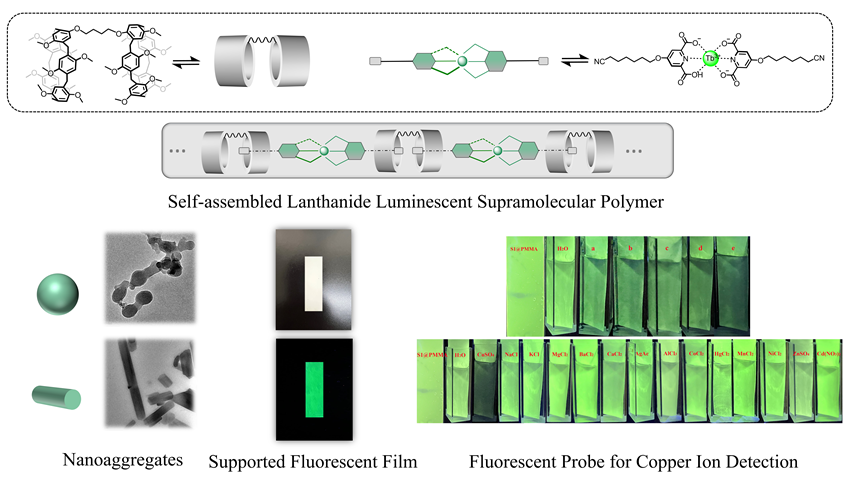
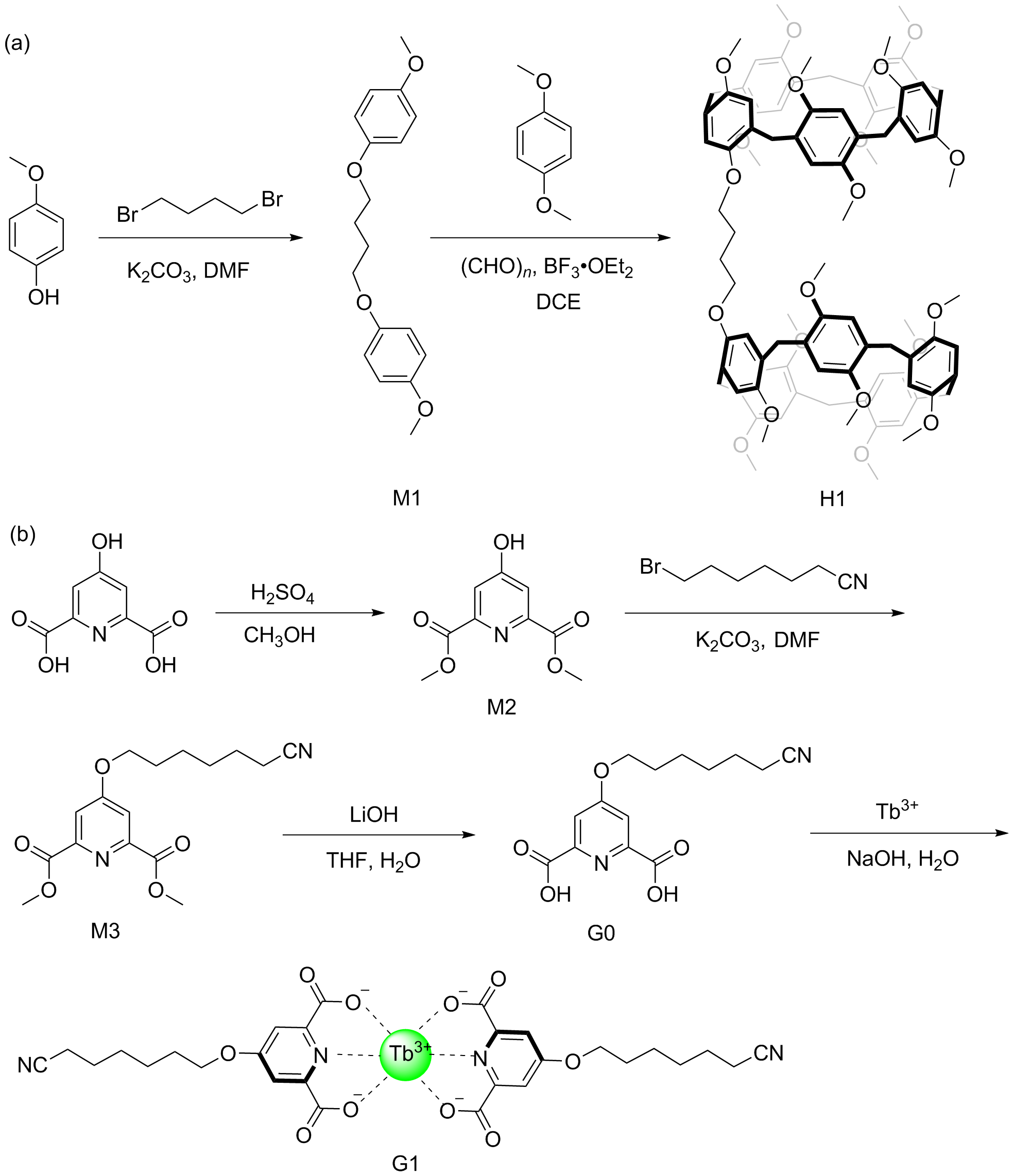
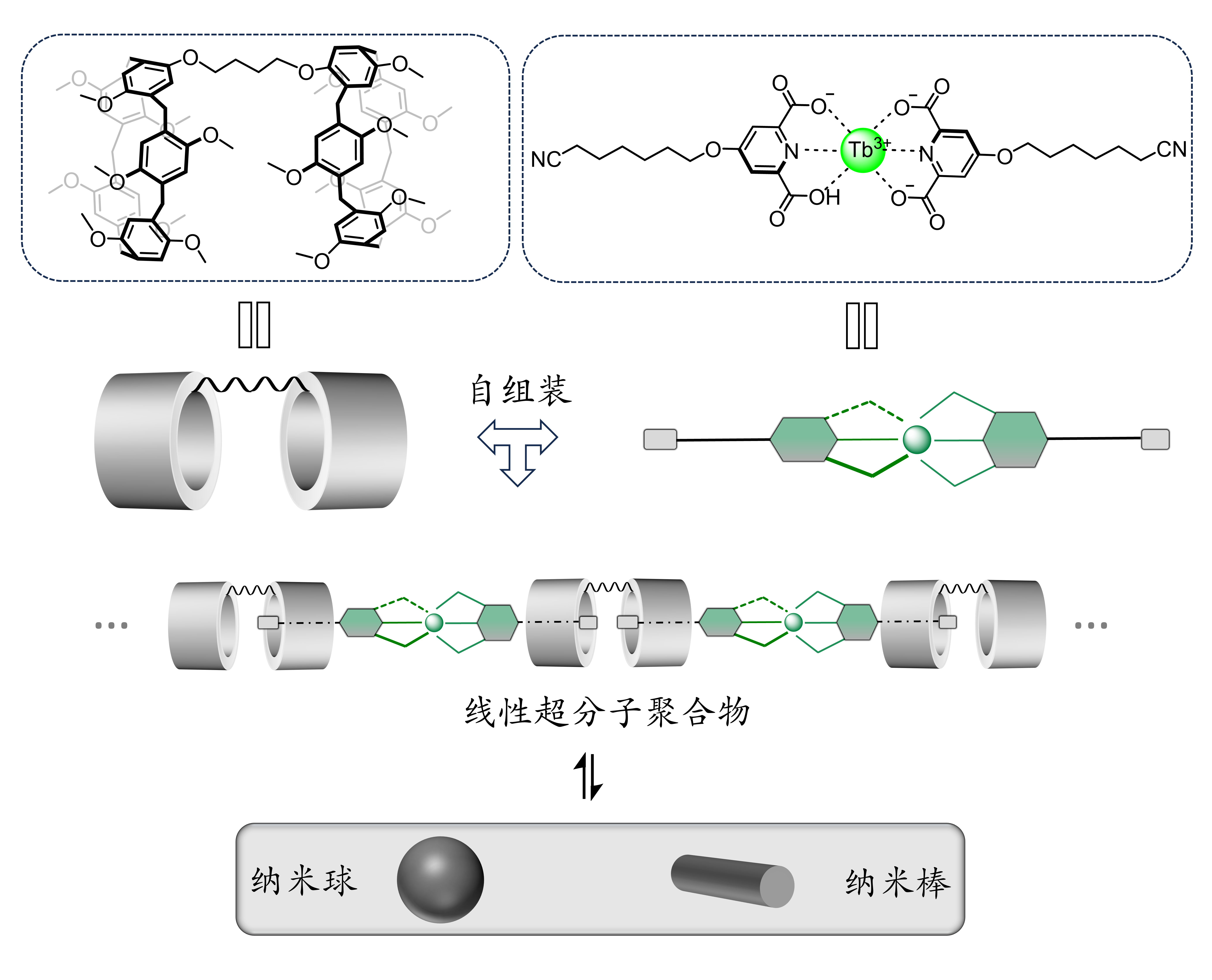
近年来, 由镧系金属配位作用参与构筑的超分子聚合物, 兼具镧系离子优异的发光性能和超分子的动态可逆性, 被广泛报道用于智能传感材料的设计与开发. 本工作合成了一种桥联双柱[5]芳烃大环分子, 通过主客体作用与制备的长链腈修饰的铽离子配合物经交联组装形成了具有镧系发光性能的超分子聚合物. 利用荧光性能探究了超分子聚合物对多种金属离子的识别作用, 结果显示其对铜离子有特异性的识别能力. 应用该超分子聚合物制成了荧光薄膜, 该薄膜可作为荧光探针用于水中铜离子的检测, 具有良好的选择性和灵敏度.
杨广慧, 韩捷, 迟清水, 李佳轩, 王雨鹏, 田霞, 苏伟, 许应桩, 韩建荣. 基于柱[5]芳烃超分子聚合物的铜离子荧光检测薄膜[J]. 化学学报, 2026, 84(6): 812-819.
Guanghui Yang, Jie Han, Qingshui Chi, Jiaxuan Li, Yupeng Wang, Xia Tian, Wei Su, Yingzhuang Xu, Jianrong Han. Copper Ion Fluorescence Sensing Film Based on Pillar[5]arene Supramolecular Polymer[J]. Acta Chimica Sinica, 2026, 84(6): 812-819.
| [1] |
pmid: 11740927 |
| [2] |
doi: 10.1021/cr900181u pmid: 19769364 |
| [3] |
doi: 10.1002/adma.v2:5 |
| [4] |
doi: 10.1021/cr500633b |
| [5] |
|
|
(姚灏, 王景霞, 田威, 高分子学报, 2021, 52, 578.)
|
|
| [6] |
doi: 10.1039/D0CC07247H |
| [7] |
doi: 10.1016/j.progpolymsci.2020.101310 |
| [8] |
doi: 10.1002/adma.v27.3 |
| [9] |
doi: 10.1002/adma.v29.14 |
| [10] |
doi: 10.1021/acs.accounts.3c00683 |
| [11] |
doi: 10.1038/s41467-021-21677-4 |
| [12] |
doi: 10.1039/D2SC02384A |
| [13] |
doi: 10.1039/D3SC01425H |
| [14] |
doi: 10.6023/A25010009 |
|
(李菲, 伊思静, 王姣, 刘晓霞, 高文梅, 李婧婧, 张海峰, 化学学报, 2025, 83, 453.)
doi: 10.6023/A25010009 |
|
| [15] |
doi: 10.1039/c8dt03768j pmid: 30379167 |
| [16] |
doi: 10.1002/cjoc.v37.8 |
| [17] |
doi: 10.1039/C5PY00683J |
| [18] |
|
| [19] |
doi: 10.1039/C1CS15164A |
| [20] |
doi: 10.1021/ol2027834 |
| [21] |
doi: 10.1039/C6CC03999E |
| [22] |
doi: 10.1002/cjoc.v42.22 |
| [23] |
doi: 10.1002/cjoc.v42.2 |
| [1] | 张杨, 张金莉, 庞建东, 卜显和. 高灵敏Eu-MOF荧光探针用于尿液中1-羟基芘的检测★[J]. 化学学报, 2026, 84(5): 667-672. |
| [2] | 赵玉强, 那迪, 和晓波, 朱立平, 周莹, 曾广智, 樊保敏. 无需催化剂的光介导生物正交荧光探针实例[J]. 化学学报, 2025, 83(8): 816-826. |
| [3] | 孟倩, 张琪伟. 用于神经递质检测与生物成像的有机小分子荧光探针★[J]. 化学学报, 2025, 83(10): 1252-1266. |
| [4] | 刘童, 皮慧慧, 陈冰昆, 张小玲. 近红外二区硫系银量子点制备方法及癌症诊疗应用研究进展[J]. 化学学报, 2024, 82(9): 1001-1012. |
| [5] | 蒋励, 陈子晗, 凡勇. 近红外二区荧光探针在活体多重成像中的研究进展[J]. 化学学报, 2024, 82(10): 1069-1085. |
| [6] | 武虹乐, 郭锐, 迟涵文, 唐永和, 宋思睿, 葛恩香, 林伟英. 喹啉基粘度荧光探针的合成及其检测应用[J]. 化学学报, 2023, 81(8): 905-911. |
| [7] | 贺晓梦, 袁方, 张素雅, 张健健. 基于尼罗红类ONOO–近红外荧光探针的开发及其成像应用[J]. 化学学报, 2023, 81(11): 1515-1521. |
| [8] | 孙丽, 王亚静, 李涛, 郭英姝, 张书圣. 金纳米笼探针用于线粒体成像和光热损伤细胞★[J]. 化学学报, 2023, 81(10): 1301-1310. |
| [9] | 宋思睿, 唐永和, 孙良广, 郭锐, 姜冠帆, 林伟英. 基于香豆素荧光团的新型极性检测荧光探针的开发及其成像应用[J]. 化学学报, 2022, 80(9): 1217-1222. |
| [10] | 吴志芬, 柯建熙, 刘永升, 孙蓬明, 洪茂椿. 稀土近红外二区纳米荧光影像探针及其生物医学应用※[J]. 化学学报, 2022, 80(4): 542-552. |
| [11] | 李勇, 王栩, 解希雷, 张建, 唐波. 一氧化碳有机荧光探针和光控释放剂研究进展[J]. 化学学报, 2021, 79(1): 36-44. |
| [12] | 罗兴蕊, 陈敏文, 杨晴来. 近红外二区活体成像技术及其应用研究进展[J]. 化学学报, 2020, 78(5): 373-381. |
| [13] | 孙延慧, 齐有啸, 申优, 井翠洁, 陈笑笑, 王新星. 基于RGO-Au-ZIF-8复合材料的电化学传感器制备及其在铅离子和铜离子同时检测中的应用[J]. 化学学报, 2020, 78(2): 147-154. |
| [14] | 贾伊祎, 王文杰, 梁玲, 袁荃. 核酸功能化稀土基纳米材料在生物检测中的应用[J]. 化学学报, 2020, 78(11): 1177-1184. |
| [15] | 刘红文, 朱隆民, 娄霄峰, 袁林, 张晓兵. 用于细胞和组织中弗林蛋白酶特异性成像的双光子荧光探针研究[J]. 化学学报, 2020, 78(11): 1240-1245. |
| 阅读次数 | ||||||
|
全文 |
|
|||||
|
摘要 |
|
|||||
