

化学学报 ›› 2026, Vol. 84 ›› Issue (8): 1236-1242.DOI: 10.6023/A26050148 上一篇 下一篇
研究论文
黄宏a, 邓德朋a,b, 卢丹a,b, 申月a,*( ), 李能泉a,*(), 张友明a, 华涛a, 任保轶b
投稿日期:2026-05-06
发布日期:2026-06-30
基金资助:
Hong Huanga, Depeng Denga,b, Dan Lua,b, Yue Shena,*(), Nengquan Lia,*(), Youming Zhanga, Tao Huaa, Bao-Yi Renb
Received:2026-05-06
Published:2026-06-30
Contact:
E-mail: Supported by:文章分享
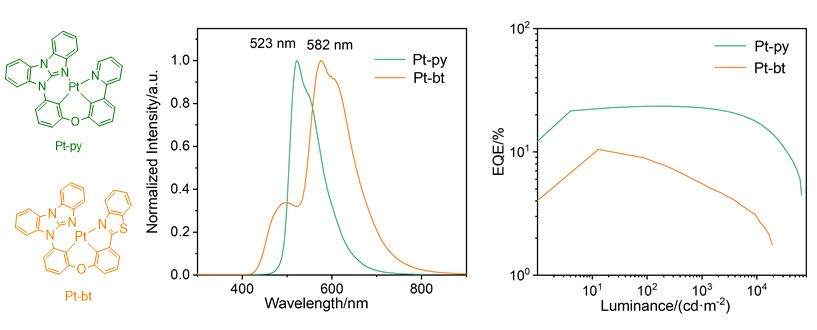
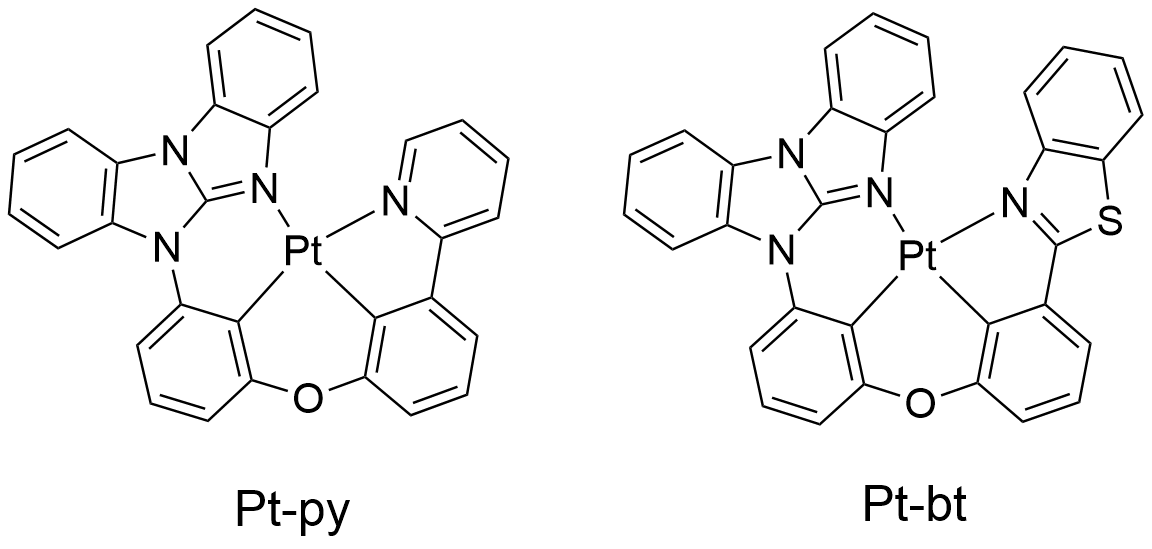
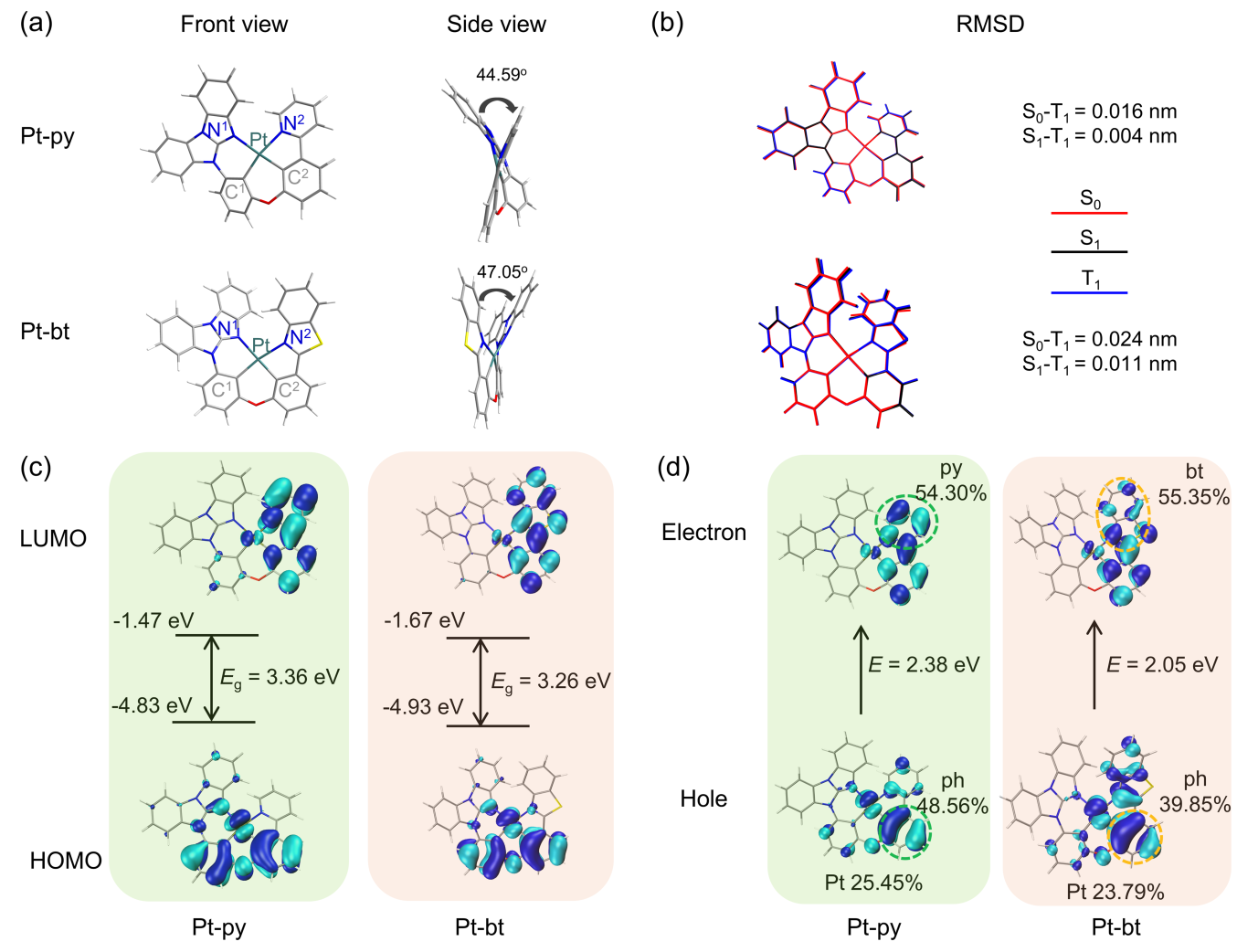
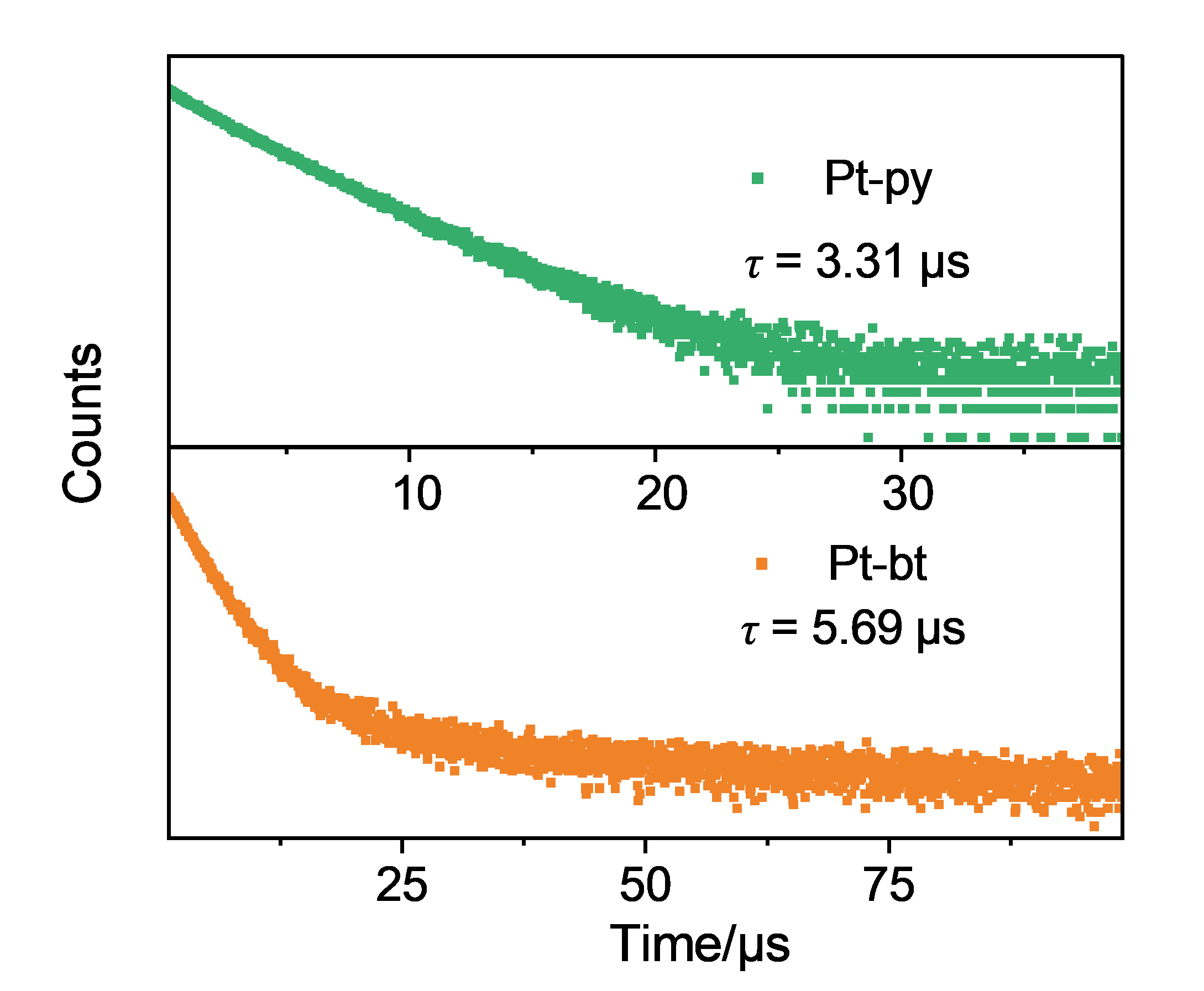
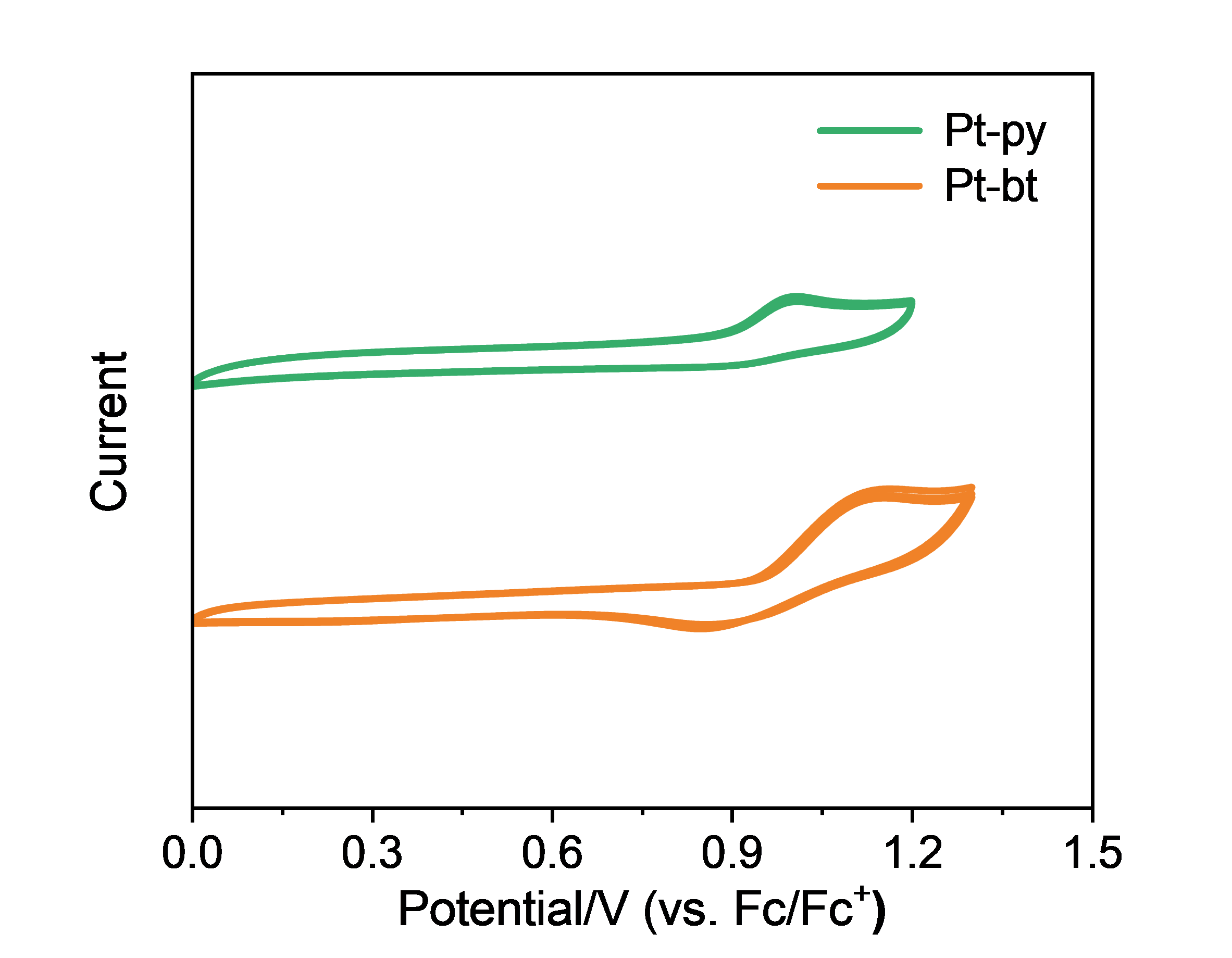
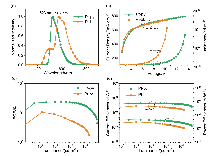
环金属铂(Ⅱ)配合物凭借优异的激子利用率与结构可修饰性, 是高性能磷光有机发光二极管(OLEDs)的核心客体材料. 本工作以刚性苯并咪唑并苯并咪唑(BZI)为基本构筑单元, 分别引入吡啶与苯并噻唑片段, 设计并制备了两种四齿环金属铂(II)配合物Pt-py与Pt-bt. 两者均具备优异的热力学与电化学稳定性. 以Pt-py为客体制备的掺杂电致发光器件, 其最大发射波长、亮度、电流效率、功率效率与外量子效率分别为523 nm、65782 cd•m−2、83.3 cd•A−1、86.5 lm•W−1与23.4%, 且在1000 cd•m−2亮度下效率滚降仅为4.7%. 相比之下, Pt-bt基器件最大外量子效率仅为10.4%, 但其实现发射光谱红移, 成功将光色调控至橙红光区. 上述结果表明, BZI刚性基团为铂(II)配合物高效磷光发射提供了结构基础, 而通过合理选择配位片段, 可在发光颜色、效率以及稳定性之间进行调控, 为新型四齿铂(II)基磷光材料的分子设计与OLEDs应用提供参考.
黄宏, 邓德朋, 卢丹, 申月, 李能泉, 张友明, 华涛, 任保轶. 苯并咪唑基四齿环金属铂(II)配合物的配位片段调控及其电致发光性能[J]. 化学学报, 2026, 84(8): 1236-1242.
Hong Huang, Depeng Deng, Dan Lu, Yue Shen, Nengquan Li, Youming Zhang, Tao Hua, Bao-Yi Ren. Coordination Fragment Modulation and Electroluminescent Performance of Benzimidazole-based Tetradentate Cyclometalated Platinum(II) Complexes[J]. Acta Chimica Sinica, 2026, 84(8): 1236-1242.
| Complex | λabsa/nm | λema/nm | Eopt gb/eV | τc/µs | Фc/% | HOMOd/eV | HOMOe/eV | Td/℃ |
|---|---|---|---|---|---|---|---|---|
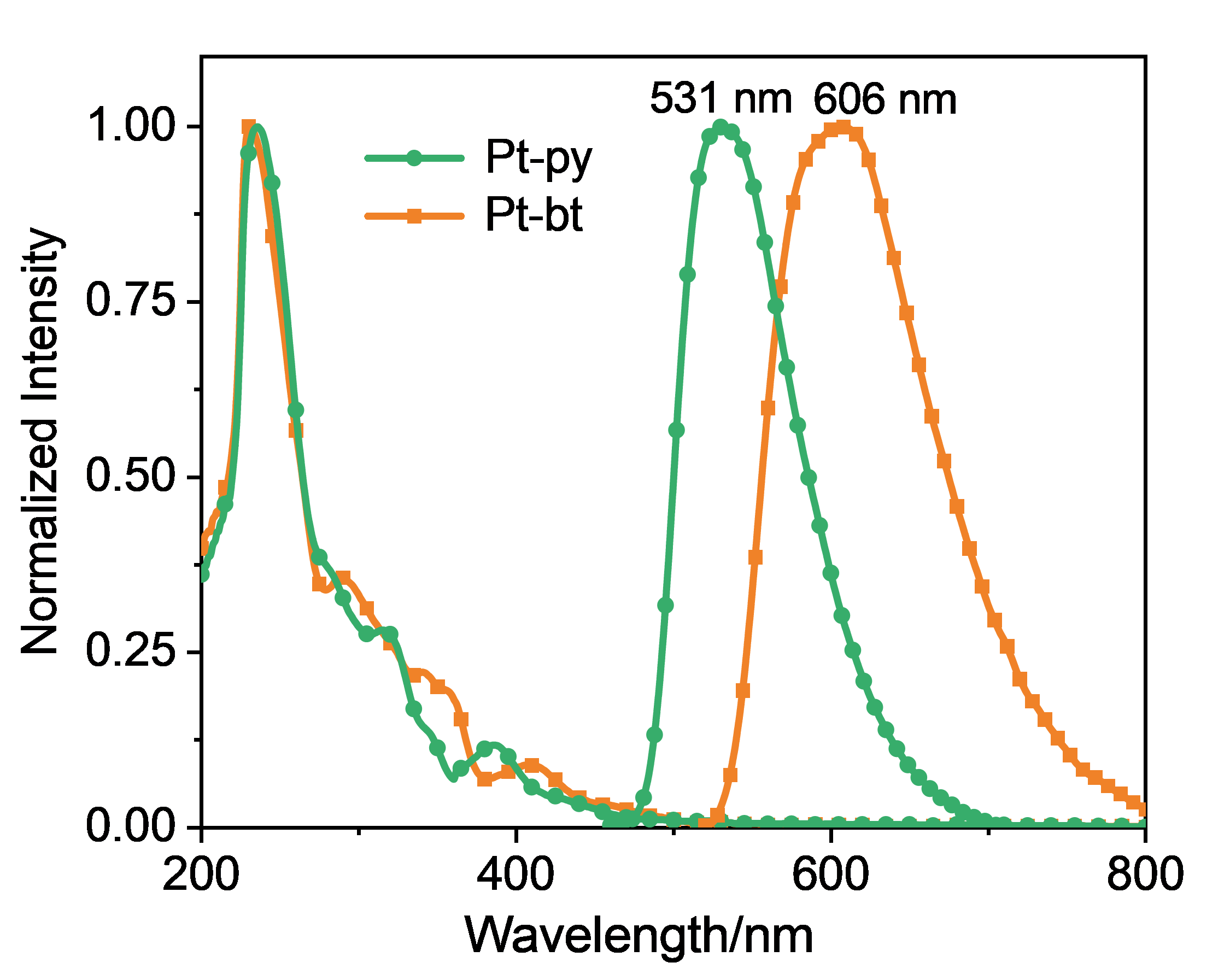
| Pt-py | 386 | 531 | 2.63 | 3.31 | 99.02 | -5.29 | -2.66 | 445.44 |
| Pt-bt | 409 | 606 | 2.44 | 5.69 | 57.24 | -5.35 | -2.91 | 389.51 |
| Complex | λabsa/nm | λema/nm | Eopt gb/eV | τc/µs | Фc/% | HOMOd/eV | HOMOe/eV | Td/℃ |
|---|---|---|---|---|---|---|---|---|
| Pt-py | 386 | 531 | 2.63 | 3.31 | 99.02 | -5.29 | -2.66 | 445.44 |
| Pt-bt | 409 | 606 | 2.44 | 5.69 | 57.24 | -5.35 | -2.91 | 389.51 |
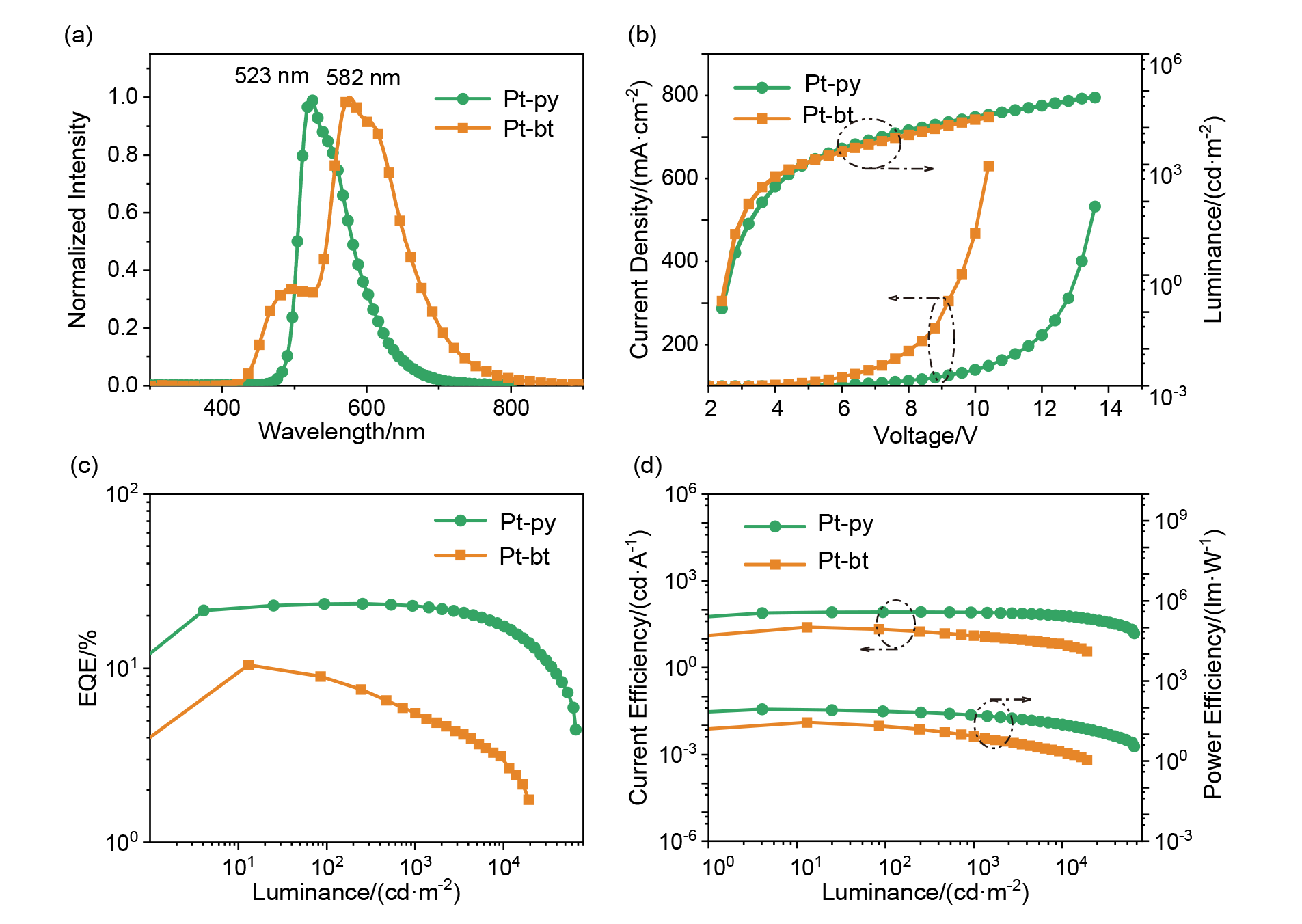
| Complex | λELa/nm | Lmax/(cd•m−2) | Von/V | CEmax/(cd•A−1) | PEmax/(lm•W−1) | EQEmax/500/1000/% | CIE1931 coordinatesb |
|---|---|---|---|---|---|---|---|
| Pt-py | 523 | 65782 | 2.8 | 83.3 | 86.5 | 23.4/23.3/22.3 | (0.35, 0.61) |
| Pt-bt | 582 | 19232 | 2.8 | 24.8 | 27.8 | 10.4/6.6/5.6 | (0.46, 0.44) |
| Complex | λELa/nm | Lmax/(cd•m−2) | Von/V | CEmax/(cd•A−1) | PEmax/(lm•W−1) | EQEmax/500/1000/% | CIE1931 coordinatesb |
|---|---|---|---|---|---|---|---|
| Pt-py | 523 | 65782 | 2.8 | 83.3 | 86.5 | 23.4/23.3/22.3 | (0.35, 0.61) |
| Pt-bt | 582 | 19232 | 2.8 | 24.8 | 27.8 | 10.4/6.6/5.6 | (0.46, 0.44) |
| [1] |
doi: 10.1038/nature02498 |
| [2] |
doi: 10.1038/s41427-021-00318-8 |
| [3] |
doi: 10.1021/acsami.0c01048 |
| [4] |
doi: 10.1002/adma.v29.5 |
| [5] |
doi: 10.1039/C5CS00424A |
| [6] |
doi: 10.1063/1.1733929 |
| [7] |
doi: 10.1063/1.98799 |
| [8] |
doi: 10.6023/A25060223 |
|
(闫安, 许世攀, 杜旭洋, 刘文平, 赵堃翔, 李胜利, 钟道昆, 周桂江, 杨晓龙, 孙源慧, 化学学报, 2025, 83, 1317.)
doi: 10.6023/A25060223 |
|
| [9] |
doi: 10.1126/science.abc8530 |
| [10] |
pmid: 12054983 |
| [11] |
doi: 10.1063/1.1409582 |
| [12] |
doi: 10.1063/1.1862777 |
| [13] |
doi: 10.1039/C7QM00588A |
| [14] |
doi: 10.1021/jacs.9b13956 |
| [15] |
doi: 10.1038/s41566-020-00734-2 |
| [16] |
doi: 10.1038/25954 |
| [17] |
doi: 10.6023/A17010015 |
|
(陈仕琦, 代军, 周凯峰, 罗艳菊, 苏仕健, 蒲雪梅, 黄艳, 卢志云, 化学学报, 2017, 75, 367.)
doi: 10.6023/A17010015 |
|
| [18] |
doi: 10.6023/A19110406 |
|
(任保轶, 依建成, 钟道昆, 赵玉志, 郭闰达, 盛永刚, 孙亚光, 解令海, 黄维, 化学学报, 2020, 78, 56.)
doi: 10.6023/A19110406 |
|
| [19] |
doi: 10.1021/ic302490c pmid: 23750738 |
| [20] |
doi: 10.1002/adma.v24.37 |
| [21] |
doi: 10.1021/acsami.5b01596 |
| [22] |
doi: 10.1002/adma.v35.32 |
| [23] |
doi: 10.1039/D4DT02743D |
| [24] |
doi: 10.1002/chem.v31.62 |
| [25] |
|
| [26] |
doi: 10.1021/ja0317776 |
| [27] |
doi: 10.1016/j.orgel.2017.07.002 |
| [28] |
doi: 10.1021/acs.chemmater.9b04263 |
| [29] |
doi: 10.1039/D2QM00806H |
| [30] |
doi: 10.3762/bjoc.19.95 |
| [31] |
doi: 10.1021/jacs.2c06948 |
| [32] |
doi: 10.1039/D0TC02884C |
| [33] |
doi: 10.1002/smll.v20.12 |
| [34] |
doi: 10.1021/j100229a010 |
| [35] |
doi: 10.1021/ja00366a051 |
| [36] |
doi: 10.1021/acsami.6b15272 |
| [37] |
doi: 10.1002/adma.v25.47 |
| [38] |
doi: 10.1016/j.cej.2026.176594 |
| [39] |
doi: 10.3390/ma18132942 |
| [1] | 张帮红, 张恒, 张斯涵, 郝建博, 张野, 王少华. 氨基丙二腈与1,4-吡啶硫内鎓盐的环化反应构建吡咯并[2,1-a]异喹啉衍生物[J]. 化学学报, 2026, 84(7): 1019-1024. |
| [2] | 徐冬青, 童海姗, 史路延, 张婷. 吡啶类双偶极主体材料及有机电致磷光器件[J]. 化学学报, 2026, 84(2): 240-247. |
| [3] | 薛虎, 徐姗, 王福周, 陈昶乐. 大位阻亚胺吡啶镍催化乙烯链行走聚合制备支化聚乙烯蜡★[J]. 化学学报, 2025, 83(12): 1480-1487. |
| [4] | 孟凡荣, 李国锋, 赵杰, 肖文精, 石德清, 陈加荣. 光催化氮自由基参与的乙烯基环丙烷加成/环化反应合成四氢吡啶★[J]. 化学学报, 2025, 83(12): 1472-1479. |
| [5] | 闫安, 许世攀, 杜旭洋, 刘文平, 赵堃翔, 李胜利, 钟道昆, 周桂江, 杨晓龙, 孙源慧. 位阻诱导扭曲结构的蓝光材料合成及其在蓝色有机发光二极管(OLED)中的应用[J]. 化学学报, 2025, 83(11): 1317-1323. |
| [6] | 朱韵飞, 郭可威, 王子路, 李昊, 朱爱云, 马靖尧, 祝守加, 冯全友, 解令海. 芴基功能化D-A型可拉伸电致发光聚合物及其发光二极管[J]. 化学学报, 2025, 83(11): 1300-1308. |
| [7] | 万贝, 陈玉婷, 文睦豪, 麦少瑜, 邱峰, 杜庆锋. 铑(III)催化的2-芳基苯并咪唑与4-乙烯基-1,3-二氧戊环-2-酮的C—H烯丙基化反应[J]. 化学学报, 2025, 83(10): 1129-1133. |
| [8] | 马金珠, 李阳, 高珊, 赵越, 丁磊, 周东营, 樊健. 基于吩嗪受体单元的高效近红外热激活延迟荧光[J]. 化学学报, 2025, 83(1): 17-24. |
| [9] | 王敏, 陈帮塘, 陈桥林, 王俊, 陈名钊, 蒋志龙, 王平山. 6,6″-二(2,6-二甲氧基苯)-三联吡啶及其衍生物金属配位自组装的研究进展[J]. 化学学报, 2024, 82(3): 336-347. |
| [10] | 王镜焱, 马海燕. 2,6-二亚甲基吡啶桥联双(氨基酚氧基)钠、钾配合物的合成及催化外消旋丙交酯开环聚合研究[J]. 化学学报, 2024, 82(10): 1058-1068. |
| [11] | 陶鹏, 郑小康, 王国良, 盛星浩, 姜贺, 李文桃, 靳继彪, 王瑞鸿, 苗艳勤, 王华, 黄维扬. 新型双极传输特性橙光铱(III)配合物的设计、合成及其电致发光★[J]. 化学学报, 2023, 81(8): 891-897. |
| [12] | 贾彦荣, 徐凯, 赵彦英, 倪华钢, 吴滢, 夏敏. 推拉电子基团区域异构苯并咪唑的发射行为与力致荧光变色性能研究[J]. 化学学报, 2023, 81(12): 1716-1723. |
| [13] | 李志凯, 罗思琪, 陈敏, 於秀君, 李霄鹏. 双三联吡啶钌配合物的研究进展★[J]. 化学学报, 2023, 81(10): 1447-1461. |
| [14] | 栾雪菲, 王聪芝, 夏良树, 石伟群. 铀酰与羧酸和肟基类配体相互作用的理论研究[J]. 化学学报, 2022, 80(6): 708-713. |
| [15] | 朱凤巧, 王文贵, 瞿旭东, 王守锋. 硫肽类抗生素化学半合成修饰研究进展[J]. 化学学报, 2022, 80(10): 1448-1462. |
| 阅读次数 | ||||||
|
全文 |
|
|||||
|
摘要 |
|
|||||
