

化学学报 ›› 2026, Vol. 84 ›› Issue (10): 1641-1648.DOI: 10.6023/A26070231 上一篇 下一篇
研究论文
张磊*( ), 张萍, 张艳峰
投稿日期:2026-07-01
发布日期:2026-08-17
基金资助:
Lei Zhang*(), Ping Zhang, Yanfeng Zhang
Received:2026-07-01
Published:2026-08-17
Contact:
*E-mail: zhanglsd@hebtu.edu.cn
Supported by:文章分享
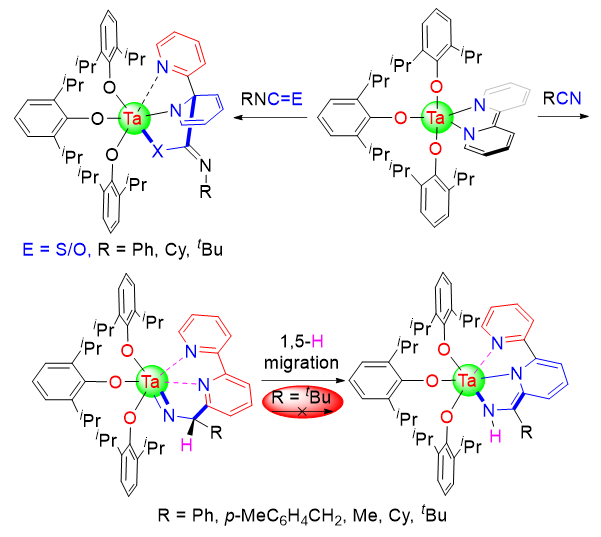
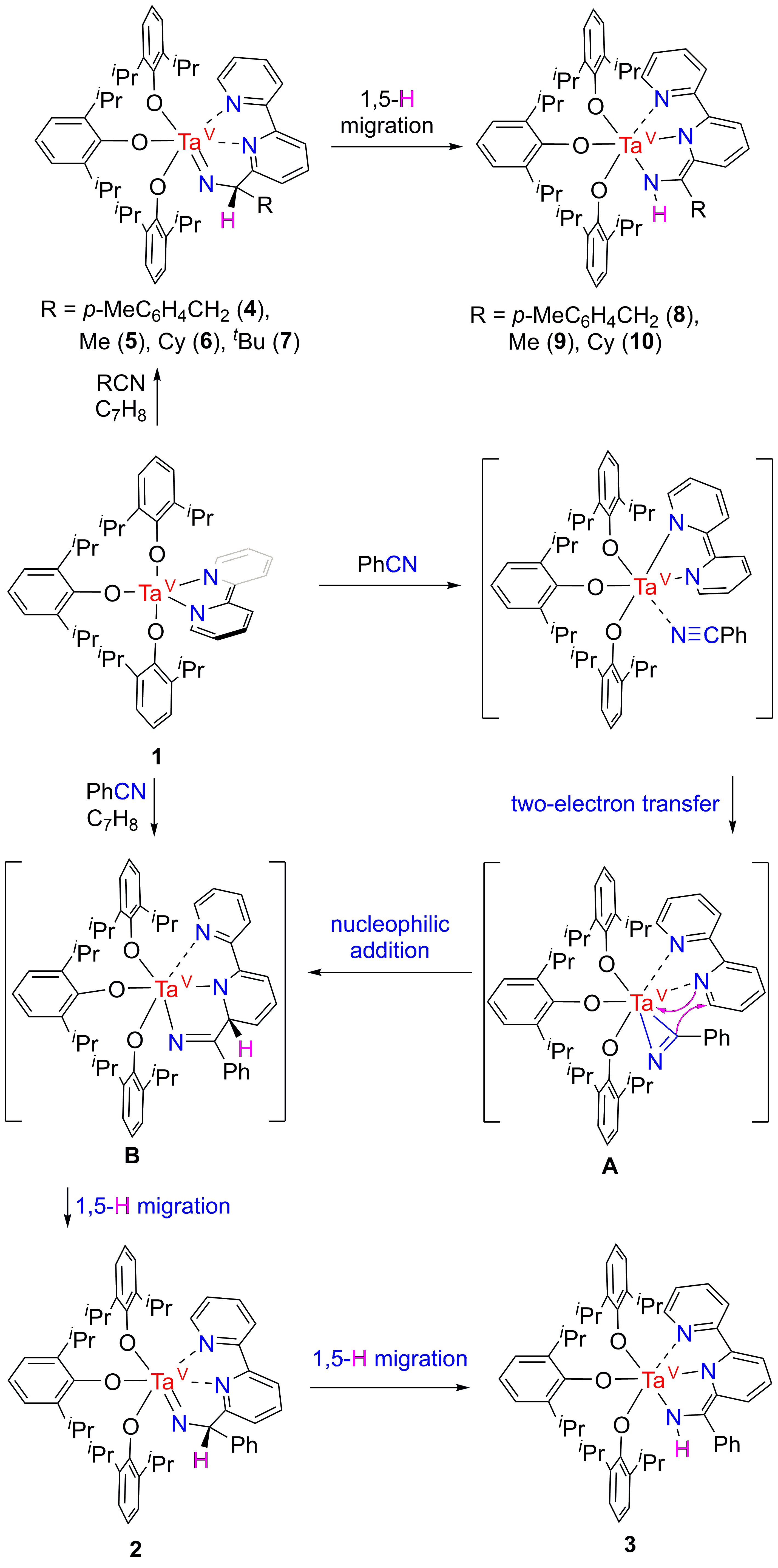
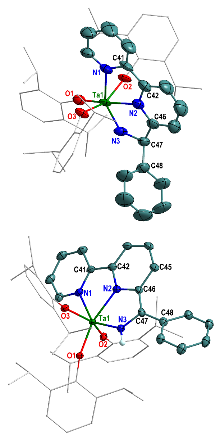
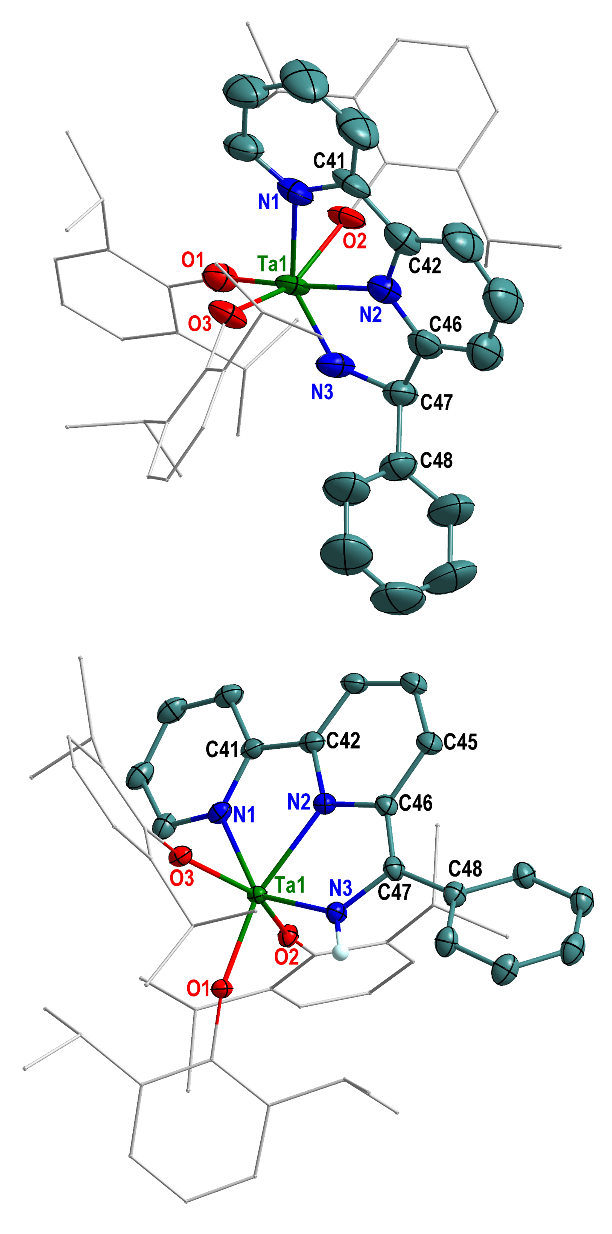
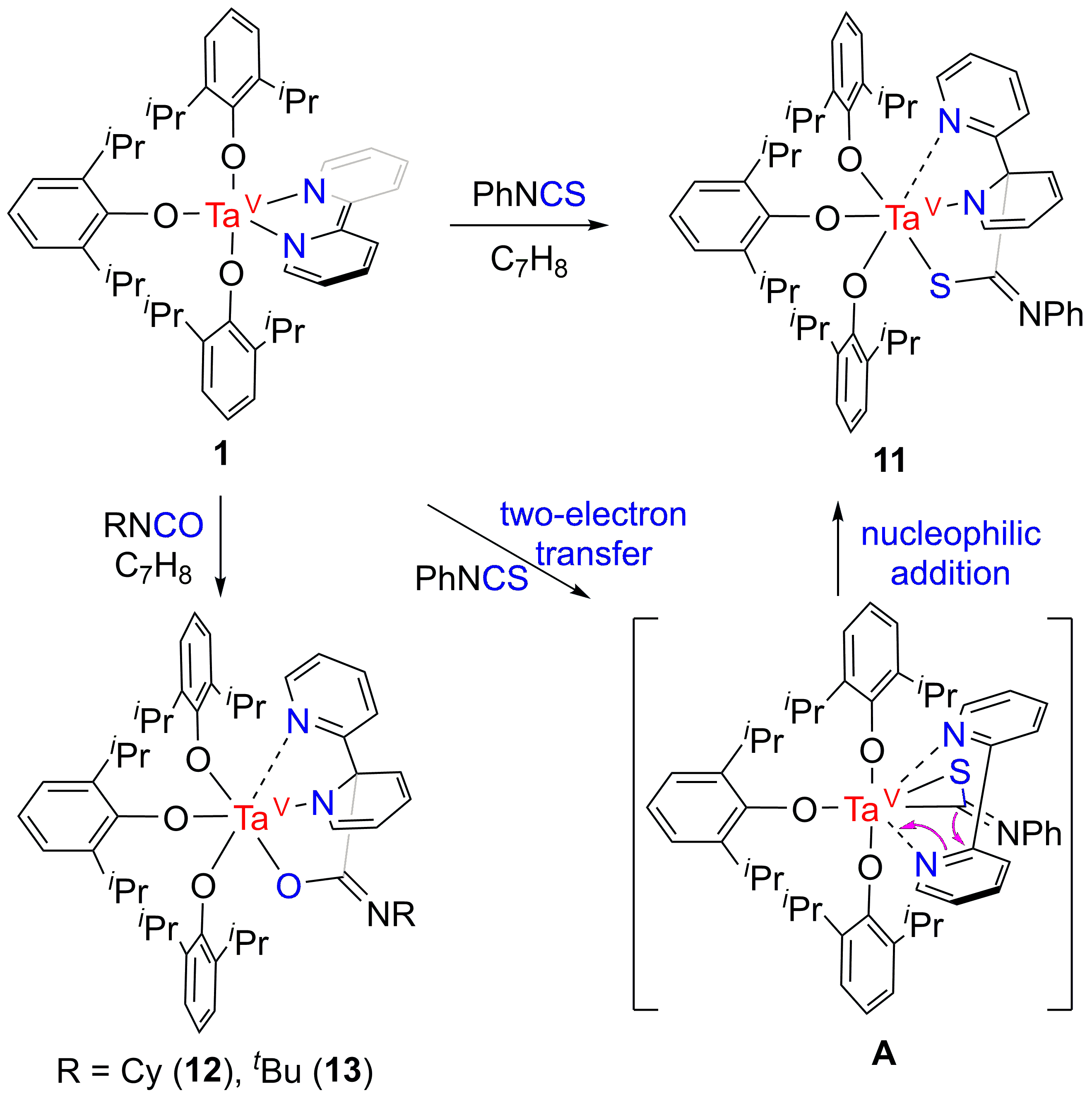
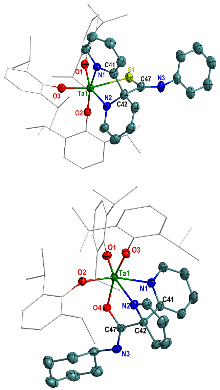
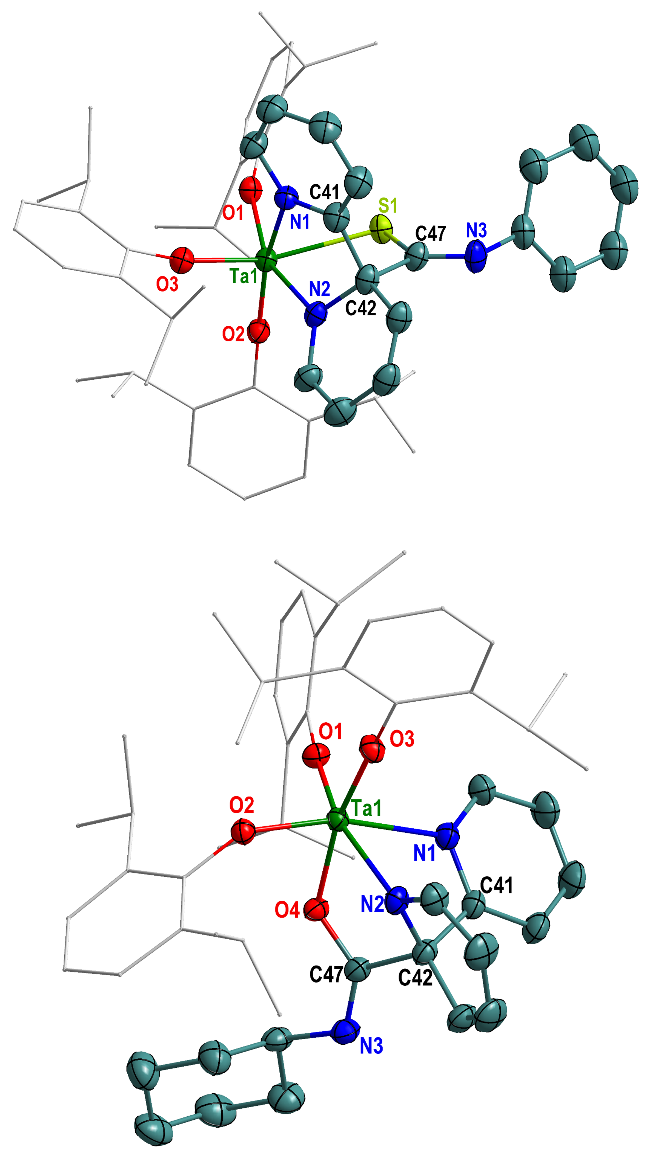
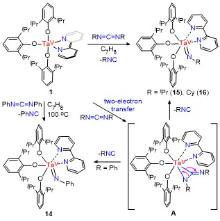
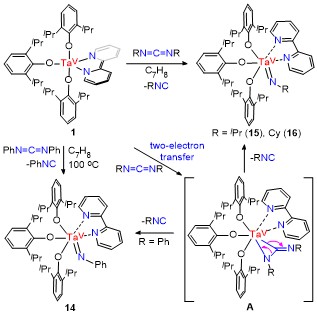
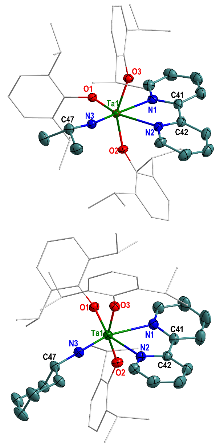
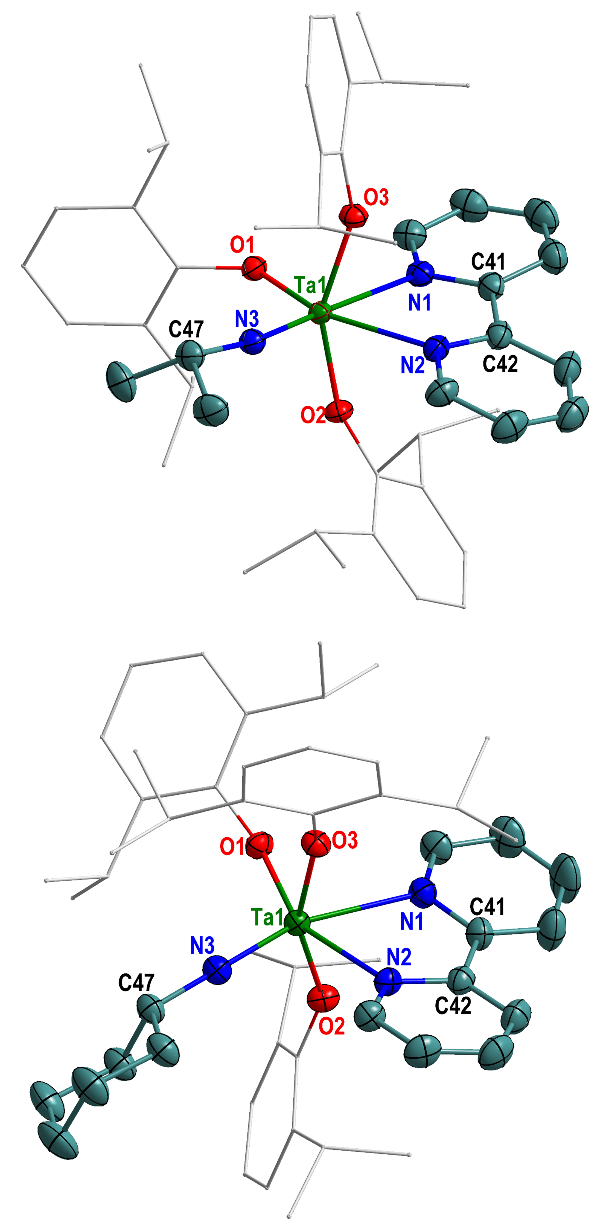
钽联吡啶化合物(2,6-iPr2C6H3O)3Ta(bipy) (1)对有机不饱和小分子表现出了丰富的反应性. 例如, PhCN中的C≡N三键可以被化合物1还原, 进而选择性地与联吡啶基团的C6/C6'发生C—C偶联并进一步发生1,5-氢迁移, 生成钽亚胺化合物(2,6-iPr2C6H3O)3Ta(=NCHPh)(C10H7N2) (2); 2可继续通过1,5-氢迁移生成二氮杂钽杂环戊烯化合物(2,6-iPr2C6H3O)3Ta(N2C10H7C(Ph)NH) (3). 同样, p-MeC6H4CH2CN、MeCN、CyCN和tBuCN均可与1发生类似的反应, 生成化合物(2,6-iPr2C6H3O)3Ta(=NCH(R))(C10H7N2) (R=p-MeC6H4CH2 (4), Me (5), Cy (6), tBu (7)); 除7之外, 化合物4~6可进一步转化为1,5-氢迁移产物(2,6-iPr2C6H3O)3Ta(N2C10H7C(R)NH) (R=p-MeC6H4CH2 (8), Me (9), Cy (10)). 另外, 异(硫)氰酸酯可以选择性地与化合物1中联吡啶基团的C2/C2'发生C—C偶联, 生成插入产物(2,6-iPr2C6H3O)3- Ta(bipy)(PhNCS) (11), (2,6-iPr2C6H3O)3Ta(bipy)(CyNCO) (12)和(2,6-iPr2C6H3O)3Ta(bipy)(tBuNCO) (13); 化合物1还可作为Ta(III)合成子与碳二亚胺发生双电子转移反应, 生成中性联吡啶配位的钽亚胺化合物(2,6-iPr2C6H3O)3Ta(=NPh)- (bipy0) (R=Ph (14), iPr (15), Cy (16)).
张磊, 张萍, 张艳峰. 钽联吡啶化合物与腈、异(硫)氰酸酯和碳二亚胺的反应性研究[J]. 化学学报, 2026, 84(10): 1641-1648.
Lei Zhang, Ping Zhang, Yanfeng Zhang. Reactivity of a Bipyridyl Tantalum Complex toward Nitriles, Iso(thio)cyanates and Carbodiimides[J]. Acta Chimica Sinica, 2026, 84(10): 1641-1648.
| [1] |
(a)
|
|
(b)
|
|
| [2] |
(a)
|
|
(b)
|
|
|
(c)
|
|
| [3] |
(a)
|
|
(b)
|
|
|
(c)
|
|
| [4] |
(a)
|
|
(b)
|
|
|
(c)
|
|
| [5] |
(a)
|
|
(b)
|
|
| [6] |
(a)
|
|
(b)
|
|
|
(c)
|
|
| [7] |
(a)
|
|
(b)
|
|
|
(c)
|
|
|
(d)
|
|
|
(e)
|
|
|
(f)
|
|
| [8] |
(a)
|
|
(b)
|
|
| [9] |
(a)
|
|
(b)
|
|
|
(c)
|
|
|
(d)
|
|
|
(e)
|
|
| [10] |
(a)
|
|
(b)
|
|
|
(c)
|
|
|
(d)
|
|
|
(e)
|
|
|
(f)
|
|
|
(g)
|
|
|
(h)
|
|
|
(i)
|
|
|
(j)
|
|
| [11] |
(a)
|
|
(b)
|
|
|
(c)
|
|
|
(d)
|
|
|
(e)
|
|
|
(f)
|
|
|
(g)
|
|
|
(h)
|
|
|
(i)
|
|
|
(j)
|
|
|
(k)
|
|
|
(l)
|
|
|
(衡义, 曹小英, 豆允灿, 王东伟, 杨丕堃, 自国甫, 有机化学, 2026, 46, 2249.)
|
|
| [12] |
(a)
|
|
(b)
|
|
|
(c)
|
|
|
(d)
|
|
|
(e)
|
|
|
(f)
|
|
|
(g)
|
|
|
(h)
|
|
|
(i)
|
|
|
(j)
|
|
|
(曹小英, 衡义, 王东伟, 杨丕堃, 侯国华, 自国甫, 有机化学, 2026, 46, 1939.)
|
|
| [13] |
(a)
|
|
(b)
|
|
|
(c)
|
|
| [14] |
|
| [15] |
|
| [16] |
(a)
|
|
(b)
|
|
|
(c)
|
|
| [17] |
(a)
|
|
(b)
|
|
| [18] |
|
| [19] |
|
| [20] |
(a)
|
|
(b)
|
|
| [21] |
|
| [22] |
|
| [23] |
|
| [24] |
(a)
|
|
(b)
|
|
|
(c)
|
|
| [25] |
|
| [26] |
|
| [1] | 徐乔良, 安光辉, 李光明. 钴催化环己烯酮脱氢胺化策略合成苯胺[J]. 化学学报, 2026, 84(9): 1428-1434. |
| [2] | 高皓炜, 杨惜晖, 闫甲乐, 曾超, 史雷. 环状二酰基过氧化物: 活性中间体的可控生成与合成应用★[J]. 化学学报, 2026, 84(9): 1507-1524. |
| [3] | 黄国玲, 黄政豪, 孙嘉琦, 赵智博, 李鹏妍, 潘雅雯, 卢训博. 碘盐/过氧化物促进次磺酰胺自由基氧化活化实现硫亚胺酰胺和硫亚胺酯的N/O分流合成[J]. 化学学报, 2026, 84(8): 1318-1325. |
| [4] | 李铁鹏, 何海兵, 杨鲍潮, 高栓虎. Coniochaetone类天然产物的克级规模合成★[J]. 化学学报, 2026, 84(8): 1265-1271. |
| [5] | 宋福嘉, 苏平如, 唐瑜. 稀土配合物功能材料: 从分子设计和性能调控到前沿应用★[J]. 化学学报, 2026, 84(8): 1326-1342. |
| [6] | 戈楠, 鲁统部. 双原子催化剂的创制与协同机理★[J]. 化学学报, 2026, 84(8): 1376-1394. |
| [7] | 张颖敏, 仝欣欣, 陈玉凤, 李建彤, 王鑫, 吴兆申, 刘俊豪, 刘健, 杨升宏. 室温构筑水稳定钙钛矿量子点用于六价铬检测与发光二极管[J]. 化学学报, 2026, 84(7): 1049-1056. |
| [8] | 苏芳谊, 张焱, 宁澄清, 徐晶. 红花菜豆酸的生物活性与合成进展[J]. 化学学报, 2026, 84(7): 1165-1174. |
| [9] | 房长波, 许孜, 朱舒芽, 孟铭, 张彬, 齐昀坤, 杜姗姗. 固相“一步法”合成基于肿瘤靶向肽/细胞穿透肽和SN38的多肽-药物偶联物(PDCs)[J]. 化学学报, 2026, 84(6): 916-932. |
| [10] | 张华轩, 刘月, 苏绪娟, 谢新刚, 厍学功. Mizoroki-Heck反应在天然产物全合成中的应用进展★[J]. 化学学报, 2026, 84(6): 933-968. |
| [11] | 陈慧滢, 黄宁宇, 廖培钦. 基于银−碳键的新型金属有机框架用于高效光催化合成过氧化氢★[J]. 化学学报, 2026, 84(5): 626-630. |
| [12] | 王炙韬, 林雨珂, 万妍, 黄鑫伟, 李云斌, 吉定豪, 项生昌, 张章静. 快速、绿色机械化学合成UTSA-16(Zn)用于高效碳捕获★[J]. 化学学报, 2026, 84(5): 631-637. |
| [13] | 李颖果, 岳小艺, 付萌萌, 于超, 巩伟. 锆基金属-有机框架的合成后配体插入工程研究进展★[J]. 化学学报, 2026, 84(5): 709-722. |
| [14] | 何乾龙, 胡洁颖, 钟礼匡, 何军. 基于金属有机框架的中性介质硝酸盐电催化还原制氨: 设计策略与机理研究★[J]. 化学学报, 2026, 84(5): 775-804. |
| [15] | 孙天凯, 韩宗甦, 程鹏, 师唯. 手性金属-有机框架的合成与性质研究进展★[J]. 化学学报, 2026, 84(5): 723-735. |
| 阅读次数 | ||||||
|
全文 |
|
|||||
|
摘要 |
|
|||||
