有机化学 ›› 2025, Vol. 45 ›› Issue (10): 3672-3690.DOI: 10.6023/cjoc202412026 上一篇 下一篇
综述与进展
诸雨楠a, 矫伟康a, 韦雪白a, 陈春华a,*( ), 莫冬亮b,*()
收稿日期:2024-12-25
修回日期:2025-03-28
发布日期:2025-04-16
基金资助:
Yu'nan Zhua, Weikang Jiaoa, Xuebai Weia, Chunhua Chena,*(), Dongliang Mob,*()
Received:2024-12-25
Revised:2025-03-28
Published:2025-04-16
Contact:
Supported by:文章分享

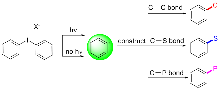
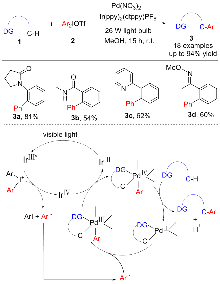
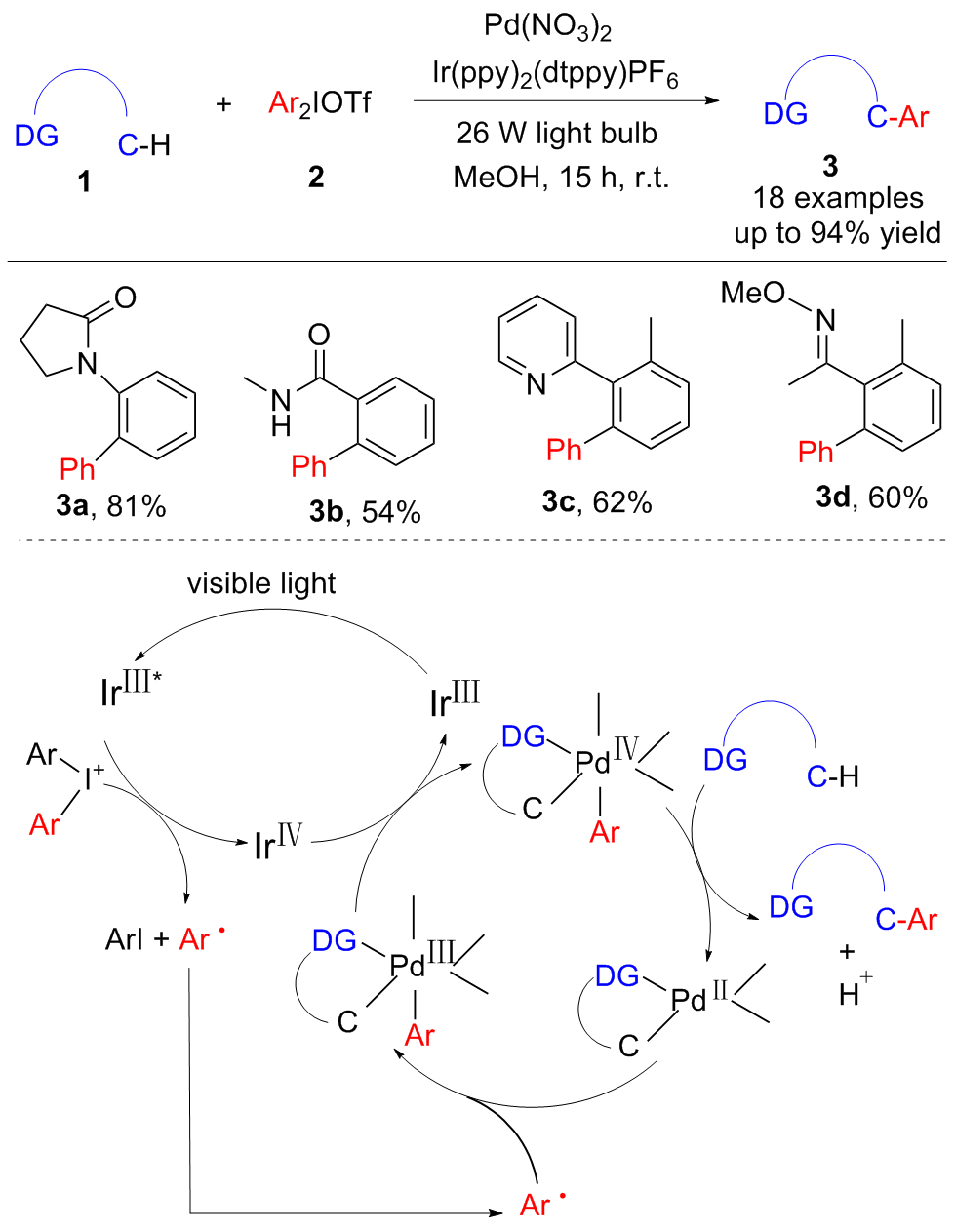
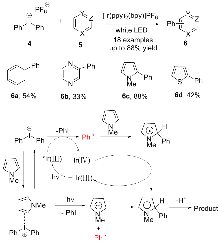
二芳基碘盐作为一类高度亲电的芳基化试剂, 因其具有环境友好、稳定性好及选择性高等优点, 在有机合成化学中得到了广泛应用. 它是一种可以产生芳基自由基来合成芳香族化合物的新型试剂. 综述了近十年来二芳基碘盐通过芳基自由基过程构建碳-碳键和碳-杂键等新键的研究进展, 内容主要分为可见光诱导和无光照催化两部分, 并讨论了它们在合成具有生物活性的芳基化合物中的应用.
诸雨楠, 矫伟康, 韦雪白, 陈春华, 莫冬亮. 二芳基碘盐参与的自由基芳基化反应研究进展[J]. 有机化学, 2025, 45(10): 3672-3690.
Yu'nan Zhu, Weikang Jiao, Xuebai Wei, Chunhua Chen, Dongliang Mo. Recent Progress in Radical Arylation Reaction Involving Diaryliodonium Salts[J]. Chinese Journal of Organic Chemistry, 2025, 45(10): 3672-3690.








































| [1] |
(a)
pmid: 18986207 |
|
(b)
doi: 10.1021/cr800332c pmid: 18986207 |
|
|
(c)
pmid: 18986207 |
|
|
(d)
pmid: 18986207 |
|
|
(e)
pmid: 18986207 |
|
|
(陈静, 曲红梅, 彭静, 陈超, 有机化学, 2015, 35, 937.)
doi: 10.6023/cjoc201501004 pmid: 18986207 |
|
|
(f)
pmid: 18986207 |
|
|
(g)
pmid: 18986207 |
|
|
(h)
pmid: 18986207 |
|
|
(i)
pmid: 18986207 |
|
| [2] |
(a)
|
|
(b)
|
|
|
(c)
|
|
|
(d)
|
|
|
(e)
|
|
|
(f)
|
|
|
(g)
|
|
| [3] |
(a)
pmid: 28793179 |
|
(b)
doi: 10.1002/chem.201702732 pmid: 28793179 |
|
|
(c)
doi: 10.2174/1385272824999200507124328 pmid: 28793179 |
|
|
(d)
pmid: 28793179 |
|
|
(孙媛媛, 宋敬城, 秦启学, 张恩选, 韩晴晴, 杨少慧, 王祖利, 岳姗, 董道青, 有机化学, 2021, 41, 4651.)
doi: 10.6023/cjoc202106006 pmid: 28793179 |
|
| [4] |
(a)
doi: 10.1039/b913880n pmid: 20532341 |
|
(b)
pmid: 20532341 |
|
|
(c)
pmid: 20532341 |
|
|
(d)
pmid: 20532341 |
|
|
(钟建基, 孟庆元, 陈彬, 佟振合, 吴骊珠, 化学学报, 2017, 75, 34.)
doi: 10.6023/A16090491 pmid: 20532341 |
|
|
(e)
pmid: 20532341 |
|
|
(李祯龙, 金健, 黄莎华, 有机化学, 2020, 40, 563.)
doi: 10.6023/cjoc201910031 pmid: 20532341 |
|
|
(f)
pmid: 20532341 |
|
|
(孔瑶蕾, 徐雯秀, 叶飞霞, 翁建全, 有机化学, 2019, 39, 3065.)
doi: 10.6023/cjoc201905016 pmid: 20532341 |
|
|
(g)
pmid: 20532341 |
|
|
(关保川, 许孝良, 王红, 李小年, 有机化学, 2016, 36, 1564.)
doi: 10.6023/cjoc201601012 pmid: 20532341 |
|
|
(h)
pmid: 20532341 |
|
|
(i)
pmid: 20532341 |
|
|
(j)
pmid: 20532341 |
|
| [5] |
(a)
|
|
(b)
|
|
|
(c)
doi: 10.1016/S1872-2067(21)63831-7 |
|
|
(d)
|
|
|
(董道青, 孙媛媛, 李光辉, 杨欢, 王祖利, 徐鑫明, 有机化学, 2020, 40, 4071.)
doi: 10.6023/cjoc202004047 |
|
|
(e)
|
|
|
(陈德茂, 孙媛媛, 董道青, 韩晴晴, 王祖利, 有机化学, 2020, 40, 4267.)
doi: 10.6023/cjoc202006025 |
|
|
(f)
|
|
| [6] |
pmid: 23950736 |
| [7] |
|
| [8] |
doi: 10.1021/ol401940c pmid: 23927030 |
| [9] |
|
| [10] |
|
| [11] |
|
| [12] |
|
| [13] |
|
| [14] |
|
| [15] |
|
| [16] |
|
| [17] |
doi: 10.1021/acs.joc.2c01234 pmid: 35925769 |
| [18] |
|
| [19] |
|
| [20] |
|
| [21] |
|
| [22] |
|
| [23] |
|
| [24] |
|
| [25] |
|
| [26] |
|
| [27] |
|
| [28] |
|
| [29] |
|
| [30] |
|
| [31] |
|
| [32] |
|
| [33] |
|
| [34] |
|
| [35] |
|
| [36] |
|
| [37] |
|
| [38] |
doi: 10.1002/chem.201902955 pmid: 31339601 |
| [39] |
|
| [40] |
doi: 10.1002/chem.201504852 pmid: 26834017 |
| [41] |
doi: 10.1021/acs.orglett.5b03706 pmid: 26859791 |
| [42] |
|
| [43] |
|
| [44] |
|
| [45] |
|
| [46] |
|
| [1] | 祝辉, 吴鹏, 钟晨鸣, 李舒铭, 林钢, 刘雪粉, 罗书平. 供体-受体-供体(D-A-D)型芳香酮设计合成与光催化C(sp3)—H偶联反应性能研究[J]. 有机化学, 2025, 45(9): 3441-3449. |
| [2] | 陈晓培, 王清龙, 侯学会, 王川川, 马志伟, 张京玉. CF3-亚胺酰基亚砜叶立德在环化反应中的应用研究进展[J]. 有机化学, 2025, 45(8): 2796-2814. |
| [3] | 解人杰, 谢复开, 孙然, 王欣, 王钰佳, 李蕾, 王贺. 电子供体-受体复合物(EDA)介导N-芳基丙烯酰胺与芳基硫鎓盐的自由基环化反应[J]. 有机化学, 2025, 45(8): 2913-2922. |
| [4] | 史茜, 李忠玉, 李晗. 杂环金属铱配合物光敏剂的研究进展[J]. 有机化学, 2025, 45(7): 2389-2405. |
| [5] | 高根伟, 李震, 李炎, 陆熹. 光/镍协同催化C(sp2)—C(sp3)键构建研究进展[J]. 有机化学, 2025, 45(6): 1905-1919. |
| [6] | 谭永波, 舒洪波, 黄华文. 光诱导N-芳基丙烯酰胺参与的吲哚酮合成研究进展[J]. 有机化学, 2025, 45(6): 2086-2108. |
| [7] | 蒋晨阳, 尹艳丽, 江智勇. 光酶催化不对称自由基加成反应研究进展[J]. 有机化学, 2025, 45(5): 1614-1633. |
| [8] | 吴昊岩, 赫明月, 马军安, 张发光. 三芳胺在光催化反应中的研究进展[J]. 有机化学, 2025, 45(5): 1634-1643. |
| [9] | 吴利华, 杨建静, 闫克鲁, 许丽荣, 文江伟. 单原子光催化有机合成研究进展[J]. 有机化学, 2025, 45(5): 1591-1613. |
| [10] | 李顺曦, 游力栩, 李玉龙, 舒伟. 光介导氨及其等价体参与的碳氮成键反应研究进展[J]. 有机化学, 2025, 45(5): 1460-1477. |
| [11] | 谭燕, 应佳乐, 於兵, 陆展. 可见光促进烯基硅化合物有氧氧化-叠氮化反应[J]. 有机化学, 2025, 45(5): 1684-1690. |
| [12] | 林风, 张艳, 吴明, 刘会艳, 郝文娟, 姜波. 利用可见光引发1,6-烯炔的增环酰化双官能化制备1-茚酮衍生物[J]. 有机化学, 2025, 45(5): 1729-1738. |
| [13] | 洪洋, 邓红平. 可见光催化的酸性C(sp3)—H键官能团化反应研究进展[J]. 有机化学, 2025, 45(5): 1569-1590. |
| [14] | 牛丽菁, 吴成娟, 梁文静, 耿琰, 董育斌. 光催化串联反应构建共价有机框架[J]. 有机化学, 2025, 45(5): 1707-1715. |
| [15] | 郭仕勋, 王卫, 张永强. 三线态能量转移促进的自由基链式烯烃氢芳基化反应研究[J]. 有机化学, 2025, 45(5): 1716-1728. |
| 阅读次数 | ||||||
|
全文 |
|
|||||
|
摘要 |
|
|||||