有机化学 ›› 2026, Vol. 46 ›› Issue (4): 1330-1359.DOI: 10.6023/cjoc202512029 上一篇 下一篇
综述与进展
刘水林a, 陈镤a,*( ), 贺晶a, 刘宁a,*(), 黄华文b,c,*()
收稿日期:2025-12-29
修回日期:2026-01-26
发布日期:2026-03-20
通讯作者:
陈镤, 刘宁, 黄华文
基金资助:
Shuilin Liua, Pu Chena,*(), Jing Hea, Ning Liua,*(), Huawen Huangb,c,*()
Received:2025-12-29
Revised:2026-01-26
Published:2026-03-20
Contact:
Pu Chen, Ning Liu, Huawen Huang
Supported by:文章分享
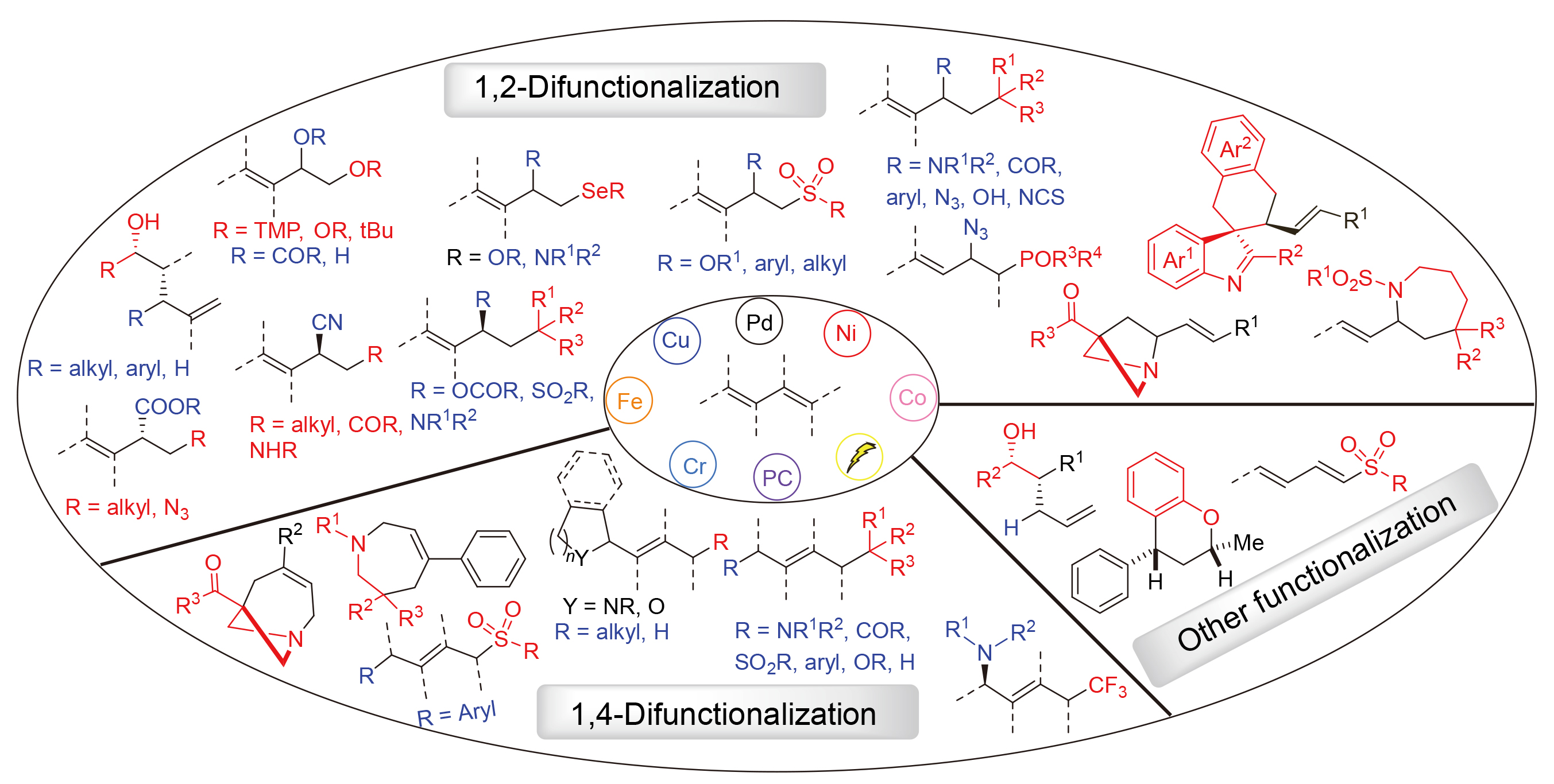
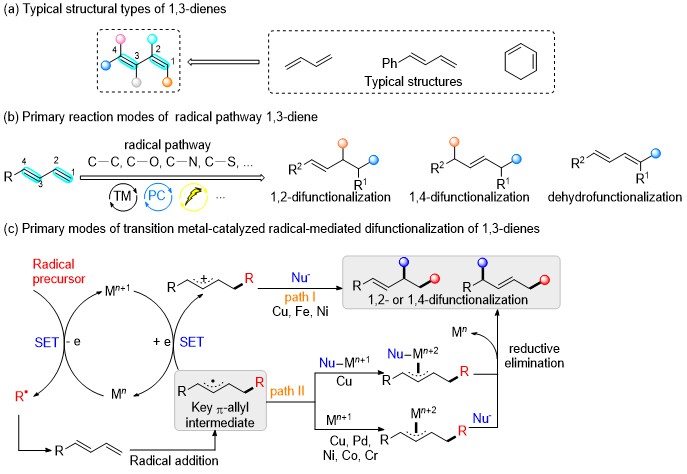
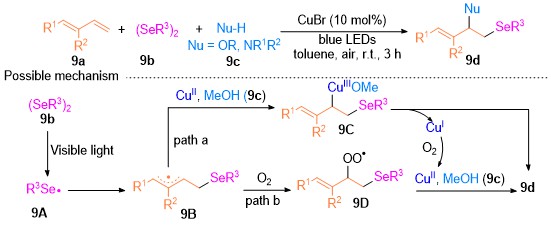
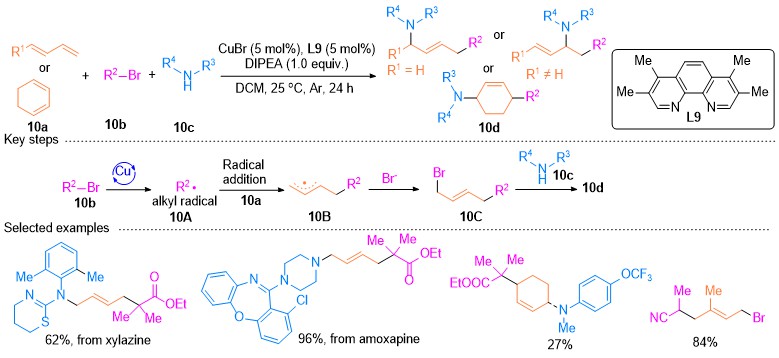
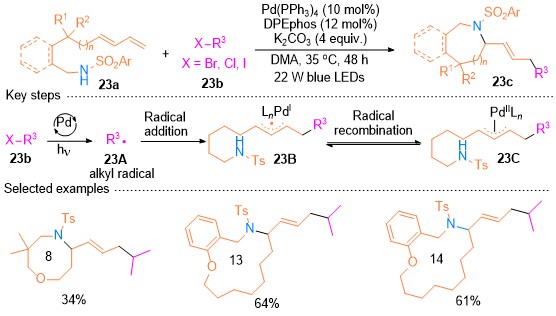
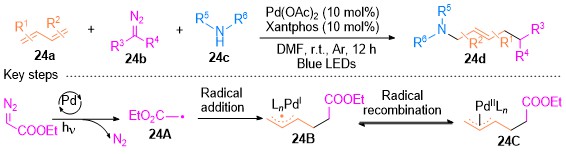
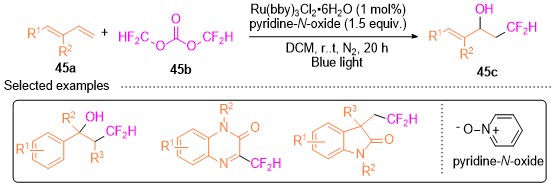
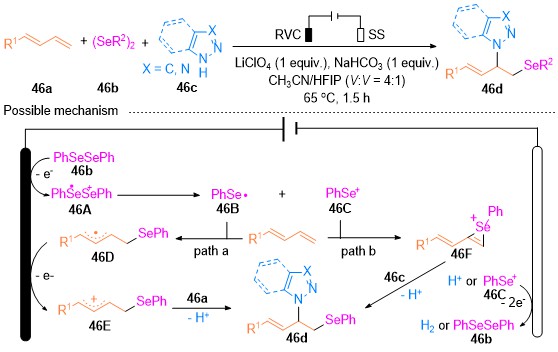
近年来, 自由基化学的蓬勃发展与过渡金属催化策略的深度融合, 为有机合成提供了高效构筑复杂分子的新范式. 与传统离子型反应相比, 自由基反应具有条件温和、官能团兼容性好以及能够快速构建复杂分子等独特优势, 因而受到合成化学家的持续关注. 1,3-二烯作为一类来源广泛、结构丰富的基础化工原料, 广泛存在于天然产物及功能分子骨架中, 其选择性双官能团化一直是有机合成的重要挑战与研究热点. 借助自由基途径, 特别是结合过渡金属催化的协同作用, 不仅能够突破传统极性反应的局限, 拓展新颖的化学空间, 还可实现一锅法高效引入两个不同官能团, 精准构建高附加值的烯丙基类化合物. 系统总结了近三年来的研究进展, 重点聚焦于不同过渡金属催化、自由基前体开发、反应机制演变以及代表性催化体系构建, 并结合典型实例深入探讨其合成应用与前景, 旨在为该领域的持续创新提供理论参考与方法启示.
刘水林, 陈镤, 贺晶, 刘宁, 黄华文. 过渡金属催化自由基介导1,3-二烯的选择性双官能团化研究进展[J]. 有机化学, 2026, 46(4): 1330-1359.
Shuilin Liu, Pu Chen, Jing He, Ning Liu, Huawen Huang. Recent Advances in Transition Metal-Catalyzed Radical-Mediated Selective Difunctionalization of 1,3-Dienes[J]. Chinese Journal of Organic Chemistry, 2026, 46(4): 1330-1359.
| [26] |
|
| [27] |
|
|
(徐毅栲, 王泽树, 何卫民, 叶龙武, 有机化学, 2024, 44, 2049.)
|
|
| [28] |
|
| [29] |
|
| [30] |
|
| [31] |
|
| [32] |
|
| [33] |
|
| [34] |
|
| [35] |
|
| [36] |
|
| [37] |
|
| [38] |
|
| [39] |
|
| [40] |
|
| [41] |
|
| [42] |
|
| [43] |
|
| [44] |
|
| [45] |
|
| [1] |
|
| [2] |
|
| [3] |
|
| [4] |
|
| [5] |
|
| [6] |
|
|
(吴洋, 夏纪宝, 有机化学, 2024, 44, 1377.)
|
|
| [7] |
|
| [46] |
|
| [47] |
|
| [48] |
|
| [49] |
|
| [50] |
|
| [8] |
|
| [9] |
|
| [10] |
|
| [11] |
|
| [12] |
|
| [13] |
|
| [14] |
|
| [51] |
|
| [52] |
|
| [53] |
|
| [54] |
|
| [55] |
|
| [56] |
|
| [57] |
|
| [58] |
|
| [59] |
|
| [60] |
|
| [61] |
|
| [62] |
|
| [63] |
|
| [64] |
|
| [65] |
|
| [66] |
|
| [67] |
|
| [68] |
|
| [69] |
|
| [70] |
|
| [71] |
|
| [72] |
|
| [73] |
|
| [74] |
|
| [75] |
|
| [76] |
|
| [77] |
|
| [78] |
|
| [79] |
|
| [80] |
|
| [81] |
|
| [82] |
|
| [83] |
|
| [84] |
|
| [85] |
|
| [86] |
|
| [87] |
|
| [88] |
|
| [89] |
|
| [90] |
|
| [91] |
|
| [92] |
|
| [93] |
|
| [94] |
|
| [95] |
|
| [96] |
|
| [15] |
|
| [16] |
|
| [17] |
|
| [18] |
|
| [19] |
|
|
(王斌, 韩万仓, 代林林, 张永红, 夏昱, 金伟伟, 刘晨江, 有机化学, 2024, 44, 1998.)
|
|
| [20] |
|
|
(蒋译锋, 尹艳丽, 江智勇, 有机化学, 2024, 44, 1733.)
|
|
| [21] |
|
|
(刘新宇, 汪顺义, 有机化学, 2024, 44, 1382.)
|
|
| [22] |
|
| [23] |
|
| [24] |
|
| [25] |
|
| [1] | 侯馨怡, 史同同, 李泽江, 董庆昊, 孙凯, 王薪. 可见光诱导的磷酰化环化合成磷酰基取代的吲哚并二氮䓬[J]. 有机化学, 2026, 46(4): 1776-1787. |
| [2] | 邹震雷, 李益凡, 陈晨, 陈王哲, 张为钢, 王毅. 关于亚磺酰基砌块法合成亚砜的研究进展[J]. 有机化学, 2026, 46(4): 1635-1658. |
| [3] | 王齐翔, 陈圣希, 王静, 陈栋, 鲍晓光, 吴新鑫. 无金属参与的多烯选择性氯代反应[J]. 有机化学, 2026, 46(4): 1750-1762. |
| [4] | 郑婧斐, 吕琪妍, 孙凯, 陈晓岚, 屈凌波, 王金泉, 於兵. 自由基介导的6-氮杂尿嘧啶官能团化研究进展[J]. 有机化学, 2026, 46(4): 1603-1620. |
| [5] | 刘世峥, 窦明煜, 崔玉, 窦建民, 魏文廷. 自由基硒磺酰化研究进展[J]. 有机化学, 2026, 46(4): 1621-1634. |
| [6] | 赵雨晴, 朱先进, 石凌宇, 魏鸣宇, 徐紫涵, 石永佳, 李旭锋, 杨道山. 环硫鎓盐开环官能化反应的研究进展[J]. 有机化学, 2026, 46(4): 1572-1602. |
| [7] | 杨珊, 陈亚苏, 朱晨. 自由基介导的官能团迁移-环化构建含氮稠杂芳烃[J]. 有机化学, 2026, 46(4): 1739-1749. |
| [8] | 陈嘉豪, 占贝贝, 张夏衡. 自由基介导的1,n-氮迁移反应研究进展[J]. 有机化学, 2026, 46(4): 1560-1571. |
| [9] | 叶富, 袁伟明. 光氧化还原催化炔烃的双碳官能团化反应进展[J]. 有机化学, 2026, 46(4): 1146-1165. |
| [10] | 卢琳玉, 亓雨彤, 张庭珲, 金胜男, 曹中艳, 张洪伟. 自由基介导烯烃的1,2,n-三官能团化反应研究进展[J]. 有机化学, 2026, 46(4): 1540-1559. |
| [11] | 唐玉青, 杨紫娴, 杨兵, 王毅, 杜炳南. 球磨条件下机械力驱动的自由基反应研究进展[J]. 有机化学, 2026, 46(4): 1111-1145. |
| [12] | 董建洋, 薛东. 自由基途径的[1.1.1]螺桨烷官能化研究进展[J]. 有机化学, 2026, 46(4): 1464-1480. |
| [13] | 缪宇辰, 杞航, 黄焕明. 可见光/铬协同催化的对映选择性转化反应研究进展[J]. 有机化学, 2026, 46(4): 1481-1495. |
| [14] | 王小曼, 王泽, 吴劼, 胡燚, 叶盛青. 水相中的自由基反应研究进展[J]. 有机化学, 2026, 46(4): 1496-1512. |
| [15] | 李明强, 周磊. Dowd-Beckwith反应: 从卤原子转移到现代引发策略[J]. 有机化学, 2026, 46(4): 1428-1439. |
| 阅读次数 | ||||||
|
全文 |
|
|||||
|
摘要 |
|
|||||


