有机化学 ›› 2026, Vol. 46 ›› Issue (4): 1166-1180.DOI: 10.6023/cjoc202511015 上一篇 下一篇
综述与进展
张皓然a,b, 贾均松a, 俞琼b, 吴宇a, 李玉龙a,*( ), 舒伟b,*()
收稿日期:2025-11-24
修回日期:2026-01-02
发布日期:2026-02-06
通讯作者:
李玉龙, 舒伟
基金资助:
Haoran Zhanga,b, Junsong Jiaa, Qiong Yub, Yu Wua, Yulong Lia,*(), Wei Shub,*()
Received:2025-11-24
Revised:2026-01-02
Published:2026-02-06
Contact:
Yulong Li, Wei Shu
Supported by:文章分享
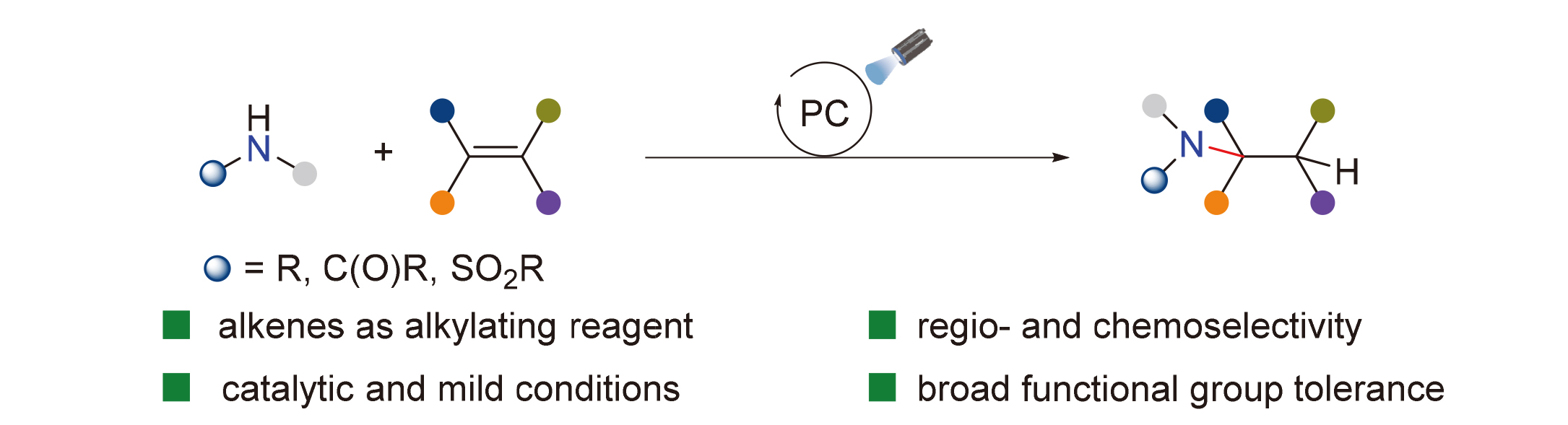
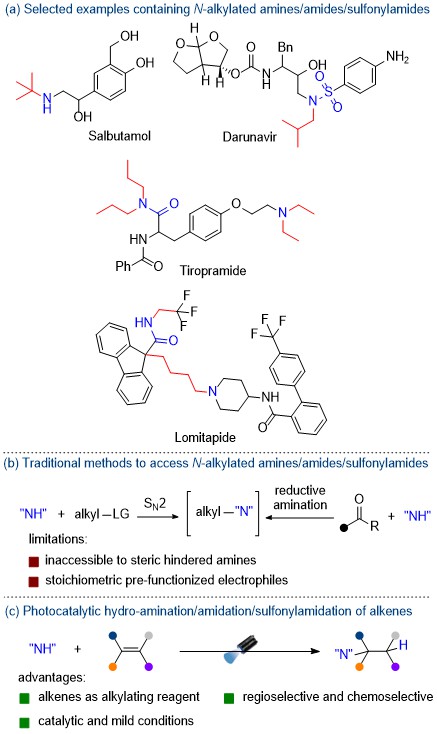
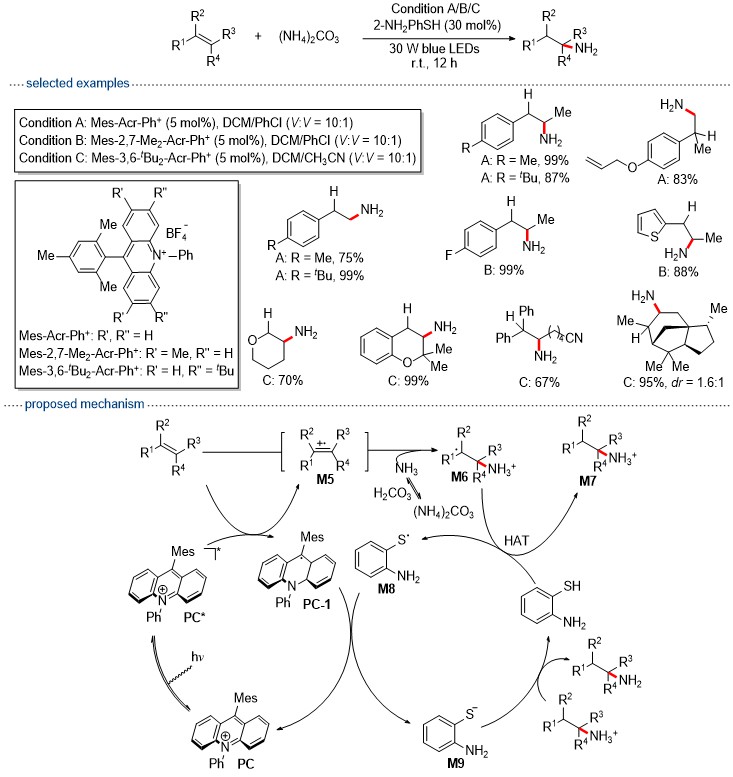
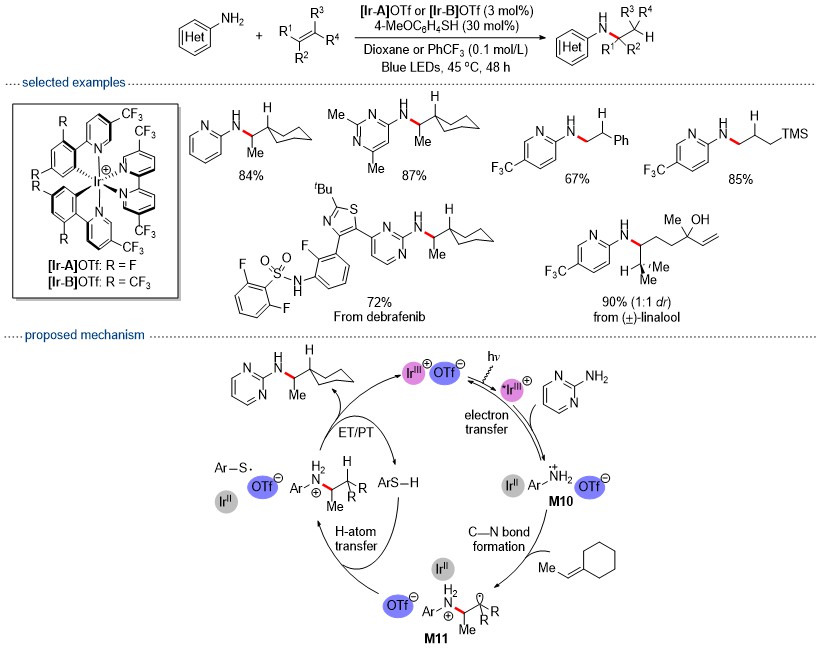
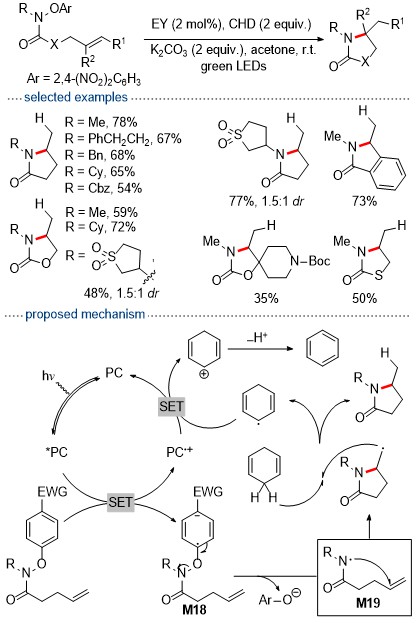
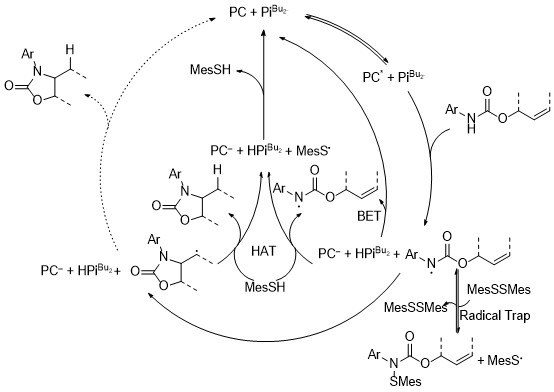
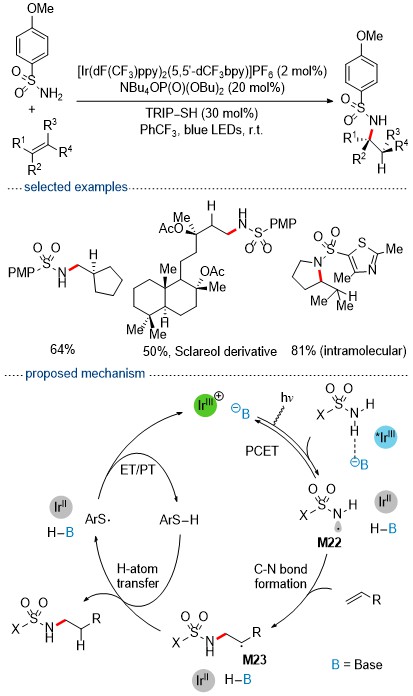
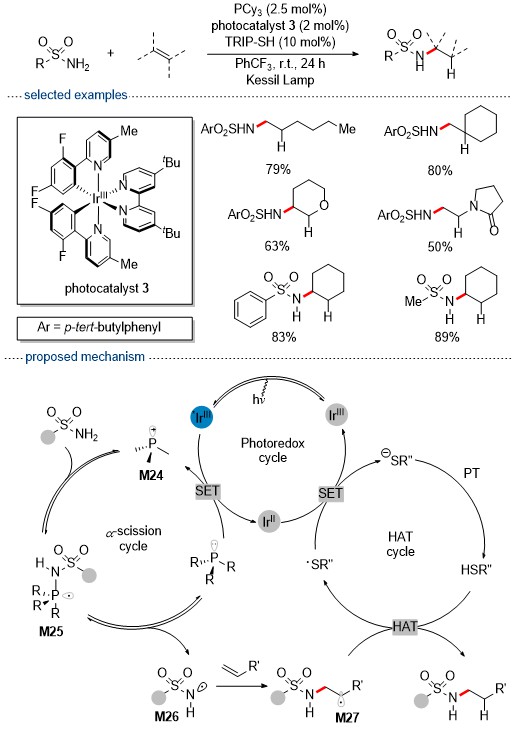
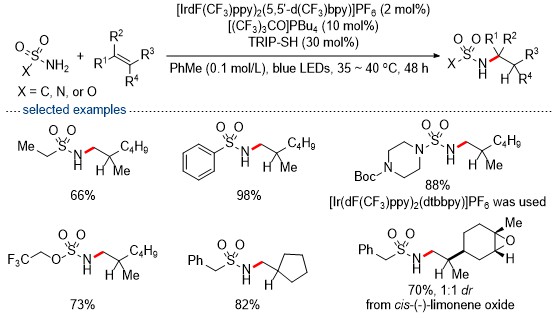
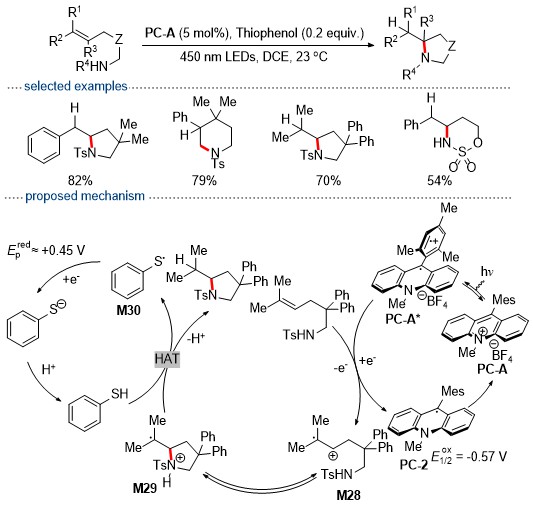
N-烷基胺、酰胺与磺酰胺作为重要的含氮结构单元, 广泛存在于药物分子、农用化学品以及功能材料中, 其高效、精准合成对分子设计与后期修饰具有重要意义. 在现有合成方法中, C—N键构建是获取此类化合物的关键策略之一, 但传统方法构建策略通常依赖预官能化底物、强氧化/还原或高温反应条件, 容易导致过烷基化、副反应增多、区域与化学选择性控制不佳, 以及对复杂分子骨架的兼容性有限等问题. 近年来, 可见光驱动的烯烃氢胺化/氢酰胺化/氢磺酰胺化反应通过单电子转移、质子耦合电子转移、氢原子转移等多种反应机制, 在温和条件下, 实现了将简单烯烃与多种氮源的直接偶联, 从而高效合成N-烷基胺、酰胺与磺酰胺. 该反应使用烯烃作为烷基化试剂, 表现出优异的步骤经济性和官能团兼容性. 系统综述了可见光催化烯烃氢胺化/氢酰胺化/氢磺酰胺化领域的进展与关键反应路径, 并总结了不同催化体系的选择性调控策略和适用范围, 并对该领域的后续发展进行了展望, 以期为相关合成方法的选择与应用提供理论依据和实践参考.
张皓然, 贾均松, 俞琼, 吴宇, 李玉龙, 舒伟. 可见光催化烯烃的氢胺化和氢(磺)酰胺化反应[J]. 有机化学, 2026, 46(4): 1166-1180.
Haoran Zhang, Junsong Jia, Qiong Yu, Yu Wu, Yulong Li, Wei Shu. Visible-Light-Catalyzed Hydroamination, Hydroamidation and Hydrosulfonamidation of Alkenes[J]. Chinese Journal of Organic Chemistry, 2026, 46(4): 1166-1180.
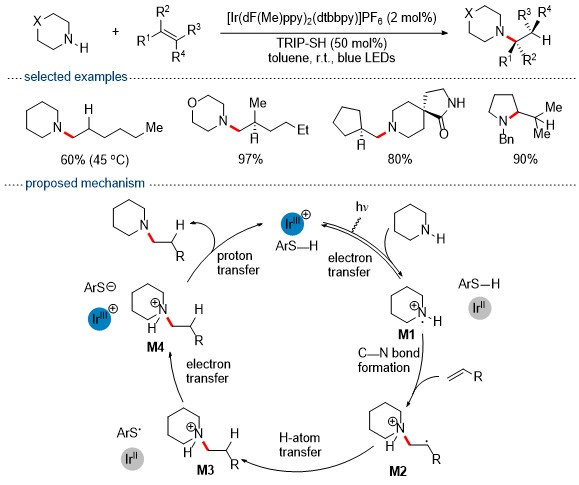
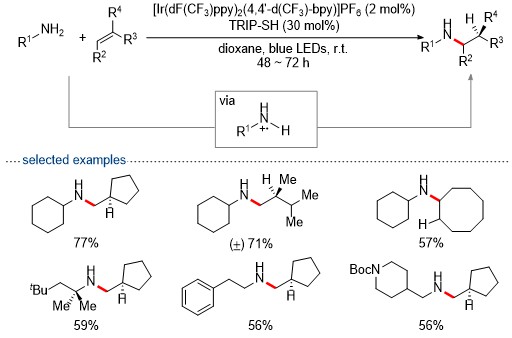
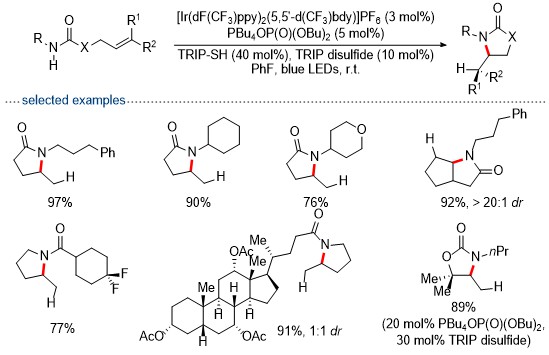
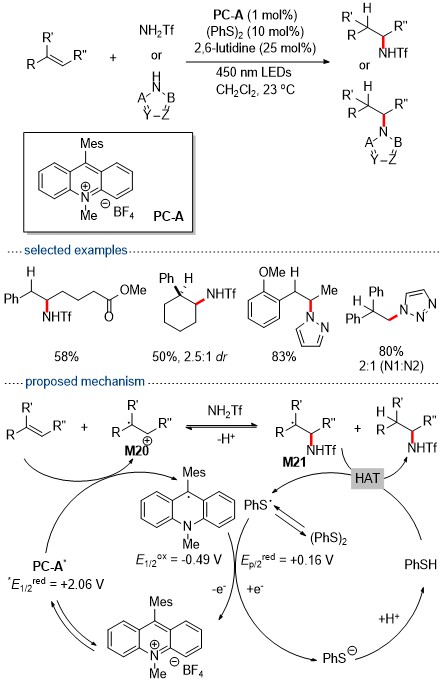
| [1] |
(a)
|
|
(b)
|
|
|
(c)
|
|
|
(d)
|
|
| [2] |
|
| [3] |
|
| [4] |
|
| [5] |
|
| [6] |
|
| [7] |
|
| [8] |
|
| [9] |
|
| [10] |
|
| [11] |
|
| [12] |
(a)
|
|
(b)
|
|
|
(c)
|
|
|
(d)
|
|
| [13] |
|
| [14] |
(a) Batey, R. A. In Boronic Acids, Ed.: Hall, D. G., Wiley-VCH, Weinheim, Germany, 2005, p. 279.
|
|
(b)
|
|
| [15] |
(a)
|
|
(b)
|
|
|
(c)
|
|
| [16] |
|
| [17] |
|
| [18] |
(a)
|
|
(b)
|
|
| [19] |
|
| [20] |
|
| [21] |
|
| [22] |
|
| [23] |
|
| [24] |
|
| [25] |
|
| [26] |
|
| [27] |
|
| [28] |
|
| [29] |
|
| [30] |
|
| [31] |
|
|
(李顺曦, 游力栩, 李玉龙, 舒伟, 有机化学, 2025, 45, 1460.)
|
|
| [32] |
|
| [33] |
|
| [34] |
|
| [35] |
|
| [36] |
|
| [37] |
|
| [38] |
|
| [39] |
|
| [40] |
|
| [41] |
|
| [42] |
|
| [43] |
|
| [44] |
|
| [45] |
|
| [46] |
|
| [47] |
|
| [48] |
|
| [1] | 卢琳玉, 亓雨彤, 张庭珲, 金胜男, 曹中艳, 张洪伟. 自由基介导烯烃的1,2,n-三官能团化反应研究进展[J]. 有机化学, 2026, 46(4): 1540-1559. |
| [2] | 孟令旭, 申霖, 罗祥玲, 林玉妹, 龚磊. 具有光活性的铬、钴配合物的设计及其在有机合成中的应用进展[J]. 有机化学, 2026, 46(4): 1513-1528. |
| [3] | 于琛, 李宁, 薛琦, 李杨, 汪苇航, 李金恒. 自由基介导双C—H键转化的烯烃官能团化反应研究进展[J]. 有机化学, 2026, 46(4): 1440-1463. |
| [4] | 吴少华, 龚帆, 曹柱, 邓清海. 高价碘试剂介导的烯烃自由基氟烷基双官能化研究进展[J]. 有机化学, 2026, 46(4): 1390-1427. |
| [5] | 刘勇, 李娟, 王凌凡, 黄宝彤, 彭凌子, 宋琎, 郭昌. 电化学驱动1,3-二羰基化合物与烯烃的自由基烷基化反应[J]. 有机化学, 2026, 46(4): 1659-1667. |
| [6] | 张斌, 肖文精, 陈加荣. 烯烃自由基阴离子的可控产生与转化[J]. 有机化学, 2026, 46(4): 1181-1204. |
| [7] | 印丘梅, 刘佳乐, 邓世强, 黄嘉明, 蒋洁, 唐裕才. 锰促进活化烯烃与亚磷酸酯串联磷酰化/环化反应合成γ-咔啉酮衍生物[J]. 有机化学, 2026, 46(3): 1078-1086. |
| [8] | 刘猛, 刘涛波, 韩梅兰, 王舒扬, 桂智排措, 徐光利, 韩鸿萍. 过渡金属催化烯烃碳硅化反应研究进展[J]. 有机化学, 2026, 46(3): 840-858. |
| [9] | 柏乐乐, 吴庆荣, 李子娟, 刘兴旺, 邓璐, 沈秋娜, 吴高荣. 钌(II)催化吲哚啉与偕-二氟烯烃的C7—H键单氟烯化反应[J]. 有机化学, 2026, 46(3): 898-906. |
| [10] | 李文静, 沈思语, 梁玲玲, 张雪娇, 苗延青, 尤静. 可见光促进有机染料催化烯烃的氧化裂解反应[J]. 有机化学, 2026, 46(2): 633-640. |
| [11] | 范润东, 陈冰然, 黎富奇, 陈锦秀, 严琼姣, 汪伟, 周慧. 无光敏剂光诱导α-三氟甲基烯烃的氢二氟烷基化反应[J]. 有机化学, 2026, 46(2): 641-652. |
| [12] | 何卫保, 贺梦云, 廖琼, 易荣楠. 亚硝酸钠介导烯烃双官能化合成β-肟基二硫代磷酸酯[J]. 有机化学, 2026, 46(2): 515-522. |
| [13] | 韩天娇, 师迁迁, 符运栋, 梅光建. 三酮烯烃与硝酮的反常区域选择性[3+2]环加成反应研究[J]. 有机化学, 2026, 46(1): 146-155. |
| [14] | 许文, 罗美明, 曾小明. 铬催化三氟甲基烯烃的还原交叉偶联[J]. 有机化学, 2025, 45(9): 3401-3411. |
| [15] | 张斌斌, 刘露娜, 竺杨彬, 邹东. 自由基介导的硝基芳烃活化反应研究进展[J]. 有机化学, 2025, 45(8): 2698-2725. |
| 阅读次数 | ||||||
|
全文 |
|
|||||
|
摘要 |
|
|||||


