有机化学 ›› 2026, Vol. 46 ›› Issue (5): 2104-2111.DOI: 10.6023/cjoc202510027 上一篇 下一篇
研究论文
程熹a, 李雅琳a, 吴鹏a, 苏敏a, 张梓轩a, 焦民均a, 刘雪粉b, 罗书平a,*( )
)
收稿日期:2025-12-02
修回日期:2026-01-14
发布日期:2026-02-06
基金资助:
Xi Chenga, Yalin Lia, Peng Wua, Min Sua, Zixuan Zhanga, Minjun Jiaoa, Xuefen Liub, Shuping Luoa,*()
Received:2025-12-02
Revised:2026-01-14
Published:2026-02-06
Contact:
* E-mail: luoshuping@zjut.edu.cn
Supported by:文章分享
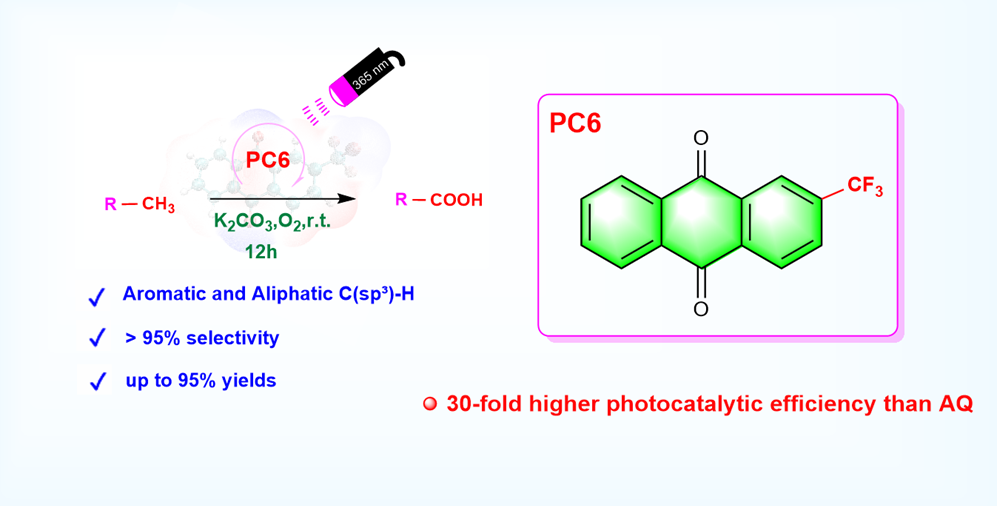
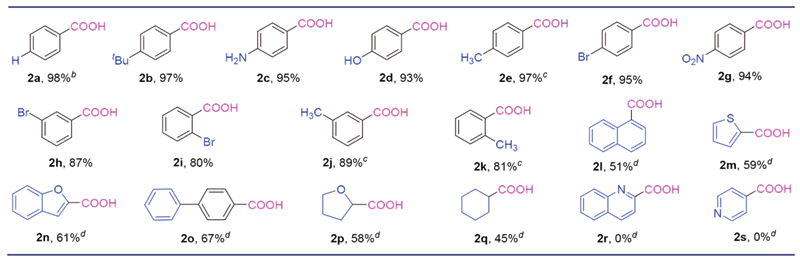
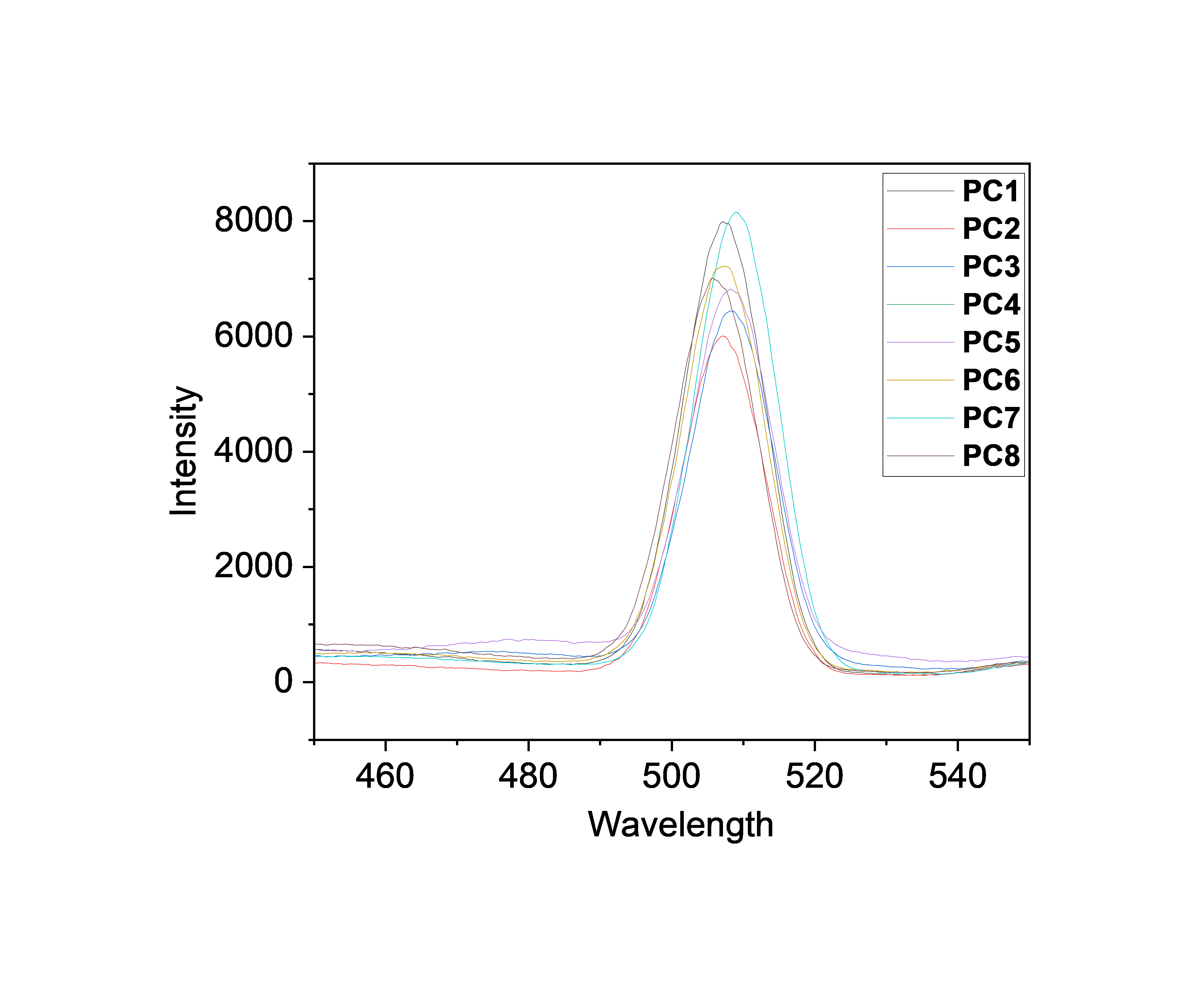
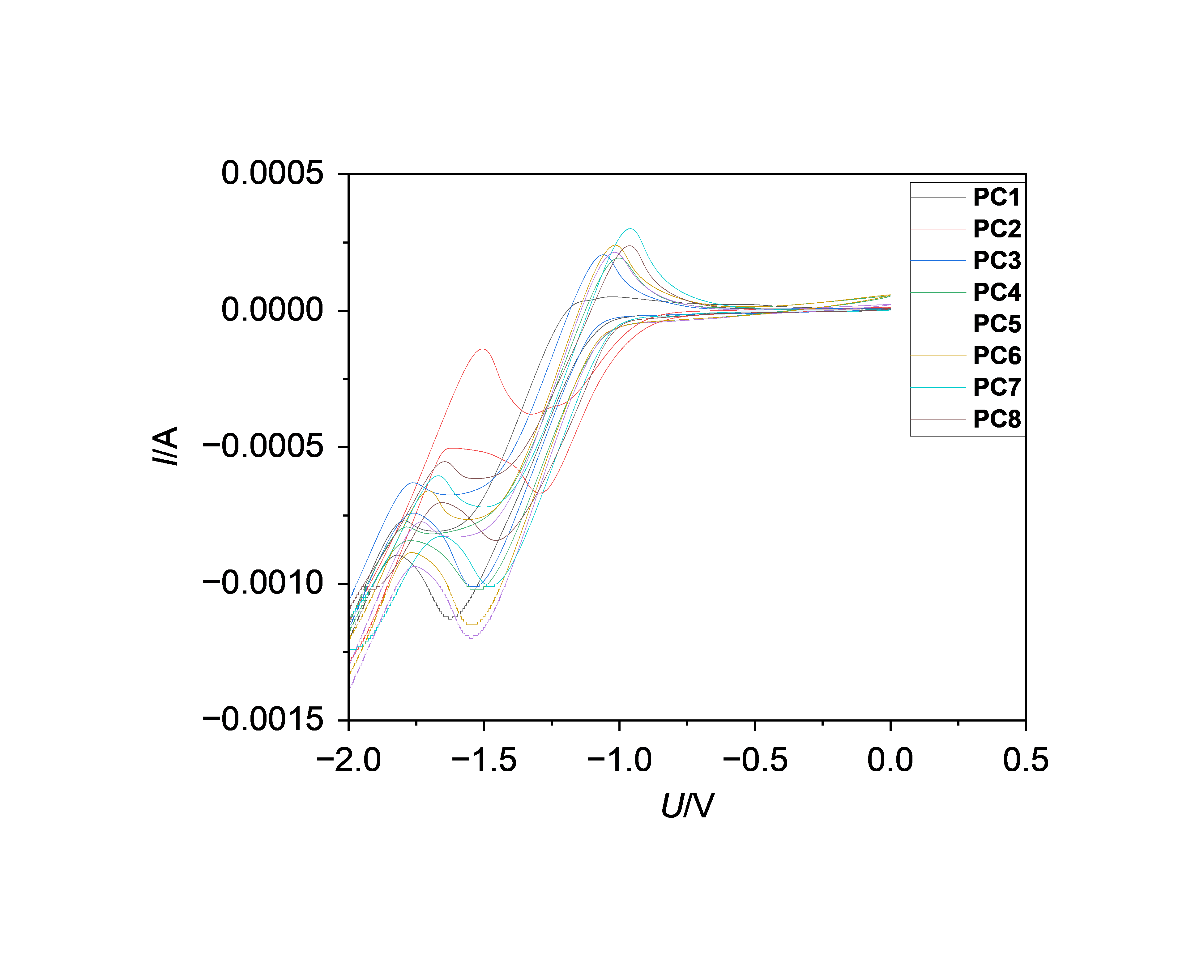
对蒽醌的α和β位进行结构编辑, 设计合成了7种新型蒽醌光敏剂, 并发现在甲基的光氧化反应中具有优异光催化性能. 研究结果表明, 在蒽醌母体β位点上引入强吸电子的三氟甲基取代基得到的2-三氟甲基蒽醌(PC6), 表现出最好的光氧化性能和选择性, 光催化速率是蒽醌的近30倍, 并具有良好底物普适性, 对大部分缺电子取代基和富电子取代基的芳杂环甲基衍生物实现良好以上的反应收率. 通过紫外-可见吸收光谱、荧光光谱、循环伏安及密度泛函理论(DFT)计算, 发现PC6的荧光量子产率达到蒽醌的2.5倍, 是其光催化效率提升的主要原因. 该反应体系具有简单高效、条件温和和官能团耐受性好的优点, 为后续的C(sp3)—H活化反应提供了高效催化剂和有效的光催化方法.
程熹, 李雅琳, 吴鹏, 苏敏, 张梓轩, 焦民均, 刘雪粉, 罗书平. 蒽醌光敏剂设计合成与光催化C(sp3)—H氧化反应性能研究[J]. 有机化学, 2026, 46(5): 2104-2111.
Xi Cheng, Yalin Li, Peng Wu, Min Su, Zixuan Zhang, Minjun Jiao, Xuefen Liu, Shuping Luo. Anthraquinone-Based Photosensitizers: Design, Synthesis and Application in Photocatalytic C(sp3)—H Oxidation[J]. Chinese Journal of Organic Chemistry, 2026, 46(5): 2104-2111.
| Entry | Photocatalyst (mol%) | Solvent | Base (mol%) | Time/h | Yieldb/% of 2a | Yieldb/% of 3a |
|---|---|---|---|---|---|---|
| 1 | PC1 (15) | EtOAc | K2CO3 (5) | 24 | 3 | 10 |
| 2c | — | EtOAc | K2CO3 (5) | 24 | None | None |
| 3d | PC1 (15) | EtOAc | K2CO3 (5) | 24 | Trace | Trace |
| 4e | PC1 (15) | EtOAc | — | 24 | Trace | Trace |
| 5 f | PC1 (15) | EtOAc | K2CO3 (5) | 24 | None | None |
| 6 | PC2 (15) | EtOAc | K2CO3 (5) | 24 | 4 | 30 |
| 7 | PC3 (15) | EtOAc | K2CO3 (5) | 24 | 2 | 16 |
| 8 | PC4 (15) | EtOAc | K2CO3 (5) | 24 | 8 | 42 |
| 9 | PC5 (15) | EtOAc | K2CO3 (5) | 24 | 3 | 50 |
| 10 | PC6 (15) | EtOAc | K2CO3 (5) | 24 | 0 | 98 |
| 11 | PC7 (15) | EtOAc | K2CO3 (5) | 24 | 8 | 35 |
| 12 | PC8 (15) | EtOAc | K2CO3 (5) | 24 | 16 | 45 |
| 13 | PC6 (10) | EtOAc | K2CO3 (5) | 24 | 0 | 98 |
| 14 | PC6 (10) | EtOAc | K2CO3 (5) | 12 | 0 | 98 |
| 15 | PC6 (10) | MeOH | K2CO3 (5) | 12 | 7 | 20 |
| 16 | PC6 (10) | MeCN | K2CO3 (5) | 12 | 5 | 10 |
| 17 | PC6 (10) | THF | K2CO3 (5) | 12 | 0 | 0 |
| 18 | PC6 (10) | DCM | K2CO3 (5) | 12 | 0 | 98 |
| 19 | PC6 (10) | EtOAc | Na2CO3 (5) | 12 | 15 | 54 |
| 20 | PC6 (10) | EtOAc | NaHCO3 (5) | 12 | 7 | 47 |
| 21 | PC6 (10) | EtOAc | NaOH (5) | 12 | 19 | 22 |
| 22 | PC6 (10) | EtOAc | KOH (5) | 12 | 0 | 95 |
| 23 | PC6 (10) | EtOAc | CH3ONa (5) | 12 | 4 | 40 |
| 24 | PC6 (10) | EtOAc | CH3OK (5) | 12 | 1 | 70 |
| 25 | PC6 (10) | EtOAc | K2CO3 (1) | 12 | 10 | 60 |
| 26 | PC6 (10) | EtOAc | K2CO3 (10) | 12 | 5 | 80 |
| Entry | Photocatalyst (mol%) | Solvent | Base (mol%) | Time/h | Yieldb/% of 2a | Yieldb/% of 3a |
|---|---|---|---|---|---|---|
| 1 | PC1 (15) | EtOAc | K2CO3 (5) | 24 | 3 | 10 |
| 2c | — | EtOAc | K2CO3 (5) | 24 | None | None |
| 3d | PC1 (15) | EtOAc | K2CO3 (5) | 24 | Trace | Trace |
| 4e | PC1 (15) | EtOAc | — | 24 | Trace | Trace |
| 5 f | PC1 (15) | EtOAc | K2CO3 (5) | 24 | None | None |
| 6 | PC2 (15) | EtOAc | K2CO3 (5) | 24 | 4 | 30 |
| 7 | PC3 (15) | EtOAc | K2CO3 (5) | 24 | 2 | 16 |
| 8 | PC4 (15) | EtOAc | K2CO3 (5) | 24 | 8 | 42 |
| 9 | PC5 (15) | EtOAc | K2CO3 (5) | 24 | 3 | 50 |
| 10 | PC6 (15) | EtOAc | K2CO3 (5) | 24 | 0 | 98 |
| 11 | PC7 (15) | EtOAc | K2CO3 (5) | 24 | 8 | 35 |
| 12 | PC8 (15) | EtOAc | K2CO3 (5) | 24 | 16 | 45 |
| 13 | PC6 (10) | EtOAc | K2CO3 (5) | 24 | 0 | 98 |
| 14 | PC6 (10) | EtOAc | K2CO3 (5) | 12 | 0 | 98 |
| 15 | PC6 (10) | MeOH | K2CO3 (5) | 12 | 7 | 20 |
| 16 | PC6 (10) | MeCN | K2CO3 (5) | 12 | 5 | 10 |
| 17 | PC6 (10) | THF | K2CO3 (5) | 12 | 0 | 0 |
| 18 | PC6 (10) | DCM | K2CO3 (5) | 12 | 0 | 98 |
| 19 | PC6 (10) | EtOAc | Na2CO3 (5) | 12 | 15 | 54 |
| 20 | PC6 (10) | EtOAc | NaHCO3 (5) | 12 | 7 | 47 |
| 21 | PC6 (10) | EtOAc | NaOH (5) | 12 | 19 | 22 |
| 22 | PC6 (10) | EtOAc | KOH (5) | 12 | 0 | 95 |
| 23 | PC6 (10) | EtOAc | CH3ONa (5) | 12 | 4 | 40 |
| 24 | PC6 (10) | EtOAc | CH3OK (5) | 12 | 1 | 70 |
| 25 | PC6 (10) | EtOAc | K2CO3 (1) | 12 | 10 | 60 |
| 26 | PC6 (10) | EtOAc | K2CO3 (10) | 12 | 5 | 80 |

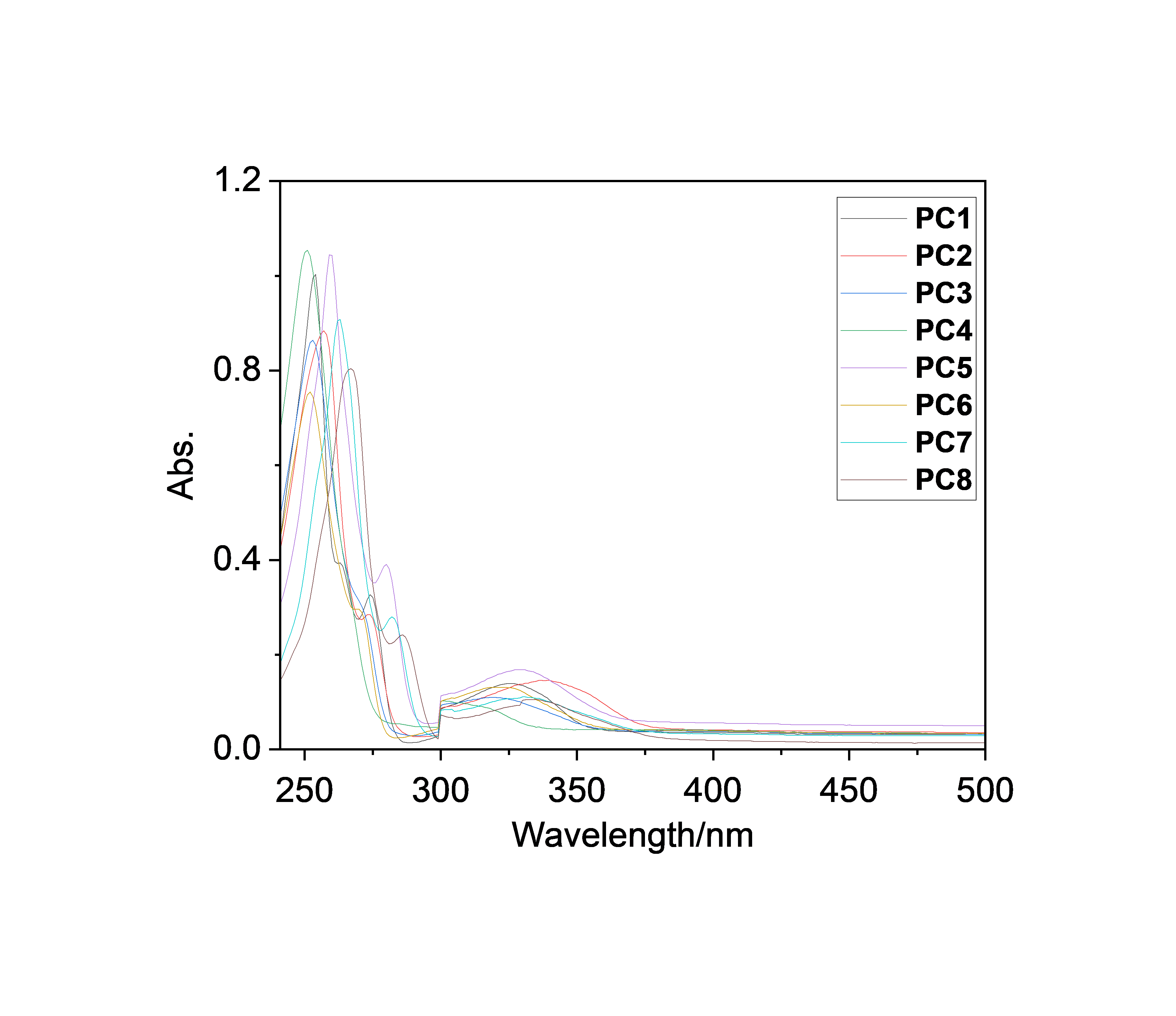
| Entry | Photocatalyst | Ultraviolet | Fluorescence | Reduction potential/V | ||||
|---|---|---|---|---|---|---|---|---|
| Maximum absorption wavelength/nm | εa/(L∙mol-1∙cm-1) | Emission wavelength/nm | Qub | |||||
| 1 | PC1 | 254 | 4.2×10⁴ | 505 | 0.08 | -1.630 | ||
| 2 | PC2 | 257 | 4.7×10⁴ | 506 | 0.16 | -1.505 | ||
| 3 | PC3 | 253 | 4.6×10⁴ | 507 | 0.13 | -1.524 | ||
| 4 | PC4 | 251 | 4.7×10⁴ | 506 | 0.11 | -1.537 | ||
| 5 | PC5 | 259 | 6.9×10⁴ | 510 | 0.17 | -1.476 | ||
| 6 | PC6 | 267 | 6.9×10⁴ | 511 | 0.24 | -1.450 | ||
| 7 | PC7 | 263 | 6.0×10⁴ | 510 | 0.14 | -1.545 | ||
| 8 | PC8 | 252 | 5.1×10⁴ | 508 | 0.12 | -1.542 | ||
| Entry | Photocatalyst | Ultraviolet | Fluorescence | Reduction potential/V | ||||
|---|---|---|---|---|---|---|---|---|
| Maximum absorption wavelength/nm | εa/(L∙mol-1∙cm-1) | Emission wavelength/nm | Qub | |||||
| 1 | PC1 | 254 | 4.2×10⁴ | 505 | 0.08 | -1.630 | ||
| 2 | PC2 | 257 | 4.7×10⁴ | 506 | 0.16 | -1.505 | ||
| 3 | PC3 | 253 | 4.6×10⁴ | 507 | 0.13 | -1.524 | ||
| 4 | PC4 | 251 | 4.7×10⁴ | 506 | 0.11 | -1.537 | ||
| 5 | PC5 | 259 | 6.9×10⁴ | 510 | 0.17 | -1.476 | ||
| 6 | PC6 | 267 | 6.9×10⁴ | 511 | 0.24 | -1.450 | ||
| 7 | PC7 | 263 | 6.0×10⁴ | 510 | 0.14 | -1.545 | ||
| 8 | PC8 | 252 | 5.1×10⁴ | 508 | 0.12 | -1.542 | ||

| Entry | Photocatalyst | ELUMO/eV | EHOMO/eV | ΔE/eV |
|---|---|---|---|---|
| 1 | PC1 | -3.176432 | -7.362284 | 4.185853 |
| 2 | PC2 | -3.440219 | -7.604373 | 4.164154 |
| 3 | PC3 | -3.420561 | -7.618221 | 4.197660 |
| 4 | PC4 | -3.380845 | -7.067312 | 3.886466 |
| 5 | PC5 | -3.356935 | -7.325514 | 3.968580 |
| 6 | PC6 | -3.528997 | -7.369484 | 3.840486 |
| 7 | PC7 | -3.525913 | -7.507099 | 3.981186 |
| 8 | PC8 | -3.509838 | -7.683236 | 4.173397 |
| Entry | Photocatalyst | ELUMO/eV | EHOMO/eV | ΔE/eV |
|---|---|---|---|---|
| 1 | PC1 | -3.176432 | -7.362284 | 4.185853 |
| 2 | PC2 | -3.440219 | -7.604373 | 4.164154 |
| 3 | PC3 | -3.420561 | -7.618221 | 4.197660 |
| 4 | PC4 | -3.380845 | -7.067312 | 3.886466 |
| 5 | PC5 | -3.356935 | -7.325514 | 3.968580 |
| 6 | PC6 | -3.528997 | -7.369484 | 3.840486 |
| 7 | PC7 | -3.525913 | -7.507099 | 3.981186 |
| 8 | PC8 | -3.509838 | -7.683236 | 4.173397 |
| [1] |
|
| [2] |
doi: 10.1002/anie.v58.23 |
| [3] |
pmid: 17836492 |
| [4] |
|
| [5] |
doi: 10.1021/acs.oprd.6b00101 |
| [6] |
doi: 10.6023/cjoc202210018 |
|
(王灵娜, 刘晓庆, 林钢, 金泓颖, 焦民均, 刘雪粉, 罗书平, 有机化学, 2023, 43, 2848.)
doi: 10.6023/cjoc202210018 |
|
| [7] |
doi: 10.6023/cjoc202501013 |
|
(祝辉, 吴鹏, 钟晨鸣, 李舒铭, 林钢, 罗书平, 刘雪粉, 有机化学, 2025, 45, 3441.)
doi: 10.6023/cjoc202501013 |
|
| [8] |
doi: 10.1021/jacs.5c01988 |
| [9] |
|
| [10] |
doi: 10.1021/acscatal.5b02204 |
| [11] |
doi: 10.1002/cssc.v12.12 |
| [12] |
doi: 10.1002/anie.v53.46 |
| [13] |
doi: 10.1016/j.tetlet.2013.09.015 |
| [14] |
doi: 10.1002/ajoc.v8.8 |
| [15] |
|
| [16] |
doi: 10.1039/D0RA06414A |
| [17] |
doi: 10.1039/c2pp05387j |
| [18] |
doi: 10.1055/s-00000084 |
| [19] |
doi: 10.1016/j.tetlet.2015.12.027 |
| [20] |
doi: 10.1002/cctc.v12.15 |
| [21] |
|
| [22] |
|
| [23] |
pmid: 10956520 |
| [24] |
|
| [25] |
|
| [26] |
|
| [27] |
|
| [28] |
|
| [29] |
|
| [30] |
|
| [31] |
doi: 10.1016/j.tetlet.2014.08.090 |
| [32] |
doi: 10.1002/cctc.v8.24 |
| [1] | 许颖, 杨美琳, 崔大鹏, 于淼, 刘颖杰. 脱氟反应的研究进展[J]. 有机化学, 2026, 46(5): 1962-1983. |
| [2] | 赵子鸣, 郑剑峰, 黄培强. 光催化的由亚胺合成胺的研究进展[J]. 有机化学, 2026, 46(5): 1984-2001. |
| [3] | 戴乐薇, 王建玲, 邹东. 芳胺对位C(sp2)—H键官能团化研究进展[J]. 有机化学, 2026, 46(5): 1813-1844. |
| [4] | 侯馨怡, 史同同, 李泽江, 董庆昊, 孙凯, 王薪. 可见光诱导的磷酰化环化合成磷酰基取代的吲哚并二氮䓬[J]. 有机化学, 2026, 46(4): 1776-1787. |
| [5] | 郑婧斐, 吕琪妍, 孙凯, 陈晓岚, 屈凌波, 王金泉, 於兵. 自由基介导的6-氮杂尿嘧啶官能团化研究进展[J]. 有机化学, 2026, 46(4): 1603-1620. |
| [6] | 赵雨晴, 朱先进, 石凌宇, 魏鸣宇, 徐紫涵, 石永佳, 李旭锋, 杨道山. 环硫鎓盐开环官能化反应的研究进展[J]. 有机化学, 2026, 46(4): 1572-1602. |
| [7] | 张皓然, 贾均松, 俞琼, 吴宇, 李玉龙, 舒伟. 可见光催化烯烃的氢胺化和氢(磺)酰胺化反应[J]. 有机化学, 2026, 46(4): 1166-1180. |
| [8] | 杨珊, 陈亚苏, 朱晨. 自由基介导的官能团迁移-环化构建含氮稠杂芳烃[J]. 有机化学, 2026, 46(4): 1739-1749. |
| [9] | 卢琳玉, 亓雨彤, 张庭珲, 金胜男, 曹中艳, 张洪伟. 自由基介导烯烃的1,2,n-三官能团化反应研究进展[J]. 有机化学, 2026, 46(4): 1540-1559. |
| [10] | 董建洋, 薛东. 自由基途径的[1.1.1]螺桨烷官能化研究进展[J]. 有机化学, 2026, 46(4): 1464-1480. |
| [11] | 孟令旭, 申霖, 罗祥玲, 林玉妹, 龚磊. 具有光活性的铬、钴配合物的设计及其在有机合成中的应用进展[J]. 有机化学, 2026, 46(4): 1513-1528. |
| [12] | 苏雯鑫, 崔浩, 张霄. 单质硫(S8)参与的光化学反应研究进展[J]. 有机化学, 2026, 46(4): 1360-1375. |
| [13] | 刘琼, 杨修龙, 李浩源, 沈佳慧, 杨硕, 孟庆元, 牛效莹. 盐酸-二甲基亚砜体系促进酰胺的需氧光催化N-脱甲基反应[J]. 有机化学, 2026, 46(4): 1713-1721. |
| [14] | 余宁, 周于强, 魏晔. 光催化自由基介导的内酯合成研究进展[J]. 有机化学, 2026, 46(4): 1222-1254. |
| [15] | 袁子亮, 李斌栋, 王定海. 可见光催化的烯烃氢膦化反应[J]. 有机化学, 2026, 46(4): 1677-1684. |
| 阅读次数 | ||||||
|
全文 |
|
|||||
|
摘要 |
|
|||||