有机化学 ›› 2026, Vol. 46 ›› Issue (4): 1320-1329.DOI: 10.6023/cjoc202601011 上一篇 下一篇
综述与进展
吉伟文, 金健*( )
)
收稿日期:2026-01-09
修回日期:2026-02-08
发布日期:2026-03-20
通讯作者:
金健
基金资助:
Weiwen Ji, Jian Jin*()
Received:2026-01-09
Revised:2026-02-08
Published:2026-03-20
Contact:
Jian Jin
Supported by:文章分享

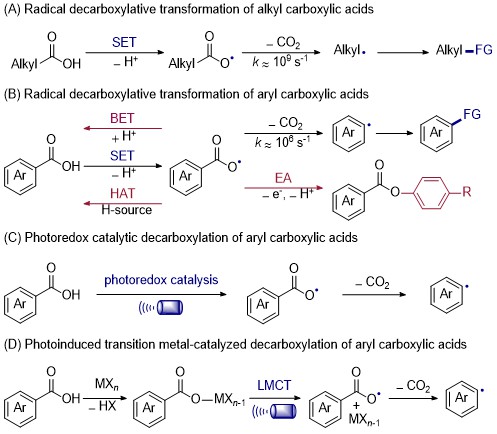
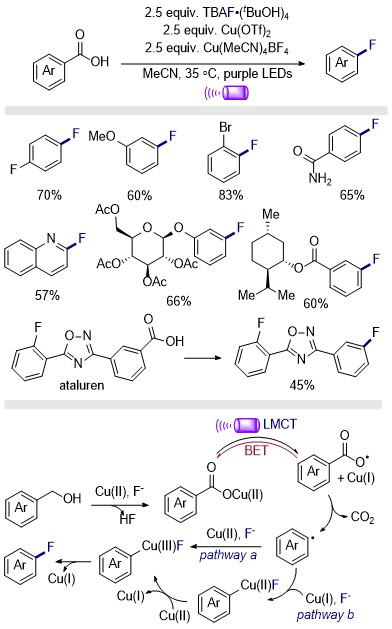
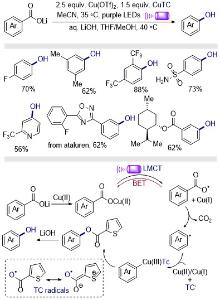
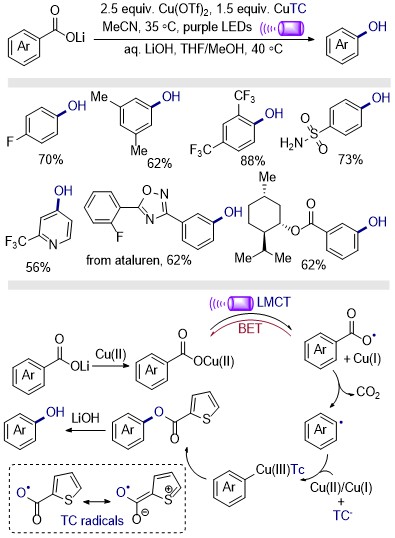
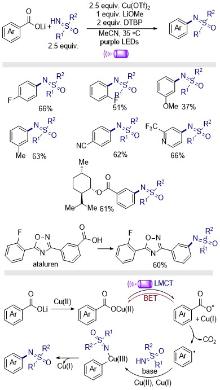
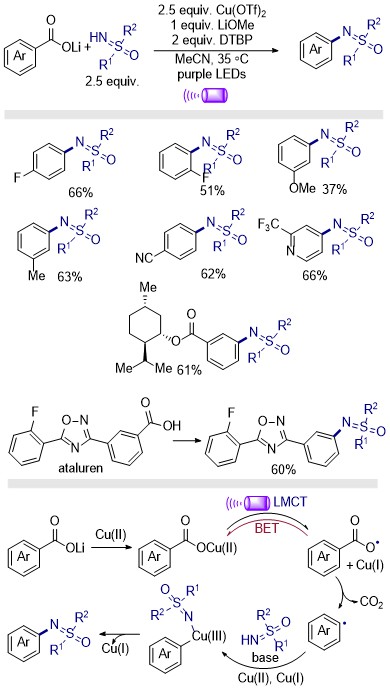
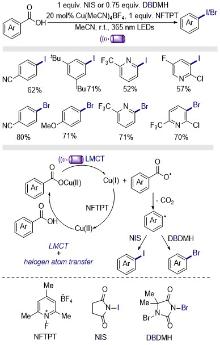
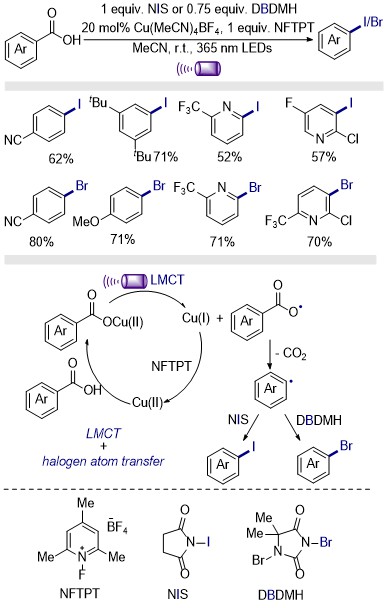
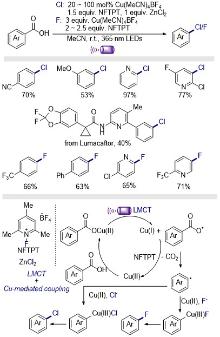
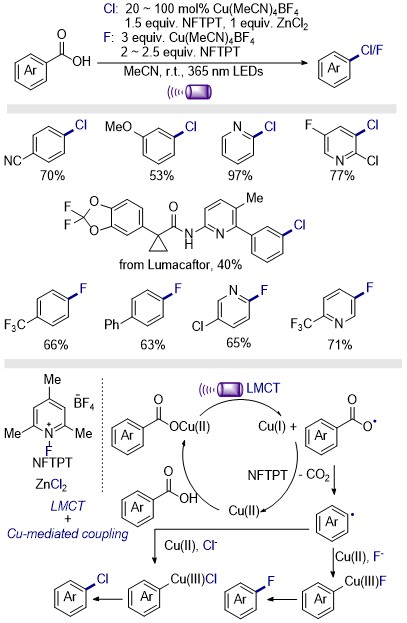
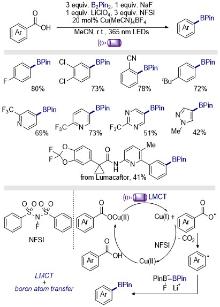
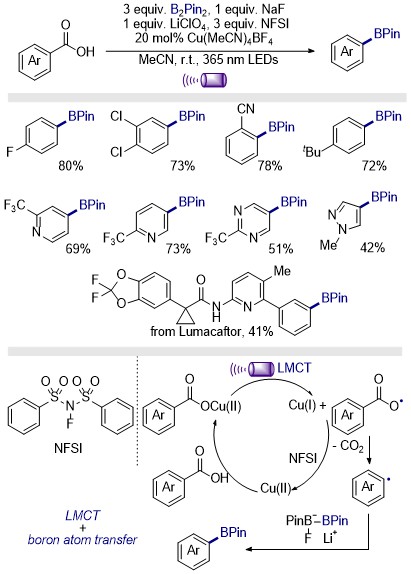
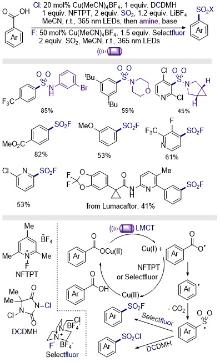
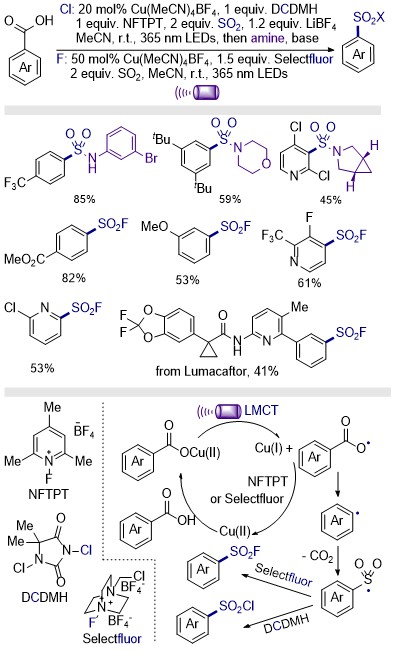
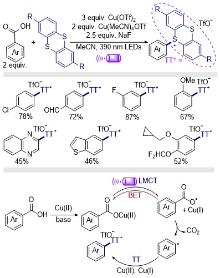
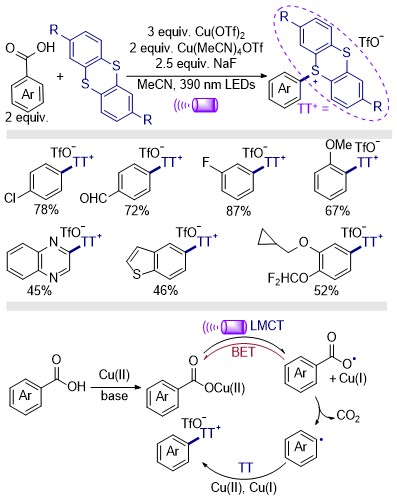
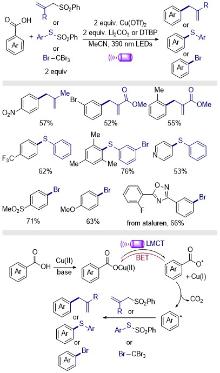
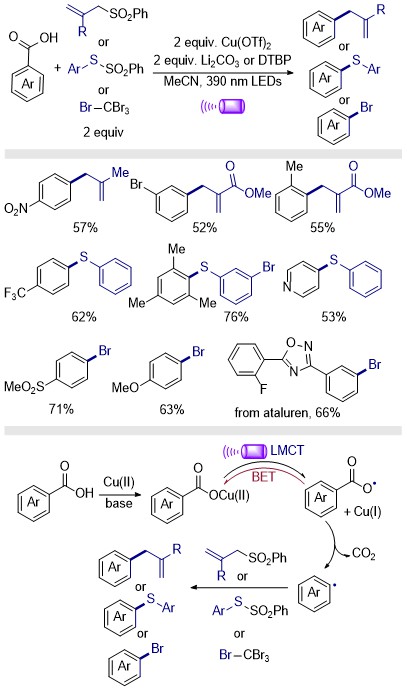
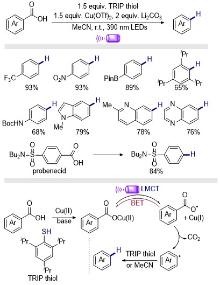
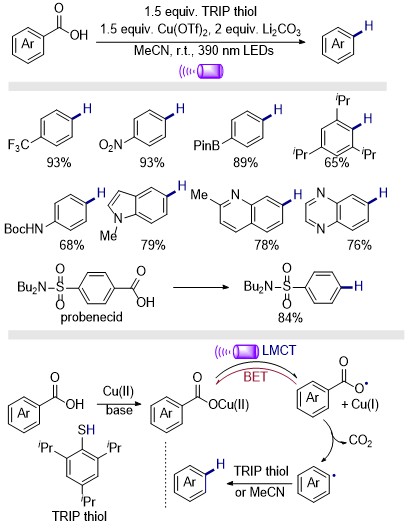
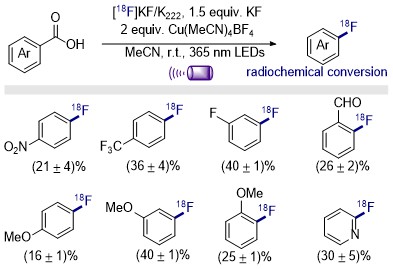
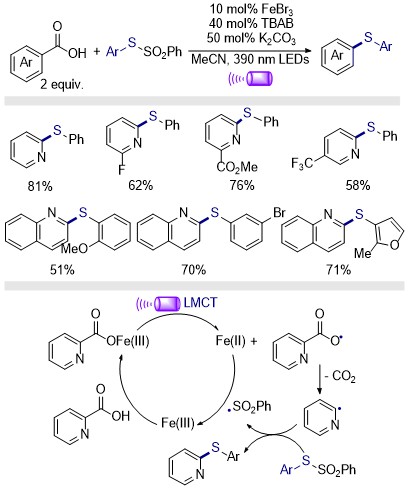
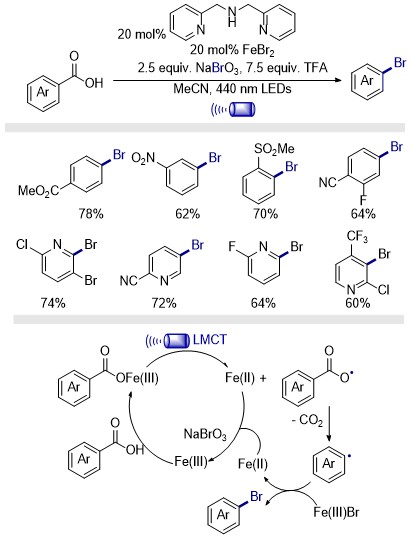
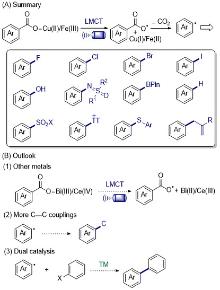
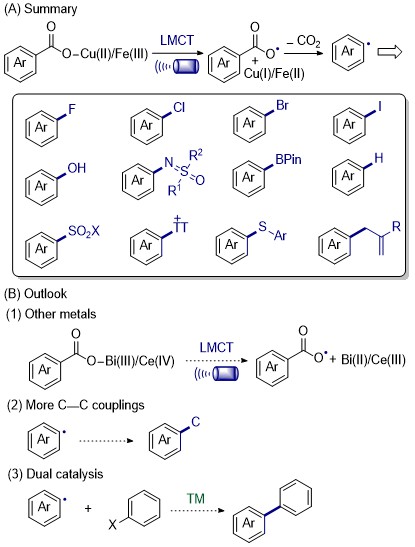
羧酸是一类来源丰富、结构多样、性质稳定、价格友好的化学物质, 是仅次于胺的第二大类商业可得有机分子砌块. 发展光催化自由基脱羧反应, 将羧酸转化为各类高附加值化合物, 是过去十余年有机化学的热门研究领域之一. 到目前为止, 光催化烷基羧酸的脱羧转化研究已经取得较大进展, 而芳基羧酸相关研究的进展较为迟缓, 主要原因是芳基羧基自由基脱羧较慢, 后续的芳基自由基活性很高, 存在诸多竞争反应. 在过去五年, 配体-金属电荷转移(LMCT)驱动的光促金属催化/介导的芳基羧酸(盐)脱羧转化研究已取得一些进展, 包括光促铜催化/介导的卤化、羟化、磺酰亚胺化、硼化、卤磺酰化、噻蒽化、烯丙基化、硫醚化和氢化, 以及光促铁催化的硫醚化和溴化, 但是仍需要通过巧妙设计、调控反应参数, 发展更多的脱羧反应类型, 比如将配体-金属电荷转移与过渡金属催化相结合, 实现芳基羧酸的脱羧交叉偶联反应.
吉伟文, 金健. 配体-金属电荷转移驱动的光促金属催化芳基羧酸脱羧转化[J]. 有机化学, 2026, 46(4): 1320-1329.
Weiwen Ji, Jian Jin. Ligand-to-Metal Charge Transfer-Driven Photoinduced Metal-Catalyzed Decarboxylative Transformation of Aryl Carboxylic Acids[J]. Chinese Journal of Organic Chemistry, 2026, 46(4): 1320-1329.
| [36] |
(徐伟, 翟宏斌, 程斌, 汪太民, 有机化学, 2023, 43, 3035.)
|
| [37] |
|
| [38] |
|
| [39] |
|
| [40] |
|
| [41] |
|
| [42] |
|
| [43] |
|
| [44] |
|
| [45] |
|
| [46] |
|
| [47] |
|
| [48] |
|
| [49] |
|
| [50] |
|
| [51] |
|
| [52] |
|
| [53] |
|
| [54] |
|
| [55] |
|
| [56] |
|
| [57] |
|
| [1] |
|
| [2] |
|
| [3] |
|
| [4] |
|
| [5] |
|
| [6] |
|
| [7] |
|
| [8] |
|
| [9] |
|
| [10] |
|
| [11] |
|
| [12] |
|
| [13] |
|
| [14] |
|
| [15] |
|
|
(王晓琴, 许盛, 平媛媛, 孔望清, 有机化学, 2025, 45, 383.)
|
|
| [16] |
|
|
(周思成, 刘运奎, 有机化学, 2025, 45, 1644.)
|
|
| [17] |
|
|
(高根伟, 李震, 李炎, 陆熹, 有机化学, 2025, 45, 1905.)
|
|
| [18] |
|
| [19] |
|
| [20] |
|
| [21] |
|
| [22] |
|
| [23] |
|
| [24] |
|
| [25] |
|
| [26] |
|
| [27] |
|
|
(张晨晨, 丁清杰, 吕琪妍, 马春华, 姜玉钦, 於兵, 有机化学, 2025, 43, 3517.)
|
|
| [28] |
|
| [58] |
|
| [59] |
|
| [60] |
|
| [29] |
|
| [30] |
|
| [31] |
|
| [32] |
|
| [33] |
|
| [34] |
|
|
(李祯龙, 金健, 黄莎华, 有机化学, 2020, 40, 563.)
|
|
| [35] |
|
|
(窦谦, 汪太民, 房丽晶, 翟宏斌, 程斌, 有机化学, 2023, 43, 1386.)
|
|
| [36] |
|
| [1] | 王齐翔, 陈圣希, 王静, 陈栋, 鲍晓光, 吴新鑫. 无金属参与的多烯选择性氯代反应[J]. 有机化学, 2026, 46(4): 1750-1762. |
| [2] | 郑婧斐, 吕琪妍, 孙凯, 陈晓岚, 屈凌波, 王金泉, 於兵. 自由基介导的6-氮杂尿嘧啶官能团化研究进展[J]. 有机化学, 2026, 46(4): 1603-1620. |
| [3] | 刘世峥, 窦明煜, 崔玉, 窦建民, 魏文廷. 自由基硒磺酰化研究进展[J]. 有机化学, 2026, 46(4): 1621-1634. |
| [4] | 赵雨晴, 朱先进, 石凌宇, 魏鸣宇, 徐紫涵, 石永佳, 李旭锋, 杨道山. 环硫鎓盐开环官能化反应的研究进展[J]. 有机化学, 2026, 46(4): 1572-1602. |
| [5] | 杨珊, 陈亚苏, 朱晨. 自由基介导的官能团迁移-环化构建含氮稠杂芳烃[J]. 有机化学, 2026, 46(4): 1739-1749. |
| [6] | 叶富, 袁伟明. 光氧化还原催化炔烃的双碳官能团化反应进展[J]. 有机化学, 2026, 46(4): 1146-1165. |
| [7] | 刘水林, 陈镤, 贺晶, 刘宁, 黄华文. 过渡金属催化自由基介导1,3-二烯的选择性双官能团化研究进展[J]. 有机化学, 2026, 46(4): 1330-1359. |
| [8] | 刘勇, 李娟, 王凌凡, 黄宝彤, 彭凌子, 宋琎, 郭昌. 电化学驱动1,3-二羰基化合物与烯烃的自由基烷基化反应[J]. 有机化学, 2026, 46(4): 1659-1667. |
| [9] | 张斌, 肖文精, 陈加荣. 烯烃自由基阴离子的可控产生与转化[J]. 有机化学, 2026, 46(4): 1181-1204. |
| [10] | 张晋瑜, 卢志刚, 刘喆, 王聪. 过渡金属催化亚甲基环丙烷的硅氢化和硼化反应[J]. 有机化学, 2026, 46(3): 806-816. |
| [11] | 杨其昌, 张筱睿, 吕剑, 古双喜. 糖羟基的选择性氧化反应研究进展[J]. 有机化学, 2026, 46(3): 743-758. |
| [12] | 梁新宇, 米春春, 郭福军, 谢文斌, 史钦钦, 黄辉. 芳基亚磺酸钠与芳基硫鎓盐的脱硫交叉偶联反应[J]. 有机化学, 2026, 46(3): 1000-1007. |
| [13] | 郭艳辉, 屈红恩, 梁佩. 手性有机硒化合物的合成研究进展[J]. 有机化学, 2026, 46(3): 786-805. |
| [14] | 刘颖杰, 闵来生, 杨锐蓉, 宋冬雪, 彭瑞, 梁德强. CuI催化C—C键偶联反应构建2-羰基-1,4-二酮[J]. 有机化学, 2026, 46(2): 603-611. |
| [15] | 关丽萍, 林志琦, 方超华, 王秋实, 符志杨, 张斌. 喹啉和异喹啉衍生物合成方法研究进展[J]. 有机化学, 2025, 45(9): 3255-3288. |
| 阅读次数 | ||||||
|
全文 |
|
|||||
|
摘要 |
|
|||||