有机化学 ›› 2026, Vol. 46 ›› Issue (8): 3227-3236.DOI: 10.6023/cjoc202601029 上一篇 下一篇
研究论文
黄丰盛a, 陈鹏飞a, 冯裕发a, 顾龙勤b, 周维友a, 何明阳a,*( ), 戴璇a,*()
收稿日期:2026-01-20
修回日期:2026-04-03
发布日期:2026-05-07
基金资助:
Fengsheng Huanga, Pengfei Chena, Yufa Fenga, Longqin Gub, Weiyou Zhoua, Mingyang Hea,*(), Xuan Daia,*()
Received:2026-01-20
Revised:2026-04-03
Published:2026-05-07
Contact:
*E-mail: hmy_cczu@163.com; chmdaix@cczu.edu.cn
Supported by:文章分享
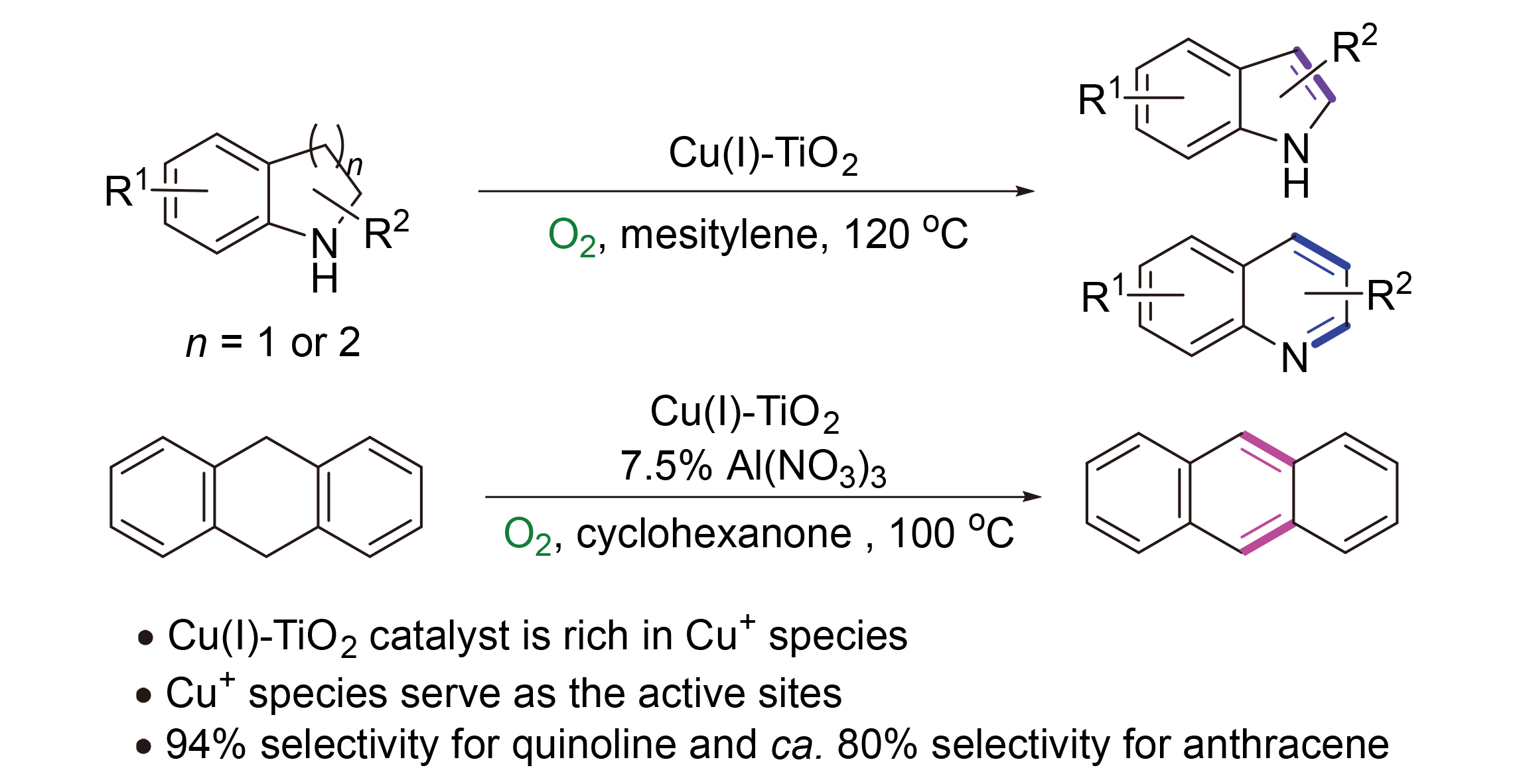
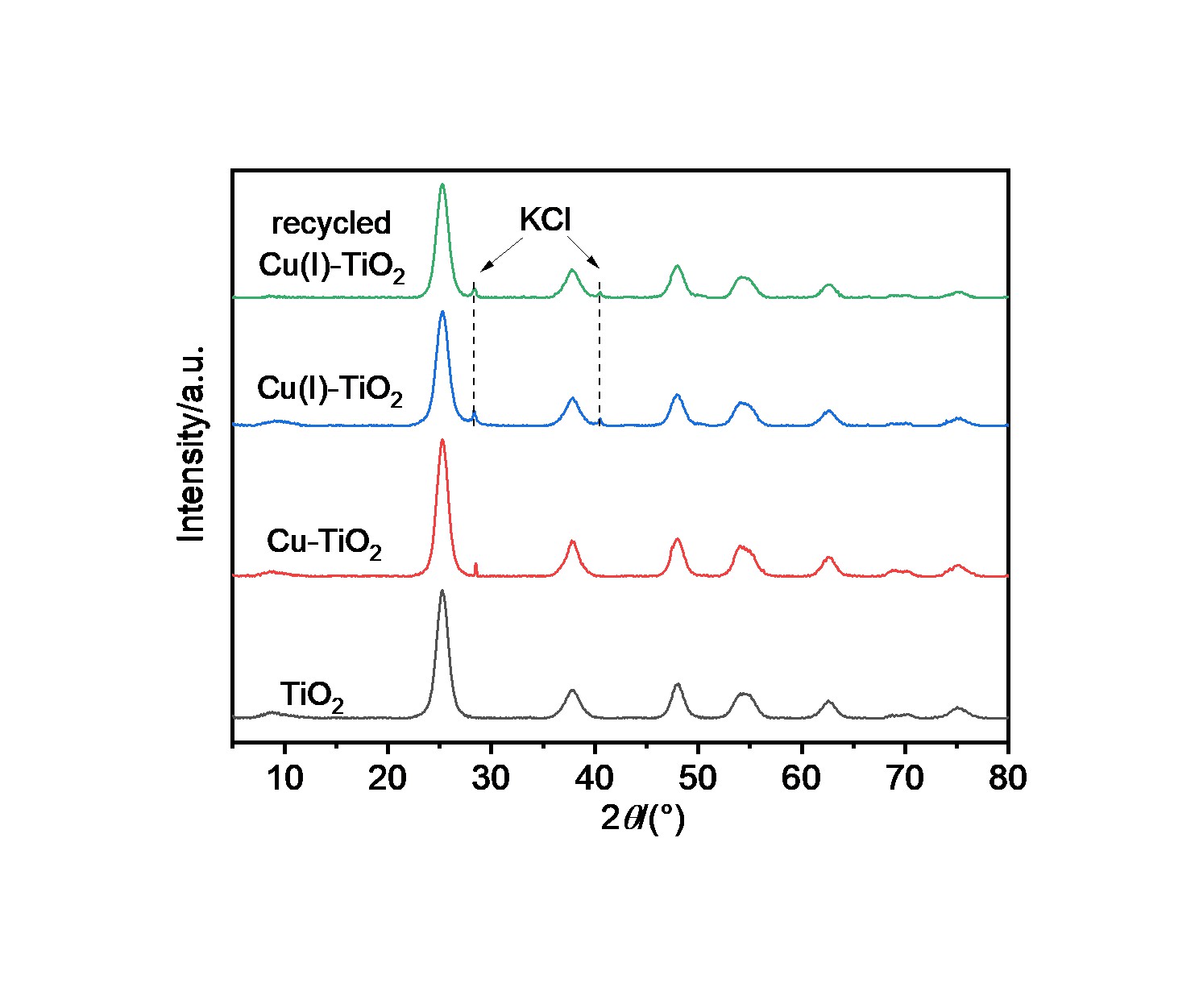
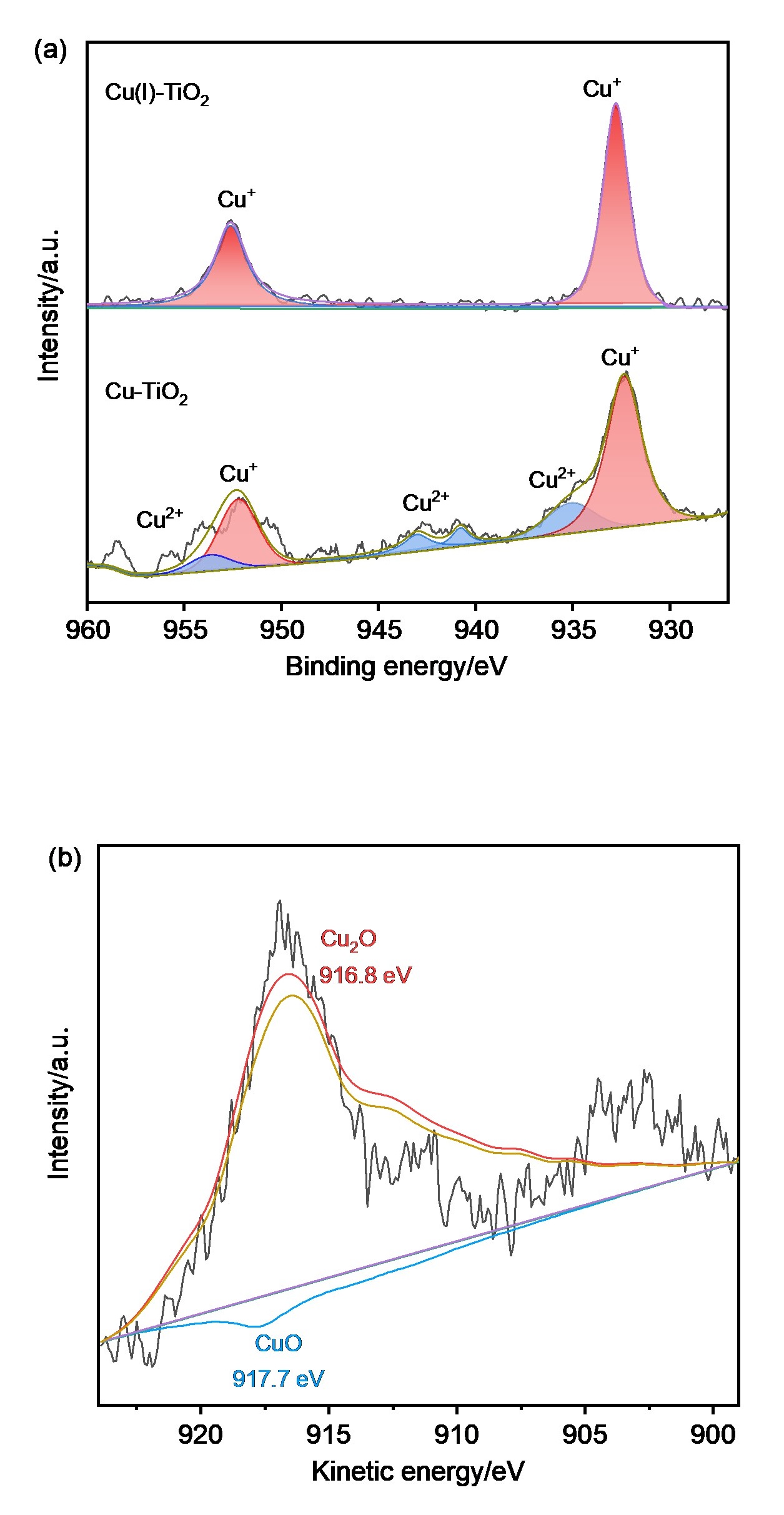
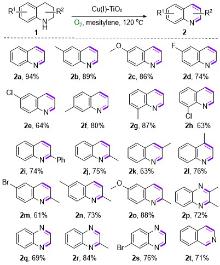
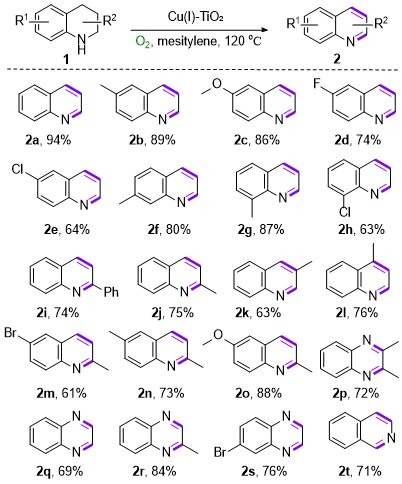
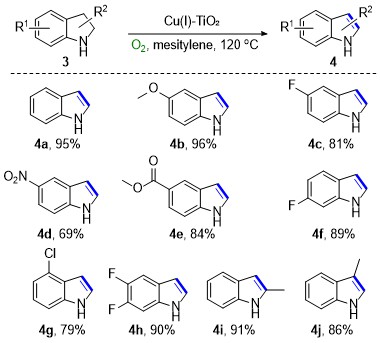
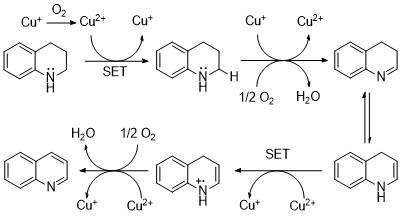
在温和条件下, Cu(I)-TiO2催化剂能够高效催化含氮杂环的氧化脱氢反应, 以分子氧为唯一氧化剂, 实现良好的转化率和选择性. 此外, 对该催化体系的可放大性及其在有价值分子合成中的应用进行了研究. 该催化剂表现出良好的稳定性与可重复使用性, 在前5次循环中活性和选择性基本保持不变, 循环至第10次时仍可实现90.0%的转化率和93.1%的选择性. 对照实验和X射线光电子能谱(XPS)分析表明, Cu+富集表面物种是关键活性位, 并提出了一个涉及界面电子转移与自由基中间体的可能反应机理.
黄丰盛, 陈鹏飞, 冯裕发, 顾龙勤, 周维友, 何明阳, 戴璇. 一价铜掺杂TiO2催化含氮杂环的氧化脱氢[J]. 有机化学, 2026, 46(8): 3227-3236.
Fengsheng Huang, Pengfei Chen, Yufa Feng, Longqin Gu, Weiyou Zhou, Mingyang He, Xuan Dai. Cu(I)-Doped TiO2 for Oxidative Dehydrogenation of N-Heterocycles[J]. Chinese Journal of Organic Chemistry, 2026, 46(8): 3227-3236.
| Entry | Solvent | T/℃ | Reaction time/h | Yield/% |
|---|---|---|---|---|
| 1a | DMF | 100 | 6 | 78 |
| 2a | MeCN | 100 | 6 | <5 |
| 3a | Mesitylene | 100 | 6 | 84 |
| 4a | 1,4-Dioxane | 100 | 6 | 32 |
| 5a | PhCN | 100 | 6 | 69 |
| 6a | Trifluorotoluene | 100 | 6 | 6 |
| 7a | Mesitylene | 80 | 6 | 55 |
| 8a | Mesitylene | 120 | 6 | 94 |
| 9a | Mesitylene | 130 | 6 | 95 |
| 10a | Mesitylene | 120 | 2 | 36 |
| 11a | Mesitylene | 120 | 4 | 66 |
| 12a | Mesitylene | 120 | 7 | 94 |
| 13a | Mesitylene | 120 | 8 | 94 |
| 14b | Mesitylene | 120 | 6 | 80 |
| 15c | Mesitylene | 120 | 6 | 94 |
| 16d | Mesitylene | 120 | 6 | 94 |
| Entry | Solvent | T/℃ | Reaction time/h | Yield/% |
|---|---|---|---|---|
| 1a | DMF | 100 | 6 | 78 |
| 2a | MeCN | 100 | 6 | <5 |
| 3a | Mesitylene | 100 | 6 | 84 |
| 4a | 1,4-Dioxane | 100 | 6 | 32 |
| 5a | PhCN | 100 | 6 | 69 |
| 6a | Trifluorotoluene | 100 | 6 | 6 |
| 7a | Mesitylene | 80 | 6 | 55 |
| 8a | Mesitylene | 120 | 6 | 94 |
| 9a | Mesitylene | 130 | 6 | 95 |
| 10a | Mesitylene | 120 | 2 | 36 |
| 11a | Mesitylene | 120 | 4 | 66 |
| 12a | Mesitylene | 120 | 7 | 94 |
| 13a | Mesitylene | 120 | 8 | 94 |
| 14b | Mesitylene | 120 | 6 | 80 |
| 15c | Mesitylene | 120 | 6 | 94 |
| 16d | Mesitylene | 120 | 6 | 94 |
| Entry | Catalyst | Additive | Conv./% | Sel./% |
|---|---|---|---|---|
| 1a | Cu(I)-TiO2 | — | >99 | 94 |
| 2a | — | — | Trace | — |
| 3b | Cu(I)-TiO2 | — | 24 | 95 |
| 4a | Cu-TiO2 | — | 55 | 53 |
| 5a | TiO2 | — | 20 | 33 |
| 6a | Cu(I)-TiO2 | BHTc | 61 | 40 |
| Entry | Catalyst | Additive | Conv./% | Sel./% |
|---|---|---|---|---|
| 1a | Cu(I)-TiO2 | — | >99 | 94 |
| 2a | — | — | Trace | — |
| 3b | Cu(I)-TiO2 | — | 24 | 95 |
| 4a | Cu-TiO2 | — | 55 | 53 |
| 5a | TiO2 | — | 20 | 33 |
| 6a | Cu(I)-TiO2 | BHTc | 61 | 40 |
| [1] |
(a)
|
|
(b)
|
|
|
(c)
|
|
|
(d)
|
|
|
(e)
|
|
|
(f)
|
|
|
(g)
|
|
| [2] |
(a)
|
|
(b) Tarnow, P.;
|
|
|
(c)
|
|
|
(d)
|
|
| [3] |
(a)
|
|
(b)
|
|
|
(c)
|
|
| [4] |
(a)
|
|
(b)
|
|
|
(c)
|
|
|
(d)
|
|
|
(e)
|
|
|
(f)
|
|
| [5] |
|
| [6] |
(a)
|
|
(b)
|
|
|
(c)
|
|
|
(d)
|
|
|
(e)
|
|
|
(f)
|
|
|
(g)
|
|
| [7] |
(a)
|
|
(b)
|
|
|
(c)
|
|
|
(d)
|
|
|
(e)
|
|
|
(f)
|
|
|
(g)
|
|
|
(h)
|
|
|
(i)
|
|
|
(j)
|
|
| [8] |
(a)
|
|
(b)
|
|
|
(c)
|
|
| [9] |
|
| [10] |
|
| [11] |
|
| [12] |
|
| [13] |
|
| [14] |
|
| [15] |
(a)
|
|
(b)
|
|
|
(c)
|
|
|
(d)
|
|
|
(e)
|
|
|
(f)
|
|
|
(g)
|
|
|
(h)
|
|
|
(i)
|
|
|
(j)
|
|
|
(k)
|
|
|
(l)
|
|
|
(m)
|
|
|
(n)
|
|
|
(o)
|
|
|
(p)
|
|
|
(q)
|
|
|
(r)
|
|
|
(s)
|
|
|
(t)
|
|
|
(u)
|
|
|
(v)
|
|
|
(w)
|
| [1] | 谭紫云, 杨新, 龚绍峰, 杨慧翎, 谢永燕, 张静雅, 冯浙泰, 李文艺, 肖新生. 非均相铜催化的叔胺与炔烃需氧氧化交叉偶联反应[J]. 有机化学, 2026, 46(1): 156-166. |
| [2] | 范玉兰, 邹小颖, 朱小青, 郑绿茵, 郭维. N-邻位C(sp3)—H键官能团化合成含氮杂环化合物研究进展[J]. 有机化学, 2025, 45(4): 1047-1096. |
| [3] | 田勋, 邓国刚, 羊晓东. 钴催化C(sp2)—H活化构建苯并含氮杂环骨架的研究进展[J]. 有机化学, 2025, 45(2): 655-667. |
| [4] | 刘艺琦, 陈文婕, 赵泽艳, 王苏棋, 唐圣松, 何卫民, 彭俊梅. 关于8种含氮杂环光催化合成的研究进展[J]. 有机化学, 2025, 45(10): 3546-3586. |
| [5] | 刘晨光. 含氮芳香性杂环化合物的不对称氢化反应研究进展[J]. 有机化学, 2024, 44(5): 1403-1422. |
| [6] | 赵永哲, 孔翔飞, 张俊良, 杨俊锋. 含膦负载催化剂的合成及应用研究进展[J]. 有机化学, 2024, 44(12): 3587-3608. |
| [7] | 周宇飞, 贾肖飞. 非均相催化氢甲酰化的串联反应研究进展[J]. 有机化学, 2024, 44(10): 3147-3158. |
| [8] | 李建文, 王涛, 陶晟, 陈飞, 李敏, 刘宁. SBA-15负载的N-杂环卡宾-吡啶钼配合物在二氧化碳转化制备环状碳酸酯中的应用[J]. 有机化学, 2024, 44(10): 3213-3222. |
| [9] | 廖旭, 王泽宇, 唐武飞, 林金清. 多孔有机聚合物用于化学固定二氧化碳的研究进展[J]. 有机化学, 2023, 43(8): 2699-2710. |
| [10] | 莫百川, 陈春霞, 彭进松. 木质素及其衍生物负载金属催化剂在有机合成中的应用研究进展[J]. 有机化学, 2023, 43(4): 1215-1240. |
| [11] | 侯学会, 李议慧, 张庆玲, 刘俊桃, 陈亚静. 1,4-吡啶硫内鎓盐在有机合成中的研究与应用[J]. 有机化学, 2023, 43(11): 3844-3860. |
| [12] | 张建涛, 张聪, 郑梓栋, 周鹏, 刘卫兵. 亚砜叶立德参与构建五/六元氮杂环的反应研究进展[J]. 有机化学, 2022, 42(9): 2745-2759. |
| [13] | 洪科苗, 黄晶晶, 姚铭瀚, 徐新芳. 氮宾/炔烃复分解串联反应研究进展[J]. 有机化学, 2022, 42(2): 344-352. |
| [14] | 赵晓伟, 夏紫琴, 张曼, 周能能. 自由基介导的串联环化反应构建七元含氮/氧杂环化合物[J]. 有机化学, 2022, 42(12): 3995-4023. |
| [15] | 陈鑫, 陈春霞, 彭进松. 纤维素及其衍生物负载铜催化有机反应的研究进展[J]. 有机化学, 2021, 41(4): 1319-1336. |
| 阅读次数 | ||||||
|
全文 |
|
|||||
|
摘要 |
|
|||||


