有机化学 ›› 2026, Vol. 46 ›› Issue (6): 2399-2408.DOI: 10.6023/cjoc202602004 上一篇 下一篇
研究论文
张文升a,b, 张建航b, 刘建明b,*( ), 汤清虎b,*()
收稿日期:2026-02-03
修回日期:2026-03-22
发布日期:2026-04-13
基金资助:
Wensheng Zhanga,b, Jianhang Zhangb, Jianming Liub,*(), Qinghu Tangb,*()
Received:2026-02-03
Revised:2026-03-22
Published:2026-04-13
Contact:
* E-mail: jmliu@htu.cn;tangqinghu@htu.edu.cn
Supported by:文章分享
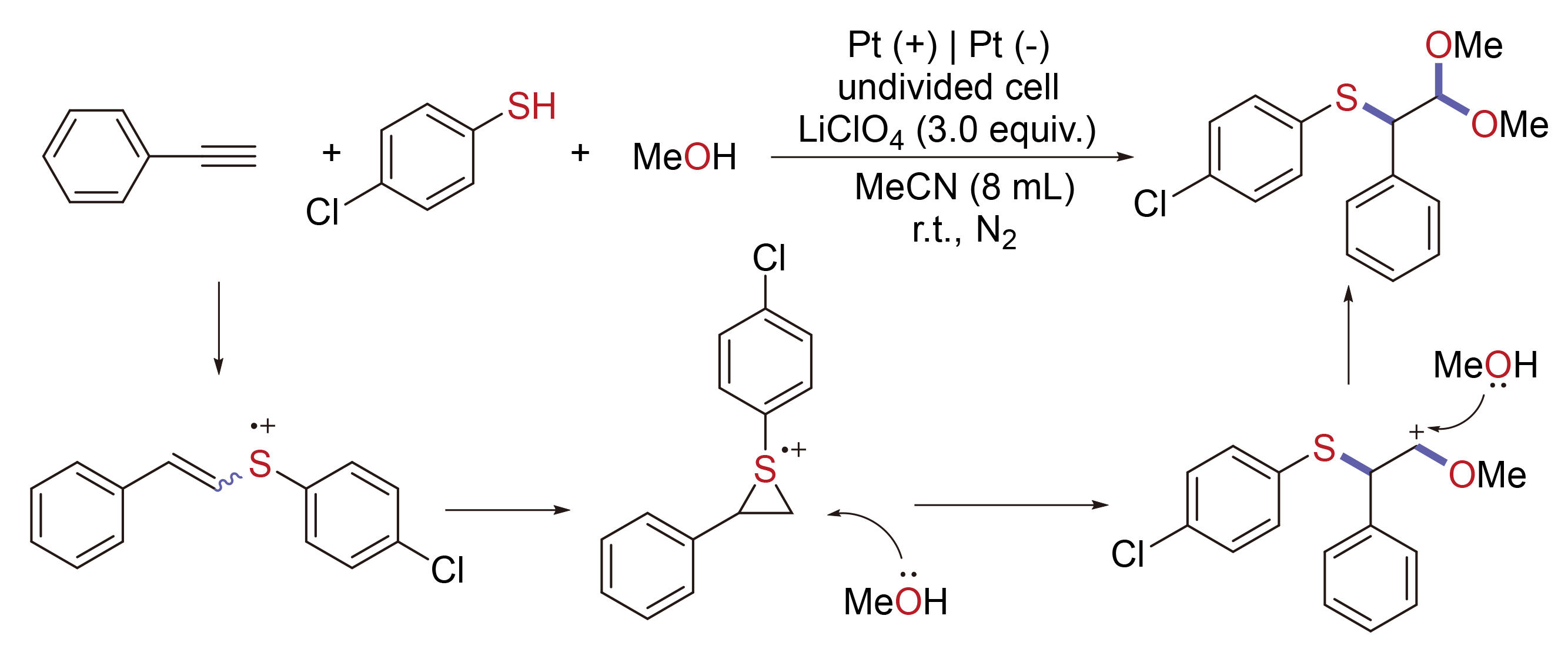
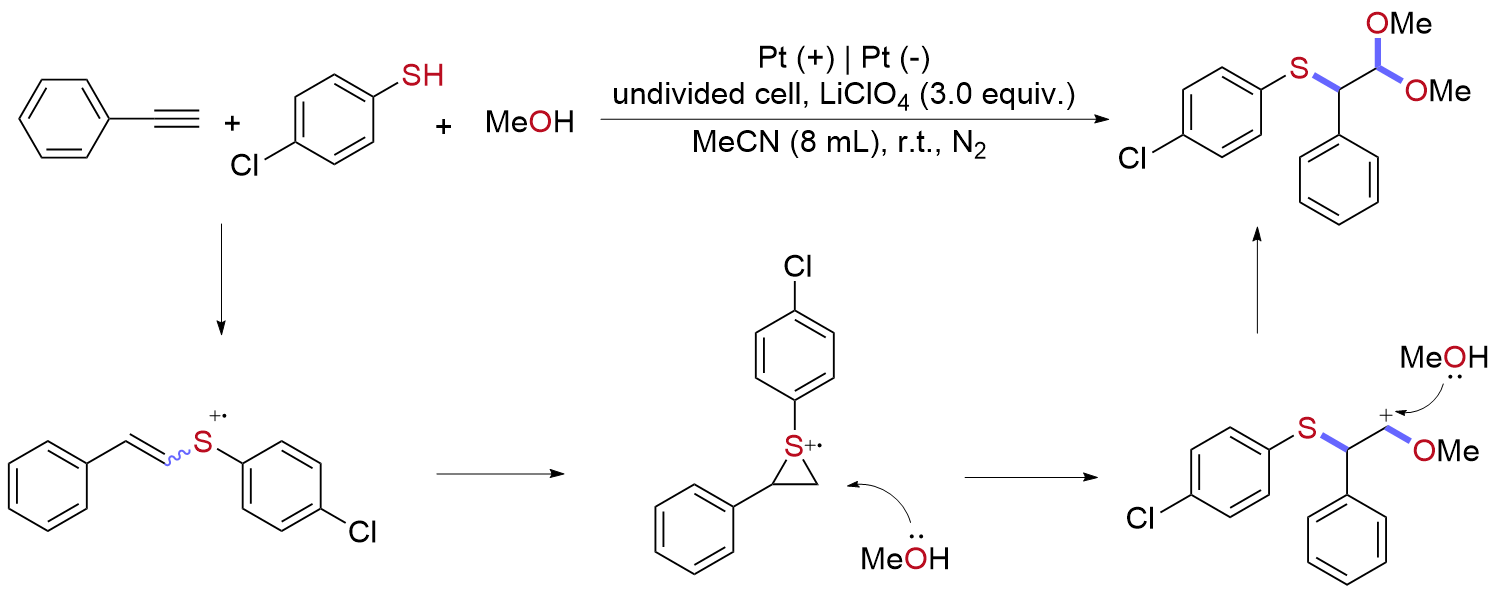
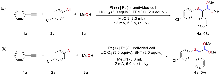
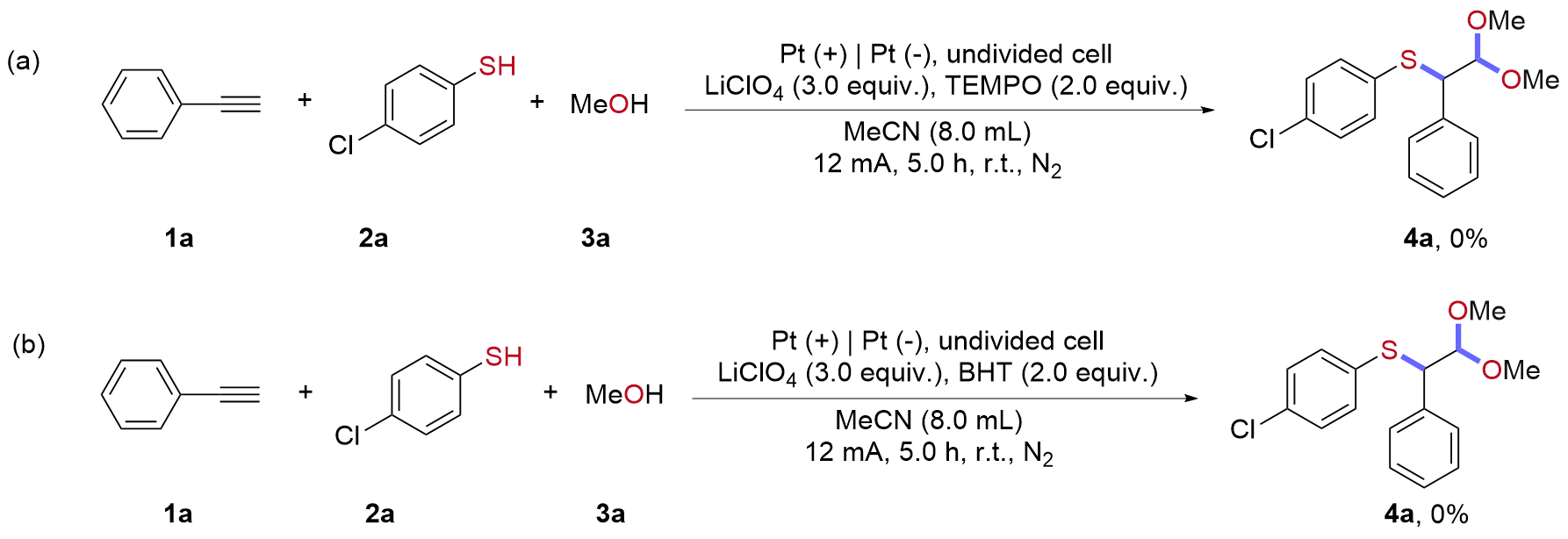
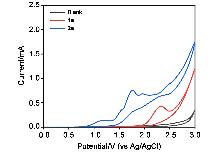
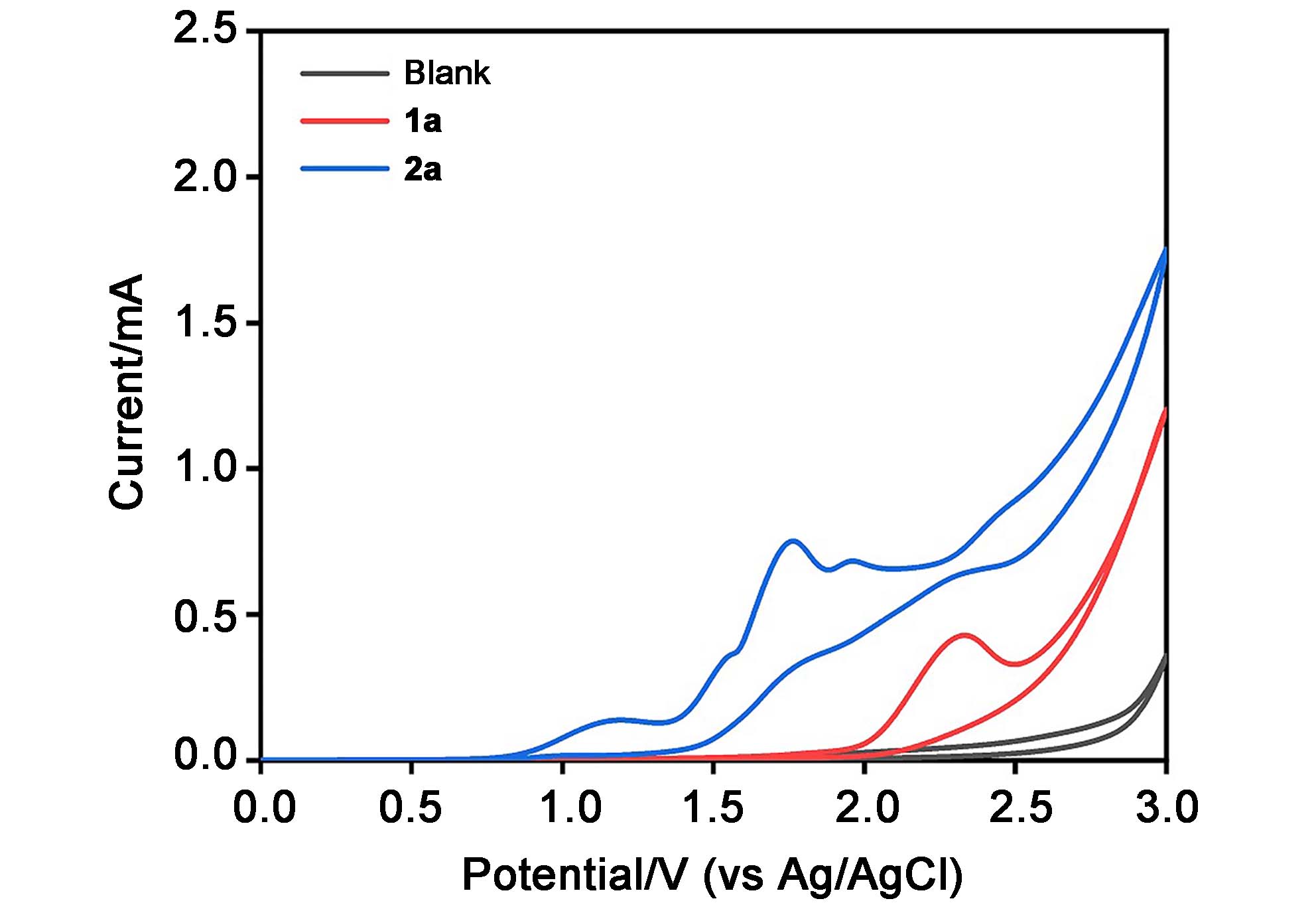
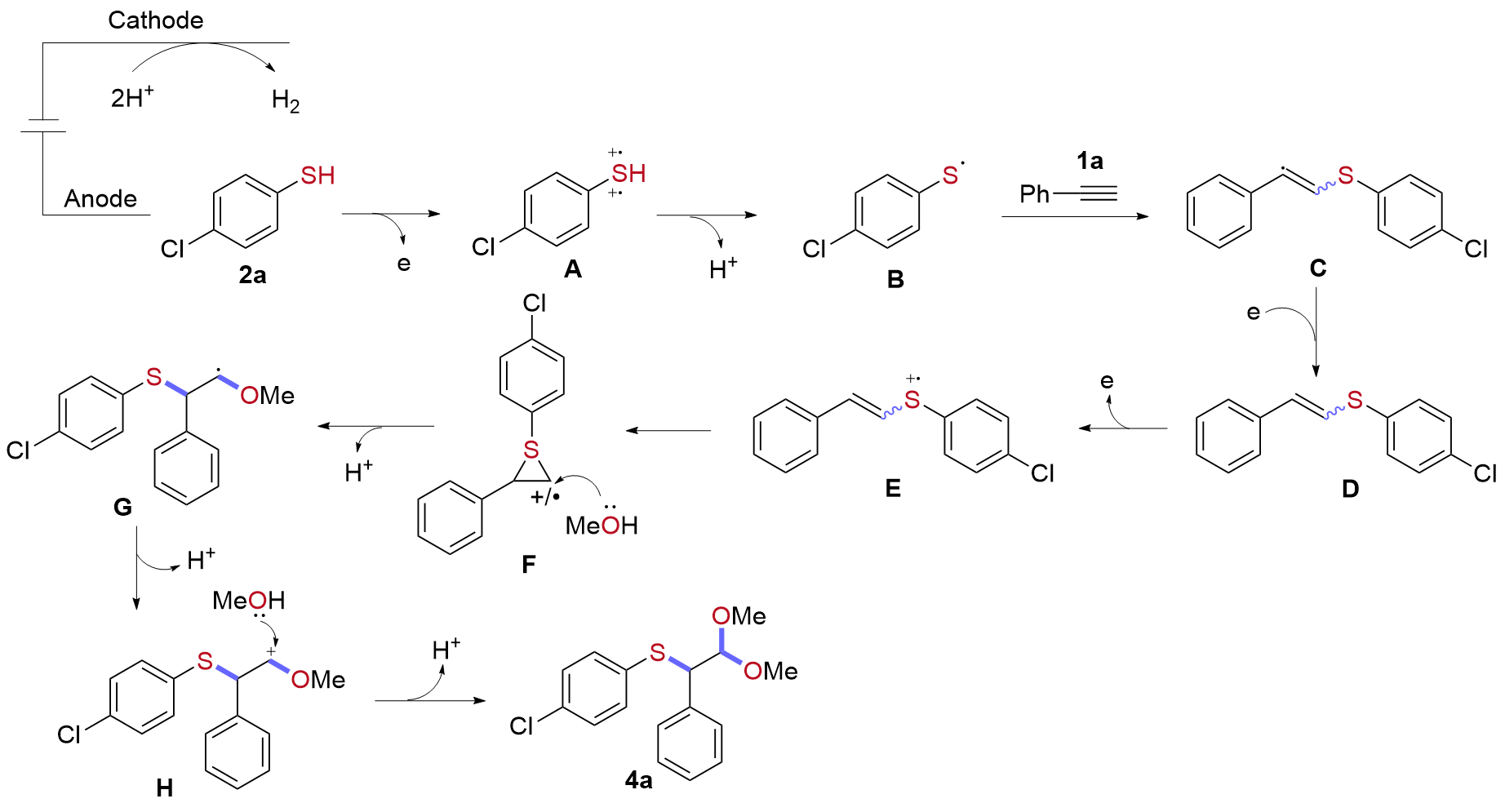
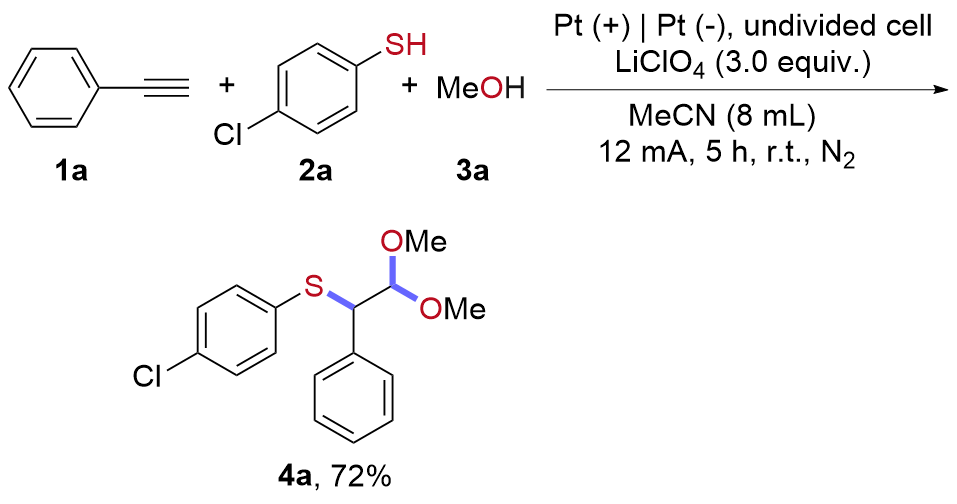
以芳香炔、芳基硫酚与醇为三组分原料, 经电化学反应合成β,β-二烷氧基硫醚. 该策略避免使用过量氧化剂和金属催化剂. 本反应采用双铂电极体系构建电解池阴阳两极, 以高氯酸锂作为电解质, 乙腈作为溶剂, 在常温常压条件下以12 mA的恒定电流持续电解5 h, 以良好的收率获得了硫醚化合物. 机理研究表明, 该反应涉及阳极氧化生成自由基阳离子中间体、三元环中间体生成和自由基氧化偶联等过程. 该策略对多种官能团展现出优异的兼容性, 为构建C—S键提供了一种绿色简洁的新方法.
张文升, 张建航, 刘建明, 汤清虎. 电化学促进芳香炔、芳基硫酚和醇三组分合成β,β-二烷氧基硫醚[J]. 有机化学, 2026, 46(6): 2399-2408.
Wensheng Zhang, Jianhang Zhang, Jianming Liu, Qinghu Tang. Electrochemical Three-Component Synthesis of β,β-Dialkoxy Sulfides from Terminal Alkynes, Thiophenols, and Alcohols[J]. Chinese Journal of Organic Chemistry, 2026, 46(6): 2399-2408.

| [1] |
|
| [2] |
doi: 10.1021/jm401375q |
| [3] |
doi: 10.1016/j.ejmech.2017.11.031 |
| [4] |
doi: 10.1016/j.bmcl.2013.10.034 |
| [5] |
doi: 10.1016/j.ejmech.2016.07.076 |
| [6] |
doi: 10.1016/j.tet.2010.09.019 |
| [7] |
doi: 10.1021/jacs.9b02266 |
| [8] |
doi: 10.1039/C8SC05143G |
| [9] |
Mei. H.; Liu. J.; Guo, Y.; Han, J. ACS Omega 2019, 4, 14353.
doi: 10.1021/acsomega.9b02442 |
| [10] |
doi: 10.1021/acs.orglett.0c01050 |
| [11] |
doi: 10.1002/asia.v15.23 |
| [12] |
doi: 10.1002/anie.202001149 pmid: 32077555 |
| [13] |
doi: 10.1039/C9CC09551A |
| [14] |
Wan. H. L.; Guan, Z.; He, Y. H. Asian J. Org. Chem. 2021, 10, 3406.
doi: 10.1002/ajoc.v10.12 |
| [15] |
doi: 10.1039/D1GC02914B |
| [16] |
doi: 10.1002/adsc.v364.5 |
| [17] |
doi: 10.1021/acs.joc.4c00297 |
| [18] |
doi: 10.1039/D4QO01803F |
| [19] |
doi: 10.1039/C5GC02626A |
| [20] |
doi: 10.1002/cjoc.v42.17 |
| [21] |
doi: 10.1021/acs.orglett.5c02295 |
| [22] |
doi: 10.1039/D5CC05687J |
| [23] |
doi: 10.1039/D0QO01161D |
| [24] |
doi: 10.1039/D3GC01194A |
| [25] |
doi: 10.1002/slct.v6.25 |
| [26] |
doi: 10.1002/cjoc.v37.6 |
| [27] |
doi: 10.1039/d0sc01939a pmid: 34094267 |
| [28] |
doi: 10.1021/acs.orglett.4c03828 |
| [29] |
doi: 10.6023/cjoc202508022 |
|
(马超, 徐晓玲, 骆翔, 鲁瑞娟, 虞国棋, 蔡涛, 有机化学, 2026, 46, 1039.)
doi: 10.6023/cjoc202508022 |
|
| [30] |
doi: 10.1021/acs.orglett.3c03263 |
| [31] |
doi: 10.1039/D1CC01257F |
| [32] |
doi: 10.1039/D2GC00845A |
| [33] |
|
| [34] |
doi: 10.6023/cjoc202209041 |
|
(郑煜, 钱沈城, 徐鹏程, 郑斌南, 黄申林, 有机化学, 2022, 42, 4275.)
doi: 10.6023/cjoc202209041 |
|
| [35] |
doi: 10.1021/acs.chemrev.7b00271 |
| [36] |
doi: 10.1021/acs.chemrev.9b00045 |
| [37] |
doi: 10.1021/acs.accounts.9b00603 |
| [38] |
doi: 10.1021/acs.accounts.9b00544 |
| [39] |
doi: 10.1021/acs.accounts.9b00529 |
| [40] |
doi: 10.1016/0040-4020(95)00009-W |
| [1] | 张美, 陈嫚, 陈雨, 姚秋丽, 王安俊. 四丁基氟化铵促进的α-(三氟甲基)苯乙烯与硫酚的氢硫醇化反应[J]. 有机化学, 2026, 46(6): 2346-2357. |
| [2] | 高谕康, 梅显贵, 刘樾, 付鹏, 刘培培, 朱伟明. 来自海洋异壁放线菌OUCMDZ-413的一种新β-咔啉及其类似物[J]. 有机化学, 2026, 46(3): 968-973. |
| [3] | 杨梓, 马超, 王祖利, 魏伟, 易东. 无添加剂条件下硫叶立德与硫代羧酸硫酯化反应合成β-羰基硫代羧酸酯[J]. 有机化学, 2026, 46(2): 578-585. |
| [4] | 何卫保, 贺梦云, 廖琼, 易荣楠. 亚硝酸钠介导烯烃双官能化合成β-肟基二硫代磷酸酯[J]. 有机化学, 2026, 46(2): 515-522. |
| [5] | 张茵, 张睿, 李文娟. 供受体(D-A)环丙烷与β-氨基酮的开环反应研究[J]. 有机化学, 2025, 45(7): 2469-2479. |
| [6] | 郭怡诗, 桑田, 刘岩, 刘平. 碱催化的β-酮腈与偶氮二甲酸酯的化学选择性取代反应[J]. 有机化学, 2025, 45(4): 1249-1260. |
| [7] | 李永梅, 孙亮博, 徐坤, 曾程初. 基于2,3-二氯-5,6-二氰基-1,4-苯醌(DDQ)的电/光电催化在碳-氢和碳-氟键官能化中的应用进展[J]. 有机化学, 2025, 45(2): 668-676. |
| [8] | 邱东平, 王兆旭, 张洁, 郭亮. 新型酰亚胺-β-咔啉的设计、合成及其抗肿瘤活性研究[J]. 有机化学, 2025, 45(12): 4362-4374. |
| [9] | 罗婷, 肖宇峰, 李珣, 夏雯, 张卡卡. 基于分子内电荷转移技术构建高效热激活延迟荧光型有机余辉材料[J]. 有机化学, 2025, 45(11): 4202-4209. |
| [10] | 陈紫薇, 段思康, 汪乙慧, 范华丹, 杨梦婕, 王思斯, 卢华. 外围基团诱导β-异靛蓝骨架氮杂-氟硼二吡咯(BODIPY)类似物的手性研究[J]. 有机化学, 2025, 45(11): 4163-4170. |
| [11] | 刘菲, 徐鑫明, 王薪, 刘春阳, 陈雪波, 孙凯. 无金属条件下烯酰胺的直接硝化反应制备β-氨基硝基烯烃[J]. 有机化学, 2025, 45(10): 3903-3911. |
| [12] | 曹茜娴, 由君, 刘其业, 刘波, 喻艳超, 武文菊. (4S,4'S)-2,2'-(4,6-二苯并呋喃二基)双[4,5-二氢-4-苯基噁唑]-镍(II)配合物催化高对映选择性氰亚胺的环加成反应[J]. 有机化学, 2024, 44(7): 2315-2332. |
| [13] | 周敏园, 赵洁, 叶发荣, 黄平, 邓明刚, 王平. 糖基化干扰素-γ的半合成[J]. 有机化学, 2024, 44(7): 2296-2304. |
| [14] | 高瑞林, 文丽荣, 郭维斯. 电化学促进未活化C(sp3)—H官能团化研究进展[J]. 有机化学, 2024, 44(3): 892-902. |
| [15] | 黄克金, 蔡金博, 王瑞革, 张永红, 王斌, 夏昱, 金伟伟, 李新勇, 刘晨江. 硼促进甘氨酸衍生物的电化学C(sp2)—H溴化反应[J]. 有机化学, 2024, 44(3): 989-996. |
| 阅读次数 | ||||||
|
全文 |
|
|||||
|
摘要 |
|
|||||


