有机化学 ›› 2025, Vol. 45 ›› Issue (8): 2726-2745.DOI: 10.6023/cjoc202412014 上一篇 下一篇
综述与进展
武烨a, 陈春霞a,b, 彭进松a,b,*( )
)
收稿日期:2025-02-12
修回日期:2025-03-04
发布日期:2025-03-25
基金资助:
Ye Wua, Chunxia Chena,b, Jinsong Penga,b,*()
Received:2025-02-12
Revised:2025-03-04
Published:2025-03-25
Contact:
*E-mail: jspeng1998@163.com
Supported by:文章分享
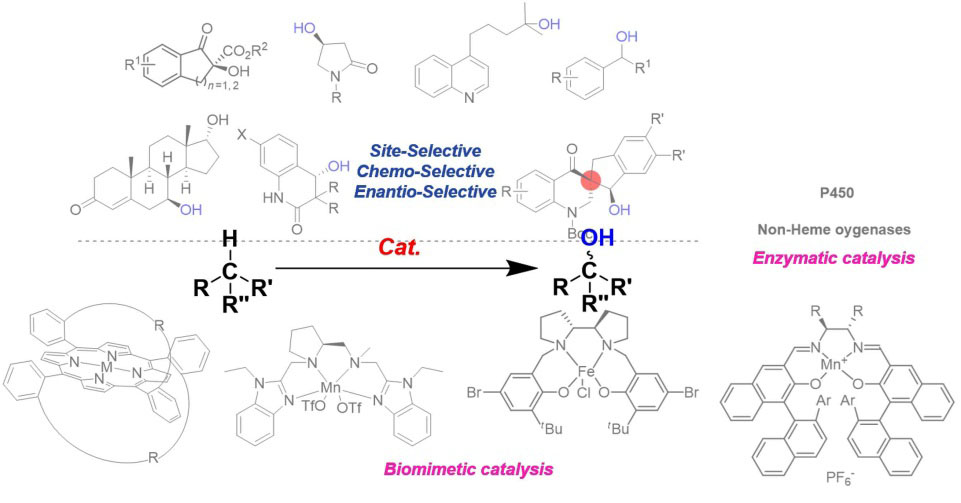
手性醇类衍生物是存在于许多生物活性物质及天然产物中的一类重要的分子; 同时也是一类重要的有机合成中间体, 可用于合成许多重要的有机化合物. 仿生催化是继生物催化后较为新兴的催化不对称羟基化的反应方式, 这一类反应主要以新颖配体的设计及在不对称催化反应中的应用为创新点. 因此, 发展高效、绿色的方法合成手性醇类化合物具有重要的研究意义. 总结了近二十年来C—H键不对称羟基化的研究进展, 论文根据反应所使用的催化剂类型, 将不对称羟基化反应进行了分类总结, 主要分为生物催化、仿生催化两大类, 其中仿生催化区分了不同类型的手性配体.
武烨, 陈春霞, 彭进松. C—H键不对称羟基化反应的研究进展[J]. 有机化学, 2025, 45(8): 2726-2745.
Ye Wu, Chunxia Chen, Jinsong Peng. Research Progress of C—H Bond Asymmetric Hydroxylation[J]. Chinese Journal of Organic Chemistry, 2025, 45(8): 2726-2745.















| Entry | Product | Isolated yield/% (rsma) |
|---|---|---|
| 1 | | 46 (26) |
| 2 | | 53 (43) |
| 3 | | 60 (18) |
| 4 | | 43 (33) |
| 5 | | 52 (21) |
| 6 | | 57 (27) |
| 7 | | 43 (42) |
| 8 | | 33 (67) 90*,b (8) |
| 9 | | 52 (20) |
| 10 | | 92* |
| Entry | Product | Isolated yield/% (rsma) |
|---|---|---|
| 1 | | 46 (26) |
| 2 | | 53 (43) |
| 3 | | 60 (18) |
| 4 | | 43 (33) |
| 5 | | 52 (21) |
| 6 | | 57 (27) |
| 7 | | 43 (42) |
| 8 | | 33 (67) 90*,b (8) |
| 9 | | 52 (20) |
| 10 | | 92* |




| Entry | Cat. | Conv/% | Total yield (isolated yield)/% | C6/C7/C12/C14 |
|---|---|---|---|---|
| 1 | 107c | 85 | 70 (50) | 75/5/23/— |
| 2 | 107d | 86 | 80 (71) | 11/1/88/— |
| 3 | 108c | 83 | 60 (49) | 82/12/3/3 |
| 4 | 108d | 50 | 48 (33) | 22/6/69/3 |
| Entry | Cat. | Conv/% | Total yield (isolated yield)/% | C6/C7/C12/C14 |
|---|---|---|---|---|
| 1 | 107c | 85 | 70 (50) | 75/5/23/— |
| 2 | 107d | 86 | 80 (71) | 11/1/88/— |
| 3 | 108c | 83 | 60 (49) | 82/12/3/3 |
| 4 | 108d | 50 | 48 (33) | 22/6/69/3 |







| [1] |
(a)
|
|
(韩叶强, 史炳锋, 化学学报, 2023, 81, 1522.)
doi: 10.6023/A23070336 |
|
|
(b)
|
|
|
(黄佳鑫, 刘敏, 徐辉, 戴辉雄, 化学学报, 2024, 82, 565.)
doi: 10.6023/A24040136 |
|
| [2] |
|
| [3] |
(a)
pmid: 14978831 |
|
(b)
doi: 10.1002/chem.200305486 pmid: 14978831 |
|
| [4] |
pmid: 10650083 |
| [5] |
|
| [6] |
|
| [7] |
|
| [8] |
|
|
(杨帆, 博士论文, 大连理工大学, 大连, 2019.)
|
|
| [9] |
|
| [10] |
pmid: 15527315 |
| [11] |
|
| [12] |
|
| [13] |
(a)
|
|
(b)
|
|
| [14] |
|
|
(孙强盛, 孙伟, 有机化学, 2020, 40, 3686.)
doi: 10.6023/cjoc202006008 |
|
| [15] |
|
| [16] |
|
| [17] |
|
| [18] |
(a)
|
|
(b)
|
|
| [19] |
(a)
|
|
(b)
|
|
| [20] |
|
| [21] |
|
| [22] |
|
| [23] |
|
| [24] |
|
| [25] |
|
| [26] |
|
| [27] |
|
| [28] |
doi: 10.1038/nchembio.71 pmid: 18277980 |
| [29] |
|
| [30] |
pmid: 6281585 |
| [31] |
|
| [32] |
|
| [33] |
|
| [34] |
|
| [35] |
|
| [36] |
|
| [37] |
|
| [38] |
|
| [39] |
|
| [40] |
|
| [41] |
|
| [42] |
|
| [43] |
|
| [44] |
|
| [45] |
|
| [46] |
|
| [47] |
|
| [48] |
|
| [49] |
|
| [50] |
|
| [51] |
|
| [52] |
|
| [53] |
|
| [54] |
|
|
|
|
| [55] |
|
| [56] |
|
| [57] |
|
| [58] |
|
| [59] |
doi: 10.1002/chem.201103802 pmid: 22532506 |
| [60] |
|
| [61] |
|
| [62] |
|
| [63] |
|
| [64] |
|
| [65] |
|
| [66] |
|
| [67] |
|
| [68] |
|
| [69] |
|
| [70] |
|
| [71] |
(a)
pmid: 31881152 |
|
(b)
doi: 10.1021/jacs.9b12239 pmid: 31881152 |
|
| [72] |
|
| [73] |
|
| [74] |
(a)
pmid: 30426998 |
|
(b)
pmid: 30426998 |
|
|
(c)
doi: 10.1039/c8cs00716k pmid: 30426998 |
|
| [75] |
|
| [76] |
|
| [1] | 蒋晨阳, 尹艳丽, 江智勇. 光酶催化不对称自由基加成反应研究进展[J]. 有机化学, 2025, 45(5): 1614-1633. |
| [2] | 白磊阳, 付蓓, 刘海平, 淳享, 姜雪峰. 白花前胡素E的全合成研究[J]. 有机化学, 2025, 45(3): 1009-1020. |
| [3] | 令天鹏, 秦海涛, 刘峰. C(sp3)—H键对映选择性自由基反应的最新进展[J]. 有机化学, 2025, 45(2): 498-515. |
| [4] | 袁晨晖, 焦雷. 手性配体在钯催化配位辅助对映选择性C(sp3)—H键官能团化反应中的应用[J]. 有机化学, 2025, 45(2): 602-619. |
| [5] | 李非凡, 余康, 倪传志, 朱园园, 曾婕, 古双喜. 测定氨基酸浓度和对映体组成的手性荧光探针[J]. 有机化学, 2024, 44(6): 1862-1869. |
| [6] | 高淳, 刘欣, 王明慧, 刘淑贤, 朱婷婷, 张怡康, 郝二军, 杨启亮. 电化学不对称合成反应的研究进展[J]. 有机化学, 2024, 44(3): 673-727. |
| [7] | 张俊杰, 徐学涛. (S)-(–)-Xylopinine和(S)-(+)-Laudanosine的不对称合成[J]. 有机化学, 2023, 43(9): 3297-3303. |
| [8] | 王文芳. 过渡金属催化不对称C—H硼化反应研究进展[J]. 有机化学, 2023, 43(9): 3146-3166. |
| [9] | 戴力, 徐迪, 毛翼斐, 朱嘉琦, 杨梦娇. 手性噁唑啉二茂铁化合物结构与合成方法[J]. 有机化学, 2022, 42(8): 2364-2375. |
| [10] | 朱雪莉, 杨绍丽, 郏彩霞, 李静, 段征. 通过邻羟基苯基膦和醛的缩合反应合成苯并氧杂磷杂环戊烯[J]. 有机化学, 2022, 42(7): 2201-2213. |
| [11] | 左鸿华, 钟芳锐. 亚稳醌类分子的活性调控与仿生催化反应[J]. 有机化学, 2022, 42(3): 665-678. |
| [12] | 闫辉, 张曼, 李琳, 胡腾, 杨武林. 手性螺环缩酮化合物的不对称催化合成研究进展[J]. 有机化学, 2022, 42(11): 3640-3657. |
| [13] | 李鑫, 宋秋玲. 手性硼烷催化的对映选择性反应[J]. 有机化学, 2022, 42(10): 3143-3151. |
| [14] | 李泉城, 姜岚, 白瑞, 韩永康, 李争宁. 3-取代苯酞的合成研究进展[J]. 有机化学, 2021, 41(9): 3390-3399. |
| [15] | 余璐璐, 丁群山, 宋传君, 常俊标. (–)-Angustureine的对映选择性合成[J]. 有机化学, 2021, 41(6): 2507-2510. |
| 阅读次数 | ||||||
|
全文 |
|
|||||
|
摘要 |
|
|||||