

化学学报 ›› 2026, Vol. 84 ›› Issue (5): 755-774.DOI: 10.6023/A26020053 上一篇 下一篇
所属专题: “框架材料化学”合集
综述
张亚a,*( ), 周功兵a, 孙为银b,*()
投稿日期:2026-02-10
发布日期:2026-05-06
作者简介: |
张亚, 重庆师范大学化学与材料科学学院讲师, 2024年于南京大学化学化工学院获博士学位, 主要从事金属有机框架及其复合材料、过渡金属纳米材料的可控合成及其在电催化小分子(CO2/H2O/N2)转化领域的应用. |
 |
周功兵, 重庆师范大学化学与材料科学学院教授, 2009年于华南理工大学获学士学位(应用化学专业), 2014年于复旦大学获博士学位(物理化学专业). 目前研究方向为金属纳米催化剂的结构调控及其在生物质小分子催化转化、电催化水分解中的应用. |
 |
孙为银, 南京大学化学学院教授, 1986年上海华东师范大学化学系本科毕业, 1990年和1993年在日本大阪大学分别获得硕士和理学博士学位. 近期的研究重点是利用金属有机框架及其衍生材料光/电催化CO2还原. 已发表超过400篇研究论文, 担任J. Coord. Chem. 编委, CrystEngComm顾问编委, 并自2014年起成为英国皇家化学学会会士(FRSC). |
★ 框架材料化学专辑.
基金资助:
Ya Zhanga,*(), Gongbing Zhoua, Wei-Yin Sunb,*()
Received:2026-02-10
Published:2026-05-06
Contact:
* E-mail: yazhang@cqnu.edu.cn;sunwy@nju.edu.cn
About author:★ For the VSI “Chemistry of Framework Materials”.
Supported by:文章分享
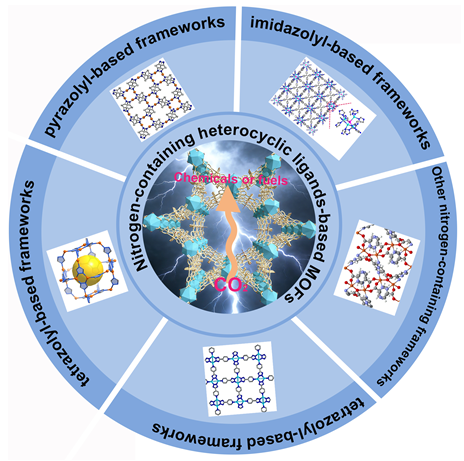
降低大气中二氧化碳(CO2)浓度以实现碳中和, 已成为环境科学与可持续发展领域一项紧迫的全球性挑战. 借助电催化CO2还原反应(electrocatalytic CO2 reduction reaction, ECRR)可将CO2转化为高附加值化学品与清洁能源燃料, 为实现碳减排及可再生电能向化学能高效转化提供了极具潜力的技术路径. 金属有机框架(metal-organic frameworks, MOFs)是一种具有潜力的ECRR催化剂, 得益于其多孔、结构清晰且可调节的框架结构, 这有利于CO2富集, 并有助于探索结构-性能之间关系和催化反应机理. 含氮杂环配体MOFs材料因其独特的物理化学特性在ECRR研究中备受关注, 这些特性包括灵活多样的框架、丰富的活性位点和高稳定性等. 此综述系统评述了基于含氮杂环配体MOFs材料的相关性质和表征手段, 并按含氮杂环结构类别, 即咪唑基、吡唑基、三唑基和四唑基等, 归纳了含氮杂环配体MOFs材料在ECRR领域的最新研究进展. 最后, 剖析了当前制约该类MOFs在ECRR实际应用方面的关键挑战, 包括本征导电性不足、在长时间运行条件下结构和电化学稳定性问题、电解槽系统集成以及催化反应过程中动态结构演变导致的机理模糊等, 并在此基础上对未来研究方向进行了展望.
张亚, 周功兵, 孙为银. 基于含氮杂环配体的金属有机框架材料在电催化CO2还原中的应用与前景展望★[J]. 化学学报, 2026, 84(5): 755-774.
Ya Zhang, Gongbing Zhou, Wei-Yin Sun. Recent Advance and Perspective of Metal-Organic Frameworks Based on Nitrogen-Containing Heterocyclic Ligands for Electrocatalytic CO2 Reduction★[J]. Acta Chimica Sinica, 2026, 84(5): 755-774.
| [1] |
doi: 10.1021/acs.accounts.3c00316 |
| [2] |
doi: 10.1002/anie.v62.34 |
| [3] |
doi: 10.1002/anie.v61.44 |
| [4] |
doi: 10.1021/acs.chemmater.4c01137 |
| [5] |
doi: 10.1002/anie.v62.15 |
| [6] |
doi: 10.1016/j.ccr.2021.214271 |
| [7] |
doi: 10.1039/D0GC00952K |
| [8] |
doi: 10.6023/A21030104 |
|
(穆春辉, 张艺馨, 寇伟, 徐联宾, 化学学报, 2021, 79, 925.)
doi: 10.6023/A21030104 |
|
| [9] |
doi: 10.1002/anie.v61.49 |
| [10] |
doi: 10.1039/D0CS01482F |
| [11] |
doi: 10.1021/acs.energyfuels.1c00700 |
| [12] |
doi: 10.31635/renewables.024.202400064 |
| [13] |
doi: 10.1002/adfm.v36.1 |
| [14] |
doi: 10.1002/anie.v60.43 |
| [15] |
doi: 10.1016/j.apcatb.2021.120119 |
| [16] |
doi: 10.1002/anie.v58.25 |
| [17] |
doi: 10.1021/acscatal.9b03180 |
| [18] |
doi: 10.1038/s41560-023-01314-8 |
| [19] |
doi: 10.1039/D2TA08209H |
| [20] |
doi: 10.1016/j.ccr.2022.214716 |
| [21] |
doi: 10.6023/A23120529 |
|
(雷雅茹, 熊廷楷, 于湘涛, 黄秀兵, 唐晓龙, 易红宏, 周远松, 赵顺征, 孙龙, 高凤雨, 化学学报, 2024, 82, 396.)
doi: 10.6023/A23120529 |
|
| [22] |
doi: 10.1021/jacs.9b08259 |
| [23] |
doi: 10.1002/cssc.v15.4 |
| [24] |
doi: 10.1002/anie.v63.50 |
| [25] |
doi: 10.1039/D4CC02635G |
| [26] |
doi: 10.1002/adma.v29.41 |
| [27] |
doi: 10.6023/A24010040 |
|
(王南南, 陈玉贞, 化学学报, 2024, 82, 621.)
doi: 10.6023/A24010040 |
|
| [28] |
doi: 10.6023/A22040143 |
|
(闫绍兵, 焦龙, 何传新, 江海龙, 化学学报, 2022, 80, 1084.)
doi: 10.6023/A22040143 |
|
| [29] |
doi: 10.1126/science.1230444 |
| [30] |
doi: 10.6023/A25040117 |
|
(高春, 张松涛, 庞欢, 化学学报, 2025, 83, 962.)
doi: 10.6023/A25040117 |
|
| [31] |
doi: 10.1021/acscatal.4c05376 |
| [32] |
doi: 10.1002/anie.v61.19 |
| [33] |
doi: 10.1021/acs.chemrev.9b00685 |
| [34] |
doi: 10.1039/C8CC01664J |
| [35] |
doi: 10.1039/C9EE04040D |
| [36] |
doi: 10.1002/cssc.v14.1 |
| [37] |
doi: 10.1002/smll.v17.16 |
| [38] |
doi: 10.1149/2.001204eel |
| [39] |
doi: 10.1016/j.elecom.2012.09.018 |
| [40] |
doi: 10.1039/C4CC03469D |
| [41] |
doi: 10.1007/s00894-014-2561-5 |
| [42] |
doi: 10.1016/j.ccr.2025.217158 |
| [69] |
doi: 10.31635/ccschem.024.202404245 |
| [70] |
doi: 10.1021/acs.accounts.7b00357 |
| [71] |
doi: 10.1021/acsnano.2c11046 |
| [72] |
doi: 10.1021/jacs.3c12423 |
| [73] |
doi: 10.1016/j.jssc.2015.12.021 |
| [74] |
doi: 10.1002/cphc.v18.22 |
| [75] |
|
| [76] |
doi: 10.1002/cssc.v13.16 |
| [77] |
doi: 10.1002/anie.v58.12 |
| [78] |
doi: 10.1039/C9CE01517E |
| [79] |
doi: 10.1002/cctc.v14.4 |
| [80] |
doi: 10.1002/sstr.v4.8 |
| [81] |
doi: 10.1016/j.jece.2024.112899 |
| [82] |
|
| [83] |
doi: 10.1002/smll.v19.10 |
| [84] |
doi: 10.1016/j.jelechem.2024.118400 |
| [85] |
doi: 10.1002/adfm.v32.36 |
| [86] |
doi: 10.1039/D3DT04056A |
| [87] |
doi: 10.1039/D4CE00991F |
| [88] |
doi: 10.1002/anie.v60.30 |
| [89] |
doi: 10.1002/aenm.v13.19 |
| [90] |
doi: 10.1007/s11426-024-2290-5 |
| [91] |
doi: 10.1002/anie.v60.36 |
| [92] |
doi: 10.1002/asia.v17.21 |
| [93] |
doi: 10.1021/jacs.0c11450 pmid: 33651597 |
| [94] |
doi: 10.1007/s12274-022-4681-z |
| [95] |
doi: 10.1021/jacs.3c10600 |
| [96] |
doi: 10.1021/acscatal.1c01506 |
| [97] |
doi: 10.1038/nature04191 |
| [98] |
|
| [99] |
doi: 10.1002/adfm.v35.48 |
| [43] |
|
| [44] |
doi: 10.1039/D4CS00141A |
| [45] |
doi: 10.1021/ar068084p |
| [46] |
doi: 10.1021/cr200139g |
| [47] |
doi: 10.1126/science.1152516 pmid: 18276887 |
| [48] |
doi: 10.1039/c1sc00136a |
| [49] |
doi: 10.1021/acs.cgd.9b00873 |
| [50] |
doi: 10.1002/cplu.v81.8 |
| [51] |
doi: 10.1021/cr5002589 |
| [52] |
doi: 10.1039/C4CS00081A |
| [53] |
doi: 10.1039/B616738C |
| [54] |
doi: 10.1021/acsenergylett.1c01350 |
| [55] |
doi: 10.1021/acscatal.9b03790 |
| [56] |
doi: 10.1002/smll.v21.4 |
| [57] |
doi: 10.1021/jacs.2c09501 |
| [58] |
doi: 10.1002/anie.v63.47 |
| [59] |
doi: 10.6023/A21120617 |
|
(耿元昊, 林小秋, 孙亚昕, 李惠雨, 秦悦, 李从举, 化学学报, 2022, 80, 748.)
doi: 10.6023/A21120617 |
|
| [60] |
doi: 10.1039/D1TA10440C |
| [61] |
|
| [62] |
doi: 10.1021/acsami.2c00487 |
| [63] |
doi: 10.1002/anie.v63.2 |
| [64] |
doi: 10.1039/D4QM01060D |
| [65] |
doi: 10.6023/A25040140 |
|
(吴子林, 张璐, 陈杨, 李晋平, 李立博, 化学学报, 2025, 83, 917.)
doi: 10.6023/A25040140 |
|
| [66] |
doi: 10.1002/anie.v62.14 |
| [67] |
doi: 10.1038/s41467-024-50791-2 pmid: 39060325 |
| [68] |
doi: 10.1021/acscatal.2c04275 |
| [100] |
doi: 10.1002/anie.v61.28 |
| [101] |
doi: 10.1021/acsnano.3c12389 |
| [102] |
doi: 10.1021/acscatal.2c01681 |
| [103] |
doi: 10.1021/jacs.2c04670 |
| [104] |
doi: 10.1039/D4TA01982B |
| [105] |
doi: 10.1002/smll.v21.39 |
| [106] |
doi: 10.1038/s41929-022-00763-w |
| [107] |
doi: 10.1038/s41929-022-00788-1 |
| [108] |
doi: 10.1038/s41467-022-35415-x |
| [109] |
doi: 10.1021/acsnano.4c12245 |
| [110] |
doi: 10.1002/anie.v64.37 |
| [111] |
doi: 10.1021/acssuschemeng.4c09723 |
| [112] |
|
| [113] |
doi: 10.1016/j.cej.2025.160493 |
| [114] |
doi: 10.1016/S1872-2067(23)64519-X |
| [115] |
doi: 10.1021/acs.nanolett.3c04092 |
| [116] |
doi: 10.1002/cssc.v18.8 |
| [117] |
|
| [118] |
doi: 10.1021/jacs.3c08571 |
| [119] |
doi: 10.1002/adfm.v32.4 |
| [120] |
doi: 10.1021/jacs.0c10774 |
| [121] |
doi: 10.1021/acsami.2c21902 |
| [1] | 陈慧滢, 黄宁宇, 廖培钦. 基于银−碳键的新型金属有机框架用于高效光催化合成过氧化氢★[J]. 化学学报, 2026, 84(5): 626-630. |
| [2] | 王炙韬, 林雨珂, 万妍, 黄鑫伟, 李云斌, 吉定豪, 项生昌, 张章静. 快速、绿色机械化学合成UTSA-16(Zn)用于高效碳捕获★[J]. 化学学报, 2026, 84(5): 631-637. |
| [3] | 刘璐, 赵砚珑, 白薛峰, 张鑫, 李建荣. 可宏量制备的层叠配位聚合物用于CH4/N2分离★[J]. 化学学报, 2026, 84(5): 638-642. |
| [4] | 丁宝童, 蔡俊凯, 郭绍杰, 段春迎. 基于拓扑固定的铜卤簇金属有机框架的稳定性与发光调控研究★[J]. 化学学报, 2026, 84(5): 682-688. |
| [5] | 张伟宏, 马亚男, 方翰, 薛东旭. 面向乙烯一步纯化的多组分金属有机框架: 金属配体导向合成与C2混合气高效分离★[J]. 化学学报, 2026, 84(5): 659-666. |
| [6] | 何乾龙, 胡洁颖, 钟礼匡, 何军. 基于金属有机框架的中性介质硝酸盐电催化还原制氨: 设计策略与机理研究★[J]. 化学学报, 2026, 84(5): 775-804. |
| [7] | 邬佳悦, 王文伯, 谢玉龙, 方伟慧. 铝基金属有机框架材料的主客体化学研究进展★[J]. 化学学报, 2026, 84(5): 697-708. |
| [8] | 彭天资, 沈嘉克, 郭淑雅, 夏潇潇, 李炜. 迁移学习预测金属/共价有机骨架材料内小分子气体自扩散系数研究[J]. 化学学报, 2026, 84(3): 305-315. |
| [9] | 叶舣, 黄正义, 赵兴雷, 赵娅俐, 刘龙杰, 吴武凤, 魏嫣莹. 垂直排列金属有机框架纳米片膜实现高效H2传输[J]. 化学学报, 2026, 84(1): 129-134. |
| [10] | 税子怡, 尹书睿, 邓锦涛, 许留云, 郭莉. 聚乙烯吡咯烷酮辅助金属有机框架衍生分级多孔碳材料的制备及其双功能催化性能研究[J]. 化学学报, 2026, 84(1): 53-63. |
| [11] | 翁惠琼, 黄河, 王雯菲, 李和国, 李晓鹏, 张守鑫, 李树华, 赵越, 吴玉芳, 乔智威. 基于MOFid赋能下的AI大数据挖掘高性能化学战剂吸附材料[J]. 化学学报, 2026, 84(1): 8-19. |
| [12] | 江惠星, 郑丽彬, 陈小丰, 张珍珍, 陈秋水, 杨黄浩. 基于钛基金属有机框架的孔径调控策略及其在海水提铀中的应用★[J]. 化学学报, 2025, 83(9): 987-992. |
| [13] | 朱永朝, 刘冰洁, 梁文杰, 徐海. 多功能MOFs隔离膜用于锂硫电池的研究[J]. 化学学报, 2025, 83(8): 861-867. |
| [14] | 高春, 张松涛, 庞欢. 金属有机框架复合材料★[J]. 化学学报, 2025, 83(8): 962-980. |
| [15] | 吴子林, 张璐, 陈杨, 李晋平, 李立博. 乙烷选择性金属有机框架材料的结构设计与分离应用★[J]. 化学学报, 2025, 83(8): 917-936. |
| 阅读次数 | ||||||
|
全文 |
|
|||||
|
摘要 |
|
|||||
