

化学学报 ›› 2026, Vol. 84 ›› Issue (5): 682-688.DOI: 10.6023/A26010020 上一篇 下一篇
所属专题: “框架材料化学”合集
研究论文
丁宝童, 蔡俊凯*( ), 郭绍杰, 段春迎*()
投稿日期:2026-01-19
发布日期:2026-03-27
作者简介:★ “框架材料化学”专辑.
基金资助:
Baotong Ding, Junkai Cai*(), Shaojie Guo, Chunying Duan*()
Received:2026-01-19
Published:2026-03-27
Contact:
* E-mail: jkcai@nju.edu.cn;cyduan@dlut.edu.cn
About author:★ For the VSI “Chemistry of Framework Materials”.
Supported by:文章分享
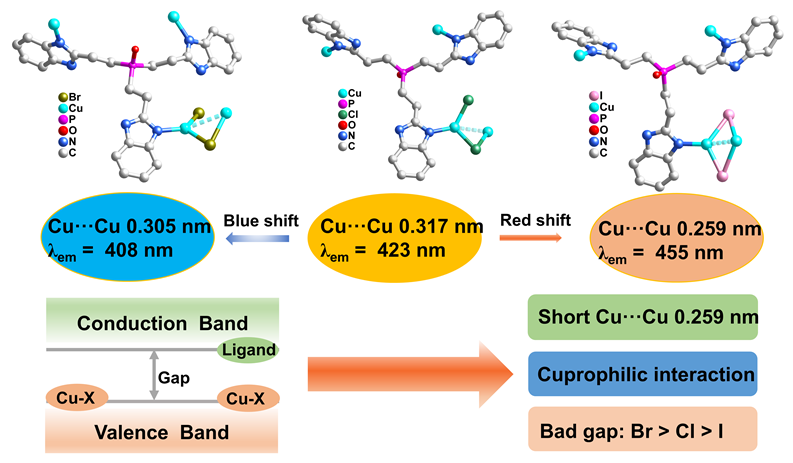
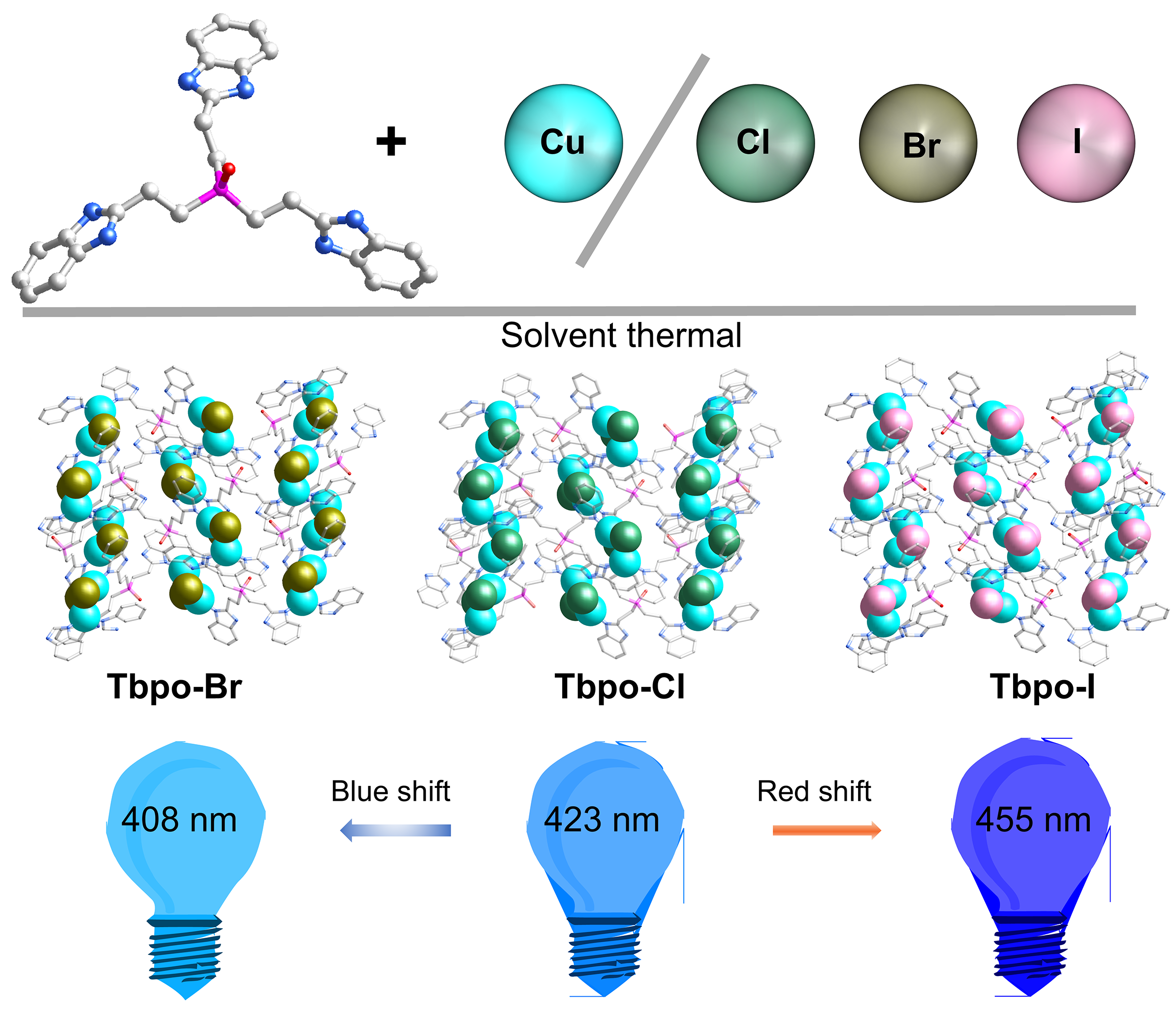
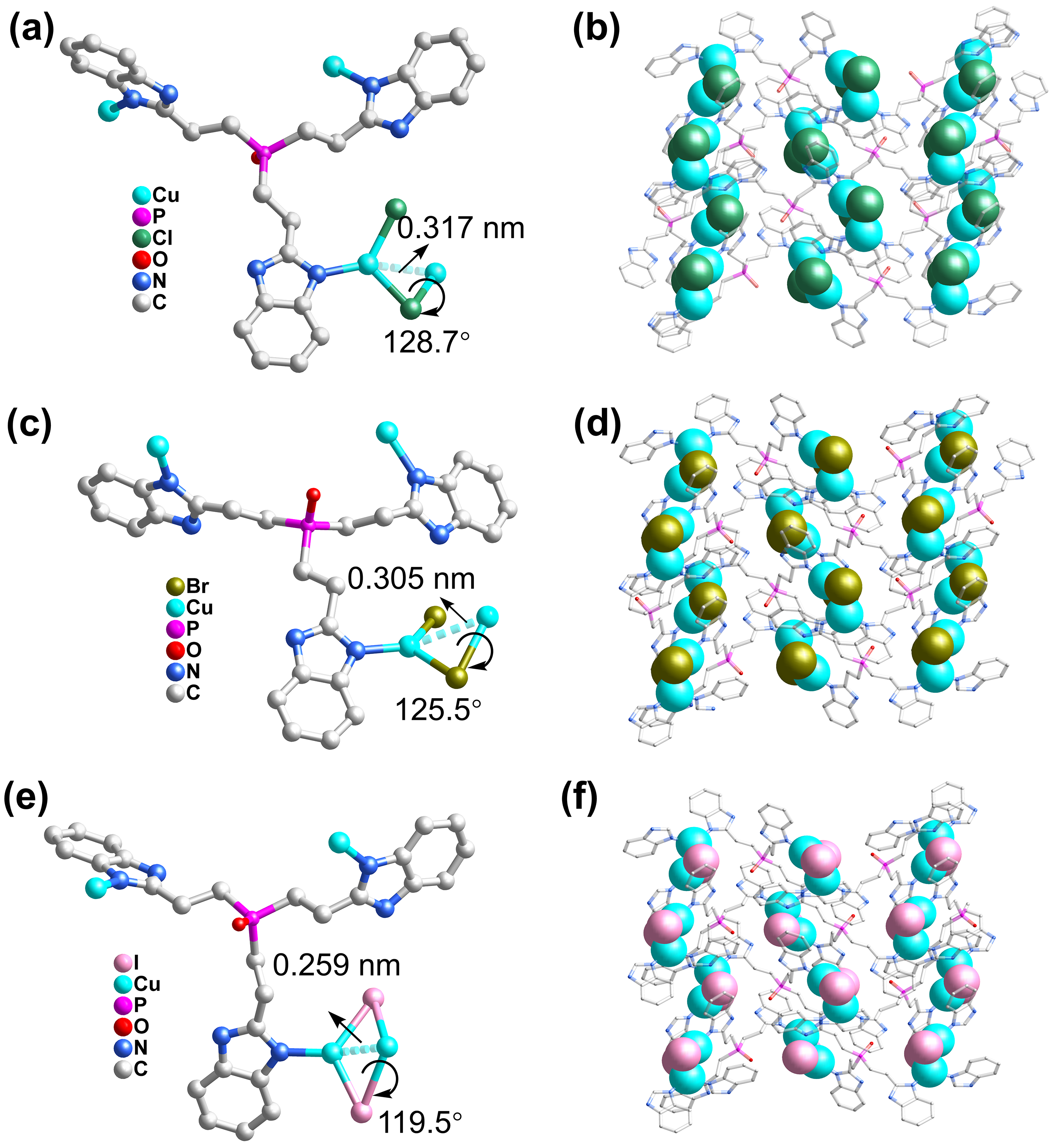
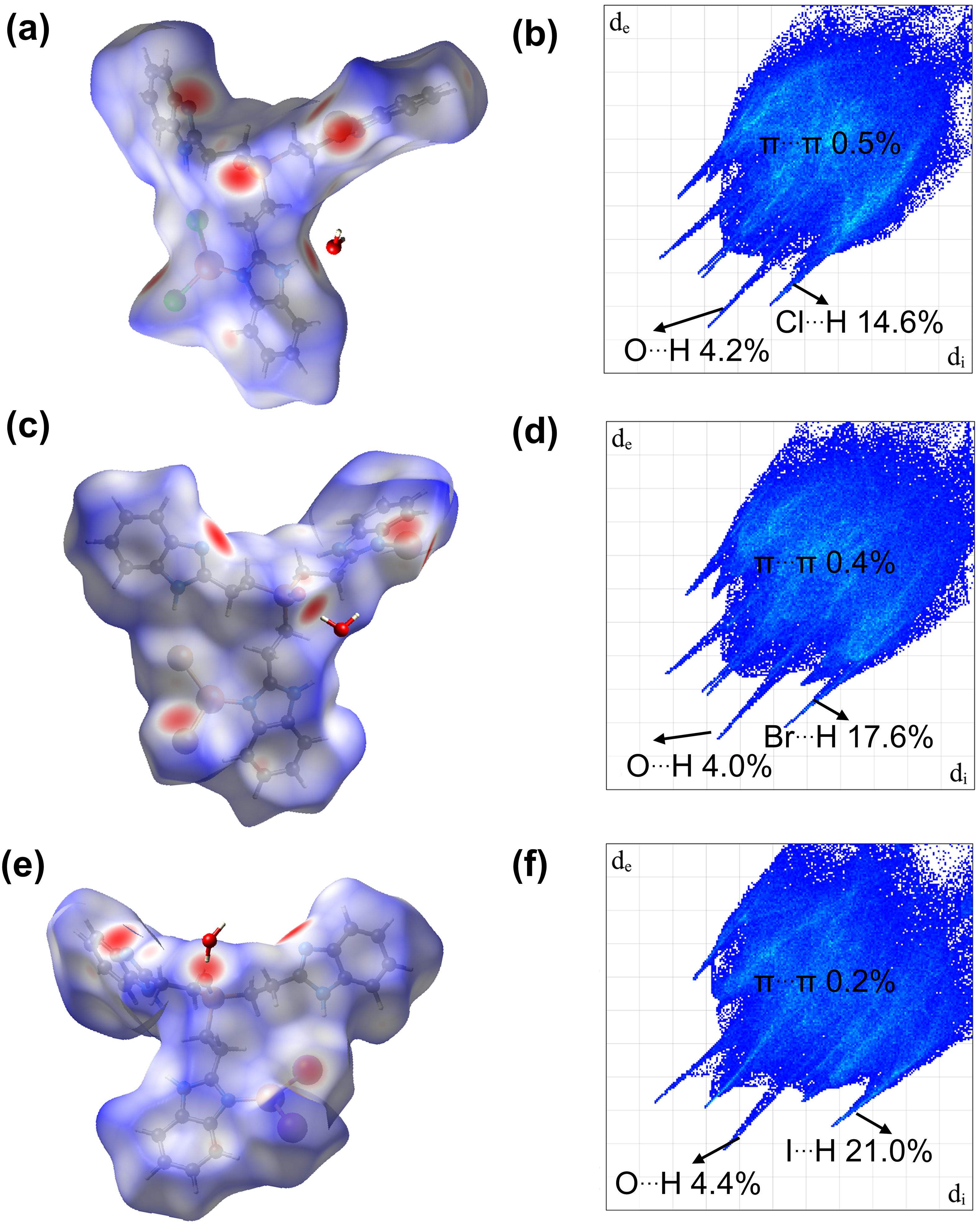
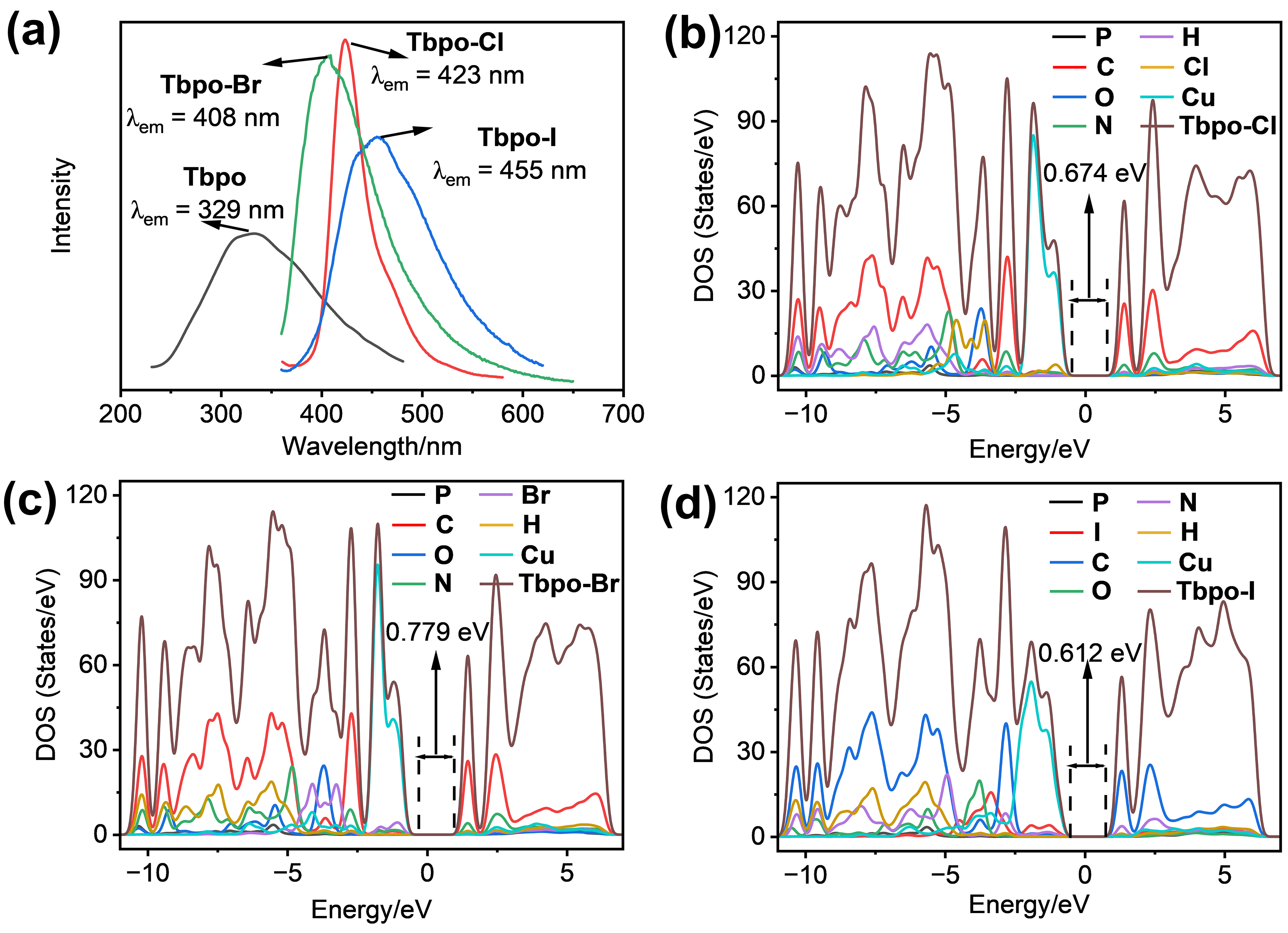
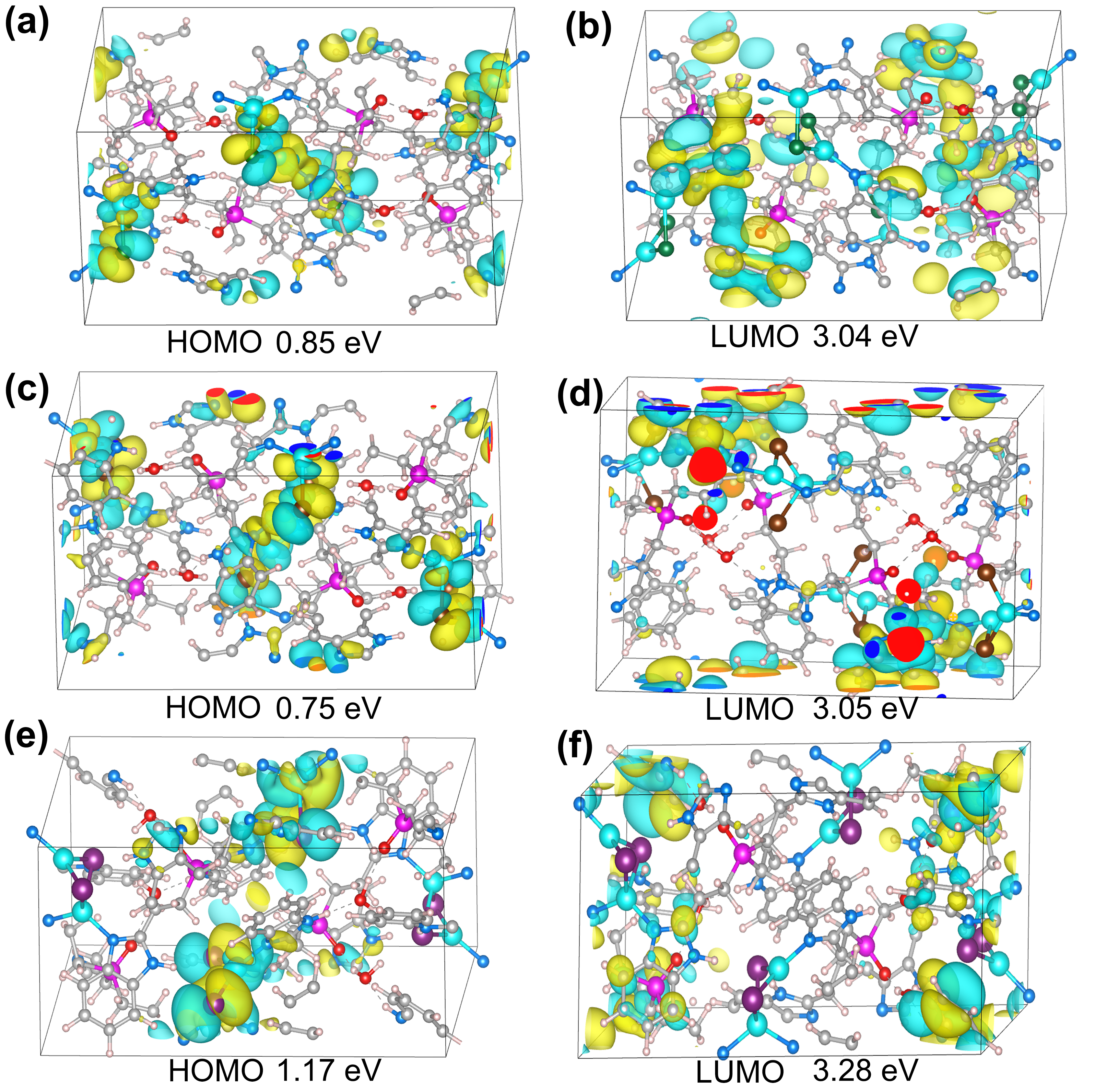
发光型Cu(I)-卤化物金属有机框架是研究微小结构变化与带边电子结构关系的良好平台, 但拓扑固定的系列卤素配合物仍较少. 本工作以三苯并咪唑配体Tbpo和金属CuX (X=Cl、Br、I)构筑了三种二维同构的Cu(I)-卤簇金属有机框架. 三者具有相同的拓扑和相近的配位环境, 随卤素由Cl到I变化, Cu…Cu距离逐渐缩短, 热稳定性逐渐下降. 三种材料均表现出固态发光, 发射峰分别位于423、408和455 nm. 理论计算表明, 其价带边缘具有Cu—X杂化特征, 带隙大小规律为Br>Cl>I, 与发光变化一致. 其中, Tbpo-I中较短的Cu…Cu接触可能增强亲铜作用, 从而导致发射明显红移.
丁宝童, 蔡俊凯, 郭绍杰, 段春迎. 基于拓扑固定的铜卤簇金属有机框架的稳定性与发光调控研究★[J]. 化学学报, 2026, 84(5): 682-688.
Baotong Ding, Junkai Cai, Shaojie Guo, Chunying Duan. Topology-Fixed 2D Cu(I)-Halide Metal-Organic Frameworks with Tunable Stability and Emission★[J]. Acta Chimica Sinica, 2026, 84(5): 682-688.
| [1] |
doi: 10.6023/A21120611 |
|
(张容, 柳江萍, 朱子怡, 陈淑妹, 王飞, 张健, 化学学报, 2022, 80, 249.)
doi: 10.6023/A21120611 |
|
| [2] |
doi: 10.6023/A25050166 |
|
(张士民, 郝朋飞, 于炜玉, 朱慧慧, 杨海英, 沈俊菊, 付云龙, 化学学报, 2025, 83, 1356.)
doi: 10.6023/A25050166 |
|
| [3] |
doi: 10.1002/anie.v61.17 |
| [4] |
doi: 10.1021/acsami.2c11761 |
| [5] |
doi: 10.1007/s40843-023-2731-0 |
| [6] |
doi: 10.1039/D1CC06261A |
| [7] |
doi: 10.1002/anie.v63.40 |
| [8] |
doi: 10.1021/jacs.5c18835 |
| [9] |
doi: 10.1021/acs.inorgchem.5c03421 |
| [10] |
doi: 10.1039/D3SC01217D |
| [11] |
doi: 10.1039/d5dt01521a pmid: 40938126 |
| [12] |
doi: 10.1039/D3CE01001E |
| [13] |
doi: 10.1039/D4CE00173G |
| [14] |
doi: 10.1038/s41586-025-09257-8 |
| [15] |
doi: 10.1021/accountsmr.1c00270 |
| [16] |
doi: 10.1039/D2QI01441F |
| [17] |
doi: 10.1002/chem.v28.25 |
| [18] |
Shubham;
doi: 10.1002/chem.v30.42 |
| [19] |
doi: 10.1016/j.ccr.2020.213757 |
| [20] |
doi: 10.1016/j.dyepig.2025.113252 |
| [21] |
doi: 10.1021/jacs.2c09348 |
| [22] |
doi: 10.1039/D3TA06046B |
| [23] |
doi: 10.1002/adfm.v32.36 |
| [24] |
doi: 10.1002/chem.v25.69 |
| [25] |
|
| [26] |
|
| [27] |
doi: 10.1021/j100785a001 |
| [28] |
doi: 10.1002/adfm.v28.8 |
| [29] |
doi: 10.1039/B818330A |
| [30] |
doi: 10.1021/acscentsci.5c00567 |
| [31] |
doi: 10.1039/D0CC06092E |
| [32] |
doi: 10.1007/s40820-023-01059-9 |
| [33] |
doi: 10.1039/D0CE01452D |
| [34] |
doi: 10.1016/j.ccr.2024.216358 |
| [35] |
doi: 10.1039/D4SC02030H |
| [36] |
doi: 10.1039/D0NR07834D |
| [37] |
doi: 10.1039/D4MH01016G |
| [38] |
doi: 10.1039/D3TC04532C |
| [39] |
doi: 10.1039/c5cp00194c pmid: 25845532 |
| [40] |
doi: 10.1016/j.poly.2022.115761 |
| [41] |
doi: 10.1007/s11431-025-2974-2 |
| [42] |
doi: 10.1021/acs.inorgchem.8b00122 |
| [43] |
doi: 10.1039/d1dt01571k pmid: 34105566 |
| [44] |
doi: 10.1039/D3SC01762A |
| [45] |
doi: 10.1021/acsami.3c17175 |
| [1] | 陈慧滢, 黄宁宇, 廖培钦. 基于银−碳键的新型金属有机框架用于高效光催化合成过氧化氢★[J]. 化学学报, 2026, 84(5): 626-630. |
| [2] | 王炙韬, 林雨珂, 万妍, 黄鑫伟, 李云斌, 吉定豪, 项生昌, 张章静. 快速、绿色机械化学合成UTSA-16(Zn)用于高效碳捕获★[J]. 化学学报, 2026, 84(5): 631-637. |
| [3] | 刘璐, 赵砚珑, 白薛峰, 张鑫, 李建荣. 可宏量制备的层叠配位聚合物用于CH4/N2分离★[J]. 化学学报, 2026, 84(5): 638-642. |
| [4] | 张杨, 张金莉, 庞建东, 卜显和. 高灵敏Eu-MOF荧光探针用于尿液中1-羟基芘的检测★[J]. 化学学报, 2026, 84(5): 667-672. |
| [5] | 张伟宏, 马亚男, 方翰, 薛东旭. 面向乙烯一步纯化的多组分金属有机框架: 金属配体导向合成与C2混合气高效分离★[J]. 化学学报, 2026, 84(5): 659-666. |
| [6] | 冯超越, 薛波, 车国强, 刘大欢. 共价交联策略强化CO2/C2H2高效分离用IL@MOF复合材料的稳定性★[J]. 化学学报, 2026, 84(5): 673-681. |
| [7] | 何乾龙, 胡洁颖, 钟礼匡, 何军. 基于金属有机框架的中性介质硝酸盐电催化还原制氨: 设计策略与机理研究★[J]. 化学学报, 2026, 84(5): 775-804. |
| [8] | 邬佳悦, 王文伯, 谢玉龙, 方伟慧. 铝基金属有机框架材料的主客体化学研究进展★[J]. 化学学报, 2026, 84(5): 697-708. |
| [9] | 张亚, 周功兵, 孙为银. 基于含氮杂环配体的金属有机框架材料在电催化CO2还原中的应用与前景展望★[J]. 化学学报, 2026, 84(5): 755-774. |
| [10] | 邵铭赫, 田烨, 汪娟丽, 苗荣, 房喻. 荧光凝胶区分气相硝基苯酚异构体及其灵敏响应[J]. 化学学报, 2026, 84(4): 484-489. |
| [11] | 彭天资, 沈嘉克, 郭淑雅, 夏潇潇, 李炜. 迁移学习预测金属/共价有机骨架材料内小分子气体自扩散系数研究[J]. 化学学报, 2026, 84(3): 305-315. |
| [12] | 汪庆辉, 任正, 张凯, 周东营, 樊健. 基于3,6-二苯硒基咔唑的多重共振热活化延迟荧光分子[J]. 化学学报, 2026, 84(2): 248-256. |
| [13] | 刘庆, 陈双龙, 王秋实, 王雪娇, 刘才龙. 等离子体辅助合成ZnO:Er3+/Yb3+分级纳米棒及其上转换发光的三模态光学测温性能[J]. 化学学报, 2026, 84(2): 196-207. |
| [14] | 叶舣, 黄正义, 赵兴雷, 赵娅俐, 刘龙杰, 吴武凤, 魏嫣莹. 垂直排列金属有机框架纳米片膜实现高效H2传输[J]. 化学学报, 2026, 84(1): 129-134. |
| [15] | 税子怡, 尹书睿, 邓锦涛, 许留云, 郭莉. 聚乙烯吡咯烷酮辅助金属有机框架衍生分级多孔碳材料的制备及其双功能催化性能研究[J]. 化学学报, 2026, 84(1): 53-63. |
| 阅读次数 | ||||||
|
全文 |
|
|||||
|
摘要 |
|
|||||
