

化学学报 ›› 2026, Vol. 84 ›› Issue (6): 888-896.DOI: 10.6023/A26030067 上一篇 下一篇
研究论文
熊相明a,b, 张林a,b, 徐文军a,b, 唐景航a,b, 杨英a,b,*( )
)
投稿日期:2026-03-04
发布日期:2026-05-15
基金资助:
Xiangming Xionga,b, Lin Zhanga,b, Wenjun Xua,b, Jinghang Tanga,b, Ying Yanga,b,*()
Received:2026-03-04
Published:2026-05-15
Contact:
E-mail: Supported by:文章分享
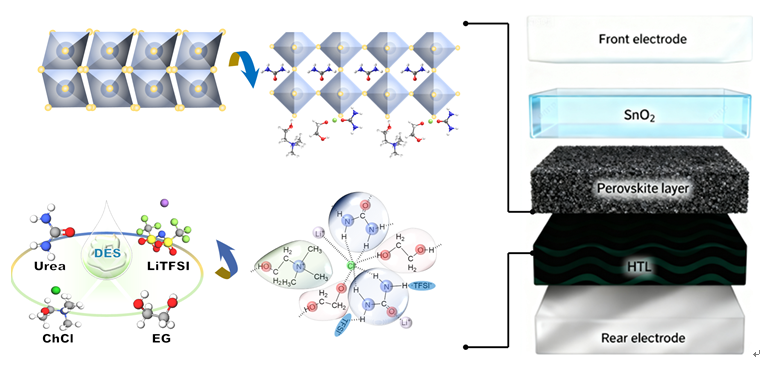
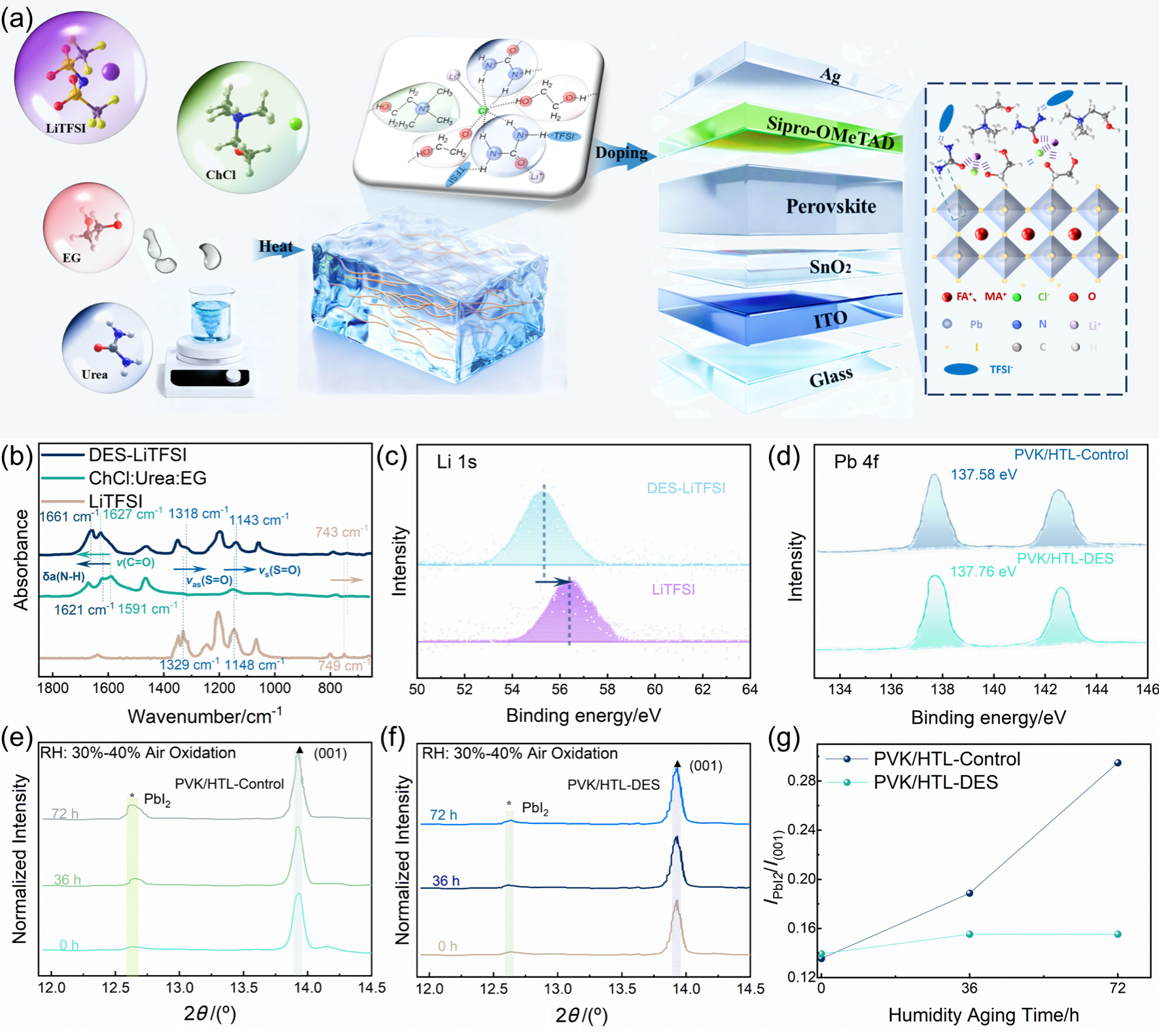
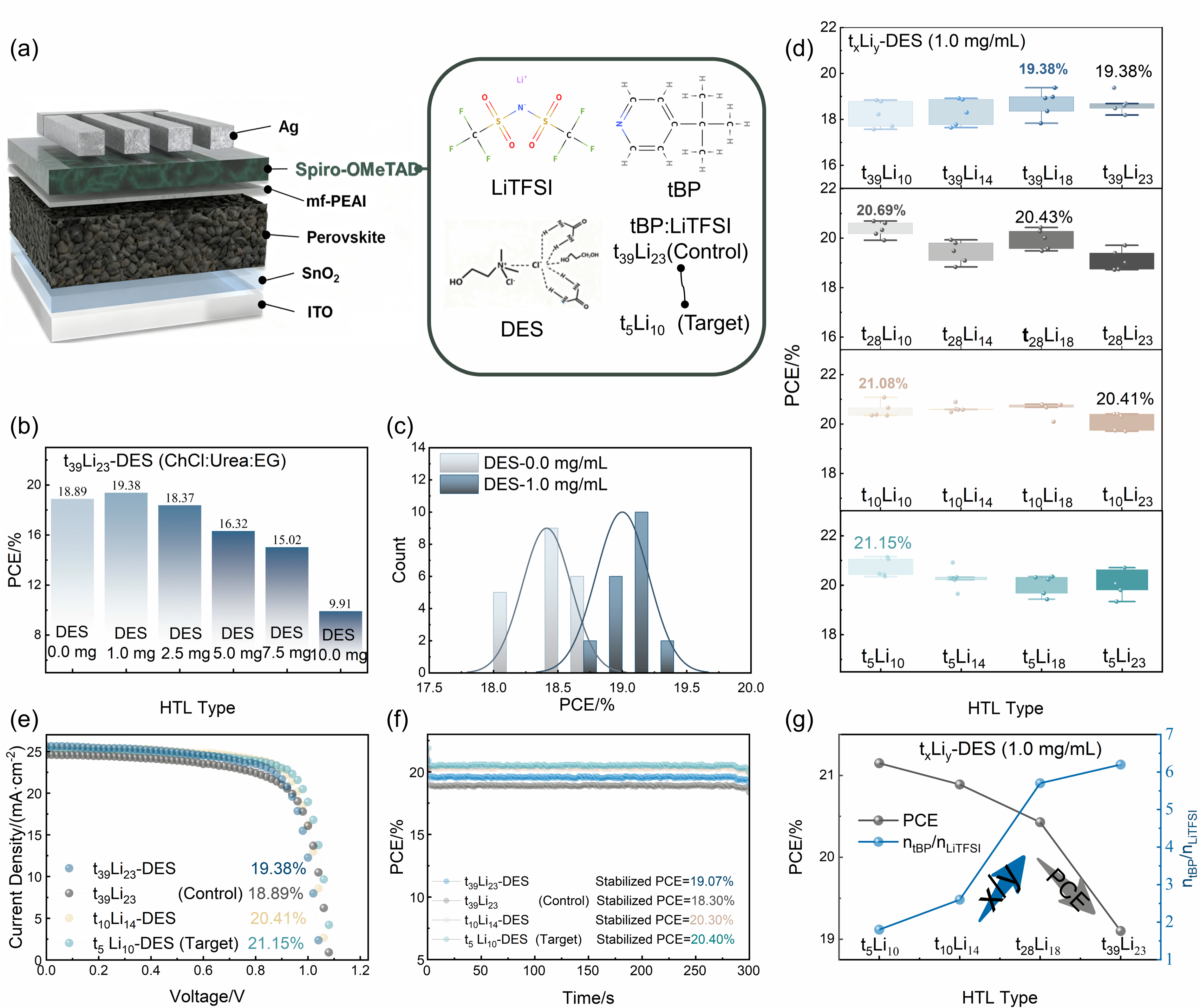
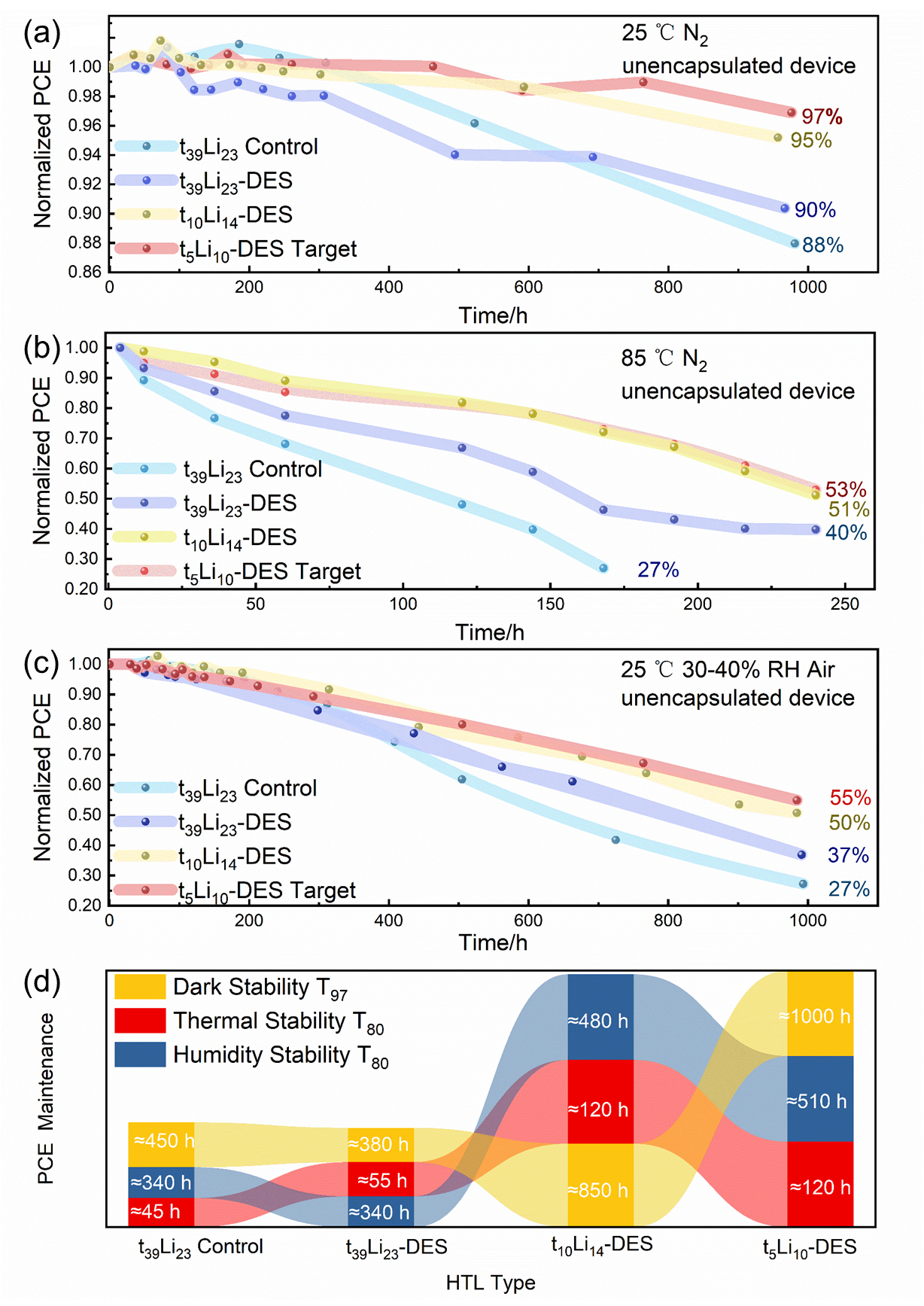
正式钙钛矿太阳能电池(PSCs)凭借高效率、低成本优势在光伏领域具备广阔商业化前景, 但其空穴传输层(HTL)载流子传输效率有限与器件稳定性不足仍是制约产业化的关键问题. 传统4-叔丁基吡啶(tBP)/双三氟甲基磺酰亚胺锂(LiTFSI)掺杂体系存在tBP易挥发、Li+迁移等缺陷, 易引发界面劣化与性能衰减. 基于此, 本工作提出氯化胆碱-尿素-乙二醇组成的低共熔溶剂(DES)掺杂及tBP减量调控策略, 利用DES的氢键与配位作用, 实现固定Li+、界面缺陷钝化与载流子传输通道优化. 该策略使最优器件效率达21.15%, 暗态、热及湿度稳定性均显著提升, 25 ℃ N2中1000 h存储效率保留97%(对照组88%), 85 ℃ N2中T80达120 h (对照组48 h), 30%~40%相对湿度空气中存储500 h后, 维持80%的初始效率(对照组60%), 为PSCs的HTL掺杂工程提供“低用量、高适配、长稳定”的有效策略.
熊相明, 张林, 徐文军, 唐景航, 杨英. 低共熔溶剂固锂与4-叔丁基吡啶减量策略提升正式钙钛矿太阳能电池稳定性[J]. 化学学报, 2026, 84(6): 888-896.
Xiangming Xiong, Lin Zhang, Wenjun Xu, Jinghang Tang, Ying Yang. Deep Eutectic Solvent-Assisted Lithium Immobilization and 4-Tert -butyl pyridine-Less Regulation Strategy for Enhancing the Stability of Conventional Perovskite Solar Cells[J]. Acta Chimica Sinica, 2026, 84(6): 888-896.
| [1] |
doi: 10.1016/j.ccr.2025.216499 |
| [2] |
doi: 10.1016/j.ccr.2025.217086 |
| [3] |
|
| [4] |
doi: 10.3866/PKU.WHXB202309045 |
|
(马尧, 赵欣, 陈红旭, 魏薇, 沈亮, 物理化学学报, 2025, 41, 100030.)
|
|
| [5] |
doi: 10.1126/science.adw8780 |
| [6] |
doi: 10.1016/j.ccr.2025.216500 |
| [7] |
doi: 10.6023/A24040134 |
|
(陈宇波, 郑德旭, 王楠, 刘吉双, 于凤阳, 吴飒建, 刘生忠, 李智鹏, 化学学报, 2024, 82, 987.)
doi: 10.6023/A24040134 |
|
| [8] |
doi: 10.1016/j.joule.2024.10.011 |
| [9] |
|
| [10] |
doi: 10.1002/adma.v37.47 |
| [11] |
doi: 10.1021/jacs.8b09809 |
| [12] |
doi: 10.1016/j.jechem.2024.02.057 |
| [13] |
doi: 10.1016/j.joule.2024.02.022 |
| [14] |
doi: 10.1021/acsaem.1c02375 pmid: 34977473 |
| [15] |
doi: 10.1007/s40820-022-00916-3 |
| [16] |
doi: 10.1016/j.chempr.2019.04.003 |
| [17] |
doi: 10.1002/anie.v64.15 |
| [18] |
doi: 10.3866/PKU.WHXB202303057 |
|
(
|
|
| [19] |
doi: 10.1038/s41467-024-52199-4 |
| [20] |
doi: 10.1038/s41586-021-03518-y |
| [21] |
doi: 10.1016/j.joule.2025.102106 |
| [22] |
doi: 10.1126/science.abo2757 |
| [23] |
doi: 10.1002/adma.v34.23 |
| [24] |
doi: 10.1002/adma.v36.47 |
| [25] |
doi: 10.1016/j.joule.2025.102217 |
| [26] |
doi: 10.1039/D4EE05699J |
| [27] |
doi: 10.1016/j.pmatsci.2024.101338 |
| [28] |
doi: 10.1016/j.jece.2022.109014 |
| [29] |
doi: 10.1039/D5EE07159C |
| [30] |
doi: 10.1038/s41566-024-01596-8 |
| [31] |
doi: 10.1021/acsomega.0c03099 |
| [32] |
doi: 10.1021/acs.jpcb.9b07623 |
| [33] |
doi: 10.1016/j.optmat.2016.01.007 |
| [34] |
doi: 10.1002/anie.v61.31 |
| [35] |
doi: 10.1016/j.jechem.2021.12.005 |
| [36] |
doi: 10.1021/acsami.3c08980 |
| [37] |
doi: 10.1002/adom.v11.17 |
| [38] |
doi: 10.6023/A24070220 |
|
(肖圣宗, 许雄文, 化学学报, 2024, 82, 1031.)
doi: 10.6023/A24070220 |
|
| [39] |
doi: 10.1021/acsenergylett.4c01912 |
| [40] |
doi: 10.1016/j.nanoen.2022.107072 |
| [41] |
doi: 10.1126/science.ade9463 |
| [42] |
doi: 10.1002/anie.v63.5 |
| [43] |
doi: 10.1038/s41566-022-01111-x |
| [44] |
doi: 10.6023/A25100347 |
|
(汪佳艳, 郭焕焕, 殷逍遥, 张昀照, 王威, 赵晨瑞, 陈洁, 文洁, 孙伟海, 化学学报, 2026, 84, 231.)
doi: 10.6023/A25100347 |
|
| [45] |
doi: 10.6023/A24120384 |
|
(朱文昊, 汪玉杰, 李浩, 汪杨, 郑松志, 王则远, 陈劭添, 孙伟海, 赵小敏, 化学学报, 2025, 83, 616.)
doi: 10.6023/A24120384 |
|
| [46] |
doi: 10.6023/A24030093 |
|
(张林, 张慧, 朱从潭, 郭学益, 杨英, 化学学报, 2024, 82, 971.)
doi: 10.6023/A24030093 |
| [1] | 马玲玲, 凌琳, 李玉学, 吕龙. 复合型含能基团结构和性能的理论研究[J]. 化学学报, 2026, 84(6): 828-839. |
| [2] | 马洪芳, 邓玉雪, 周平凡, 黄鹏, 吴岭, 曲会鑫, 李金焕, 申来法, 张校刚, 佟浩. 铟离子掺杂ZIF-8涂层修饰锌电极实现锌离子混合电容器长循环寿命[J]. 化学学报, 2026, 84(6): 840-848. |
| [3] | 丁宝童, 蔡俊凯, 郭绍杰, 段春迎. 基于拓扑固定的铜卤簇金属有机框架的稳定性与发光调控研究★[J]. 化学学报, 2026, 84(5): 682-688. |
| [4] | 冯超越, 薛波, 车国强, 刘大欢. 共价交联策略强化CO2/C2H2高效分离用IL@MOF复合材料的稳定性★[J]. 化学学报, 2026, 84(5): 673-681. |
| [5] | 汪佳艳, 郭焕焕, 殷逍遥, 张昀照, 王威, 赵晨瑞, 陈洁, 文洁, 孙伟海. 四乙基氢氧化铵界面修饰制备高效甲脒溴化铅钙钛矿太阳能电池[J]. 化学学报, 2026, 84(2): 231-239. |
| [6] | 武传硕, 程靓. 5-甲基尿苷(m5U)RNA修饰的生物学功能研究进展★[J]. 化学学报, 2025, 83(9): 1046-1054. |
| [7] | 薛兰, 刘爽, 章硕, 伽龙. Ni2+掺杂改性对LiMn0.75Fe0.25PO4正极材料电化学性能的影响[J]. 化学学报, 2025, 83(8): 853-860. |
| [8] | 朱文昊, 汪玉杰, 李浩, 汪杨, 郑松志, 王则远, 陈劭添, 孙伟海, 赵小敏. 聚丙烯酸钠界面工程制备高效稳定的全无机CsPbBr3钙钛矿太阳能电池[J]. 化学学报, 2025, 83(6): 616-623. |
| [9] | 张子晗, 马光政, 年彬彬, 胡燚. 固定化与溶剂设计协同提高脂肪酶合成维生素E琥珀酸酯效率机制研究[J]. 化学学报, 2025, 83(2): 119-125. |
| [10] | 张智强, 董德锐, 曹柳悦, 张斌伟. 三维碳基集流体在高比能钠金属电池中的应用与展望★[J]. 化学学报, 2025, 83(11): 1386-1396. |
| [11] | 马莹, 陈维希, 刘羽辰, 刘子义, 吴涛, 陆安慧, 王东琪. 六方氮化硼氧化模式的密度泛函理论研究[J]. 化学学报, 2025, 83(1): 52-59. |
| [12] | 马金珠, 李阳, 高珊, 赵越, 丁磊, 周东营, 樊健. 基于吩嗪受体单元的高效近红外热激活延迟荧光[J]. 化学学报, 2025, 83(1): 17-24. |
| [13] | 张林, 张慧, 朱从潭, 郭学益, 杨英. CsPbIBr2钙钛矿太阳能电池湿度稳定机制研究[J]. 化学学报, 2024, 82(9): 971-978. |
| [14] | 郭云凤, 王俊贤, 王泽星, 李家茂, 刘畅. (1-x)NaNbO3-x(0.3Bi0.5Na0.5TiO3-0.7BiFeO3)陶瓷的介电以及储能性能研究[J]. 化学学报, 2024, 82(5): 511-519. |
| [15] | 刘雪朋, 李博桐, 韩明远, 张先付, 陈建林, 戴松元. 自组装单分子空穴传输层在反式钙钛矿太阳电池的研究进展[J]. 化学学报, 2024, 82(3): 348-366. |
| 阅读次数 | ||||||
|
全文 |
|
|||||
|
摘要 |
|
|||||
