

化学学报 ›› 2026, Vol. 84 ›› Issue (9): 1525-1533.DOI: 10.6023/A26050172 上一篇 下一篇
综述
赵逸伦a, 王朝晖b, 姜玮a,*( )
)
投稿日期:2026-05-21
发布日期:2026-07-08
通讯作者:
姜玮
作者简介: |
赵逸伦, 中国科学院大学化学科学学院2025级在读博士研究生. 目前研究方向为手性共轭分子材料的设计合成及其手性性质研究. |
 |
王朝晖, 清华大学化学系教授, 博士生导师. 2005年入选中国科学院百人计划, 2012年获国家杰出青年科学基金资助, 2014年获中国化学会--巴斯夫公司青年知识创新奖, 2017年入选万人计划科技创新领军人才. 长期从事多尺度多维度分子碳材料体系的设计合成、可控组装以及分子器件的研究工作. 迄今在国际学术刊物上发表SCI收录论文200余篇. 承担国家重点研发计划纳米科技专项(首席科学家)、国家自然科学基金重点项目、中国科学院先导B项目子课题和科技部国家重大研究计划子课题等. |
 |
姜玮, 中国科学院大学化学科学学院教授, 博士生导师. 2011年博士毕业于中国科学院化学研究所, 2017年入选“中国科学院青年创新促进会”会员, 2021年获国家自然科学基金委优秀青年科学基金项目资助, 2024年获Thieme Chemistry Journals Award. 长期聚焦有机共轭分子功能材料的高效创制和功能调控开展研究工作, 迄今在Acc. Chem. Res., Chem. Soc. Rev., J. Am. Chem. Soc., Angew. Chem. Int. Ed., Adv. Mater., CCS Chemistry, Sci. China Chem.等国际学术刊物上发表SCI收录论文120余篇. |
基金资助:
Yilun Zhaoa, Zhaohui Wangb, Wei Jianga,*()
Received:2026-05-21
Published:2026-07-08
Contact:
Wei Jiang
Supported by:文章分享
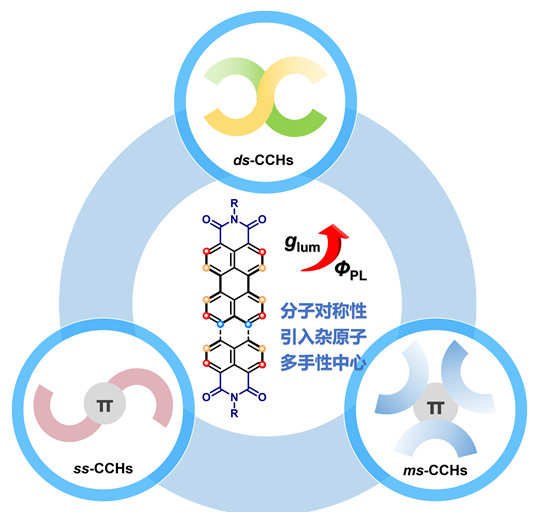
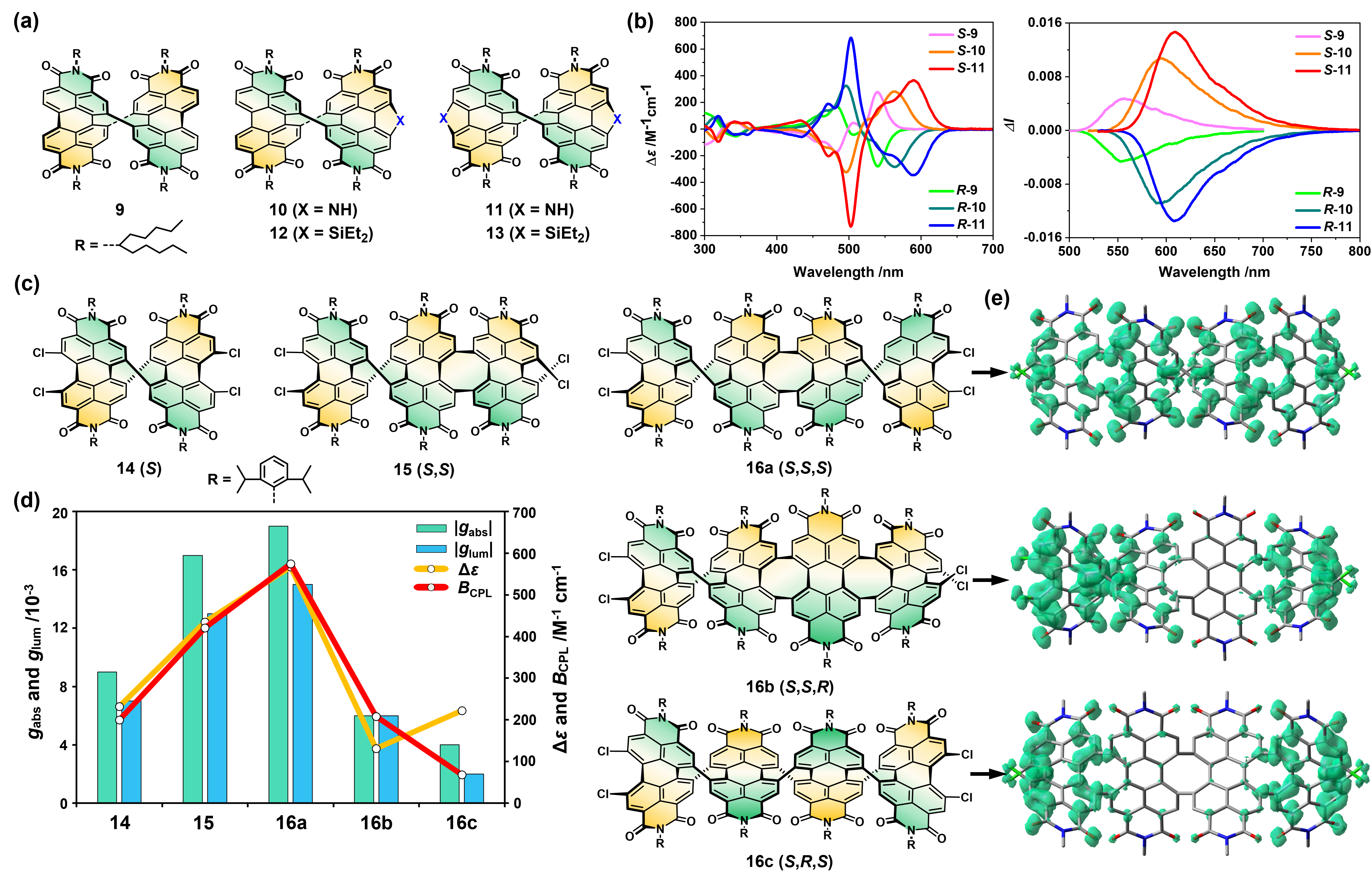
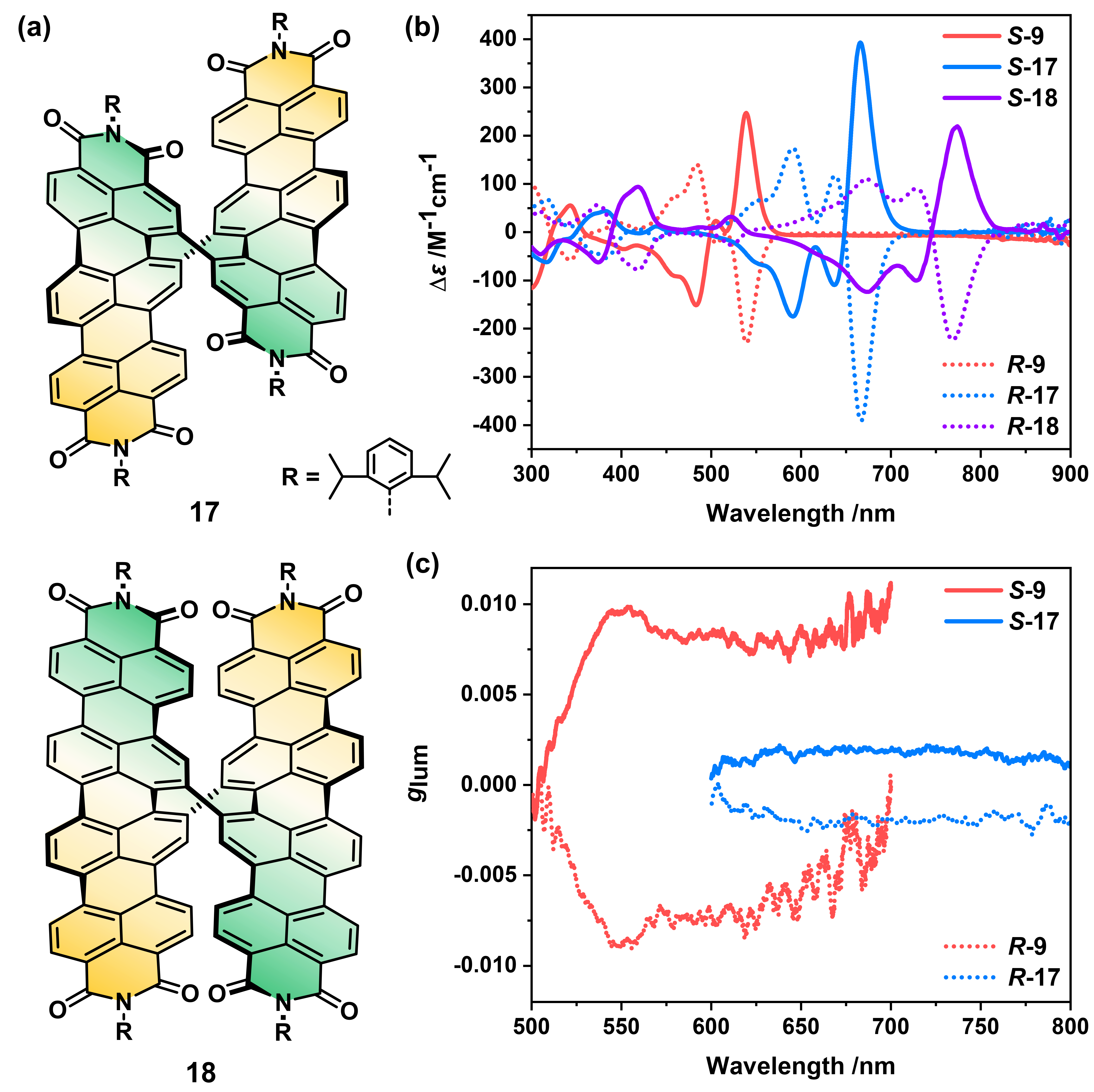
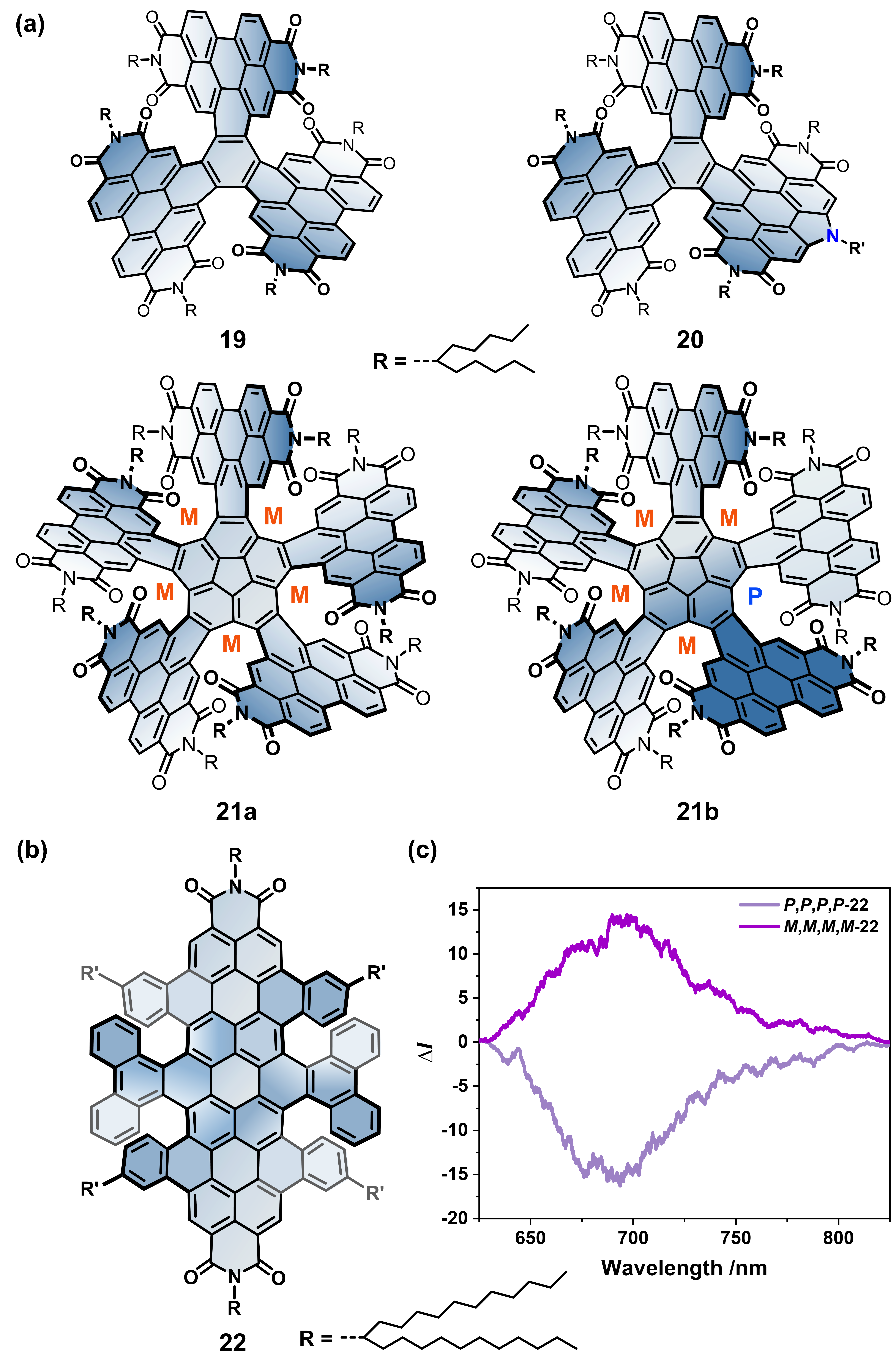
手性分子碳酰亚胺(CMCIs)凭借其独特的π-共轭骨架、优异的光化学稳定性以及可调控的光电性质, 为高效圆偏振发光(CPL)材料的设计与开发提供了新的契机. 近年来, 随着分子设计与精准合成策略的不断发展, 研究人员通过提高分子对称性、引入杂环结构以及构建多手性中心等方法, 在提升发光不对称因子(glum)、荧光量子产率(ΦPL)和圆偏振发光亮度(BCPL)等方面取得突破, 并揭示了手性的产生、传递和放大的内在规律, 推动了圆偏振发光体系的发展. 然而, 如何实现glum、ΦPL与BCPL的协同优化, 是手性功能材料领域的核心挑战. 本文系统综述了近年来具有圆偏振发光性质的手性分子碳酰亚胺研究进展, 从单链、双链到多链手性共轭螺旋等不同拓扑结构对代表性体系进行了分类总结, 重点阐述了分子结构特征、电子跃迁行为与圆偏振发光性能之间的构效关系, 分析了影响圆偏振发光性能的关键分子设计因素. 最后, 对该领域面临的分子设计策略和应用前景做了展望.
赵逸伦, 王朝晖, 姜玮. 手性分子碳酰亚胺的圆偏振发光[J]. 化学学报, 2026, 84(9): 1525-1533.
Yilun Zhao, Zhaohui Wang, Wei Jiang. Chiral Molecular Carbon Imides for Circularly Polarized Luminescence[J]. Acta Chimica Sinica, 2026, 84(9): 1525-1533.

| 化合物 | ФPL/% | glum (10-3) | BCPL/(mol-1•L•cm-1) | Ref. | ||
|---|---|---|---|---|---|---|
| 1 | 73 | 0.5 | 22 | [ | ||
| 2 | 69 | 2.3 | 67 | [ | ||
| 3 | 33 | 2.0 | 9 | [ | ||
| 4 | 31 | 0.5 | 2 | [ | ||
| 5 | 27 | 3.1 | 30 | [ | ||
| 6 | 48 | 2.8 | 77 | [ | ||
| 7 | 58 | 6.1 | 219 | [ | ||
| 8 | 68 | 12 | 522 | [ | ||
| 9 | 62 | 10 | 187 | [ | ||
| 10 | 50 | 22 | 346 | [ | ||
| 11 | 41 | 30 | 573 | [ | ||
| 12 | 70 | 9.0 | 162 | [ | ||
| 13 | 68 | 15 | 207 | [ | ||
| 14 | 95 | 7.0 | 200 | [ | ||
| 15 | 93 | 13 | 421 | [ | ||
| 16a | 93 | 15 | 575 | [ | ||
| 16b | 83 | 6.0 | 208 | [ | ||
| 16c | 85 | 2.0 | 68 | [ | ||
| 17 | 39 | 2.0 | 54 | [ | ||
| 18 | — | — | — | [ | ||
| 19 | 13 | — | — | [ | ||
| 20 | 11 | 1.2 | 6 | [ | ||
| 21a | 10 | 12 | 172 | [ | ||
| 21b | 14 | 8.0 | 132 | [ | ||
| 22 | 37 | 3.0 | 93 | [ | ||
| 化合物 | ФPL/% | glum (10-3) | BCPL/(mol-1•L•cm-1) | Ref. | ||
|---|---|---|---|---|---|---|
| 1 | 73 | 0.5 | 22 | [ | ||
| 2 | 69 | 2.3 | 67 | [ | ||
| 3 | 33 | 2.0 | 9 | [ | ||
| 4 | 31 | 0.5 | 2 | [ | ||
| 5 | 27 | 3.1 | 30 | [ | ||
| 6 | 48 | 2.8 | 77 | [ | ||
| 7 | 58 | 6.1 | 219 | [ | ||
| 8 | 68 | 12 | 522 | [ | ||
| 9 | 62 | 10 | 187 | [ | ||
| 10 | 50 | 22 | 346 | [ | ||
| 11 | 41 | 30 | 573 | [ | ||
| 12 | 70 | 9.0 | 162 | [ | ||
| 13 | 68 | 15 | 207 | [ | ||
| 14 | 95 | 7.0 | 200 | [ | ||
| 15 | 93 | 13 | 421 | [ | ||
| 16a | 93 | 15 | 575 | [ | ||
| 16b | 83 | 6.0 | 208 | [ | ||
| 16c | 85 | 2.0 | 68 | [ | ||
| 17 | 39 | 2.0 | 54 | [ | ||
| 18 | — | — | — | [ | ||
| 19 | 13 | — | — | [ | ||
| 20 | 11 | 1.2 | 6 | [ | ||
| 21a | 10 | 12 | 172 | [ | ||
| 21b | 14 | 8.0 | 132 | [ | ||
| 22 | 37 | 3.0 | 93 | [ | ||
| [1] |
doi: 10.1103/PhysRevLett.118.113901 |
| [2] |
doi: 10.1002/adma.v35.44 |
| [3] |
doi: 10.1002/lpor.v19.3 |
| [4] |
doi: 10.1038/s41570-017-0045 |
| [5] |
doi: 10.1002/adfm.v31.20 |
| [6] |
doi: 10.1002/adom.v6.17 |
| [7] |
doi: 10.1002/adfm.v31.38 |
| [8] |
doi: 10.1038/s41586-023-05877-0 |
| [9] |
doi: 10.1038/nature05136 |
| [10] |
doi: 10.1002/admt.v5.9 |
| [11] |
doi: 10.1038/s41467-022-28070-9 |
| [12] |
doi: 10.1002/adma.v30.13 |
| [13] |
doi: 10.1002/advs.v9.20 |
| [14] |
doi: 10.1126/science.1134231 |
| [15] |
doi: 10.1002/chem.v25.53 |
| [16] |
doi: 10.1038/nphoton.2013.176 |
| [17] |
doi: 10.1038/s41467-025-57000-8 |
| [18] |
doi: 10.1038/s41467-022-35745-w |
| [19] |
doi: 10.1021/acsnano.8b08273 |
| [20] |
doi: 10.1038/s41467-025-62232-9 |
| [21] |
doi: 10.1021/nl303445u |
| [22] |
doi: 10.6023/cjoc202510014 |
|
(张梦媛, 袁之敏, 有机化学, 2026, 46, 1871.)
doi: 10.6023/cjoc202510014 |
|
| [23] |
doi: 10.6023/cjoc202208023 |
|
(杨晓东, 郑小康, 董海亮, 孙静, 王华, 有机化学, 2023, 43, 1292.)
doi: 10.6023/cjoc202208023 |
|
| [24] |
doi: 10.1021/cr60310a001 |
| [25] |
doi: 10.1002/chem.v27.9 |
| [26] |
doi: 10.1007/s11426-021-1146-6 |
| [27] |
doi: 10.6023/A25010004 |
|
(潘禹州, 殷炜杰, 张雨霞, 化学学报, 2025, 83, 639.)
doi: 10.6023/A25010004 |
|
| [28] |
doi: 10.6023/A24030071 |
|
(李小贞, 孙庆福, 化学学报, 2024, 82, 707.)
doi: 10.6023/A24030071 |
|
| [29] |
doi: 10.1002/anie.v61.30 |
| [30] |
doi: 10.1002/anie.v57.11 |
| [31] |
doi: 10.1021/jacs.1c08482 |
| [32] |
doi: 10.1021/acs.macromol.6b02798 |
| [33] |
doi: 10.1002/anie.v59.28 |
| [34] |
doi: 10.1039/c2py20530k |
| [35] |
doi: 10.1021/jacs.9b13184 pmid: 31909994 |
| [36] |
|
| [37] |
doi: 10.1021/ja412294s pmid: 24524257 |
| [38] |
doi: 10.6023/A25010010 |
|
(方素琴, 童恺宁, 陈思浛, 张千峰, 童碧海, 冯敏强, 孔辉, 化学学报, 2025, 83, 471.)
doi: 10.6023/A25010010 |
|
| [39] |
doi: 10.1039/C9CC06861A |
| [40] |
doi: 10.1021/jacs.1c09058 |
| [41] |
doi: 10.1021/ja500841f pmid: 24670158 |
| [42] |
doi: 10.6023/cjoc202504012 |
|
(孙翠萍, 薛雨婷, 陈磅宽, 有机化学, 2025, 45, 4048.)
|
|
| [43] |
doi: 10.1073/pnas.1717524114 |
| [44] |
doi: 10.1002/anie.v59.4 |
| [45] |
|
| [46] |
doi: 10.1021/jo2001963 pmid: 21410184 |
| [47] |
doi: 10.1021/acs.chemrev.6b00160 |
| [48] |
doi: 10.1039/D0CS00239A |
| [49] |
doi: 10.1039/c8qo01368c |
| [50] |
doi: 10.1002/chem.19970030209 pmid: 24022951 |
| [51] |
|
| [52] |
doi: 10.1021/ja110486s |
| [53] |
doi: 10.1002/smll.v20.17 |
| [54] |
doi: 10.1002/anie.v58.6 |
| [55] |
doi: 10.1021/jacs.2c04642 |
| [56] |
doi: 10.1021/accountsmr.4c00304 |
| [57] |
doi: 10.1039/c5cs00620a pmid: 26765050 |
| [58] |
doi: 10.1021/jacs.3c03441 |
| [59] |
doi: 10.1021/jacs.0c00954 pmid: 32197045 |
| [60] |
doi: 10.1002/adom.v13.12 |
| [61] |
doi: 10.1039/c0cc01011a |
| [62] |
doi: 10.1002/chem.201103954 pmid: 22556113 |
| [63] |
doi: 10.1021/jacs.2c04012 |
| [64] |
|
| [65] |
doi: 10.1021/jacs.3c11942 |
| [66] |
doi: 10.1021/jacs.4c02914 pmid: 38696816 |
| [67] |
doi: 10.1021/jacs.6b04368 |
| [68] |
doi: 10.1007/s11426-019-9632-2 |
| [69] |
doi: 10.1021/jacs.9b00053 |
| [70] |
doi: 10.1007/s11426-023-1686-4 |
| [71] |
|
| [72] |
doi: 10.1007/s11426-023-1902-0 |
| [1] | 唐允浩, 周齐治, 王韬, 邱智恒, 乐效靖, 张燕, 余金生. 三红胡萝卜和香菜介导的氟代芳香酮不对称还原反应[J]. 化学学报, 2026, 84(8): 1305-1311. |
| [2] | 刘腾, 郭易江, 田冰倩, 吴建萍, 何江波. 手性膦酸对映选择性催化开环/亲电反应合成α,α-双吲哚三芳基甲烷[J]. 化学学报, 2026, 84(7): 1025-1032. |
| [3] | 王赵兴, 王新超, 郑晨阳, 李尚达, 张健. 基于天然樟脑酸构筑的阶梯状手性金属-有机框架及其协同不对称催化★[J]. 化学学报, 2026, 84(5): 619-625. |
| [4] | 孙天凯, 韩宗甦, 程鹏, 师唯. 手性金属-有机框架的合成与性质研究进展★[J]. 化学学报, 2026, 84(5): 723-735. |
| [5] | 甘定伟, 周儒森, 应见喜, 周仁武. 等离子体放电在生命化学起源中的研究进展[J]. 化学学报, 2026, 84(2): 257-263. |
| [6] | 黄静, 赵乐妍, 徐勃. 基于发光太阳能聚光器的透明光伏技术: 效率瓶颈、材料设计与前景展望[J]. 化学学报, 2026, 84(1): 160-172. |
| [7] | 李斌, 张静枫, 聂慧芳, 卢泽星, 杨贵东, 张生勇. Mn(0)催化酮的不对称氢化反应[J]. 化学学报, 2025, 83(7): 661-666. |
| [8] | 潘禹州, 殷炜杰, 张雨霞. 手性超分子组装圆偏振室温磷光材料的研究进展[J]. 化学学报, 2025, 83(6): 639-654. |
| [9] | 方素琴, 童恺宁, 陈思浛, 张千峰, 童碧海, 冯敏强, 孔辉. 基于呫吨酮电子受体的高效圆偏振热活化延迟荧光材料[J]. 化学学报, 2025, 83(5): 471-478. |
| [10] | 李晖, 殷亮. 手性有机硒化合物的催化不对称合成研究进展[J]. 化学学报, 2025, 83(10): 1237-1251. |
| [11] | 张妞, 韩书冉, 马宏伟, 陈磅宽. 基于联二萘酚的手性有机发光分子合成与性能研究[J]. 化学学报, 2025, 83(1): 10-16. |
| [12] | 王玉, 于聪, 夏艳芳, 林蓝, 陈强, 王新波. 一种手性自具微孔聚合物的合成及手性荧光识别[J]. 化学学报, 2024, 82(8): 914-918. |
| [13] | 江杏杏, 武卫龙, 任慧莹, 张凤, 莫文枝, 卢志强. 新型手性三齿PNN配体锰配合物催化的芳香酮类化合物的不对称氢化反应研究[J]. 化学学报, 2024, 82(7): 736-741. |
| [14] | 李小贞, 孙庆福. 稀土圆偏振发光材料研究进展[J]. 化学学报, 2024, 82(6): 707-730. |
| [15] | 郑灏宁, 刘金宇. 有机催化吲哚碳环官能团化研究进展[J]. 化学学报, 2024, 82(6): 641-657. |
| 阅读次数 | ||||||
|
全文 |
|
|||||
|
摘要 |
|
|||||
