有机化学 ›› 2026, Vol. 46 ›› Issue (8): 2926-2948.DOI: 10.6023/cjoc202602018 上一篇 下一篇
综述与进展
朱晓宇, 罗宜铭, 孙墁, 李文泽*( )
)
收稿日期:2026-02-21
修回日期:2026-05-06
发布日期:2026-05-27
基金资助:
Xiaoyu Zhu, Yiming Luo, Man Sun, Wenze Li*()
Received:2026-02-21
Revised:2026-05-06
Published:2026-05-27
Contact:
*E-mail: liwenze@syuct.edu.cn
Supported by:文章分享
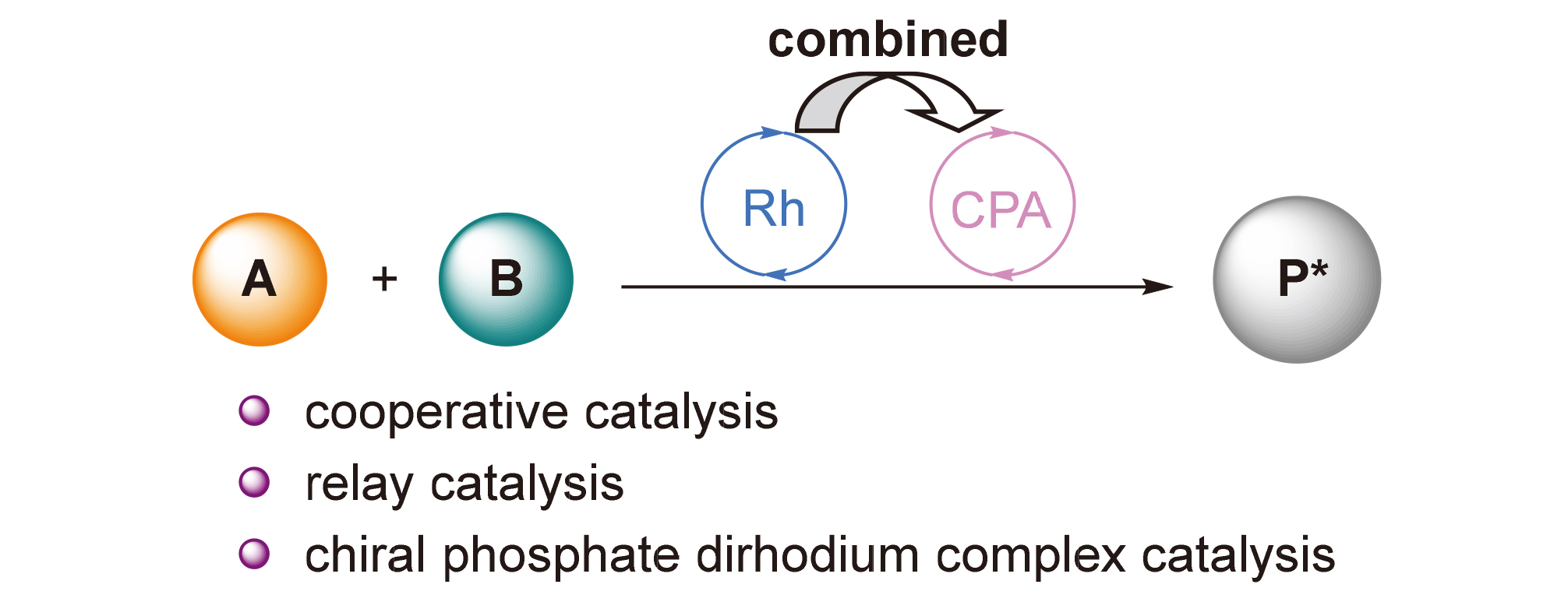
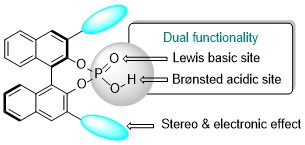
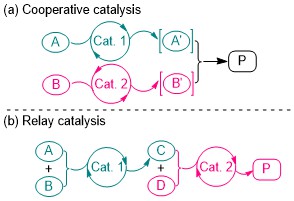
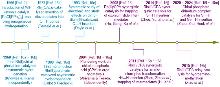
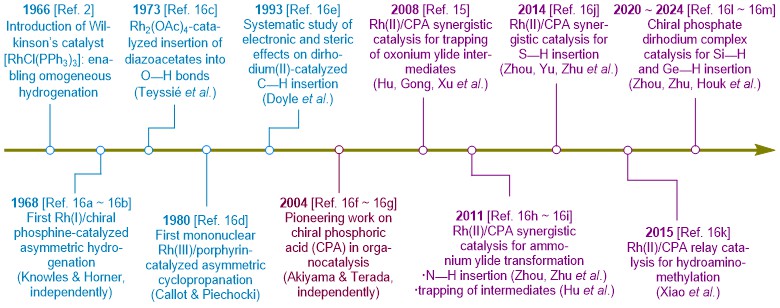
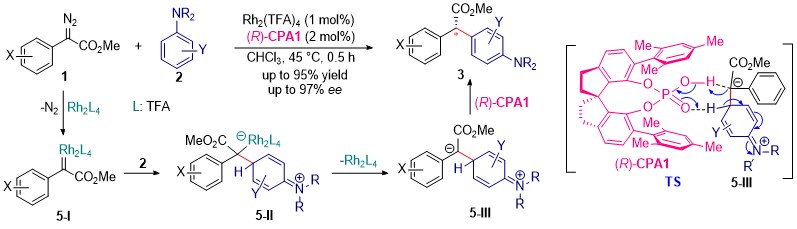
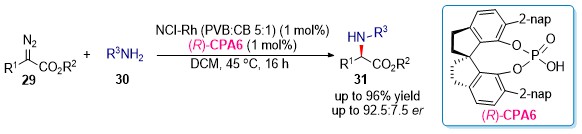
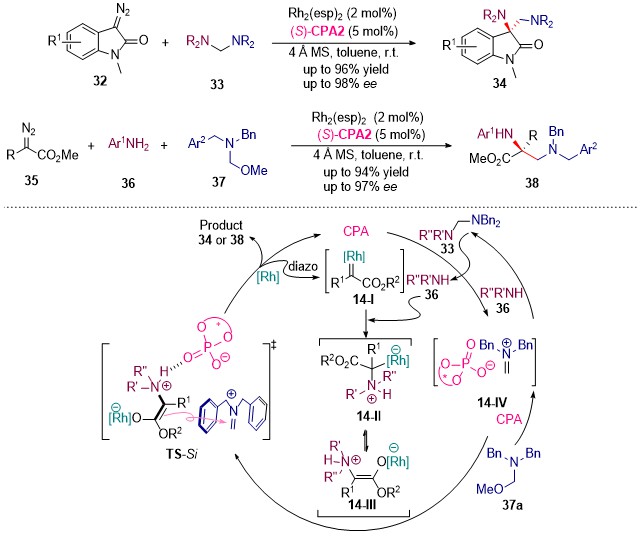
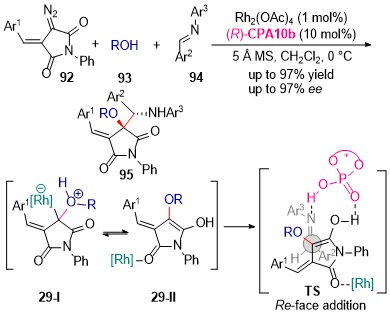
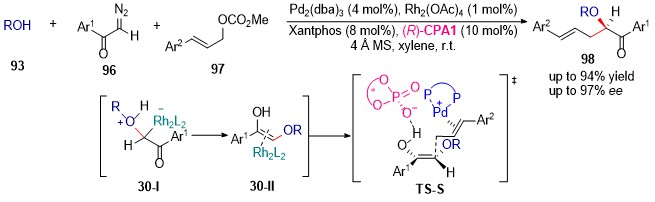
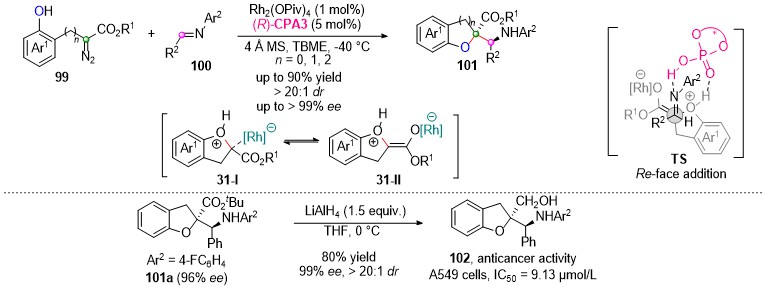
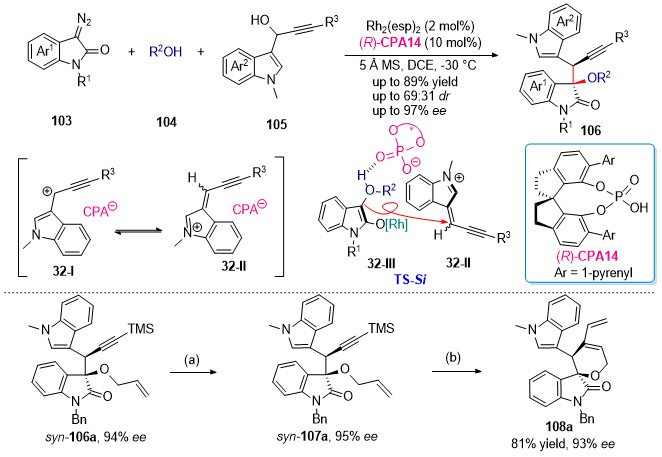
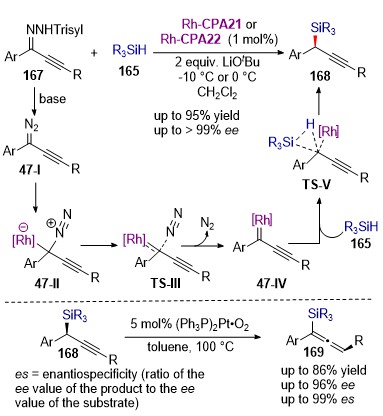
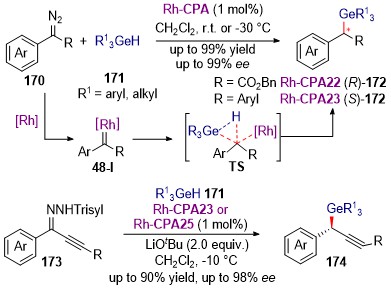
铑配合物因其独特的电子构型和多样的氧化态, 在过渡金属催化领域占据核心地位, 尤其是具有“桨轮”结构的双核铑(II)配合物, 能够高效介导重氮化合物的分解, 并生成高活性的铑卡宾中间体, 进而参与多种重要的卡宾转移反应. 然而, 在传统的单一手性铑催化的不对称卡宾转移反应中, 当经历分步机理时, 金属中心往往在立体选择性决定步骤之前发生解离, 导致产物的对映选择性难以得到有效控制. 为克服这一挑战, 化学家们发展了铑与手性磷酸协同作用的双催化策略. 手性磷酸作为一种优异的双功能有机小分子催化剂, 能够通过其独特的空间位阻效应与氢键供体能力, 在不依赖金属中心配位的情况下, 精准控制反应的立体选择性. 系统综述了2014年以来铑与手性磷酸共同参与的卡宾不对称催化反应的研究进展, 重点从协同催化、接力催化以及手性磷酸铑配合物催化三个方面展开讨论, 梳理该领域的发展脉络, 为复杂手性分子的构建提供新的思路.
朱晓宇, 罗宜铭, 孙墁, 李文泽. 铑和手性磷酸参与的卡宾不对称催化反应研究进展[J]. 有机化学, 2026, 46(8): 2926-2948.
Xiaoyu Zhu, Yiming Luo, Man Sun, Wenze Li. Recent Advances in Asymmetric Carbene Catalytic Reactions Mediated by Rhodium and Chiral Phosphoric Acid[J]. Chinese Journal of Organic Chemistry, 2026, 46(8): 2926-2948.










| [1] |
|
| [2] |
|
| [3] |
(a)
|
|
(b)
|
|
|
(c)
|
|
| [4] |
(a)
|
|
(b)
|
|
| [5] |
(a)
|
|
(b)
|
|
|
(c)
|
|
| [6] |
(a)
|
|
(b)
|
|
|
(c)
|
|
| [7] |
(a)
|
|
(洪科苗, 黄晶晶, 姚铭瀚, 徐新芳, 有机化学, 2022, 42, 344.)
|
|
|
(b)
|
|
|
(c)
|
|
|
(d)
|
|
|
(蒋镓西, 刘全忠, 有机化学, 2024, 44, 2640.)
|
|
|
(e)
|
|
|
(f)
|
|
|
(g)
|
|
|
(h)
|
|
|
(i)
|
|
|
(j)
|
|
|
(k)
|
|
| [8] |
|
|
(张君友, 徐明华, 中国科学: 化学, 2023, 53, 447.)
|
|
| [9] |
(a)
|
|
(b)
|
|
| [10] |
(a)
|
|
(b)
|
|
| [11] |
(a)
|
|
(b)
|
|
|
(高勇军, 杨丽华, 宋双居, 马晶军, 唐然肖, 边瑞环, 刘海燕, 吴秋华, 王春, 有机化学, 2008, 28, 8.)
|
|
|
(c)
|
|
|
(d)
|
|
| [12] |
(a)
|
|
(吴祥, 李明丽, 龚流柱, 化学学报, 2013, 71, 1091.)
|
|
|
(b)
|
|
|
(向勋, 何照林, 董秀琴, 有机化学, 2023, 43, 791.)
|
|
|
(c)
|
|
|
(朱晓宇, 杨诗林, 罗宜铭, 李文泽, 有机化学, 2025, 45, 1178.)
|
|
| [13] |
|
| [14] |
|
| [15] |
(a)
|
|
(b)
|
|
| [16] |
(a)
|
|
(b)
|
|
|
(c)
|
|
|
(d)
|
|
|
(e)
|
|
|
(f)
|
|
|
(g)
|
|
|
(h)
|
|
|
(i)
|
|
|
(j)
|
|
|
(k)
|
|
|
(l)
|
|
|
(m)
|
|
| [17] |
(a)
|
|
(b)
|
|
|
(c)
|
|
|
(d)
|
|
|
(e)
|
|
| [18] |
|
| [19] |
|
| [20] |
|
| [21] |
|
| [22] |
|
| [23] |
|
| [24] |
|
| [25] |
|
| [26] |
|
| [27] |
|
| [28] |
|
| [29] |
|
| [30] |
|
| [31] |
|
| [32] |
|
| [33] |
|
|
(李茂霖, 陈梦青, 徐彬, 朱守非, 周其林, 化学学报, 2013, 76, 883).
|
|
| [34] |
|
| [35] |
|
| [36] |
|
| [37] |
|
| [38] |
|
| [39] |
|
| [40] |
(a)
|
|
(b)
|
|
| [41] |
|
| [42] |
|
| [43] |
|
| [44] |
|
| [45] |
|
| [46] |
|
| [47] |
|
| [48] |
|
| [49] |
|
| [50] |
|
| [51] |
|
| [52] |
|
| [53] |
|
| [54] |
|
| [55] |
|
| [56] |
|
| [57] |
|
| [58] |
|
| [59] |
|
| [60] |
|
| [61] |
(a)
|
|
(b)
|
|
| [62] |
|
| [63] |
|
| [1] | 郑湧龙, 罗鑫龙, 徐裕敏, 霍浩华. 金属-光协同催化的C(sp3)—C(sp3)还原偶联[J]. 有机化学, 2026, 46(7): 2589-2603. |
| [2] | 奚晓翔, 高明, 韩立彪. 铑催化氢气还原RS—SR到硫酚/醇[J]. 有机化学, 2026, 46(3): 859-865. |
| [3] | 曾依玲, 梁方鹏, 李辉, 刘荣荣, 李世清. α-氧代羧酸、炔和伯胺的多组分碳氢环化构筑异喹啉鎓骨架[J]. 有机化学, 2026, 46(2): 554-563. |
| [4] | 任才艺, 董文楠, 刘敬功, 杨爽, 房新强. 铑催化由环丙烯酮合成酰偶姻衍生物[J]. 有机化学, 2026, 46(2): 486-495. |
| [5] | 张丛玉, 陈晓琦, 孟凡涛, 王海营, 郝文娟, 姜波. 金自接力催化1,3-烯炔醋酸酯与环醚缩醛的环化/亲核取代反应研究[J]. 有机化学, 2025, 45(6): 2199-2207. |
| [6] | 马海宸, 周钧岍, 王嘉利, 王优, 朱少林. 镍催化的迁移偶联反应研究进展[J]. 有机化学, 2025, 45(6): 1871-1904. |
| [7] | 高根伟, 李震, 李炎, 陆熹. 光/镍协同催化C(sp2)—C(sp3)键构建研究进展[J]. 有机化学, 2025, 45(6): 1905-1919. |
| [8] | 唐梦瑶, 杨晓瑜. 手性磷酸催化不对称亲电胺化反应研究进展[J]. 有机化学, 2025, 45(6): 1785-1818. |
| [9] | 朱晓宇, 杨诗林, 罗宜铭, 李文泽. 金和手性磷酸共催化的不对称合成研究进展[J]. 有机化学, 2025, 45(4): 1178-1193. |
| [10] | 张晓锋, Aggeliki Roumana, 毛海康, 徐晶. 虎皮楠生物碱Daphniglaucin C的AB环系合成[J]. 有机化学, 2025, 45(3): 925-932. |
| [11] | 王晓琴, 许盛, 平媛媛, 孔望清. 光/镍协同催化实现C(sp3)—H键选择性官能团化[J]. 有机化学, 2025, 45(2): 383-422. |
| [12] | 杨帆, 范小梦, 姚雪婧, 米瑞杰, 于松杰, 李兴伟, 肖建. 铑(III)催化氧化锍叶立德和重氮化合物环化偶联反应[J]. 有机化学, 2025, 45(1): 331-342. |
| [13] | 叶增辉, 刘华清, 张逢质. 有机光电催化合成研究进展[J]. 有机化学, 2024, 44(3): 840-870. |
| [14] | 文思, 丁宇浩, 田青于, 葛进, 程国林. 铑(III)催化苯甲亚胺酸乙酯和CF3-亚胺氧锍叶立德C—H 活化/环化反应合成CF3-1H-苯并[de][1,8]萘吡啶[J]. 有机化学, 2024, 44(1): 291-300. |
| [15] | 张彦波, 孙萌. 铑催化碳酸亚乙烯酯与吲哚啉C(7)位C—H甲酰甲基化反应[J]. 有机化学, 2023, 43(8): 2905-2912. |
| 阅读次数 | ||||||
|
全文 |
|
|||||
|
摘要 |
|
|||||


