综述与进展
郭浩哲a, 李玉银a, 汤培琛a, 樊江莉a,b,*
收稿日期:2025-05-20
修回日期:2025-06-05
基金资助:Guo Haozhea, Li Yuyina, Tang Peichena, Fan Jianglia,b,*
Received:2025-05-20
Revised:2025-06-05
Contact:
*E-mail: Supported by:文章分享
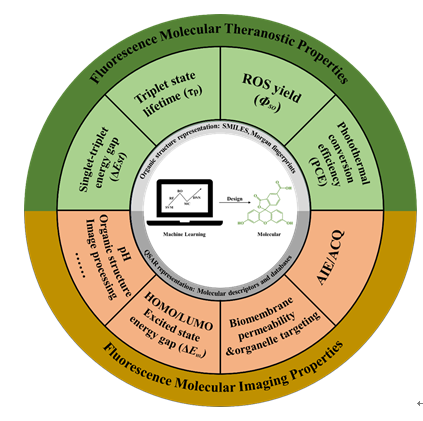
有机荧光诊疗分子因其高灵敏度、优异的生物相容性、低毒性、诊疗一体化等特点广泛应用于生命成像与肿瘤治疗等领域. 然而, 随着精细化诊疗需求的不断增加, 传统的分子设计方法受限于长周期试错实验与高昂计算成本, 难以满足设计需求. 基于机器学习(Machine Learning, ML)方法直接构建有机分子各种性质与结构的映射关系成为荧光分子设计领域有效提高精准诊疗功能、缩短设计周期的新方法. 本文系统梳理了基于各种ML算法的荧光分子设计模型, 针对多种诊疗分子特征属性对当前研究进行归类综述, 并提出了未来基于ML方法分子设计的发展方向.
郭浩哲, 李玉银, 汤培琛, 樊江莉. 机器学习设计有机荧光诊疗分子的研究进展[J]. 有机化学, doi: 10.6023/cjoc202505022.
Guo Haozhe, Li Yuyin, Tang Peichen, Fan Jiangli. Advances in Machine Learning-Based Design of Organic Fluorescent Theranostic Molecules[J]. Chinese Journal of Organic Chemistry, doi: 10.6023/cjoc202505022.
| [1] Andrea, T. A.; Kalayeh, H.J. Med. Chem., 1991, 34, 2824. [2] Gómez-Bombarelli, R.; Wei, J. N.; Duvenaud, D.; Hernández-Lobato, J. M.; Sánchez-Lengeling, B.; Sheberla, D.; Aguilera-Iparraguirre, J.; Hirzel, T. D.; Adams, R. P.; Aspuru-Guzik, A.ACS central science, 2018, 4, 268. [3] Pillai, N.; Dasgupta, A.; Sudsakorn, S.; Fretland, J.; Mavroudis, P. D.Drug Discov. Today, 2022, 27, 2209. [4] Feng, G.; Zhang, G.-Q.; Ding, D.Chem. Soc. Rev., 2020, 49, 8179. [5] Hansch, C.; Fujita, T.J. Am. Chem. Soc., 1964, 86, 1616. [6] Iyer, D. K.; Shaji, A.; Singh, S. P.; Tripathi, A.; Hazra, A.; Mandal, S.; Ghosh, P.Coordination Chemistry Reviews, 2023, 495, [7] Rodriguez-Perez, R.; Miljkovic, F.; Bajorath, J.Annual review of biomedical data science, 2022, 5, 43. [8] Weininger, D.J. Chem. Inf. Comput. Sci., 1988, 28, 31. [9] Morgan, H. L.J. Chem. Doc., 1965, 5, 107. [10] Xu, S.; Li, J.; Cai, P.; Liu, X.; Liu, B.; Wang, X.J. Am. Chem. Soc., 2021, 143, 19769. [11] Wu, S.; Kondo, Y.; Kakimoto, M.-A.; Yang, B.; Yamada, H.; Kuwajima, I.; Lambard, G.; Hongo, K.; Xu, Y.; Shiomi, J.; Schick, C.; Morikawa, J.; Yoshida, R.npj Computational Materials, 2019, 5, 66. [12] Wu, S.; Lambard, G.; Liu, C.; Yamada, H.; Yoshida, R.Molecular Informatics, 2020, 39, 1900107. [13] Guo, Z.; Wu, S.; Ohno, M.; Yoshida, R.J. Chem. Inf. Model., 2020, 60, 4474. [14] Sia, R. C. E.; Arellano-Reyes, R. A.; Keyes, T. E.; Guthmuller, J.Phys. Chem. Chem. Phys., 2021, 23, 26324. [15] Riahi, S.; Beheshti, A.; Ganjali, M. R.; Norouzi, P.Spectrochimica Acta Part A: Molecular and Biomolecular Spectroscopy, 2009, 74, 1077. [16] Mahato, K. D.; Kumar, U.Spectrochimica Acta Part A: Molecular and Biomolecular Spectroscopy, 2024, 308, 123768. [17] Pu, Y.; Wu, B.; Mo, H.; Alfano, R. R.Opt. Lett., 2023, 48, 936. [18] Chen, C.-H.; Tanaka, K.; Funatsu, K.J. Fluoresc., 2018, 28, 695. [19] Kang, B.; Seok, C.; Lee, J.J. Chem. Inf. Model., 2020, 60, 5984. [20] Ksenofontov, A. A.; Lukanov, M. M.; Bocharov, P. S.Spectrochimica Acta Part A: Molecular and Biomolecular Spectroscopy, 2022, 279, 121442. [21] Hall, H. C.; Fakhrzadeh, A.; Luengo Hendriks, C. L.; Fischer, U.Frontiers in Plant Science, 2016, 7, [22] Cardelli, V.; Weindorf, D. C.; Chakraborty, S.; Li, B.; De Feudis, M.; Cocco, S.; Agnelli, A.; Choudhury, A.; Ray, D. P.; Corti, G.Geoderma, 2017, 288, 130. [23] Ishizawa, J.; Nakamaru, K.; Seki, T.; Tazaki, K.; Kojima, K.; Chachad, D.; Dinardo, C. D.; Pierce, S.; Patel, K. P.; Tse, A.Blood, 2016, 128, 2893. [24] Hulbert, A.; Jusue-Torres, I.; Stark, A.; Chen, C.; Rodgers, K.; Lee, B.; Griffin, C.; Yang, A.; Huang, P.; Wrangle, J.Clin. Cancer Res., 2017, 23, 1998. [25] He, Z.; Zhang, M.; Zhang, H.Ceram. Int., 2016, 42, 5123. [26] Weindorf, D. C.; Chakraborty, S.; Herrero, J.; Li, B.; Castañeda, C.; Choudhury, A.Eur. J. Soil Sci., 2016, 67, 173. [27] Rodríguez-Pérez, R.; Vogt, M.; Bajorath, J. R.ACS omega, 2017, 2, 6371. [28] Mai, J.; Lu, T.; Xu, P.; Lian, Z.; Li, M.; Lu, W.Dyes Pigm., 2022, 206, 110647. [29] Ju, C.-W.; Bai, H.; Li, B.; Liu, R.J. Chem. Inf. Model., 2021, 61, 1053. [30] Zhao, Y.; Chen, K.; Zhu, L.; Huang, Q.Dyes Pigm., 2023, 220, 111670. [31] Li, P.; Wang, Z.; Li, W.; Yuan, J.; Chen, R.J. Phys. Chem. Lett., 2022, 13, 9910. [32] Caruso, E.; Gariboldi, M.; Sangion, A.; Gramatica, P.; Banfi, S.J. Photochem. Photobiol. B Biol., 2017, 167, 269. [33] Wang, X.; Wang, S.; Wang, J.; Yin, S.J. Phys. Chem. A, 2023, 127, 5930. [34] Jensen, J. H.Chem. Sci., 2019, 10, 3567. [35] Brown, N.; Mckay, B.; Gilardoni, F.; Gasteiger, J.J. Chem. Inf. Comput. Sci., 2004, 44, 1079. [36] Moon, S. W.; Min, S. K. J. J. O. C. I.J. Chem. Inf. Model., 2024, 64, 1522. [37] Trusova, V. M.; Gorbenko, G. P.; Deligeorgiev, T.; Gadjev, N.Method. Appl. Fluoresc., 2016, 4, 034014. [38] Ingargiola, A.; Weiss, S.; Lerner, E.J. Phys. Chem. A, 2018, 122, 11598. [39] Chauhan, N. K.; Singh, K. A review on conventional machine learning vs deep learning; proceedings of the 2018 International conference on computing, power and communication technologies (GUCON), F, 2018 [C]. IEEE. [40] Baskin, I.; Ait, A.; Halberstam, N.; Palyulin, V.; Alfimov, M.; Zefirov, N. The use of artificial neural networks for predicting properties of complex molecular systems. Prediction of the long-wave absorption band of symmetrical cyane dyes; proceedings of the Dokl. Akad. Nauk, F, 1997 [C]. MEZHDUNARODNAYA KNIGA 39 DIMITROVA UL., 113095 MOSCOW, RUSSIA. [41] Shao, J.; Liu, Y.; Yan, J.; Yan, Z.-Y.; Wu, Y.; Ru, Z.; Liao, J.-Y.; Miao, X.; Qian, L.J. Chem. Inf. Model., 2022, 62, 1368. [42] Lu, T.; Li, M.; Yao, Z.; Lu, W.J. Materiomics, 2021, 7, 790. [43] Ghosh, K.; Stuke, A.; Todorović, M.; Jørgensen, P. B.; Schmidt, M. N.; Vehtari, A.; Rinke, P.Adv. Sci, 2019, 6, 1801367. [44] Wang, J. N.; Jin, J. L.; Geng, Y.; Sun, S. L.; Xu, H. L.; Lu, Y. H.; Su, Z. M.J. Comput. Chem., 2013, 34, 566. [45] Wang, F.; Xiong, S.; Wang, T.; Hou, Y.; Li, Q.Anal. Methods, 2023, 15, 5803. [46] Jiao, Y.; Yin, J.; He, H.; Peng, X.; Gao, Q.; Duan, C.J. Am. Chem. Soc., 2018, 140, 5882. [47] Gu, J.; Yuan, W.; Chang, K.; Zhong, C.; Yuan, Y.; Li, J.; Zhang, Y.; Deng, T.; Fan, Y.; Yuan, L.Angew. Chem. Int. Ed., 2025, 137, 15637. [48] Nina, L.; Alisa, A.; Elizaveta, V.; Artem, K.; Aigul, K.; Emil, M.; Nikita, C.; Aleksei, S.arXiv - CS - Machine Learning, 2020, arxiv-2011.12117( [49] Kim, K.; Kang, S.; Yoo, J.; Kwon, Y.; Nam, Y.; Lee, D.; Kim, I.; Choi, Y.-S.; Jung, Y.; Kim, S.; Son, W.-J.; Son, J.; Lee, H. S.; Kim, S.; Shin, J.; Hwang, S.npj Computational Materials, 2018, 4, 67. [50] Meylan, W. M.; Howard, P. H.Perspect. Drug Discovery Des., 2000, 19, 67. [51] Daina, A.; Michielin, O.; Zoete, V.Sci. Rep., 2017, 7, 42717. [52] Daina, A.; Michielin, O.; Zoete, V.J. Chem. Inf. Model., 2014, 54, 3284. [53] Datta, R.; Das, D.; Das, S.Chemom. Intell. Lab. Syst., 2021, 213, 104309. [54] Soliman, K.; Grimm, F.; Wurm, C. A.; Egner, A.Sci. Rep., 2021, 11, 6991. [55] Alamudi, S. H.; Satapathy, R.; Kim, J.; Su, D.; Ren, H.; Das, R.; Hu, L.; Alvarado-Martínez, E.; Lee, J. Y.; Hoppmann, C.Nat. Commun., 2016, 7, 11964. [56] Park, S.-H.; Lee, H.-G.; Liu, X.; Lee, S. K.; Chang, Y.-T.Chemosensors, 2023, 11, 310. [57] Dong, J.; Qian, J.; Yu, K.; Huang, S.; Cheng, X.; Chen, F.; Jiang, H.; Zeng, W.Research, 2023, 6, 0075. [58] Yang, Y.; Ji, Y.; Han, X.; Long, Y.; Stewart, C.; Wen, Y.; Lee, H. Y.; Cao, T.; Han, J.; Chen, S.Adv. Mater. Technol., 2023, 8, 2300427. [59] Li, Z.; Liu, P.; Ji, X.; Gong, J.; Hu, Y.; Wu, W.; Wang, X.; Peng, H. Q.; Kwok, R. T.; Lam, J. W.Adv. Mater., 2020, 32, 1906493. [60] Mei, J.; Leung, N. L.; Kwok, R. T.; Lam, J. W.; Tang, B. Z.Chem. Rev., 2015, 115, 11718. [61] Luo, J.; Xie, Z.; Lam, J. W.; Cheng, L.; Chen, H.; Qiu, C.; Kwok, H. S.; Zhan, X.; Liu, Y.; Zhu, D.Chem. Commun., 2001, 1740. [62] Xu, S.; Duan, Y.; Liu, B.Adv. Mater., 2020, 32, 1903530. [63] Kokado, K.; Sada, K.Angew. Chem., 2019, 131, 8724. [64] Gong, J.; Deng, Z.; Xie, H.; Qiu, Z.; Zhao, Z.; Tang, B. Z.Adv. Sci, 2025, 12, 2411345. [65] Bi, H.; Jiang, J.; Chen, J.; Kuang, X.; Zhang, J.MATERIALS, 2024, doi: 10.3390/ma17071664. [66] Xu, S.; Liu, X.; Cai, P.; Li, J.; Wang, X.; Liu, B.Adv. Sci, 2022, 9, 2101074. [67] Zhang, Y.; Fan, M.; Xu, Z.; Jiang, Y.; Ding, H.; Li, Z.; Shu, K.; Zhao, M.; Feng, G.; Yong, K.-T.; Zhu, W.J. Nanobiotechnol., 2023, 21, 107. [68] Qiu, J.; Wang, K.; Lian, Z.; Yang, X.; Huang, W.; Qin, A.; Wang, Q.; Tian, J.; Tang, B.; Zhang, S.Chem. Commun. (Cambridge, U. K.), 2018, https://doi.org/10.1039/C8CC02850H. [69] Wang, L.; Salguero, C.; Lopez, S. A.; Li, J.Chem., 2024, 10, 2295. [70] Choi, J. Y.; Zhang, P.; Mehta, K.; Blanchard, A.; Lupo Pasini, M.J. Cheminf., 2022, 14, 70. [71] Zheng, F.; Zhu, Z.; Lu, J.; Yan, Y.; Jiang, H.; Sun, Q.Chem. Phys. Lett., 2023, 814, 140358. [72] Dhakal, P.; Gassaway, W.; Shah, J. K.J. Chem. Phys., 2023, 159, [73] Wang, Y.; Cai, L.; Chen, W.; Wang, D.; Xu, S.; Wang, L.; Kononov, M. A.; Ji, S.; Xian, M.Chemistry‐Methods, 2021, 1, 389. [74] Xiang, F. F.; Zhang, H.; Wu, Y. L.; Chen, Y. J.; Liu, Y. Z.; Chen, S. Y.; Guo, Y. Z.; Yu, X. Q.; Li, K.Adv. Mater., 2024, 36, 2404828. [75] He, L.; Dong, J.; Yang, Y.; Huang, Z.; Ye, S.; Ke, X.; Zhou, Y.; Li, A.; Zhang, Z.; Wu, S.J. Mol. Struct., 2025, 1321, 139850. [76] Mayder, D. M.; Hojo, R.; Primrose, W. L.; Tonge, C. M.; Hudson, Z. M.Adv. Funct. Mater., 2022, 32, 2204087. [77] Guo, H.; Jiang, G.; Diao, B.; Du, J.; Sun, W.; Fan, J.; Peng, X.J. Mater. Chem. C, 2024, 12, 14515. [78] Shi, H.; Shi, Y.; Liang, Z.; Zhao, S.; Qiao, B.; Xu, Z.; Wang, L.; Song, D.Chem. Eng. J., 2024, 494, 153150. [79] Sifain, A. E.; Lystrom, L.; Messerly, R. A.; Smith, J. S.; Nebgen, B.; Barros, K.; Tretiak, S.; Lubbers, N.; Gifford, B. J.Chem. Sci., 2021, 12, 10207. [80] Wang, S.; Yam, C.; Chen, S.; Hu, L.; Li, L.; Hung, F. F.; Fan, J.; Che, C. M.; Chen, G.J. Comput. Chem., 2024, 45, 321. [81] Mao, Y.; Yao, X.; Yu, Z.; An, Z.; Ma, H.Angew. Chem. Int. Ed., 2024, 63, 18836. [82] Muyassiroh, D. a. M.; Permatasari, F. A.; Hirano, T.; Ogi, T.; Iskandar, F.ACS Appl. Nano Mater., 2024, 7, 5465. [83] Wu, S.; Pan, Z.; Li, X.; Wang, Y.; Tang, J.; Li, H.; Lu, G.; Li, J.; Feng, Z.; He, Y.; Liu, X.Chem. Eng. Sci., 2023, 273, 118619. [84] Fan, D.; Chen, X.; Wang, S.; Zhan, J.; Chen, Y.; Zhou, H.; Li, D.; Tang, H.; He, Q.; Chen, T.Angew. Chem. Int. Ed., 2025, 64, 23799. [85] Kim, H.; Choi, S.-K.; Ahn, J.; Yu, H.; Min, K.; Hong, C.; Shin, I.-S.; Lee, S.; Lee, H.; Im, H.Sens. Actuators, B, 2021, 329, 129248. [86] Zeune, L. L.; Boink, Y. E.; Van Dalum, G.; Nanou, A.; De Wit, S.; Andree, K. C.; Swennenhuis, J. F.; Van Gils, S. A.; Terstappen, L. W. M. M.; Brune, C.Nat. Mach. Intell., 2020, 2, 124. [87] Copp, S. M.; Bogdanov, P.; Debord, M.; Singh, A.; Gwinn, E.Adv. Mater., 2016, 28, 3043. [88] Wong, D. R.; Conrad, J.; Johnson, N. R.; Ayers, J.; Laeremans, A.; Lee, J. C.; Lee, J.; Prusiner, S. B.; Bandyopadhyay, S.; Butte, A. J.; Paras, N. A.; Keiser, M. J.Nat. Mach. Intell., 2022, 4, 583. |
| [1] | 张桂苹, 丁昌华, 郭勇, 李遥, 薛小松. 机器学习在表面活性剂性能预测和设计方面的研究进展[J]. 有机化学, 2026, 46(6): 2310-2326. |
| [2] | 董梅, 林国强, 洪然, 黄莎华, 谢昌敏. 强效神经毒剂Anatoxin-a的不对称合成研究进展[J]. 有机化学, 2026, 46(6): 2193-2206. |
| [3] | 郭在翔, 邹昀, 程沛浩, 李富军, 陶胜洋. Ullmann反应条件的高通量筛选及其规律性研究[J]. 有机化学, 2026, 46(3): 993-999. |
| [4] | 刘小晨, 雷英, 唐楷, 林昳, 马昌期. 有机太阳能电池非富勒烯受体的分子结构空间拓扑研究进展[J]. 有机化学, 2026, 46(2): 399-419. |
| [5] | 崔心怡, 郭丽帆, 马聪璇, 李耘, 梁建华. 抗耐药菌红霉素的结构修饰策略、构效关系及全合成研究进展[J]. 有机化学, 2026, 46(1): 39-73. |
| [6] | 洪赛, 尹发红, 陈明慧, 傅滨, 肖玉梅, 覃兆海. 含吡啶环的1-唑基-1,1-二芳基甲烷类化合物的合成及杀菌活性研究[J]. 有机化学, 2026, 46(1): 106-117. |
| [7] | 赵友学, 李兮若, 孟洛冰, 李春秀, 范贵生, 许建和. 醇脱氢酶/羰基还原酶与多底物分子适配性研究的进展★[J]. 有机化学, 2025, 45(9): 3175-3185. |
| [8] | 郭浩哲, 李玉银, 汤培琛, 樊江莉. 机器学习设计有机荧光诊疗分子的研究进展★[J]. 有机化学, 2025, 45(9): 3203-3212. |
| [9] | 沈晴, 曾玉, 黎忠昊, 曹西颖, 郭玉婷, 叶蕴仪, 汪朝阳. 基于共价键形成与切断的反应型小分子荧光探针的研究进展[J]. 有机化学, 2025, 45(4): 1194-1205. |
| [10] | 赵瑜, 张紫越, 许书伟, 胡华伟, 吴宏伟, 张琳萍, 陈丰坤. 锯齿形给体-受体齐聚物的设计、合成及光伏性能研究[J]. 有机化学, 2025, 45(11): 4210-4219. |
| [11] | 孙翠萍, 薛雨婷, 陈磅宽. 杂螺烯圆偏振发光材料的研究进展[J]. 有机化学, 2025, 45(11): 4048-4069. |
| [12] | 田海平, 刘东东, 裴鸿艳, 叶家麟, 郑子锐, 高一星, 李昌兴, 田欢, 张静, 张立新. 新型苯基吡唑类衍生物的设计、合成和杀虫活性研究[J]. 有机化学, 2025, 45(1): 227-239. |
| [13] | 秦丽清, 林桂汕, 段文贵, 崔玉成, 杨卯芳, 李芳耀, 李典鹏. 新型长叶烯基萘满并N-酰基吡唑化合物的合成、抗增殖活性、三维定量构效关系及分子对接研究[J]. 有机化学, 2024, 44(6): 1967-1977. |
| [14] | 刘吉永, 吴明慧, 相君成, 庞怀林, 李斌, 吕亮. 新型含(卤代)烷氧基类双酰胺化合物的合成、杀虫活性及构效关系研究[J]. 有机化学, 2024, 44(5): 1584-1591. |
| [15] | 涂开槐, 江雪, 段泰男, 肖泽云. 高性能有机小分子光伏给体材料研究进展[J]. 有机化学, 2024, 44(11): 3282-3298. |
| 阅读次数 | ||||||
|
全文 |
|
|||||
|
摘要 |
|
|||||


