有机化学 ›› 2026, Vol. 46 ›› Issue (5): 1916-1938.DOI: 10.6023/cjoc202510004 上一篇 下一篇
综述与进展
沈国礼a,b,c,*( ), 何玥a, 景士文a, 安子博a,b,c, 徐丹丹a,*()
收稿日期:2025-10-10
修回日期:2025-11-16
发布日期:2025-12-29
基金资助:
Guoli Shena,b,c,*(), Yue Hea, Shiwen Jinga, Zibo Ana,b,c, Dandan Xua,*()
Received:2025-10-10
Revised:2025-11-16
Published:2025-12-29
Contact:
* E-mail: shenguoli0208@163.com;
18837053307@163.com
Supported by:文章分享
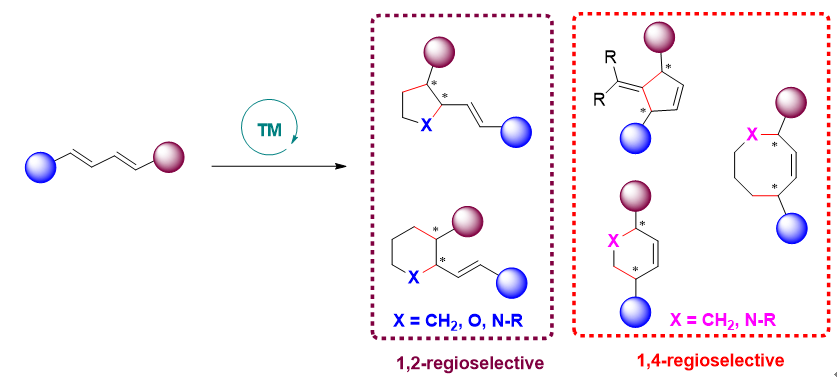
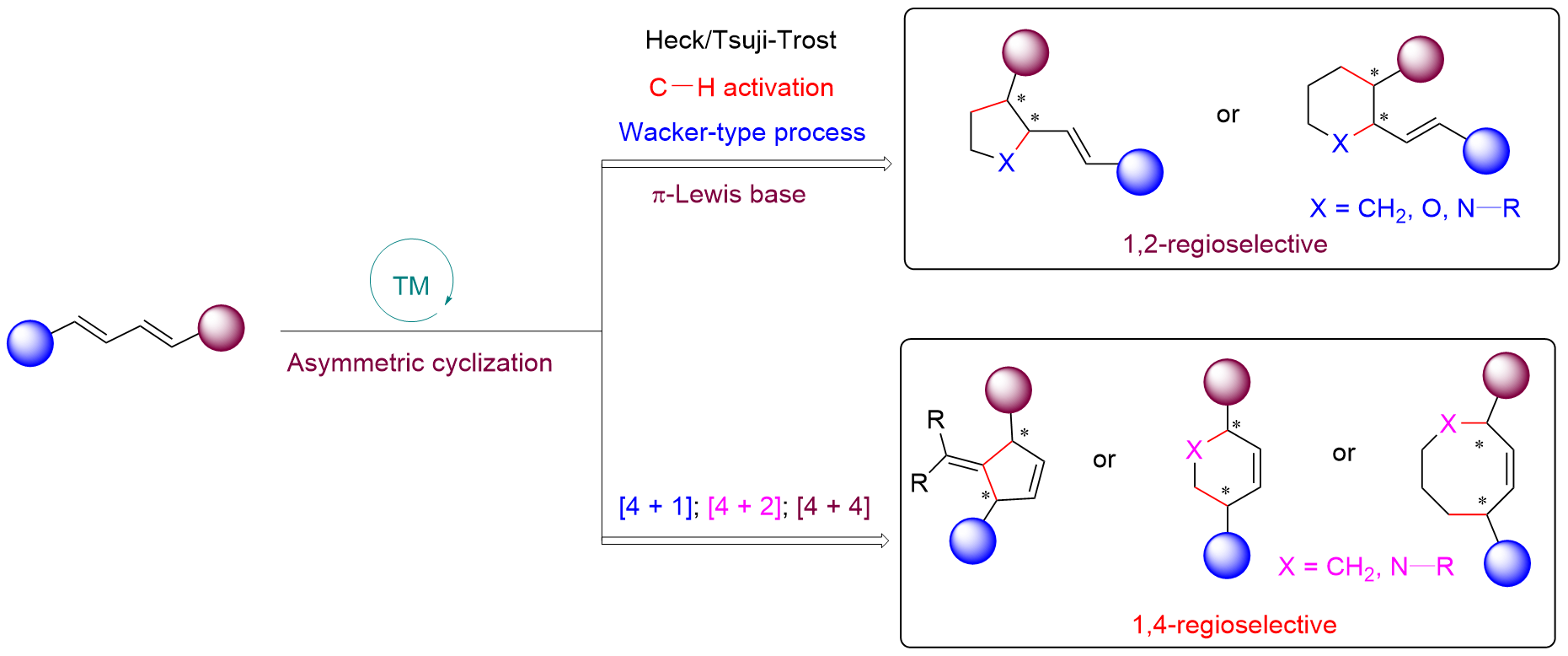
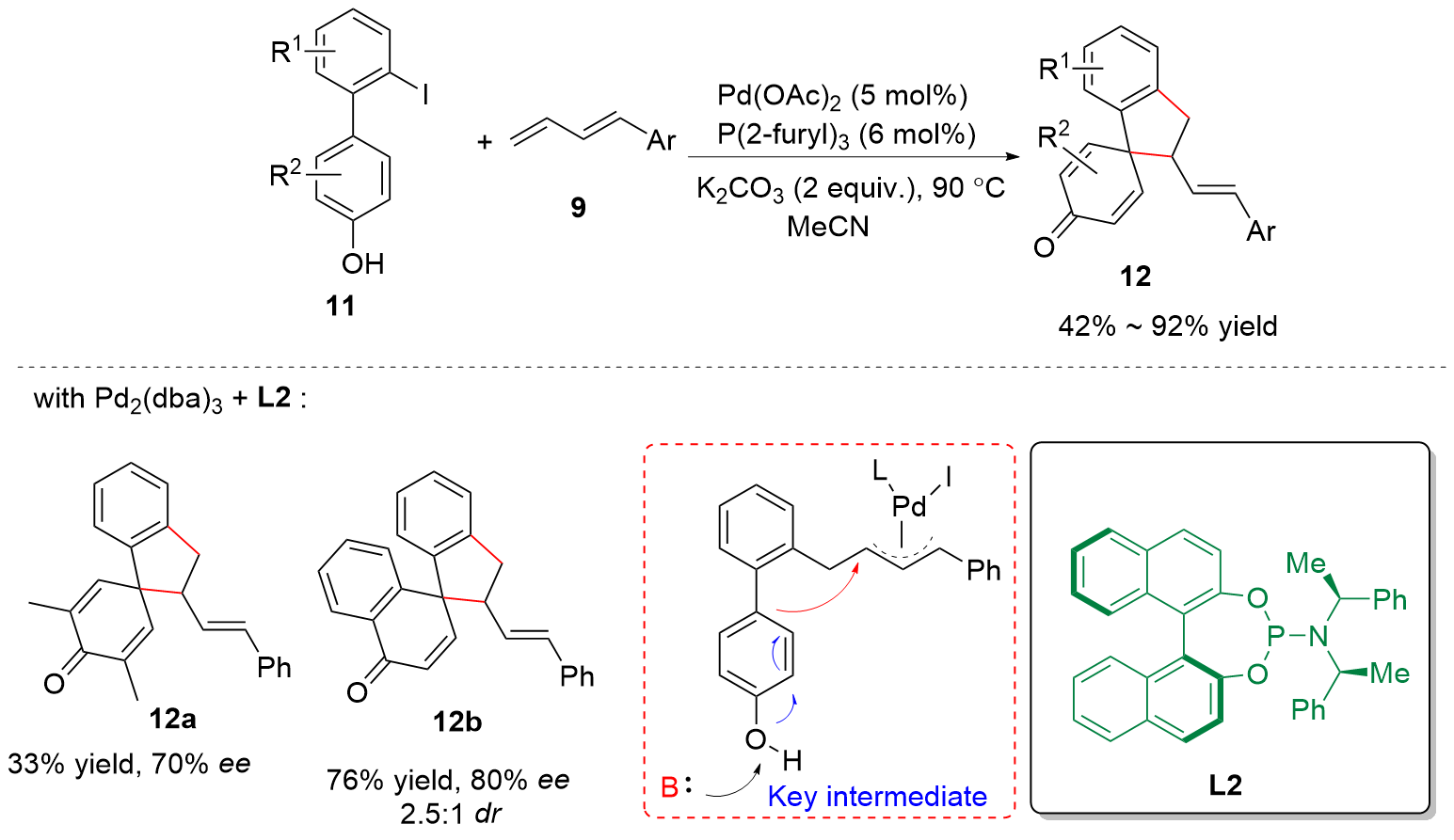
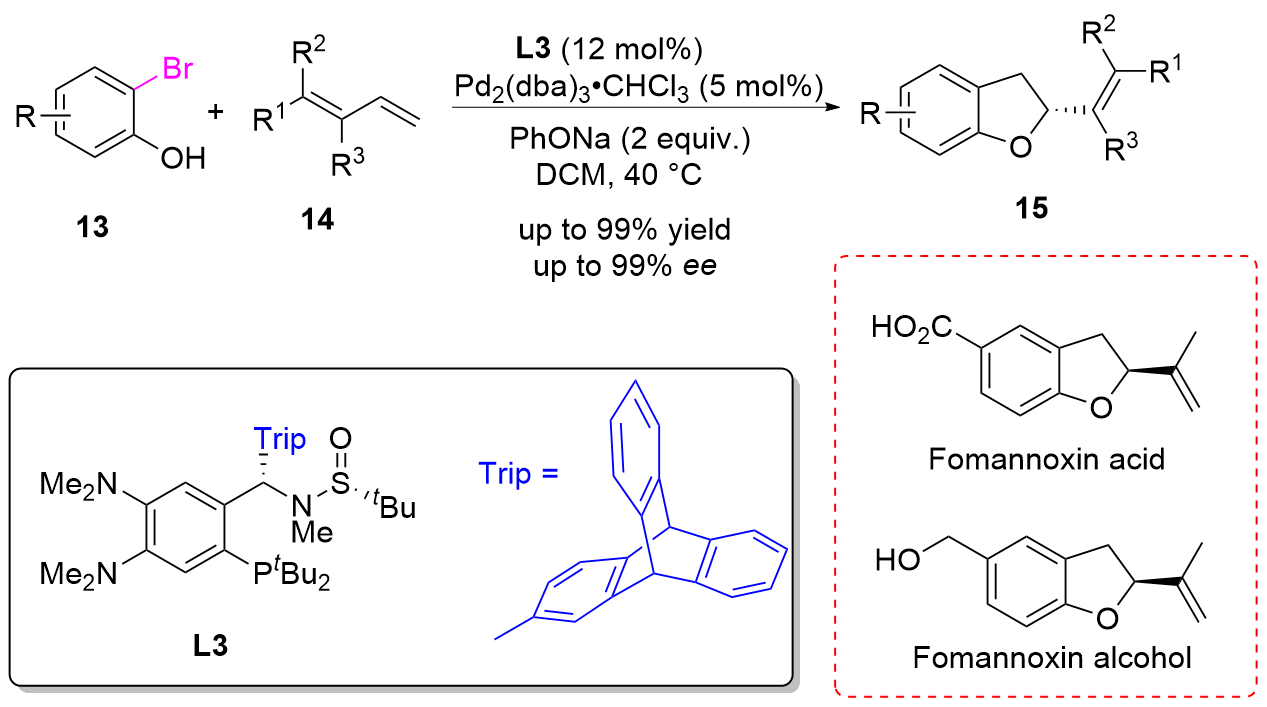
过渡金属催化的1,3-二烯不对称环化反应是构建手性环状分子的重要策略, 在天然产物、药物分子及功能材料的合成中具有广泛应用. 系统介绍了近年来该领域的研究进展, 重点围绕1,2-位和1,4-位环化两种模式, 详细讨论了Heck反应、C—H键活化、Wacker-type氧化以及π-Lewis碱催化等多种策略介导的串联环化反应. 这些方法能够高效、高对映选择性地构建五元到八元的多种环系, 并展现出良好的官能团兼容性和底物多样性. 尽管该领域已取得显著成果, 但仍面临机理不明确、底物普适性有限和手性控制不足等挑战. 未来需通过机理深入研究、新型廉价金属催化剂开发以及底物范围拓展, 进一步推动该类反应的发展与应用.
沈国礼, 何玥, 景士文, 安子博, 徐丹丹. 过渡金属催化1,3-二烯的不对称环化反应研究进展[J]. 有机化学, 2026, 46(5): 1916-1938.
Guoli Shen, Yue He, Shiwen Jing, Zibo An, Dandan Xu. Research Progress on Transition Metal-Catalyzed Asymmetric Cyclization Reactions of 1,3-Dienes[J]. Chinese Journal of Organic Chemistry, 2026, 46(5): 1916-1938.




| [1] |
(a)
doi: 10.1002/anie.v53.42 pmid: 29936839 |
|
(b)
doi: 10.1021/jacs.7b13601 pmid: 29936839 |
|
|
(c)
doi: 10.1021/jacs.8b05421 pmid: 29936839 |
|
|
(d)
doi: 10.1002/anie.v57.20 pmid: 29936839 |
|
|
(e)
doi: 10.6023/cjoc202403021 pmid: 29936839 |
|
|
(龙姣, 刘白雪, 张双双, 朱园园, 古双喜, 有机化学, 2024, 44, 3309.)
doi: 10.6023/cjoc202403021 pmid: 29936839 |
|
| [2] |
(a)
doi: 10.1055/s-0037-1610379 |
|
(b)
doi: 10.1021/ar200236v |
|
|
(c)
doi: 10.6023/cjoc201704031 |
|
|
(吴正兴, 张万斌, 有机化学, 2017, 37, 2250.)
doi: 10.6023/cjoc201704031 |
|
|
(d)
doi: 10.1002/anie.v62.1 |
|
| [3] |
(a)
doi: 10.1126/science.aac7440 pmid: 23351145 |
|
(b)
doi: 10.1021/acs.orglett.7b02826 pmid: 23351145 |
|
|
(c)
doi: 10.1021/acs.orglett.7b00438 pmid: 23351145 |
|
|
(d)
doi: 10.1021/acs.joc.7b01150 pmid: 23351145 |
|
|
(e)
doi: 10.1021/jacs.3c14674 pmid: 23351145 |
|
|
(f)
doi: 10.1021/jacs.2c12752 pmid: 23351145 |
|
|
(g)
doi: 10.1021/ja311968d pmid: 23351145 |
|
|
(h)
doi: 10.1039/c3sc52379a pmid: 23351145 |
|
| [4] |
O’ Connor, J. M.; Stallman, B. J.; Clark, W. G.; Shu, A. Y. L.; Spada, R. E.; Stevenson, T. M.; Dieck, H. A. J. Org. Chem. 1983, 48, 807.
doi: 10.1021/jo00154a010 |
| [5] |
doi: 10.1021/ja00171a040 |
| [6] |
doi: 10.1016/S0040-4039(00)73208-4 |
| [7] |
(a)
doi: 10.1021/jo00013a004 pmid: 20725641 |
|
(b)
doi: 10.1016/S0040-4020(01)80534-2 pmid: 20725641 |
|
|
(c)
doi: 10.1021/ja9609359 pmid: 20725641 |
|
|
(d)
doi: 10.1016/j.tet.2010.05.048 pmid: 20725641 |
|
|
(e)
doi: 10.1002/(ISSN)1521-3773 pmid: 20725641 |
|
|
(f)
doi: 10.1016/S0040-4039(99)00628-0 pmid: 20725641 |
|
|
(g)
doi: 10.1021/jacs.5b08734 pmid: 20725641 |
|
| [8] |
doi: 10.1021/acs.joc.6b01611 |
| [9] |
doi: 10.1039/C8CC04641G |
| [10] |
doi: 10.1021/acs.orglett.6b00710 |
| [11] |
doi: 10.1016/j.tetlet.2022.154120 |
| [12] |
doi: 10.1038/s41467-025-56142-z |
| [13] |
doi: 10.1021/acs.orglett.1c00910 |
| [14] |
doi: 10.1039/C7CC07543J |
| [15] |
doi: 10.1021/jacs.1c07212 |
| [16] |
(a)
doi: 10.1038/s41929-020-0434-0 |
|
(b)
doi: 10.1021/jacs.0c03993 |
|
|
(c)
doi: 10.1021/jacs.0c03993 |
|
|
(d)
doi: 10.1055/a-2122-1573 |
|
|
(e)
doi: 10.1021/acs.orglett.4c03080 |
|
|
(f)
doi: 10.1021/acscatal.4c00470 |
|
| [17] |
doi: 10.1021/acs.orglett.2c02101 pmid: 35848222 |
| [18] |
doi: 10.1002/anie.v64.30 |
| [19] |
doi: 10.1002/anie.v63.26 |
| [20] |
(a)
doi: 10.1021/acs.chemrev.6b00692 pmid: 33491691 |
|
(b)
doi: 10.1021/ar200185g pmid: 33491691 |
|
|
(c)
doi: 10.1021/cr100280d pmid: 33491691 |
|
|
(d)
doi: 10.1021/cr900184e pmid: 33491691 |
|
|
(e)
doi: 10.1039/d0cs00447b pmid: 33491691 |
|
|
(f)
doi: 10.1021/acs.chemrev.9b00495 pmid: 33491691 |
|
|
(g)
doi: 10.1021/acs.accounts.9b00510 pmid: 33491691 |
|
| [21] |
doi: 10.1021/ja803397y pmid: 18613664 |
| [22] |
doi: 10.1002/anie.v56.23 |
| [23] |
doi: 10.1021/acs.orglett.9b00216 pmid: 30901225 |
| [24] |
(a)
doi: 10.1002/anie.v54.22 |
|
(b)
doi: 10.1021/acs.orglett.6b02947 |
|
| [25] |
doi: 10.1021/acs.orglett.1c00945 |
| [26] |
doi: 10.1021/jacs.3c06482 |
| [27] |
(a)
doi: 10.1021/ar500344t pmid: 21428440 |
|
(b)
doi: 10.1021/cr100371y pmid: 21428440 |
|
|
(c)
doi: 10.1038/nchem.256 pmid: 21428440 |
|
| [28] |
doi: 10.1002/(ISSN)1521-3773 |
| [29] |
doi: 10.1021/ja051181d |
| [30] |
(a)
doi: 10.1021/acs.orglett.7b00919 |
|
(b)
doi: 10.1021/ja103838d |
|
| [31] |
doi: 10.1021/ol801605w |
| [32] |
doi: 10.1021/acs.orglett.8b00870 |
| [33] |
doi: 10.1002/anie.v57.9 |
| [34] |
doi: 10.1002/cjoc.v37.3 |
| [35] |
doi: 10.1021/jacs.1c01420 |
| [36] |
doi: 10.1021/acs.orglett.2c03762 |
| [37] |
doi: 10.1021/acs.orglett.3c02443 |
| [38] |
doi: 10.1021/acs.orglett.4c00160 |
| [39] |
doi: 10.1021/acs.orglett.5c01957 |
| [40] |
doi: 10.1039/D2SC06813C |
| [41] |
(a)
pmid: 18494473 |
|
(b)
doi: 10.1016/S0040-4039(97)01287-2 pmid: 18494473 |
|
|
(c)
doi: 10.1021/ja991190k pmid: 18494473 |
|
|
(d)
doi: 10.1021/ol061153f pmid: 18494473 |
|
|
(e)
doi: 10.1021/ja8015318 pmid: 18494473 |
|
|
(f)
doi: 10.1021/jacs.8b09974 pmid: 18494473 |
|
| [42] |
(a)
doi: 10.1002/anie.v42:2 |
|
(b)
doi: 10.1021/cr5006974 |
|
| [43] |
doi: 10.1126/science.aau0364 |
| [44] |
doi: 10.1021/jacs.0c08262 |
| [45] |
doi: 10.1021/jacs.3c04209 |
| [46] |
doi: 10.1039/D0OB00361A |
| [47] |
doi: 10.1002/anie.v62.8 |
| [48] |
doi: 10.1021/acs.orglett.3c03261 pmid: 37933993 |
| [49] |
doi: 10.1002/anie.v64.35 |
| [50] |
|
| [51] |
doi: 10.1021/jacs.0c09486 pmid: 33175501 |
| [52] |
doi: 10.1002/anie.v63.6 |
| [1] | 许颖, 杨美琳, 崔大鹏, 于淼, 刘颖杰. 脱氟反应的研究进展[J]. 有机化学, 2026, 46(5): 1962-1983. |
| [2] | 戴乐薇, 王建玲, 邹东. 芳胺对位C(sp2)—H键官能团化研究进展[J]. 有机化学, 2026, 46(5): 1813-1844. |
| [3] | 叶富, 袁伟明. 光氧化还原催化炔烃的双碳官能团化反应进展[J]. 有机化学, 2026, 46(4): 1146-1165. |
| [4] | 刘水林, 陈镤, 贺晶, 刘宁, 黄华文. 过渡金属催化自由基介导1,3-二烯的选择性双官能团化研究进展[J]. 有机化学, 2026, 46(4): 1330-1359. |
| [5] | 刘猛, 刘涛波, 韩梅兰, 王舒扬, 桂智排措, 徐光利, 韩鸿萍. 过渡金属催化烯烃碳硅化反应研究进展[J]. 有机化学, 2026, 46(3): 840-858. |
| [6] | 张晋瑜, 卢志刚, 刘喆, 王聪. 过渡金属催化亚甲基环丙烷的硅氢化和硼化反应[J]. 有机化学, 2026, 46(3): 806-816. |
| [7] | 梁新宇, 米春春, 郭福军, 谢文斌, 史钦钦, 黄辉. 芳基亚磺酸钠与芳基硫鎓盐的脱硫交叉偶联反应[J]. 有机化学, 2026, 46(3): 1000-1007. |
| [8] | 周可, 王泽涌, 黎亚琳, 张倩, 李馨月, 邹汉芳, 张明忠, 郭圣荣, 陈铁桥. 一种由四卤化碳生成三氯甲基自由基的氧化策略: 无过渡金属合成三氯甲基化吲哚酮[J]. 有机化学, 2026, 46(3): 974-985. |
| [9] | 杨利婷, 潘慧茹, 许晓旭, 张益恺, 来姝妤, 曹信誉, 刘国群, 乔辉杰, 焦明立. 一种无过渡金属、绿色温和的一锅法合成3-碘代/溴代咪唑并[1,2-a]吡啶类化合物[J]. 有机化学, 2026, 46(3): 915-924. |
| [10] | 刘颖杰, 闵来生, 杨锐蓉, 宋冬雪, 彭瑞, 梁德强. CuI催化C—C键偶联反应构建2-羰基-1,4-二酮[J]. 有机化学, 2026, 46(2): 603-611. |
| [11] | 赵宇含, 马惠敏, 戈书林, 孔令斌. 碘催化烯烃与活性亚甲基化合物的分子间环丙烷化反应[J]. 有机化学, 2025, 45(9): 3469-3477. |
| [12] | 任揽星, 徐阿娜, 肖锡林, 游恒志, 宋利娟. 溶剂效应对Ir催化的不对称氢化反应对映选择性影响的理论研究[J]. 有机化学, 2025, 45(8): 2904-2912. |
| [13] | 陈明, 张敬. 芳基羧酸无痕导向官能化反应的研究进展[J]. 有机化学, 2025, 45(8): 2660-2676. |
| [14] | 杜一鸣, 贾均松, 李玉龙, 舒伟. 手性α-芳基酮的催化合成研究进展[J]. 有机化学, 2025, 45(6): 1838-1870. |
| [15] | 苏雷, 杨熙, 闫捷, 蒋元力, 陈丽娟, 郑庆舒, 刘家旺. 不对称羰基化偶联反应研究进展[J]. 有机化学, 2025, 45(6): 2007-2047. |
| 阅读次数 | ||||||
|
全文 |
|
|||||
|
摘要 |
|
|||||