有机化学 ›› 2026, Vol. 46 ›› Issue (7): 2835-2852.DOI: 10.6023/cjoc202511014 上一篇 下一篇
研究论文
王力卓, 刘馨忆, 宋戈洋*( ), 石晓莉, 薛东*()
收稿日期:2025-11-21
修回日期:2025-12-22
发布日期:2026-02-11
基金资助:
Lizhuo Wang, Xinyi Liu, Geyang Song*(), Xiaoli Shi, Dong Xue*()
Received:2025-11-21
Revised:2025-12-22
Published:2026-02-11
Contact:
*E-mail: songgeyang@snnu.edu.cn;xuedong_welcome@snnu.edu.cn
Supported by:文章分享
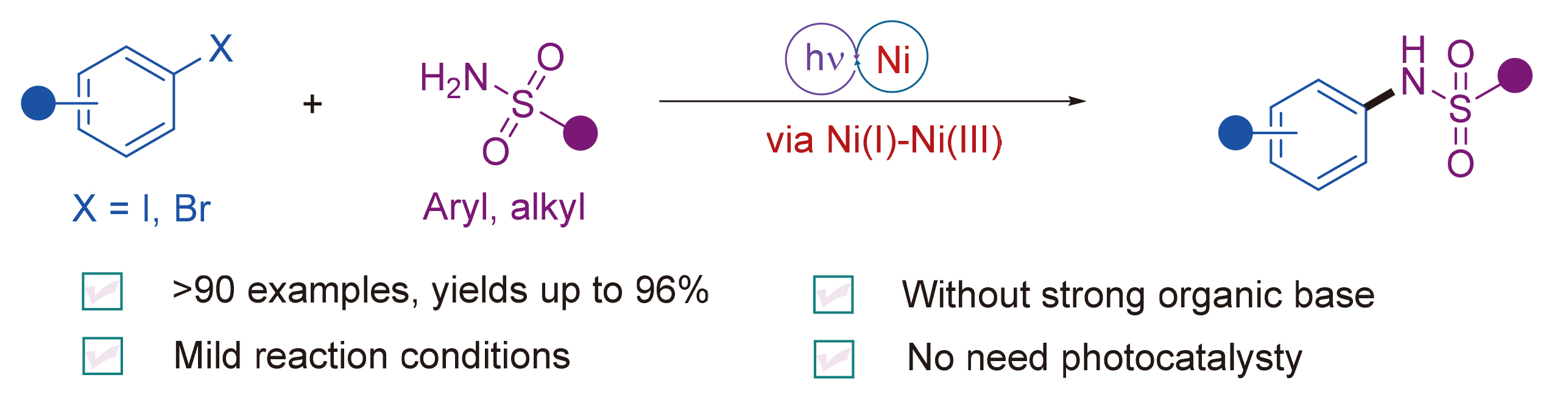
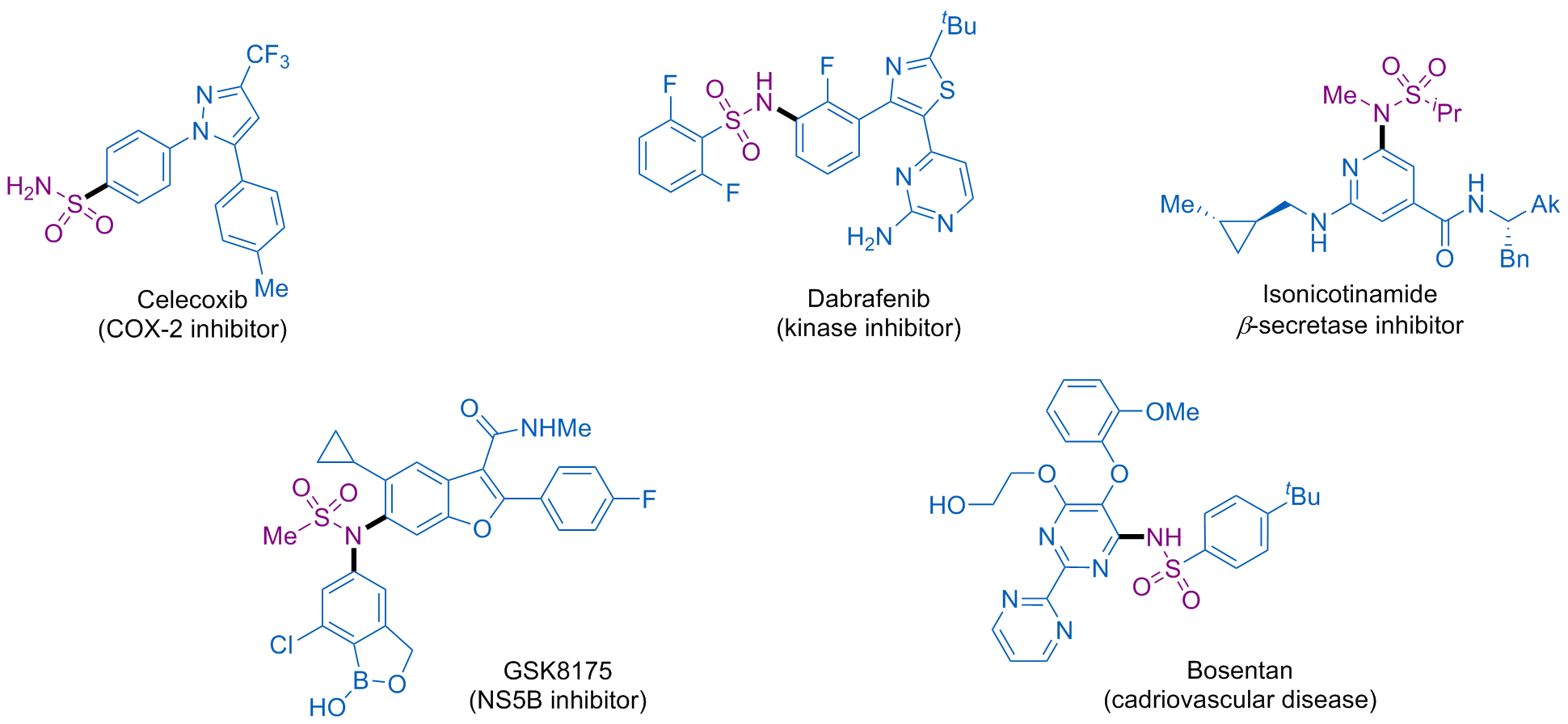
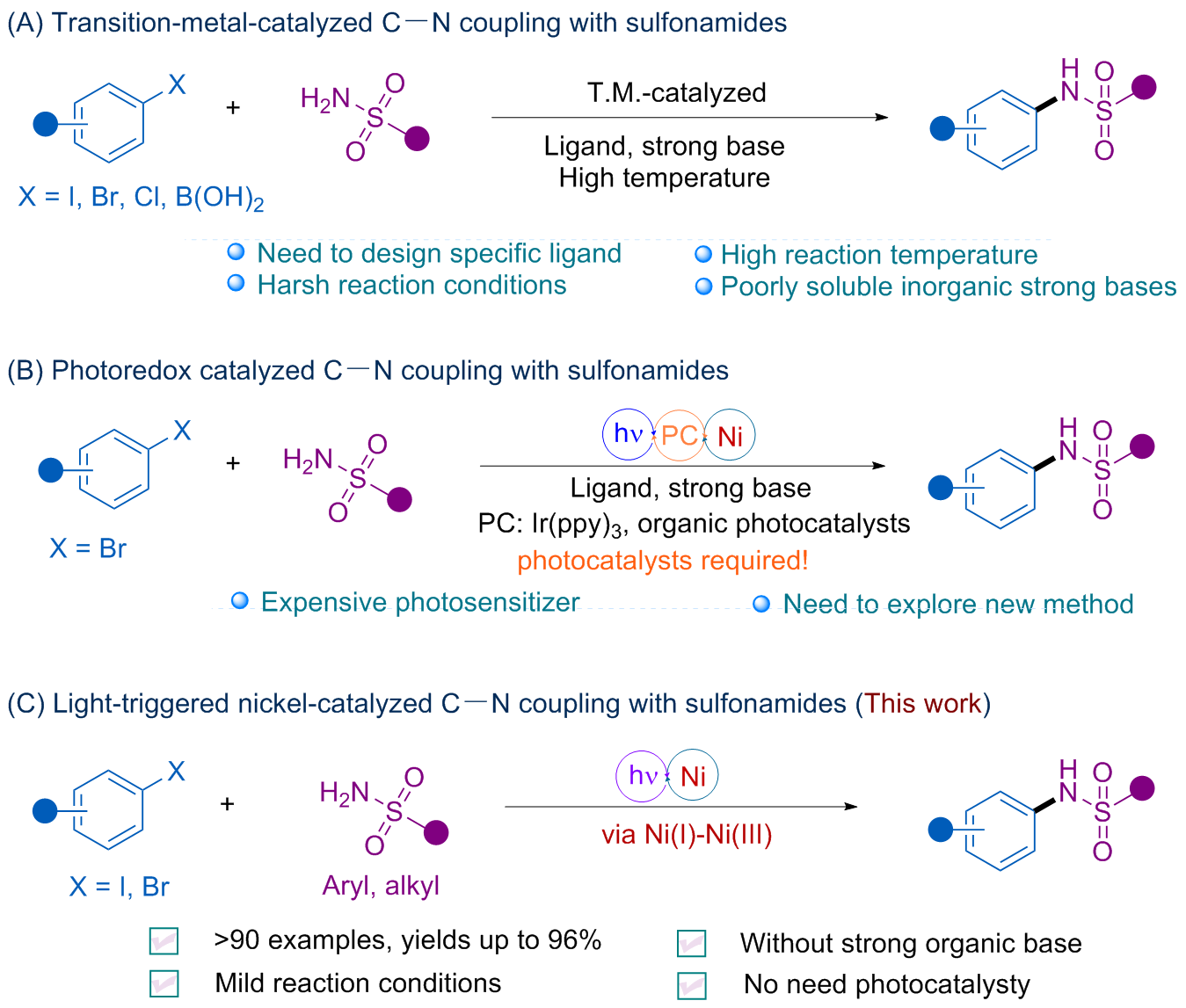
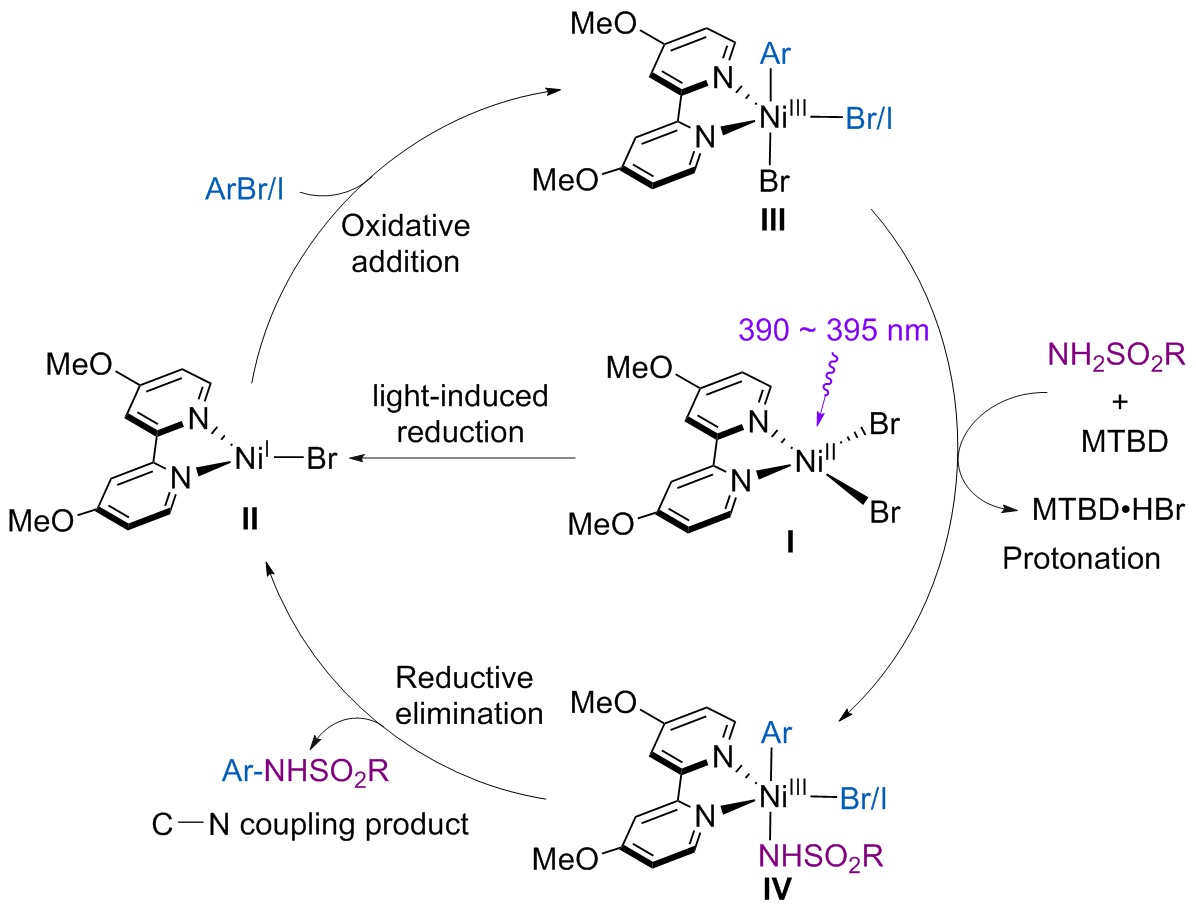
磺酰胺类化合物因其丰富的生物活性、独特的反应活性和潜在的药用价值, 在药物化学与合成化学中备受关注. 发展了一种无需外加光敏剂的温和高效的方法, 在390~395 nm LED光照下, 实现了丰产金属镍催化卤代芳烃与磺酰胺类化合物的C(sp²)—N偶联反应. 该方法以易得的丰产金属镍为催化剂, 温和可溶性的有机胺作为碱, 无需外加光敏剂, 具有原料易得、反应条件温和、操作简便、底物适用性及官能团兼容性强等优点, 并可用于生物活性分子的后期修饰. 在克级反应中, 依然能够保持高效的反应产率, 为合成重要的芳基磺酰胺提供了一种可行的替代方案. 机理研究表明, 该反应可能通过Ni(I)-Ni(III)的催化循环过程.
王力卓, 刘馨忆, 宋戈洋, 石晓莉, 薛东. 光激发丰产金属镍催化卤代芳烃与磺酰胺的C(sp2)—N偶联反应[J]. 有机化学, 2026, 46(7): 2835-2852.
Lizhuo Wang, Xinyi Liu, Geyang Song, Xiaoli Shi, Dong Xue. Photoexcitation-Enabled C(sp2)—N Coupling of Aryl Halides with Sulfonamides Catalyzed by Earth-Abundant Nickel[J]. Chinese Journal of Organic Chemistry, 2026, 46(7): 2835-2852.
| Entry | Deviation from the standard conditions | Yield/% |
|---|---|---|
| 1 | Standard conditions | 92 (88)b |
| 2 | NiCl2 | 67 |
| 3 | NiI2 | 62 |
| 4 | Ni(OAc)2 | 38 |
| 5 | NiBr2•dme | 79 |
| 6 | NiBr2 | 83 |
| 7 | NiCl2•dme | 85 |
| 8 | DABSO | 7 |
| 9 | BTMG | 67 |
| 10 | DIPEA | 25 |
| 11 | DBU | 77 |
| 12 | DMAP | 9 |
| 13 | K2CO3 | N.R. |
| 14 | MeONa | N.R. |
| 15 | Blue LEDs (460~465 nm) | 21 |
| 16 | UV (365~370 nm) | N.R. |
| 17 | Green LEDs (530~535 nm) | N.R. |
| 18 | White LEDs | N.R. |
| 19 | Standard conditions, without ligand | 13 |
| 20 | Standard conditions, without Ni(cod)2 | N.R. |
| 21 | Standard conditions, without base | N.R. |
| 22 | Standard conditions, light, r.t. | N.R. |
| 23 | Standard conditions, without light, heat to 80 ℃ | N.R. |
| Entry | Deviation from the standard conditions | Yield/% |
|---|---|---|
| 1 | Standard conditions | 92 (88)b |
| 2 | NiCl2 | 67 |
| 3 | NiI2 | 62 |
| 4 | Ni(OAc)2 | 38 |
| 5 | NiBr2•dme | 79 |
| 6 | NiBr2 | 83 |
| 7 | NiCl2•dme | 85 |
| 8 | DABSO | 7 |
| 9 | BTMG | 67 |
| 10 | DIPEA | 25 |
| 11 | DBU | 77 |
| 12 | DMAP | 9 |
| 13 | K2CO3 | N.R. |
| 14 | MeONa | N.R. |
| 15 | Blue LEDs (460~465 nm) | 21 |
| 16 | UV (365~370 nm) | N.R. |
| 17 | Green LEDs (530~535 nm) | N.R. |
| 18 | White LEDs | N.R. |
| 19 | Standard conditions, without ligand | 13 |
| 20 | Standard conditions, without Ni(cod)2 | N.R. |
| 21 | Standard conditions, without base | N.R. |
| 22 | Standard conditions, light, r.t. | N.R. |
| 23 | Standard conditions, without light, heat to 80 ℃ | N.R. |


| [1] |
doi: 10.1016/j.bmcl.2019.06.041 |
| [2] |
doi: 10.1002/chem.201903582 |
| [3] |
doi: 10.1021/jacs.8b11800 |
| [4] |
doi: 10.1021/jacs.9b10985 |
| [5] |
doi: 10.1002/anie.v58.50 |
| [6] |
doi: 10.1126/science.287.5460.1960 pmid: 10720314 |
| [7] |
|
| [8] |
doi: 10.1039/c9sc01818b pmid: 31341593 |
| [9] |
|
| [10] |
doi: 10.1016/j.dyepig.2006.12.003 |
| [11] |
doi: 10.1016/0040-4020(96)00266-9 |
| [12] |
doi: 10.1021/ol035655u |
| [13] |
doi: 10.1021/ol200660s |
| [14] |
doi: 10.1021/jo200443u |
| [15] |
doi: 10.1021/ja405949a pmid: 23837740 |
| [16] |
doi: 10.1021/acscatal.9b03012 |
| [17] |
doi: 10.1021/ol403072r pmid: 24256546 |
| [18] |
doi: 10.1016/S0040-4039(98)00503-6 |
| [19] |
doi: 10.1021/ol100263r |
| [20] |
doi: 10.1021/acscatal.8b03238 |
| [21] |
doi: 10.1002/anie.202002392 pmid: 32162451 |
| [22] |
doi: 10.1039/C4OB00638K |
| [23] |
doi: 10.1038/s41570-017-0052 |
| [24] |
doi: 10.1038/nature13274 |
| [25] |
doi: 10.1002/anie.v57.13 |
| [26] |
doi: 10.1126/science.aag0209 pmid: 27338703 |
| [27] |
doi: 10.1126/science.aal2490 pmid: 28126814 |
| [28] |
doi: 10.1039/C8QO00805A |
| [29] |
|
|
(黄航, 王兮, 王剑波, 有机化学, 2019, 39, 1.)
doi: 10.6023/cjoc201808030 |
|
| [30] |
doi: 10.1002/anie.202003359 pmid: 32281220 |
| [31] |
doi: 10.1002/anie.v60.10 |
| [32] |
doi: 10.1002/anie.v60.39 |
| [33] |
doi: 10.1021/acscatal.2c04959 |
| [34] |
doi: 10.1002/chem.v29.37 |
| [35] |
doi: 10.1002/anie.v63.6 |
| [36] |
doi: 10.1021/acs.organomet.3c00506 |
| [1] | 吴蕊, 武治权, 张娟, 高文超, 王英雄, 常宏宏. 乙二醇选择性催化氧化合成乙醇酸的研究进展[J]. 有机化学, 2026, 46(8): 2969-2987. |
| [2] | 冯亚栋, 毕寺恒, 唐明清, 吴养洁, 皮超. 紫外光驱动的芳香醛与邻氨基苯甲酰胺构建喹唑啉酮化合物[J]. 有机化学, 2026, 46(8): 3114-3122. |
| [3] | 王东平, 张淯新, 魏闪闪, 王峰娇, 朱丛军. 光氧化还原镍催化羧酸脱氧偶联的研究进展[J]. 有机化学, 2026, 46(7): 2669-2682. |
| [4] | 房毅, 王川. 镍催化三氟甲基取代烯烃与烷基甲磺酸酯的烯丙位脱氟交叉亲电偶联[J]. 有机化学, 2026, 46(7): 2743-2750. |
| [5] | 陈海鸿, 赵一譞, 林杰, 张潜, 李杰. 镍催化烯基三氟甲磺酸酯立体保持的烷基羰基化反应[J]. 有机化学, 2026, 46(7): 2713-2722. |
| [6] | 陈安, 王泽艺, 李万梅, 徐骏. 光驱动一步法合成双碳取代双环[1.1.1]戊烷研究进展[J]. 有机化学, 2026, 46(6): 2177-2192. |
| [7] | 许颖, 杨美琳, 崔大鹏, 于淼, 刘颖杰. 脱氟反应的研究进展[J]. 有机化学, 2026, 46(5): 1962-1983. |
| [8] | 赵子鸣, 郑剑峰, 黄培强. 光催化的由亚胺合成胺的研究进展[J]. 有机化学, 2026, 46(5): 1984-2001. |
| [9] | 戴乐薇, 王建玲, 邹东. 芳胺对位C(sp2)—H键官能团化研究进展[J]. 有机化学, 2026, 46(5): 1813-1844. |
| [10] | 程熹, 李雅琳, 吴鹏, 苏敏, 张梓轩, 焦民均, 刘雪粉, 罗书平. 蒽醌光敏剂设计合成与光催化C(sp3)—H氧化反应性能研究[J]. 有机化学, 2026, 46(5): 2104-2111. |
| [11] | 侯馨怡, 史同同, 李泽江, 董庆昊, 孙凯, 王薪. 可见光诱导的磷酰化环化合成磷酰基取代的吲哚并二氮䓬[J]. 有机化学, 2026, 46(4): 1776-1787. |
| [12] | 郑婧斐, 吕琪妍, 孙凯, 陈晓岚, 屈凌波, 王金泉, 於兵. 自由基介导的6-氮杂尿嘧啶官能团化研究进展[J]. 有机化学, 2026, 46(4): 1603-1620. |
| [13] | 赵雨晴, 朱先进, 石凌宇, 魏鸣宇, 徐紫涵, 石永佳, 李旭锋, 杨道山. 环硫鎓盐开环官能化反应的研究进展[J]. 有机化学, 2026, 46(4): 1572-1602. |
| [14] | 张皓然, 贾均松, 俞琼, 吴宇, 李玉龙, 舒伟. 可见光催化烯烃的氢胺化和氢(磺)酰胺化反应[J]. 有机化学, 2026, 46(4): 1166-1180. |
| [15] | 杨珊, 陈亚苏, 朱晨. 自由基介导的官能团迁移-环化构建含氮稠杂芳烃[J]. 有机化学, 2026, 46(4): 1739-1749. |
| 阅读次数 | ||||||
|
全文 |
|
|||||
|
摘要 |
|
|||||